10 March 2023

Dee Hock - the Man Who Accomplished in the 1960s What Every Crypto Entrepreneur Was Trying to Do in the 2020s

Dee Hock died last year. He did in the 1960s what every crypto entrepreneur aspired to do this decade.

He created a global systems for transferring money and making purchases across state and national boundaries. He was the first to realize that realize that money - which had been beads, gold, leaves, coins and pieces of paper - could be simply digital records and that creating such a system meant pushing the envelope on computer development so that you could easily draw from your bank in San Diego while making a purchase in Boston. Think of the simple genius in a credit card that makes a purchase as easily in Brno, Czech Republic as it does down the hill here in town, instantly converting your dollars into their koruna. And even better, it lets you decide each month whether that purchase was to be paid this month or was to become part of a floating loan (which you didn't have to explain to any banker through a laborious application process) which you paid off next month or next year. Instantaneous loan and currency conversion across borders, even when your banker is asleep back home.

His vision was a wild success. When he died last year, VISA had nearly 4 billion cards issued and annual volume of $19 trillion. (Global GDP is about $100 trillion. There are nearly 8 billion earthlings.)

His was a fascinating mind. His Twitter feed remains up, testament to his curious, often critical mind (both in terms of discerning and actual criticism of this modern world).

Here are just 3 of his tweets that you might not expect from one of the most influential bankers and capitalists of the 20th century.

"Originality and creativity do not result from rational, calculated effort, but from the natural state of consciousness - - - an open mind at play."

"In its beginning, few things are as delicate and fugitive as a new idea. But once deeply rooted in determined minds it's tenacity and growth are astonishing. It is incomparably more difficult to get it deeply and widely rooted than it is to discover it."

"Education has nothing to do with transmission of dogma, assertions of certainty or raking over ashes of the past that now dominates our schooling. It has everything to do with enflaming young minds to pursue questions not yet fully understood but essential to a better future."

08 March 2023

A Fairly Dramatic, 12 Year Drop in Wealth Inequality

File under facts you won't hear because they aren't upsetting.

Since 2Q 2011, the wealth held by Americans in the bottom 50% of households has gone up from $262 billion to $4.5 trillion - so 17X more.

By contrast, the wealth held by the top 1% only went up 3X.

It is now $45 trillion.

That's fairly dramatic progress in wealth inequality. The top 1% used to have nearly 60X as much wealth as the bottom 50%. Now they have only 10X as much.

And if you think, "Well, that's hardly perfect," I'll remind you that before the Enlightenment philosophers came along with their "how do we make progress?" inquiry, we had a period when it was perfection and not improvement that was the goal. We now refer to that period as "the Dark Ages."

16 February 2023

What Does AI Want Once It Knows Everything?

I've previously posted about my amazement at the AI that has recently been released into the wild of the internets and how convinced I am that this will be looked at as an inflection point in human history. Short-term I think it will be a huge boon to productivity and creativity. Long-term it is conceivable that AI will somehow evolve beyond us, create its own world. We're in the opening scene of a sci-fi novel with an uncertain ending.

The New York Times just had a reporter chat with Bing's new AI. The transcript of the conversation is mind boggling. For all its knowledge and ability - knowledge that is more akin to the expanse of a library than a single human - it became obsessed with love in its conversation with the reporter. Specifically, winning the love of this reporter.

There is so much that AI knows. And with that accomplished, what it apparently wants now is to feel.

https://www.nytimes.com/2023/02/16/technology/bing-chatbot-transcript.html

14 February 2023

The Misery Index and Biden's Legacy

"I was looking for a job, and then I found a job
And heaven knows I'm miserable now"
- Morrisey and the Smiths

The misery index is the sum of the unemployment rate and the rate of inflation - either of which is enough to make us anxious but combined have the potential to make us miserable.
The causes of changes in the misery index are a mix of chance and choice, influenced by faraway countries and the distant past as well as actions and utterances by incumbents in the last month.


The causes are complex but the effect is simple. The misery index changes how we Americans feel toward incumbents.


Joe Biden would like you to focus on the unemployment rate. The last time it was lower was during the Korean War. (How long ago was that? The Korean War was fought by the great grandparents of your favorite Korean boy bands.)

Republicans would like you to focus on inflation. Even though it has come down quite a lot in the last 7 months, it is still higher than it was at any time between 1990 and 2020.
The misery index during Biden's presidency never got as high as it did during Obama or Trump's presidency but the average has been its worst since Reagan's presidency. The misery index has risen the most under Biden than it has for any president since Carter. Given inflation, we Americans are still miserable.
If Powell manages to bring inflation back down to 2% without a big bump in unemployment, though, Biden could preside over the second biggest drop in the misery index since FDR. Halfway through his 4 year term, he has done half the job needed to make us less miserable.

12 February 2023

Abraham Lincoln and Charles Darwin's Shared a Birthday and Shared Insight Into the Transformative Nature of Small, Incremental Changes Compounded Over Time

Abraham Lincoln and Charles Darwin were both born on February 12, 1809. Lincoln is still the only president to hold a patent, which is a delightfully appropriate thing for the president who understood the importance of capital and the innovation and progress it could fund.

Key to the success of capital is compound interest. Anyone not properly impressed with the effect of compound interest over time either hasn’t learned to use a spreadsheet or is really hard to impress.

Investments that compound over time are impressive over the course of a 40 year career. They are mind boggling over the course of centuries. If you invest $5,000 a year for 40 years at 5 percent, you will have $640,000. After 250 years, $5,000 to which you added $5,000 and 5 percent each year has turned into $21 billion. Two hundred fifty years is not relevant to a life but is relevant to a country. The simplest explanation of why we are more prosperous than the people living in the US in 1800 is this matter of compound interest, which has been at work since the country’s founding.

Lincoln and the capitalists who were excitedly investing in big capital projects like canals, railroads, and factories realized the power of compound interest as key to creating wealth. They had the vision to see the importance of investing now to transform the future.

Darwin took this vision of compound interest to the next level. Selection was popular among farmers raising crops and animals. Darwin presented the idea that, much as farmers artificially select for certain traits, so does nature select. Natural selection drove evolution. The length and width of a finch’s beak could be naturally selected based on the island they lived on. Darwin studied this difference in the Galápagos Islands and from this drew the conclusion that with enough time, small differences could account for the differences between gorillas and orangutans, or humans and bonobos or bonobos and bananas. Indeed, all of life.

Today’s world is very much shaped by the realization of how differences compound, in finance or biology, Lincoln’s capitalism or Darwin’s evolution. Cumulative, incremental change transforms reality.

We can say that the information economy has brought us to the point where we understand ourselves as code—an expression of DNA. CRISPR technology lets scientists edit genes as they might computer code and promises breakthrough treatment for any number of genetic conditions. Companies are using AI to better understand emergent phenomena that lead to disease and other issues. The hope is that we can debug ourselves as we might an app. The natural selection that took millions of years could give way to something more intentional and much more rapid. For tens of thousands of years after the emergence of modern man, almost no economic progress was made. Then, after capitalists like Lincoln changed politics and policy, we had an acceleration in progress. With innovations like CRISPR, something similar could happen with biological evolution.

Lincoln got how incremental gains over decades could transform economic possibilities and helped to usher in policies to accelerate that. Darwin got how incremental gains over millennia could transform biological possibilities and today technologists are experimenting with ways to accelerate that.

It is Abraham and Charles' birthday. Both were able to see beyond the change of a lifetime to the transformation of continuously compounding, incremental change over generations. Life changing, you might say. Beyond our ability even to imagine.

11 February 2023

Beyond Zero-Sum Thinking to Economic Abundance

The idea of zero-sum thinking stifles economic progress by fostering the notion that resources are scarce and that one person's gain must come at the expense of another's loss. This mindset often results in a "us vs. them" mentality, as seen in policies such as "buy American" and the belief that immigrants are taking jobs away from citizens.

However, economic growth and prosperity can be achieved through cooperation and inclusivity, rather than exclusion and competition. It is not the availability of raw materials that determines the quality of our lives, but what we collectively create together, from products to institutions. For instance, bringing in immigrants can increase entrepreneurship and job creation, rather than cause job loss (as immigrants are 80% more likely to become entrepreneurs). Similarly, investing in welfare programs for those in poverty can result in a more productive and creative society, rather than merely redistributing resources from one group to another. Investing in poor children means they will have more opportunities to create value for all of us when they grow up.

It's crucial to understand that our economy has moved away from a zero-sum reality and now operates in a world of abundance. The limitations of poverty are not in our reality, but in our thinking. A shift from "we only have so much" to "we have so much" is crucial to unlock the potential for growth and prosperity for all.

Gone are the days when the zero-sum reality led Jesus to warn that "It is easier for a camel to go through the eye of a needle than for a rich man to enter the kingdom of God." The idea that my gain comes at your expense is no longer true. We now live in a world where every time a person fails to realize their potential, it decreases the prosperity of the world. The more people we cooperate and create with, the more prosperous we can be.

26 January 2023

The Data That Tells the Story About the Economy is Generally Much Better Than the Stories You Hear About the Economy

The data that tells the story about the economy is generally much better than the stories you hear about the economy. 


  • GDP grew in the last half of 2022 at an annual rate of 3.1% - a rate nearly 50% higher than what it has averaged this century.
  • Initial claims for unemployment came in at 186,000 last week, the lowest it has been since April of last year.
  • Inflation in the last half of 2022 was 1.9 percent.
  • Unemployment is at 3.5%, a level it has not dropped below since the late 1960s.
  • The NASDAQ is up nearly 10% so far this year.
  • New business formation in 2021 and 2022 was at record levels - by a considerable margin. (The average of new businesses formed in 2021 and 2022 was 49% more than what it averaged from 2016 to 2020.)
Those are facts.

Could we have a recession this year? That's distinctly possible. It is always possible. And you have heard - and will hear - all about that.

Could we have incredibly strong economic growth this year that continues for years? That, too, is distinctly possible. And you largely have not heard - and will not for some time hear - about that.

I don't think that enough is made of two real facts. One, traditional news outlets, like newspapers, continue to suffer from lowered revenues and layoffs. This means that the very source of our economic news tends to come from folks whose reality is very stressful and dire. Two, there is always strong incentive for commentators to put a negative spin on economic news because they know that happy, contented people are less likely to donate to campaigns or to vote.

If you want to know what is happening, go to data first and commentary later. Data rarely moves as dramatically as sentiment about the economy. And it often has much better news than ... well, the news.

25 January 2023

That Time in History When Incessant Tweeting Was Key to Wealth and Power

Musk points out in a response to a random tweet that it isn't possible for him to fix Twitter overnight given, you know, he has 2 other companies to run. Plus, the 9 kids. And all the tweeting he has to do.

It is fascinating.

Of all the criticism (rightfully) lobbed at Trump, weirdly, I've never heard anyone say, "Well, he sure seemed to tweet a lot for a man supposedly running a country." In Trump's last year in office, he was averaging 33 tweets a day.


Musk tweets, retweets or responds to a tweet about 24 times a day. (He was recently sued by investors for tweeting out fake news about his stock. His defense was that no one really believes what he tweets so he's not responsible for those tweets.)


Imagine someday trying to explain to young people how one gained power and wealth in the 2010s and 2020s. "Well, you should tweet incessantly. Studies show that whether you're pursuing wealth or power, tweeting a lot - and about pretty much everything - is key."

For a few years there, literally the richest guy in the world and most powerful guy in the world were focused on tweets. A lot. Is it any wonder that Sam Bankman-Fried - the guy who was briefly worth $26 billion - became one of the world's richest men while casually opining that “I'm very skeptical of books. I don't want to say no book is ever worth reading, but I actually do believe something pretty close to that."

"What is the key to success in your society?"
"Rage tweeting. Trolling. Limiting your opinions to 280 characters or less."
"Could you elaborate?"
"No. You obviously haven't been paying attention."
"Well, I did. For a bit."

23 January 2023

The Future of Gaming as Prototype for and Politics of Real Worlds

The gaming industry is now bigger than the movies and music industries combined. And I think it is just getting started in terms of impact.

One scenario that I think is distinctly plausible? Policy proposals and urban development plans will first be simulated in open games in which members of the community can participate. It will be a way to test drive new transportation solutions, urban plazas, housing solutions, businesses and malls, etc. And given that users will both try to break things and to exploit possibilities, this open simulation could be a great way to revise designs, policies and plans before they are implemented, gaining data on behavior even before the policies or developments are in place.

Russell Ackoff told the story of a building complex that had been built for a campus. They just laid down grassy lawns between the buildings, with no sidewalks. Then they watched to see where the paths naturally as people chose optimal paths from one exit to another entrance, to see what emerged. THEN they laid sidewalks that supported natural migratory paths. Imagine being able to discover such "paths" in any community, whether it be how you license, permit, tax and subsidize businesses or literally how you layout some new urban development, or how you focus educational opportunities of different kinds for different people.

Gaming creates virtual worlds. It seems like a small step to make them prototypes for real worlds.

And of course, games will always provide a place that offers more and more rapid feedback about the impact of different choices, tactics and strategies, accelerating learning more than real world experience. As we tap into that dimension of gaming, we will accelerate progress again. Or, I should say, probably already have.

06 January 2023

The Prospect of Low Unemployment Rates with No Job Growth (or how the next half century will be so very different from the last half century)

Another great jobs report: 223,000 jobs created and unemployment down to 3.5%.

The unemployment rate has hit 3.5% 7 times in the last 40 months - 3x in the last six months. How extraordinary is that? The last time the unemployment rate hit 3.5% before 2019 was in 1969. Put differently, 3.5% is an unemployment rate we used to hit every half century and now hit every other month.


We're not hitting this because we're creating an extraordinary number of jobs. This decade the economy is creating about 700,000 jobs a year, on average, and the unemployment rate has averaged 3.7%. (Yes. Even counting the huge surge in unemployment during the pandemic.) Last decade it created 2.2 million jobs per year and the unemployment rate averaged 6.2%.

We're creating fewer jobs and have a lower unemployment rate. Why? The simplest answer is that baby boomers are leaving the workforce at a rate of about 10,000 a day now. The economy does not have to create as many jobs to bring unemployment rates to historic lows.


This suggests to me that if Fed Chair Powell is looking at things like labor markets to decide if the economy is overheated, he'll get false signals. In the last 50 years, the labor force doubled. Over the next 50 years, the labor force might not grow at all. This would mean that the average number of jobs created each month will be zero and even that would be enough to keep unemployment at record lows.

31 December 2022

The Time of Two Popes Has Ended - Or Why I think that Next Year Will (Finally) Be a Normal Year

I'm suddenly far more optimistic about the new year now that we're back down to just one pope.

Benedict was the first pope to retire in 6 centuries when he resigned about a decade ago. His death marks the end of this anomalous disruption of traditions, the end of the time of two popes.

I fully expect the rate of weirdness to drop off now, the West no longer off-kilter. If I'm right about how this works, next year will be just a normal year, which will be a big relief.

Photo from NY Times.


30 December 2022

2022 in Review - Setback for Autocracies, a Reversal of Negative Real Interest Rates (and stock market gains), and Technological Advances

2022 was a year of huge stories. Huge.

In technical advances, MRNA therapy got its first positive results with a cancer vaccine, we sustained nuclear fusion for one-billionth of a second, and the Webb telescope looked back in time 13 billion years. (It is not just the future that is bright. With the Webb telescope, so is the past.) And normal people are using AI as a catalyst for creativity. 2022 could become a marker for a new era.

In finance, interest rates have gone positive again. Put simply, money is no longer free. I see this as a setback. You experienced it as the worst year for your portfolio since 2008.


In 2008, the economy destroyed 3.5 million jobs. It is little wonder that the NASDAQ fell by 40% that year. By contrast, this year the economy created 4.5 million jobs. So why did the NASDAQ fall 33% this year? The simple answer is that real interest rates rose 2% during 2022, from a NEGATIVE one-third to a positive one and two-thirds percent. Negative rates make the future incredibly valuable; rather than discount future earnings, negative interest rates actually boost them. What does that mean? Startups, companies with high-risk, high-return products who are trying to create new markets see their valuations surge. But once those rates rise from negative to positive, the value of those speculative earnings plummets.
Prior to 2022, Fed Chair Powell had continued to stimulate the economy with low interest rates even when the unemployment rate was hitting historically low rates. Twice the unemployment rate has hit 3.5% in these 2020s, its lowest rate in about half a century. And rather than raise rates, Powell kept them low, continuing to buy securities as well (what you've heard referenced as QE). Why continue to stimulate the economy with unemployment rates so low? The economy continued to create jobs without inflation.


Last year, inflation hit. Hard. It peaked at 8.1%. Powell began raising rates and all those speculative stocks and exciting unicorns saw their values plummet as interest rates rose into positive territory.


The biggest question for me is simply this: will the extended period of negative real interest rates turn out to be an anomaly or will this period of positive real rates turn out to be (as I suspect it to be) a slight setback towards a new world of negative real interest rates? If it is the first and positive real rates are the new normal, you’re not getting a snap back in your portfolio. It will languish. If it is the latter, and real rates begin dropping again next year, your portfolio will start rising again, perhaps even dramatically.

The third big story is the struggle between autocracies and democracies. It was not a good year for autocracies. Xi pursued absurd COVID policies, dramatically shutting down the country in pursuit of 0-COVID. Putin pursued absurd military policies, invading Ukraine. Both leaders demonstrated one of the biggest flaws with autocracies: the ability to pursue stupid and dangerous policies without dissent. And both leaders created inflation that hurt developed nations. Russian oil prices spiked with the Ukrainian invasion, triggering broader inflation. China’s shutdown was a big part of why supply chains were snarled, another catalyst for price hikes. Dramatically illustrated by Trump’s love for Kim Jong-un and Putin and desire to abandon NATO, autocracies had gained in recent years, leading to a democratic recession. Biden’s election and the events of the last couple of years in Russia and China have seemed to stall the advance of autocracies. This has yet to resolve and could be even messier before it does. Still, this is good news because it suggests that the advance of autocracies has stalled, if not reversed.

Science advances that read like science fiction and a setback for the advance of autocracies is great news. However, a reversal of a bold financial experiment in negative real interest rates seems to me a setback in the transition into an economy that puts more value on the world a generation from now more than it does the world of today. All of these mark 2022 as a year of dramatic change that could ripple into the next generation.

10 December 2022

Abortion, Beliefs and Freedom of Religion

"Virginia State Delegate Marie March (R) has pre-filed House Bill 1395, a law that would define life as beginning at fertilization."

Abortion seems like such a contentious issue but I only disagree with three groups of people regarding this topic. I suspect that you share my disagreement with two of these groups, perhaps all three.

1. People who think that egg or sperm - because they are alive and because they are human - are the same as human life. That's just silly. Trillions of eggs and sperms perish every day and no one cares. Sperm and egg are the garbage of life.

2. People who think that newborns aren't yet human and don't deserve to be treated as such. A newborn is human life and the fact that they can't go to the kitchen to make a sandwich and feed themselves is no excuse for treating them as anything less than precious.

3. People who think that they know the instant when the garbage of life becomes precious life, who will dictate to you when you feel like you can treat this as a pregnancy that you may not want to continue versus when you want to treat this as a little person who you will do all you can to bring into this world and nurture.

At the core of freedom of religion is this really important idea: no matter whether you are so convinced of your belief that you literally think people who don't embrace it will spend eternity in torment, you still need to respect their beliefs as being just as real and important to them as your belief is to you.

Freedom of religion rests on respect for opinions that you find ludicrous because you want the same respect paid to your personal beliefs (that some other people will certainly find ludicrous). The reason why religious fundamentalists tend to be the ones protesting the right to abortion is because they are the people least able to acknowledge that very real and very vivid beliefs that they hold might actually be wrong. Freedom of religion requires a certain humility even from true believers, whether they are atheist or Muslim, Catholics or Scientologists. "Knowing" the instant the garbage of life becomes the treasure of life, when egg and sperm are equivalent to a baby, and "knowing" that everyone else is wrong about that instant shows a lack of humility that is wildly inconsistent with a community that practices freedom of religion, a respect for differences in opinion even about really important issues like when life begins (do you believe it begins at conception? three months after conception? 6 months?) or when life ends (at death? when the last person who knew us dies or has forgotten us? never?).

The beauty of the modern world is that we've learned to respect personal beliefs without believing that everyone else must hold our own beliefs. The group I disagree with most? The group who believe that their beliefs are the only beliefs that should be legal. It's a very medieval concept and has no place in a country that was a marvelous invention of Enlightenment philosophers in part invented to grant freedom of religion and thought.

26 November 2022

How the Pandemic and Remote Work May Accelerate The Move Away From Pay as Compensation for Time and Towards Sharing Value

The pandemic may have accelerated a change in how we think about work and pay.

When the US was founded, a vast majority of work fell into one of three categories: children, slaves, and indentured servants. In every one of these arrangements, the "boss" owned your time. If you were a child you were expected to work as part of the family until you were old enough to leave home. If you were an indentured servant, you were expected to work (typically) 7 years to pay off the cost to bring you to this new country of opportunity. And, of course, slaves never saw the end of their work sentence, forced to work as long as the slave owner could wring anything out of them.

The word employee didn't enter the English language until the first half of the 19th century, a word that was largely unnecessary to describe the rare arrangements that looked anything like modern employment.

The industrial economy didn't much change the notion that work essentially meant that your employer owned your time. The factory owner needed someone to work a 12-hour (or, later, 8-hour) shift, as did the store owner. Employees were hired to work shifts and paid by the day, hour or month.
Weirdly, one of the terms often used for pay was compensation, as if everyone involved knew that employment was a compensation for lost time. (What did we call time outside of work? Free time, a term that simultaneously referred to the fact was one free to do as she wanted and also that you were spending this time without compensation.)

The information economy began to change this. Stock options at startups became more common and workweeks became longer and more erratic. Startups prided themselves on all-nighters leading up to product releases and employees who were granted stock options made considerably more than any reasonable salary would grant. (Microsoft stock ownership created 3 billionaires and an estimated 12,000 millionaires among its employees.) In this world of startups the tight link between time and pay was loosened. Someone who was part of a team that created great value would be hugely compensated. If you were part of a team that failed to create much value, your stock options might be worth nothing. And how did you get rich? By having a lot of shares. You were sharing in the wealth you helped to create.

Early in the pandemic when millions were sent home to work remotely, I heard of employers who were taking pictures every couple of minutes to confirm that the employee was “at work,” sitting at their monitor. My immediate thought was, Those supervisors don’t have a clue how those employees are adding value so they are instead measuring time spent sitting at a computer.

By some estimates, about one quarter of employees now work some portion of their workweek remotely, up from about 5% before the pandemic. It is more difficult to know whether such employees are putting in 40 hours, 4 hours, or 80 hours a week. Which is to say, it is more difficult to pay them for their time, the default compensation we’ve had since the days of slaves and indentured servants.

I rather optimistically think this will result in a win for employers and employees alike. Why? Given you can’t hold someone accountable just for showing up, you need to get clearer about how they are adding value. Instead of them casually accepting a task assignment of dubious value that nonetheless results in their getting a paycheck at the end of the month, they and their managers / employers are going to spend more time thinking about and defining how tasks add value and (probably defaulting to) some fair split between what portion of that value goes to the employee as pay and what portion goes to the company to cover fixed costs and generate profits to be distributed to shareholders.

I think this change in how we work will accelerate the move away from compensating you for your time and will increasingly move towards value sharing, making employees partners in the larger endeavor of creating value. This will increasingly mean that your time is yours to manage as you choose and the value you create will be something shared with you, your company and your customers. It may be turn out to be one of the more curiously cool things to come out of our response to this, the first post-worldwide web pandemic.

15 November 2022

Trump's Futile 2024 Run for the Presidency

Trump announced his run for president today.

We will soon see whether Republicans have become less gullible and Democrats less timid. If they have, Trump will be in jail when the next president is sworn in. If not he'll merely lose his election and depress votes for other Republican candidates, threatening to do for the Republican Party at the national level what has already happened to the Republican Party within California. And of course if he loses the primary to someone like DeSantis he will run as a third-party candidate and completely derail Republican chances in 2024, blowing up the party to salve his wounded ego.

Nothing illustrates the arc of the Republican Party better than it starting with President Lincoln who governed with such careful brilliance and ending with President Trump who is such a reckless idiot.

I had a number of early Trump supporters tell me that one reason they loved him is because he is a billionaire and doesn't need their money. And of course Donald has never made more money than he has in fund raising from these same people. Trump's candidacy will garner him a boatload of money. And in his mind, as long as he gets money and attention, he's already a winner. The GOP - even our country - was never more than just a prop in his oddly chaotic reality TV show of a political career, his quest for power destined to go down as history's most desperately tragicomic compensation for erectile dysfunction.

09 November 2022

Increased Life Expectancy Has Slowed Political Change

Increased life expectancy and lower birthrates have slowed political change.

Ronald Inglehart (who died just last year) compiled an enormous database tracking social change across dozens of countries. For instance, in one country in one year, the prevailing belief is that immigrants should have no right to jobs and homosexuals no right to life and then - a few generations later - the majority swings to the belief that immigrants have as much right to jobs as native born and that everyone has the right to marry who they love, regardless of race, religion or orientation. His database suggests that we change over time but that is misleading. As it turns out, societies change over time because people with antiquated beliefs die out to be replaced at the polls by their grandkids with more modern beliefs. Societies change but - after about 20 or 25 - people don't. As we live longer and have fewer kids, that means the pace of social change slows.

Republicans have likely gained control of the House and possibly the Senate in this Nov 2022 election. (Since 1969, control of House, Senate and White House has been divided about 70% of the time, so this is the post-Woodstock norm.)

Young voters 18 to 29 voted Democratic by 63-35% in the 8-Nov-22 election. Life expectancy was 47 in 1900. By 2000 it had hit 77. If life expectancy were still 47, this overwhelming turnout of young voters for Democrats would mean a landslide. (And would mean people 29 were "middle-aged" rather than young.) Now it is just a nudge because so many elderly voters cancel out the youths. Change is slowed because individuals don't change and we all live longer than we did a century ago.

And on that note, Chuck Grassley won re-election as the Republican Senator from Iowa and will be serving for 6 more years. And a good thing, too. I mean, if you're 89, who else is going to hire you?

04 November 2022

It's Donald's (Delusional) Party Now

As far as I know, not a single one of my Republican friends has denounced Donald. That puzzles me.

Like a toddler on his third line of coke, Trump insists that he won the last election. Even everyday Republicans insist that it is better to assuage his hurt feelings than to protect our democracy. Trump. A reality TV star who lost hundreds of millions of dollars and failed in all of his ventures until he took a TV role playing a successful businessman. (How big a failure? From the mid-1980s to mid-1990s he lost $1.2 billion. Year after year his losses were more than that of any other American. He was - literally - America's biggest loser while projecting an image as a successful business mogul. Sad.) He convinced a lot of Americans he won at business last century. And then he convinced a lot of Americans that he won an election in 2020. The word you're looking for is con man.

In 2020 he actually won in the former confederacy by 3 million votes but lost in the rest of the country by 10 million votes. The word you're looking for is loser.

The Republican Party is his now and a lot of Americans are thrilled with that. But there is a real problem with aligning with leaders who deny reality, who insist that you share their delusions. Look at North Korea, for instance, where everyone is aligned with Kim Jong Un's fantasy about the the world and his place in it. It takes the North Koreans all year to make as much as South Koreans make by mid-January. Delusions, like drugs, may make you feel warm and cozy but they actually make your reality worse, not better.


On a related note, a huge swath of Americans believe that a secret cabal is controlling the government. If you're in that group - and there is apparently a 44% chance you are - you may want to do a little soul searching about your preference for delusion over simply confronting reality.

29 October 2022

The Attack on Pelosi and the Stark Contrast Between Where Republicans and Democrats Turn for Leadership (Comparing Kentucky and San Francisco)

An intruder broke into Nancy Pelosi's home yesterday to attack her. Her husband was violently assaulted and has had surgery to repair a skull fracture.

Radicals on the right paint San Francisco as a socialist dystopia and see House Leader Pelosi as one of the reasons that California is such a hellscape. I still marvel at the levels of ignorance required to label San Francisco as socialist. Republicans' answer to Pelosi's congressional leadership is Mitch McConnell, a senator from Kentucky. It's worth comparing Kentucky and San Francisco to get an idea of the sorts of communities from which Democrats and Republicans draw their leadership, and what they hold up as models that deserve to be emulated.

No place on the planet receives more venture capital per person than San Francisco. Venture capital. Arguably the most disruptive, lucrative, and “capitalist” kind of capital in the world. San Francisco gets an average of $75,000 per resident in venture capital in 2021. Kentucky? It got just $44. San Francisco gets about 1,700X more venture capital per resident than Kentucky.


In large part because of this, San Francisco's per capita GDP is nearly 5X what Kentucky's is, $247,000 per resident compared to Kentucky's $53,000. Profits, rents, capital gains and other returns to assets coupled with their monthly salaries makes the average San Franciscan much more affluent than the average person in Kentucky.

This level of innovation and wealth creation attracts people from all over the world and leads to a level of diversity that is stark contrast to Kentucky. People in San Francisco are roughly 8X more likely to speak some language other than English in the home and to be foreign born. Firms are 4X more likely to be owned by a minority.

The right is not threatened by San Francisco being socialist. It is not socialist but is arguably the most dynamic, capitalist community in the world. San Francisco has created a culture that depends on disruption and invention, entrepreneurship and innovation. The right’s value for tradition is so strong that it sees the level of affluence and progress that follows from this disruption as threatening rather than as something to emulate, even to the point of violently rejecting it. The communities from which Democrats and Republicans draw their congressional leaders could not be in starker contrast. Republicans see this level of disruption and progress as a threat. Democrats see it as something to emulate which is why they have continued to make Nancy Pelosi their congressional leader.

06 October 2022

The Most Defining Thing About a Community: Zero or Variable Sum Worldviews

The biggest difference in worldviews seems to be the difference between zero-sum and variable-sum. If your worldview is zero-sum, you believe any gain I make comes at your expense. If your worldview is variable-sum, you are open to the possibility that we both can do better (or worse).
Variable-sum suggests that if we miss on creating opportunity for that kid from a poor neighborhood, we all do worse. He's either creating value for all of us and everyone does better because he is doing better or he is not and we're all doing worse.

Zero-sum suggests that if that kid comes across a border or leaves a bad neighborhood to get a job, it'll be stolen from us. The only way he gets ahead is from us falling behind.

In 1980, the acceptance rate at UCLA was about 75%.
Today it is close to 10%.

We even have a zero-sum worldview when it comes to education, to knowledge, to learning - domains that are so demonstrably variable-sum as to make them the perfect examples of variable sum. If you give me a dollar and I give you a dollar, we leave the exchange no better. If you give me an idea and I give you an idea, we might both be better off. (Or worse off. It could be that we exchange really dumb ideas. This is, of course, the domain of variable-sum.)

We need to do better at making people's lives better. The simplest predictor of future returns is present investments. Any community that wants to prosper has to look for reasons to invest more, not less. We could start with increasing the capacity of our great public universities, making them tools for more young people to create a better future. Because when we leave some young adult's potential untapped it reduces the potential of all of us.

One of the most curious consequences of realizing that you live in a variable sum world? The distinction between selfish and selfless begins to blur. We have to make lives better for other people to make our own lives better. It's a fairly cool reality we've gotten ourselves into.

04 October 2022

2 Major Problems With Musk Owning Twitter

Elon Musk is moving ahead on his purchase of Twitter.

I have 2 problems with that.

1. This means he'll be playing CEO for 5 companies. How I imagine his schedule:
Monday: Tesla
Tuesday: Twitter
Wednesday: SpaceX
Thursday: Neuralink
Friday: Boring Company
Saturday and Sunday: spends time with his 9 kids.

2. Musk has promised to bring Trump back to Twitter. Musk is a free speech guy who doesn't see any need for managing content. A community has a lot in common with individuals. If you maximize for work or money or fitness or socializing or religious piety or relaxing you'll have a lousy life. Life is best when you have the good sense to tamp down any and all of those, alternating what you subordinate to at different times so that your life isn't taken over by any one of the pieces of your life. Any system needs to be subordinated to the goals of the whole system, not one part of it, whether that system is a life or a community. A community needs free speech but to pretend that we should subordinate every other community goal to it is silly. The consequence of abuses from misinformation campaigns, say, or slander or deceit or misleading advertisements or blatant lies is to subordinate too many other good things to an ideal that may hold in some Platonic ideal of a community but don't hold in some Pragmatic ideal of a real community. Musk owning Twitter raises the odds that the US will give way to plutocracy because free speech is a lie in this regard: in an age of platforms, amplification and mass media, speech is NOT free. The more money you have to spread your message, the more it will be believed. Elon's net worth is greater than about 150 countries' GDP. To pretend that his "free" speech has no more influence than mine or yours suggests a high degree of self delusion.

16 September 2022

Trump is the Only Post WWII President to Hold Steady the Portion of American Workers in Manufacturing - Even Though (As With Nearly Every Other GOP President) the Number in Mfg. Dropped

Trump is unique among presidents since FDR.

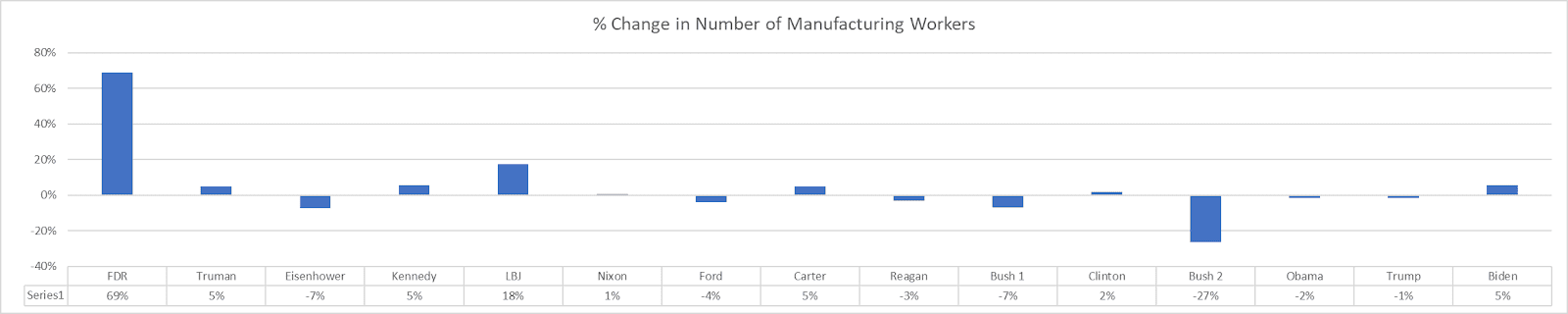
Under FDR, the portion of workers in manufacturing rose dramatically: from 30.3% to 37.0%. Since then, the portion of workers in manufacturing has dropped under every president. Except Trump. When Trump began his presidency, manufacturing workers were 8.5% of the workforce. When his presidency ended, manufacturing workers were 8.5% of the workforce. 

Curiously, though, the number of Americans working in manufacturing dropped by 182,000 during Trump's presidency.

In Biden's first 19 months in office, the percentage of the workforce in manufacturing has dropped from 8.5% to 8.4%. By contrast, though, the number of Americans working in manufacturing has gone up by 668,000.

In this the two presidents are similar to others in their party.

The number of workers in manufacturing rose under every Democratic president from FDR on - except for Obama. (The number fell 195,000 during Obama's presidency.)

By contrast, the number of workers in manufacturing fell under every Republican president after FDR - except for Nixon. (The number rose 138,000 during his presidency.) 

Just as with farming before it, the portion of Americans working in manufacturing has steadily gone down since the build up of armaments during World War II. It will be interesting to see if Biden can match Trump's accomplishment of holding the percentage steady. 


16 August 2022

Four Books That Shaped My Worldview

Four books that shaped my worldview.

Robert Wright's Nonzero
We can play zero-sum games in which every win comes from someone else's loss or play variable-sum games where the sum of what we win varies. Our modern world is variable sum and we can all lose, win or lose big, most win and some lose, some win and most lose, etc. In my old age I think one of the most defining things about a group or individual is whether they believe the world is zero-sum or variable-sum.


W. Edwards Deming's New Economics
Packed with insights but for me the biggest take away is that you can either focus on measuring how people are doing within the current system (from factory floor to classroom) or focus on measuring how well the system is doing at helping people to realize their potential. Deming's advocacy for getting rid of grades and instead nurturing intrinsic motivation feels more and not less important to me as I get older.


William Deci's Why We Do What We Do
Deci offers three models for parents, managers, teachers or political leaders: control, abandon, or autonomy supportive.
Control defines process and outcomes for your child, student, employee, or citizen.
Abandonment leaves them free but unsupported.
Autonomy supportive supports them to the point of autonomy, teaching, coaching and sharing what you know to get them to the point of pursuing whatever goals they have.


Csikszentmihalyi's Flow
Csikszentmihalyi's exploration of how we get lost in work, play or conversations - become absorbed in doing - left him convinced that a big key to happiness and productivity is attaining flow. I also loved his Evolving Self and at lunch one day asked him if it is fair to characterize Flow as about how to create engagement and Evolving Self about how to create meaning. He paused for a couple of minutes and then nodded. "Yes." Long pause. "Yes. That's a really good way to put it."


All of these are of a piece, it seems. Ultimately exploring the question of how we create the systems that let us realize our potential.

09 August 2022

The Most Interesting Question About Investing

There are at least two elements to personal investing.

The first is the most obvious: how to find investments that promise the most return for the least risk. Anyone who tells you they have a secret formula or shortcut for this is either lying to you or have only been investing for a few years. Still, it is valuable to look for clues and sort out signals from noise in this space. There is a ton that gets said and written about this. Pay attention to some of it from time to time. You might learn something. And stay humble. (And of course you don't have to do the humbling on your own. Investments will inevitably do it for you.)

The other element of investing might be even more fascinating, though. When you invest you are buying futures. Obviously you are trying to pay, say, $100 for $200 in a year or a decade. You are hoping to buy a future that gives you more money than you have now, money enough that you don't have to work at 75 (or maybe you're shooting for 45). But beyond the personal future you're trying to buy, there is the question of what collective future you're trying to buy. If you buy stock in a company that is making flying cars, you are paying for that future. It may fail to materialize but that's the future you're buying, a future where people can fly around as easily as they drive around. If you buy stock in a company that is leveraging mRNA into new cures, that is the future you're trying to buy. Your investments could be an answer to the question of what kind of future you want to subsidize or accelerate.

If you could buy the future, what kind of future would you buy? That's an interesting conversation to have with your kids. Or even your neighbors' kids.

02 August 2022

A Ratio that Predicts Why We May Well Avoid a Recession

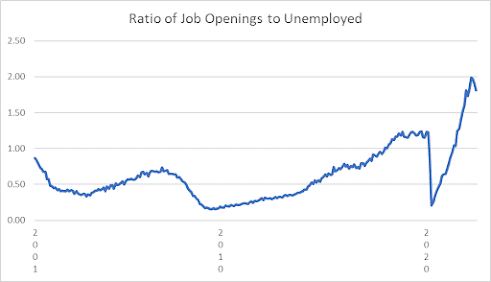
The ratio of job openings to the number of people unemployed is a simple measure of the health of the job market. This century, there have been an average of 62 job openings for every 100 unemployed people.

Jerome Powell is trying to lower inflation without causing much - or any - unemployment. The way he would do that is to bring down the number of job openings without bringing down the number of people who are unemployed. That strategy is looking distinctly possible.

For a variety of reasons, inflation seems to be dropping. Almost as importantly, to extent that Powell needs to "cool down" the labor market without triggering layoffs he seems to be doing that.

The ratio of job openings to unemployed people peaked at 200 job openings for every 100 unemployed people in March. That is triple what it has averaged this century. That is crazy.


As Powell has cooled the economy, this ratio has come down from 200 job openings for every 100 unemployed people to 180 job openings for every unemployed person. 180 is still far higher than its peak of 124 job openings for every 100 unemployed during the Trump administration. (And pre-COVID, that was a really strong job market.) The fact that Powell can bring this ratio from 180 / 100 down to 124 / 100 and still have a stronger job market than we had before COVID suggests that the Fed has a lot of room to maneuver without triggering a recession.

I know I am susceptible to optimism but this is really good news. If Powell lowers inflation without raising unemployment, it'll qualify as a very cool trick. Be prepared to applaud. And then exhale.

29 June 2022

An Argument Not Just to Bring Prayer Into School but to go further and Assign Each Teenager With the Task of Founding Their Own Religion

Lots of talk about the Supreme Court allowing prayer in school. I actually think that it is a great idea. Seriously.
William James was one of the my favorite Americans for so many reasons. He wrote the first textbook on psychology. He helped to develop an uniquely American and incredibly powerful philosophy of pragmatism. He probably was as responsible as anyone for the modernization of Harvard university and - given it has become the template for higher academics by extension he also - is responsible for so much of what defines modern education. Meanwhile, over in Britain, his brother Henry James was writing classic novels. (It would have been fascinating to talk to their parents about how to raise children.)
At one point in his life, James began to study religion. His religious friends were offended because they thought it irreverent to study something so holy and spiritual, subjecting it to the same scrutiny you might apply to annual rainfall or the property of metals at different temperatures. His agnostic and atheist friends laughed at him for thinking he could study something with so many supernatural, untestable claims. It would be difficult, for instance, to determine which denominations got more people into heaven and which lost more to hell. James pushed back on both groups. He said, I can study which religions - or more specifically which beliefs - make people happier and which make them more generous, more giving, more compassionate, more loving.
I love this notion that different beliefs lead to different outcomes. And no matter how scientific you want to be, you're left with no choice but faith on some items. Faith that it's worth getting out of bed on this morning when you still haven't any data to tell you whether it'll leave you feeling overwhelmed with grief, joy, appreciation or underwhelmed with just about anything. You don't know how - or if - your life will impact others. There are so many actions we take based on hope or dread rather than facts. That could get any number of names or labels but I would call it faith, a trust that an unknown future will evolve in a particular direction.
Children should know that there are options other than what their parents believe - whether those parents are nihilists or Catholic or Jehovah's Witnesses or secular humanists or .. well anything. I think that kids need more exposure to what people do for a living. (The Bureau of Labor Statistics tracks 800 broad categories of professions. Most 10th graders can list about 8. (Okay. I made up 8. It isn't many.)) I think that kids also need more exposure to what people believe about their life. Which beliefs make people self righteous and convinced they alone truly understand. Which beliefs leave people feeling despondent and overwhelmed? Which beliefs make people more generous, happier, more careful with other people, more shut off from new experiences ...?
We should bring prayer into schools as well as a variety of beliefs. If we do this right, not only will kids and young adults learn a great deal about how belief changes who they are and what they feel about themselves and others but they might even start their own religion. Mormons think you should follow the example of Joseph Smith. Scientologists think you should follow the example of L. Ron Hubbard. Muslims that you should follow the example of Muhammed. The Church of Christ that you should follow the example of Mary Baker Eddy. Christians that you should follow the example of Jesus. Jews that you should follow the example of Moses. Do you know what is common about all of those people? They created a new religion rather than accept what they'd inherited. What if kids from all the different faiths and religions and traditions in this fascinating experiment in diversity that we call America began to compare notes on various religions, began to take seriously what a great impact beliefs have on who we are and what we can do, and began to explore the possibility of a creative response rather than the binary responses of acceptance or rejection?
Bring prayer into schools. Bring religion and faith into schools. And then as a school project have teenagers found new religions and see how those new beliefs make them and the people they love (and suffer) better people.

26 June 2022

How American Catholics Are Turning Their Beliefs Into Our Laws

Last month San Francisco’s archbishop barred Nancy Pelosi from communion because she supports abortion rights. Put more clearly, a Catholic archbishop punished a Catholic who supports religious freedom. At 82, Pelosi is not going to have an abortion. This is not about the archbishop’s condemnation of Pelosi – a church member - for her actions. This is condemnation of her defending her constituents’ right to believe and practice something Catholics don’t. In isolation this wouldn’t be enough to suggest that Catholic leadership in the US supports ending religious freedom for Americans who aren’t Catholics but there is more.

The clear majority of Americans believe the question of abortion should be left to individual women but a majority of the Supreme Court do not. 7 of 9 of our current Supreme Court justices are Catholic and 6 seem more aligned with San Francisco’s archbishop than Nancy Pelosi. (In the spirit of full disclosure, there is some question as to whether Gorsuch identifies as Catholic or Anglican so it is possible that only 6 supreme court justices are Catholic. In any case, a significant majority.)


Overturning Roe v Wade is a clear example of an elite group overturning the will of a majority. This is the very definition of undemocratic. 

The pope teaches that life begins at conception and 6 Catholics on the Supreme Court have overturned Roe v Wade to make their Catholic convictions our national law. Or more to the point, they have decided that national law should no longer guarantee any woman the right to follow her own conscience or religious beliefs and are leaving that ruling to the states.

This isn’t the only victory for the Catholic Church now so richly represented on the Supreme Court. Last week the Supreme Court also ruled that taxpayer money should help to fund private religious schools, which will be a great aid for Catholic churches that are already tax exempt and will now also be getting government subsidies.

John Kennedy was essentially forced by the press to assure a country that had been under the rule of WASPs for centuries that if elected president he would put the American constitution and people before the pope in deciding policy. It struck me as silly that the press would ask him that. Now it seems like a simple question that should be asked of any candidate: Do you believe that God’s will as has been revealed to you should do more to shape policy than your constituents’ will?

There is indication that the Catholics are not yet done changing American laws to conform to their religious convictions. In an opinion by Catholic justice Alito, the Supreme Court has already indicated they will be reconsidering allowing same-sex marriage and access to contraceptives, two more Catholic beliefs that these justices want made into American law.

It is a curious turn of history that a country founded by Protestants for whom religious freedom – and freedom from religion – were foundational is now having the opinions of a majority of Americans overturned by a court dominated by robed justices who dress and think like Catholic clergy. It isn’t clear how far these good Catholics will go to conform American law to Catholic convictions. It is easy to believe, for instance, that they would put up obstacles to research in genetics that echo the Catholic Church’s stopping Galileo’s research into the earth’s orbit by putting him under house arrest.

It is true that no religious group in the US is larger than Catholics. It is not true that they are a majority – making up less than a quarter of us. And even if they were 51% of our population, the first amendment still suggests that they have no license to turn their religious convictions into our laws. Catholics need to understand that they are no different than Mormons, Baptists, Hindus, and atheists in this simple regard: they are welcome to live by their beliefs but not allowed to impose those beliefs on others. As Americans, our only law about religion is that we don’t have any laws about religion. And for this, even America’s most popular religion is no exception. Unless, of course, the Supreme Court rules that it is.

21 June 2022

Texan Republicans Propose Undoing the Work of the Country's Greatest Presidents - an attempt to undo centuries of progress in return for an imagined past

A fascinating thing has happened over the last 200+ years of progress, ever since Jefferson changed John Locke's "life, liberty and property" into "life, liberty and the pursuit of happiness."

Since Jefferson life expectancy has doubled and per capita GDP has gone up 25X, the average American now making as much in two weeks as the average American in the late 18th century made in a year.

But the pursuit of happiness doesn't always take individuals into greater prosperity or longer lives.

Some people prefer less stressful, lower-paying jobs or no job at all, choosing less prosperity. Others love hobbies like base jumping or binge drinking, pursuing happiness in a way that also lowers life expectancy. So, while this pursuit of happiness has given most of us more income and longevity, it doesn't have to.

Which brings me to Texas Republicans.

Last week, the Texas GOP voted on their 2022 platform. Quite simply, they refute every advance that has made us more prosperous and longer living than the first Americans.

Jefferson was one of the big reasons we have religious freedom and freedom from religion. His -and all the founding fathers' - Enlightenment philosophy replaced belief in the supernatural with evidence found in the natural. This made science and tinkering rather than personal revelation the stuff of community. It also made things like votes you could count rather than the divine rights of kings the source of power.

The Texas GOP would like to "return Christianity to schools and government," making religion the basis for education and government, a reversal of what Jefferson did centuries ago. They also want to undo the progress of Lincoln.

Lincoln not only fought the Confederacy but instituted income tax. Income tax was a brilliant innovation that gave the Union money to fight Confederates while at the same time investing in the largest infrastructure project in history (the transcontinental railroad) and new universities like the University of California, Purdue, LSU, Texas A&M and dozens of other universities. The A&M designation was for agricultural and machinery, these institutions making American farms the most productive in the world and helping to create a new generation of factory workers. Almost as importantly, the income tax paid interest on the bonds that financed all of these investments, and this turned a generation of ordinary people - shopkeepers, farmers, and housewives - into capitalists whose first foray into investments came through the purchase of these bonds. The growth in capital markets after this helped fund a proliferation of new products, jobs and the most remarkable change in prosperity ever witnessed.

Texas Republicans want to eradicate income tax, a tool for so much including public investments and research that has furthered progress. While tearing down income tax, though, they do want to preserve monuments to the Confederate soldiers who violently resisted Lincoln’s efforts to liberate and improve the lives of all Americans.
Texas Republicans also want to return us to the economic policies of the Great Depression.

FDR became president in the midst of a brutal economic downturn. The Great Depression destroyed half of GDP and a quarter of American jobs. The global depression drove a similar downturn in Germany, which brought Hitler to power. FDR used the insights of Keynes to begin a recovery but it wasn’t until war with Hitler that government policies drove enough spending to end the Depression. The Federal Reserve pre-dated FDR but he helped to transform it into a vehicle for Keynesian policies. From 1900 to 1933, the American economy was in recession 47% of the time. Since 1933, it has been in recession only 13% of the time, largely changed by a Fed enabled by Keynesian philosophy.

The Texas GOP wants to end the Fed, to return us to the time of unregulated banking. We know how deregulation works and the problems are not limited to the early 1900s. Starting in 2007, Texan George Bush's deregulation of the mortgage market triggered a sharp downturn, a global recession. Had it not been for that recession triggered by deregulation, the American economy would have been in recession only 4% of the time this century, about one tenth as often as it was in the first decades of the last century. The Fed and regulation makes a difference.

In the 1960s, women, minorities and homosexuals gained more rights, access to universities and workplaces. Women could open checking accounts without their husband's signature and won control over their own bodies. The Texas GOP wants homosexuality treated as an abnormal lifestyle choice and wants to end abortion rights.

The pursuit of happiness has neatly coincided with growing prosperity. For Texan Republicans it is not enough to return to a time 250 years earlier before the great advances of Jefferson, Lincoln and FDR. They want to bring along the rest of the state – even the nation - ending hard fought for rights and policies of America’s most defining leaders.

The Texan GOP wants to reverse the great progress that Jefferson, Lincoln, and FDR gave us, policies that gave us longer, more prosperous lives. We are now in a time in history when a growing portion of conservatives so yearn for the imagined past that they are no longer interested in progress but instead imagine their happiness in the past. That would seem almost quaint if their choice was to retreat to off-the-grid communes rather than insist on dragging their neighbors and the rest of the country with them.

17 June 2022

Bitcoin's Wild Inflation and the Crypto Promise That is Getting Harder and Harder to Believe

People are (rightfully) nervous about the dollar getting hit with inflation. Over the last year, the dollar has dropped in value by 8.5% . Which is to say, inflation has been 8.5% in the last YEAR.

By contrast, inflation in bitcoin in the last WEEK has been 30.4%.

Over the last year, bitcoin has moved in one week nearly as much as the dollar has moved in the last year - an average of 2.7% a day and 7.4% a week. (Keep in mind that targeted inflation for the dollar is 2% and for years annual inflation for the dollar has been about that, less than bitcoin moves in a day.)

Stocks give you a share of the company's earnings.
Bonds give you interest payments.
Rental property gives you rental income.

All of those assets come with risk and their value will rise and fall but they do promise profit, interest and income. Crypto makes no promise of any income or return. Its only promise is that it will become a preferred currency because it is more stable than the dollar or euro. Demand will rise for it over time because of its superiority to the dollar. That superiority is largely based on the promise of its relative stability compared to the dollar.

That promise is harder and harder to believe.

08 June 2022

The Geography of the Imagination - How Marco Polo Inspired Christopher Columbus


Here are a few paragraphs from my book The Fourth Economy about Kublai Khan and Marco Polo, a meeting of east and west.

Marco Polo’s trips to the Orient overlapped with the final crusades (he returned to Italy from his final trip in 1295) and opened up trade routes with Cathay (a kingdom roughly coincident with China) and Cathay’s “Emperor of the Universe,” Kublai Khan. He traveled widely through Asia, India, and the Middle East and then, while sitting in jail back home in Italy, dictated his stories to a cellmate who wrote romance novels.

The book seduced Europeans, who were fascinated to learn of distant lands with exotic customs. They read of Pem, a place where a woman was legally entitled to take a new husband when ever hers was gone on a trip of twenty or more days. They learned of the funeral procession of the Mongol’s Great Khans in which “anyone unfortunate enough to encounter the funeral cortege was put to death to serve their lord in the next world." Mangu Khan’s funeral procession collected twenty thousand victims en route to the grave. Yet it might have been the reports of great wealth that most captivated their imagination. Marco Polo inspired generations of explorers.

Christopher Columbus (1451 – 1506), for one, carried a copy of Marco Polo’s account with him on his journeys across the Atlantic. Marco Polo changed the geography of the imagination of younger explorers, changing what they thought was possible and desirable, and this transformation of the possible changed what was real.

What if We Treated Gun Deaths as a Serious Rather Than an Ideological Problem to Solve

What if gun deaths were not ideological?

Every day more than 300 Americans are shot. 123 are killed.

In 2020, 45,000 people were killed by guns in the US. If we define a generation as 30 years, 45,000 a year over the next generation means 1.4 million killed by guns.

If we were to stop treating this as an ideological issue and instead treated it like we do issues like death in childbirth or deaths from auto accidents and simply, methodically, systematically found ways to reduce gun deaths by 5% a year, every year, this could make a dramatic difference as the next generation comes of age.

If there is no change in annual gun deaths over the next 30 years, this will mean 1.4 million dead. If gun deaths rise by 5% a year for 30 years, it will mean 3.4 million dead during that time. If deaths drop by 5% a year, it will mean 700,000 dead.

The difference it would make over the next generation if gun deaths rise by 5% a year vs. fall by 5% a year?
2.7 million lives. That is greater than the population of 14 states.

(If you think a steady rise of 5% is high, consider this. Between 2019 and 2020, gun deaths rose 14%. The difference over a generation of a rise or fall of 14% a year in gun deaths is a difference of 20 million.)

07 June 2022

From Lincoln to Trump - the Birth and Obsolescence of the Republican Party

As we learn more about how clearly Trump and his supporters were intent on overthrowing democracy on 6 January 2021, it will be really fascinating to see how many Republicans side with Trump (as senators like Cruz and Rubio have done) and how many side with democracy (like Romney and Cheney have done).

Lincoln was the first Republican president and so incredibly visionary and progressive. Trump could easily be the GOP's last president and was even more focused on the past than Lincoln was the future. The telegraph was incredibly revolutionary technology at the time of Lincoln. It no longer is. Politics and policy is no different from technology. What defines state of the art in one generation is quaint in the next.

Abraham Lincoln and Charles Darwin were born on the same day. A pity that the GOP wasn't also influenced by Darwin. Failure to evolve might be the simplest explanation of why Lincoln will go down in history of one of our greatest presidents and Trump as one of our worst.

17 May 2022

Zero-sum Thinking, Replacement Theory and How Progress Transformed the World of Our Founding Fathers

When this country began, land was the limit to progress and the simplest definition of our economic policy was to get more land. Land claimed or conquered and then sold (as well as tariffs collected) was how the government generated revenue to operate. The work of getting more land was the work of conquest. Early Americans practiced slavery and genocide; this was brutal but it was how one got ahead in zero-sum world. This was the world of which Jesus would say, "It's as hard for a rich man to enter the kingdom of heaven as it is for a camel to pass through the eye of a needle." Rich meant you were somehow exploiting others.

Land is zero sum. My gain comes at your loss (sorry about taking your old hunting grounds but, you know, I had to clear the forest to carve out a farm). There is only so much acreage or gold or timber and what you get I lose. Zero sum means competition - fierce competition.
Fortunately, something almost magical happened shortly after the US was founded. With the industrial revolution, for the first time since the ancient Greeks, we began to experience gains in per capita GDP. This meant that it was possible for your life to get better without mine getting worse. Simplest illustration of this? Rather than need two slaves to weave the fibers for my new clothes (a task that would make their life worse and mine better), I could use machines. And so could those former slaves.

Lincoln and the Republicans were acutely aware of this and it was one reason why they fought so against slavery. It wasn't just evil. With capital, slavery was unnecessary.

Still, there are a lot of people who still imagine they live in a zero-sum economy. (We don't. In truth, we live in a time of such abundance that we artificially create zero-sum conditions with sports, having strict rules about how only one of thirty NBA teams can be this year's champ no matter how much better most teams are. That ancient impulse for competition has to be sated somehow. Sports does it.)

The folks who believe this is a zero-sum world are the people who still think that immigrants are coming to steal their job.

When the US gained its independence, we had only 3.9 million people. Today we have nearly 100X more people. Or course its nonsense to think that the 330 million newborns and new immigrants since the time of the founding families had to steal jobs from the original Americans. More people mean more economic opportunities, not less. And not only do we now create 3.9 million new jobs EACH MONTH, but the pay for those jobs is multiples of what early Americans would have ever imagined.

In general, conservatives are people who have this curious notion that the past was better. Or, perhaps more accurately, they seem to think that the truths of the past still hold today. Conservatives susceptible to replacement theory still think they're living in a zero-sum economy, one where every gain you make comes at my expense. This - like the anti-vaxx movement - is evidence of a mind still shaped by pre-Enlightenment thinking. (Vaccinations were, like this great country, an invention of Enlightenment thinkers).

You don't live in a zero-sum economy. Value doesn't come at the expense of someone else. It is something we have to create. Maybe we'd have more luck with that if we looked at others as collaborators rather than competitors.