Showing posts with label history. Show all posts

17 September 2019

A Curious Explanation as to Why Europe's Population Fell During the Dark Ages

Learned something curious from Berkowitz's Sex and Punishment, a book I picked up from the Harvard Bookstore a week ago.

Medieval priests used penitentials to define rules and punishment. A lot of prohibitions involved sex and some were odd. (To be fair, in an age before cars, guns, and corporations there wasn't much other behavior to regulate.) In a few regions, the penalty for performing fellatio on one's husband was greater than the penalty for killing him.

The penitentials offered a labyrinth of penalties and prohibitions. Among other things, it left only about 4 days a month during which it was "legal" to have sex. Even those limits weren't enough: married couples could be prosecuted if they were known to enjoy sex too much. Pope Gregory (~540 to 604) declared that marital sex was blameless only when there was no pleasure involved.

Perhaps unsurprisingly, during the period of the Dark Ages when these penitentials had the most influence - from about 500 to 1050 - Europe's population actually shrank.

So that's kind of interesting.

14 September 2018

The Recovery is Real And Yet We Still Have Poor People. That's How Economies Have Always Worked

I'm seeing a fair bit about how the recovery isn't real or isn't really done because people are still poor. That's nonsense. We have had and always will have poor people. Markets simply don't lift up everyone. Markets are marvelous but they've never taken care of everyone.

The philosopher Karl Jaspers (who died in 1969) argued for an Axial Age. Within a few centuries the foundations for religions we still have today were laid. 

Confucius and Lao-Tse were living in China, all the schools of Chinese philosophy came into being, including those of Mo Ti, Chuang Tse, Lieh Tzu and a host of others; India produced the Upanishads and Buddha and, like China, ran the whole gamut of philosophical possibilities down to materialism, scepticism and nihilism; in Iran Zarathustra taught a challenging view of the world as a struggle between good and evil; in Palestine the prophets made their appearance from Elijah by way of Isaiah and Jeremiah to Deutero-Isaiah; Greece witnessed the appearance of Homer, of the philosophers – Parmenides, Heraclitus and Plato, – of the tragedians, of Thucydides and Archimedes. Everything implied by these names developed during these few centuries almost simultaneously in China, India and the West.
— Karl Jaspers, Origin and Goal of History, p. 2

One theory (I don't think it is Jaspers') is that this happened at this point in history because of the emergence of the city which lead to wealth. Oh, and disparities in wealth. If you are living as a hunter gatherer, you can't accumulate much. If you settle down in a city, you can. And as more people live in proximity there is more opportunity for trade (of goods, ideas and services) and the prosperity that comes with it. This emergence of wealth raised the question of who we should be towards the poor; the major religions emerged - in part - as answers to that question.

There are certainly things we can do to make the poor more self-sufficient, to create opportunities for them and their children. I think that's hugely important. But once we've done that, we will still have poor people. And at that point how we treat them is not a question of economic policy; it's a question of morality, something humans were clear about roughly 3,000 years ago.


07 July 2018

The Most Important Development in the Evolution of Humans

First an excerpt from Thinking Big, a book about how our brains evolved to adapt to social realities. A key point here is this matter of thinking in terms of relationships and not just rationally.

Food was certainly of vital importance and obtaining it efficiently and securely must have dominated much of their [early hominins’] lives. The archaeologist Rhys Jones, who lived with Aborigines in Northern Australia, once said to us that these hunters and gatherers were always 24 hours away from hunger.But for us the keys to understanding food lie in the implications for social cooperation. This takes two forms. First are the tactical demands, of getting working parties together to hunt or gather safely and with greater chance of success. This covers defence against predators as well as obtaining those foods that were needed to fuel expanding brains. Second is the strategic matter of planning for bad times. This is achieved by looking for help beyond your immediate community. Instead of restricting access to resources by defending them against all-comers, it is better to allow other people in. By linking individuals and their communities over very large geographical areas a form of ecological insurance is produced. [highlighted added]Archaeologists refer to this as social storage: tokens exchanged for food in bad times, and vice versa in good. In other words, if conditions deteriorate where you happen to be ranging, then we will allow your community to come over to our range and use our resources for a while. Later, the reverse will be the case, and you can pay us back. Such a system works well, but it requires that the community has a territory large enough to cover a wide range of habitats. It won’t work so well if community territories are small and consist of essentially the same kind of habitat.
…..Rather than concentrating on what may be rational explanations of why they hunted bison rather than reindeer or chose not to eat fish, as the isolated Tasmanians famously did 6000 years ago, we need to shift the perspective and see the role of food and other materials in creating relationships rather than simply meeting calorific goals. Archaeological explanations for the human story need to be relational (being social) as well as rational (being economic). Social life is not based on calories alone but on the relationships that emerge when things are made, exchanged, used, and kept.pp. 86-7 of Clive Gamble, John Gowlett, and Robin Dunbar’s Thinking Big: How the Evolution of Social Life Shaped the Human Mind, Thames & Hudson, London, 2014, paperback version 2018.


Put more simply, as humanity evolved it faced two choices.
1. Defend your limited resources from others.
2. Expand your limited resources by sharing with others.

Archaeologists think that Neanderthals adopted the first strategy and early humans adopted the second. Neanderthals went extinct. We've become the dominant species.

As it turns out, the second strategy of strengthening relationships rather than walls has a host of advantages. Not only do you have more insurance against bad times but this strategy requires you to cooperate with larger groups of others, which enables all sorts of advances. This means opportunities for wider array of mates, the exchange of ideas, and the "outsourcing" of or cooperation on explanations, research and development, and cultural and technological innovations that eventually dwarfed the diversification of food sources in importance.

The choice to cooperate to share more rather than compete to protect less may be the single most important choice early humans ever made.

01 June 2018

Video Games, Systems, Consequences and the Afterlife

I'm a fan of video games. I think that the world will get better as we build more effective simulators to teach systems dynamics that include the behavior of nations at war, ecosystems, financial and labor markets, popularity, and the change in social norms. Different dynamics are tough to understand as prose or equations; sometimes the patterns become easier to see when they play out in video simulations that let us see causality that simulates centuries within an hour. I don't think that we've really understood how powerful this potential technology is for teaching systems dynamics that so define our world.

There is one lesson that these video games gloss over, though. And it may be the most important lesson of all.

What we enjoy or suffer today rarely has anything to do with today.

Mark Zuckerberg made $1.5 billion today. I'm not even sure he went into the office today. He may have stayed home with a cold or may have had a really important strategic meeting. I don't know what he did today but I guarantee you that it does not explain his gain in wealth today. That is the consequence of things he did years ago.

Probably 99.9% of what we enjoy or suffer from today is the consequence of something done in the past. Little of it even done by us. Today my portfolio is up. It is the result of investments and sacrifices I made in the past, but that's the least of it. It's also the result of the Dutch who came over to New Amsterdam and recreated the stock market they'd first established in Amsterdam. It's the result of countless employees and entrepreneurs who have created equity out of thin air. It's the result of laws that protect private property. And so on.

That lesson that evolutionary biologists and religious teachers would both teach you is that causality does not stop at death. There is an afterlife. The lives of people in the future will be diminished or enhanced based on what you do in your lifetime. I suppose it is a kind of evil to believe that your life has no consequence and a sort of good to believe that it does.

If you are looking for cause and effect that can be experienced within a day or even a year, it is easy to get discouraged. Little of consequence plays out that rapidly and if you are measuring the impact of yesterday or last month's efforts on today, you'll conclude that there's not much that can be done. But the stories that inspire are those of the immigrant mom who worked two jobs to get her kids through college. There is generational causality and it doesn't end with her grandkids. One of the reasons I love history is that it explains so much of what defines today. We are the product of decisions made centuries earlier.

The community you live in is the product of the despair or hope of past generations, their action or inaction, their creativity or conformity. One definition of foolishness might be to believe that nothing we do has any consequence; one definition of wisdom might be to believe that what we do has consequences for generations. (Even if that consequence is to have made no difference because even not making a difference makes a difference.)

Finally, I leave you these words of advice from one of my favorite people.

The Buddhists have a good piece of advice: “Act always as if the future of the universe depended on what you did, while laughing at yourself for thinking that whatever you do makes any difference.” It is this serious playfulness, a combination of concern and humility, that makes it possible to be both engaged and carefree at the same time. One does not need to win to feel content; helping to maintain order in the universe becomes its own reward, regardless of the consequences. - Mihaly Csikszentmihalyi


27 May 2018

Monarchs (Butterflies, that is) and Millennials

I went on a business trip with my wife Friday. She calls them field trips. She teaches 2nd grade and Wednesday her 7 and 8 year olds reached the end of their unit on butterflies by releasing some they had watched transform from caterpillars into butterflies. Friday they went to the IMAX to watch a movie about monarchs.

It's cliche to express wonder at the transformation from caterpillar to butterfly but the wonder is deserved. If you saw the two creatures without any knowledge that they were related, you likely wouldn't even put them in the same category, much less realize they were two stages of the same life. There's more, though.

Every fourth generation is a super butterfly. For three generations the butterfly's life expectancy is about two to six weeks. This fourth generation, though, lives for six to eight moths. It's also bigger and able to fly from Canada into the heart of Mexico, thousands of miles. The transformation from caterpillar to butterfly is genetic code triggered each generation; the transformation from regular to super butterfly is genetic code only triggered every fourth generation.

Which made me wonder whether something similar is going on in our community.

If we define a generation as 25 years, four generations back takes us to those born about 1900. These people fought in World War 1 and then were the leaders during World War 2. Their inventions, speculations, investments and desires fueled the roaring 20s, tipped into the Great Depression, and then a hot war with fascists and then a cold war with communists. When they were born in 1900, the two most common jobs were farmer and household servants (families with fewer than 3 servants were considered lower-middle class); by the time they died in the 1960s through 1990s, men had walked on the moon, the internet was linking people across the world, and the discovery of DNA had evolved into genetic engineering.

The kids at Parkland so impressed me. Millennials and younger are aware, conscientious, and the best educated generation in history. They are informed by thousands of stories and have access to millions of lives through a media that includes TV, radio, podcasts, video, social media and every other permutation of the internet.

It is, of course, a whimsical idea, but what if those kids born about 2000 - who are 4 generations removed from the generation born about 1900 - are a super generation who will carry us farther than the generations before?

22 January 2018

The Trick is Finding Someone Whose Unusual Interest in Dwarfs Has Forced Them to Sell Their Art

From the early 1500s to early 1600s, the English destroyed a lot of art. Perhaps as much as 98% of their paintings and statues as part of their rejection of Catholicism and its rather worldly reliance on images. 

King Charles (the king who ruled until the Puritans cut off his head in 1649) revived an interest in art. An avid collector, at one point he was able to get a good deal on some great paintings (among them a Titian) because a certain Gonzaga family had fallen on hard times morally and financially; only interested in sex with dwarfs, they sold him paintings in order to get money to purchase a rather extraordinary Hungarian she-dwarf for a high price. (Yes. The actual woman. Not a painting of her.)

Had Shakespeare only lived a few more decades, he could have included accounts like this in his plays. As it is, we have only stories of passionate teens and mad kings.

[This is a story that was casually dropped into conversation on Andrew Marr's Start the Week podcast today. It struck me as remarkable.]

02 December 2017

Why the Republican Tax Cuts Won't Help the Economy: Understanding the Difference Between the Economies and Parties of Lincoln and Trump

Trillions in excess reserves, cash and negative interest rate bonds calls into question Republican's claim that the economy needs tax cuts to create additional capital.

Abraham Lincoln was the first Republican president. He was part of a visionary party who realized that the industrial economy had changed the rules in a few ways. One, it made capital even more important than land. Two, it made slavery, which was always immoral, now bad economics. Three, it made the national economy most relevant to good policy (goods now produced in growing factories were now transported across state lines by growing railroads to be sold in department stores all across the country) rather than the old state economy. When the south seceded, the largely Republican northern legislators passed a flurry of laws to accommodate this new industrial economy that was supplanting the agricultural economy.

Since the time of Lincoln, a key to understanding Republican policy and strategy is understanding that they believe that nothing is more important to economic prosperity than capital.

There is good reason for such a belief. If you are working with your bare hands you do well to create more than a few pennies - maybe a few dollars - of value a day. If you have capital equipment like a vehicle, a lathe, a computer or factory, you can potentially create thousands - even millions - of dollars in value each day.

The thinking behind the Republican tax breaks traces back to this belief that they need to encourage more investment by corporations by taxing them less. Their belief is that as more money is invested in things like lathes, computers and factories, American workers will be more productive. As it has since the time of Lincoln, more capital from more investments will make us more prosperous.

It is true that capital is essential to our economy. So is agriculture. There is a difference, though, between knowing that we'd perish without farmers and expecting agriculture to employ a growing number of people. In 1800 about 90% of Americans worked in agriculture; by 2017, about 1 or 2% do. Agriculture is essential but that is very different from saying that more farmers will make our country more prosperous. Agriculture is not the place we look in 2017 for the creation of new jobs and wealth.

Capital, too, is essential but that is different from saying that more capital will make us more prosperous. Manufacturing (admittedly just one manifestation of capital) is not the place we look in 2017 for the creation of new jobs and wealth. As farming before it, jobs in manufacturing have been in steady decline as a percentage of the workforce since about 1940.

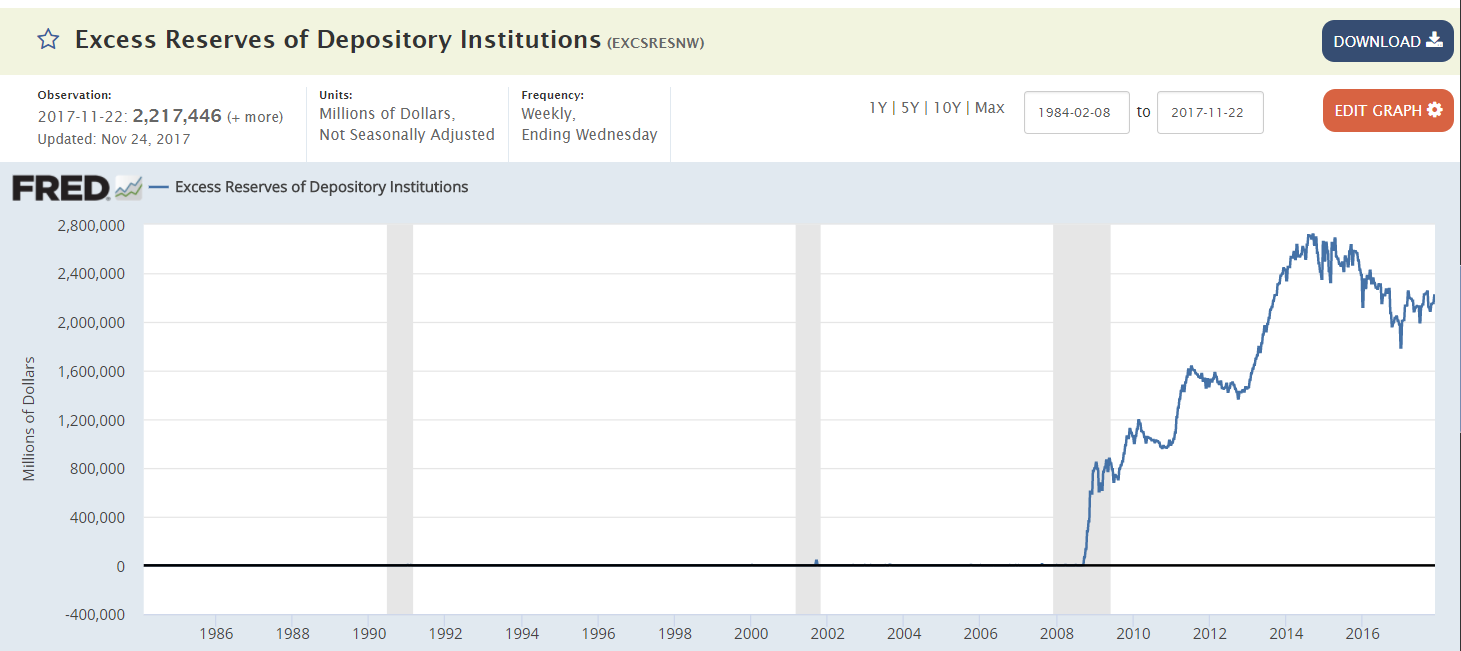
Again, the simple justification for Republican tax cuts is the belief that they will result in more capital investment. The story of excess reserves calls that into question.

From the early 1980s through 2008, excess reserves in the US banking system mostly bounced around between $1 and $2 billion dollars. Banks are required to keep a certain level of reserves on hand, essentially money they hold in case you come in to make a withdrawal on your account. And simply because it is nearly impossible to have every dime "working" as loans, etc., banks also keep a little reserves in excess of what is required. They have an incentive to keep these reserves to a minimum because they just sit there idle, generating no interest, so it makes sense that they wouldn't hold much in excess reserves.


Then we got hit with the Great Recession. One huge risk was that the credit system would collapse. Among other things, the Fed pumped capital into the banking system to encourage economic activity. The Fed could put capital into the banking system but banks had to put it out into the economy via loans to households and businesses.

Banks are literally professionals at understanding credit risk and knowing when to loan money for a kitchen remodel or a business expansion. Bankers - like business executives, teachers, police,  and engineers - make mistakes but this matter of deciding where capital should be employed to maximize the returns on capital is quite literally their job. If they have a billion dollars, they will look for a way to invest or loan that out in order to create a return. Only as a last resort will they leave it idle and not making money.

So what happened when the Fed pumped a record amount of money into the banking system? You can see that below; the one to two BILLION became two to three TRILLION, a jump of 1,000X.


Janet Yellen has helped to engineer a draw down of these excess reserves without disrupting the economy but after peaking at $2.7 TRILLION in 2014, excess reserves are still $2.2 trillion.

Bankers - the experts on capital allocation - are letting trillions sit idle because they don't see profitable ways to employ this capital. Another way to put it is that they don't see capital as scarce.

Excess reserves are not the only bits of evidence that the economy has an abundance of capital. Last year companies in the S&P 500 spent $536.4 billion on buybacks. What does that mean? They spent half a trillion simply buying their own stock rather than investing that money into hiring, factory expansion, or advertising. Like bankers, big corporations don't see capital as scarce but instead see it as abundant, literally having more than they can use. Corporate cash is close to $2 trillion.

The Dutch have financial records that go back 500 years. Think about all that has transpired since 1517: the Protestant Revolution and religious wars that killed tens of percent of the population in certain regions of Europe, coming to an understanding that Columbus had actually discovered new continents and then settling those Americas, democratic revolutions, the industrial revolution, world wars, a Great Depression .... these 500 years have hardly been uneventful. And yet, last year was the first time that the Dutch recorded the sale of negative interest rate bonds. You give a country $100 and get back $99. The Netherlands, the EU, France, Japan .... nine countries had issued about $12 trillion in negative interest rate bonds as of last year

To sum up, US banks have $2.2 trillion in reserves, the S&P 500 has $2 trillion in cash (even while spending half a trillion a year on buybacks), and there are more than $12 trillion in negative interest rate bonds around the world.

None of this suggests that the West faces a scarcity of capital.

So let's get back to the Republican tax cut. The thinking behind it is simple: if we tax less there will be more capital and that capital can be employed to expand businesses that will generate more profit and jobs. And that, of course, assumes that capital is scarce.

Capital was scarce 150 years ago during Lincoln's presidency. At that time, nearly any policies that encouraged the growth of capital were likely to have a positive effect on the economy, helping to make us all more prosperous.

Capital is now abundant. Policies that starve public education and research to send back more capital to corporations and individuals will hurt economic growth, not help it. There is no way that someone can look at the evidence and conclude that what our economy lacks now is capital. There is no way, of course, unless you have failed to update what was once a great perspective to adjust to a new landscape. The party of Lincoln has given way to the party of Trump and mindful intelligence that carefully considers new facts has given way to mindless ideology that ignores them.

03 January 2017

What if History Has Only Just Begun? Contemplating a Post Economic Society

If you bring together parents of little ones aged 0 to 3, you'll hear them discuss very similar - nearly identical - stages of development. Getting potty trained, sleeping through the night, learning to walk and talk, and learn self control are constants for every child. Those little ones may grow up to become very different people who make their living, pursue romance, create or engage in hobbies, struggle with wild bout of optimism or depression - that is, live their lives in wildly different ways but in the first few years of their life they're dealing with nearly identical issues.

Which brings me to economic development.

We have this tendency to think of ourselves as having reached the pinnacle of evolution. Probably amoeba and early primates had even greater difficulty conceiving of the possibility that evolution hadn't ended now that they'd arrived, but even we tend to think of ourselves as a culmination rather than an intermediate stop. Not just as humans but as a culture or civilization. And yet, we're so obviously still a work in progress, so obviously not yet done.

I think that we've not only entered a fourth economy but that this fourth economy will be less a culmination than a mere phase, perhaps the equivalent of learning to walk or talk. It will transform what is possible but the talking is incidental to the communication, the walking incidental to getting somewhere. In the same way that writing brought humanity into a new phase of history but didn't end history, so will moving beyond scarcity bring us to a new phase but hardly end the continuation of history. And once we've moved beyond scarcity, economics as we've learned it will be less defining than assumed, in the same way that we don't now talk about different communities around the globe having a talking or writing culture.

Having social inventions that allow us overcome the limits of capital or entrepreneurship will be pretty cool. What is even more interesting, though, is the question of what we do when we've overcome all four economic limits. At that point we have the harder but more difficult work of then determining what sorts of societies we want to create. Or, rather, the generations that will come after us will have that work.


02 January 2017

Childhood 200 Years Ago (when it was outrageous to limit work days to 12 hours or offer 30 minutes a day of education)

This little tidbit from Chris Jennings' fascinating Paradise Now: The Story of American Utopianism. The Owen mentioned is Robert Owen who became fabulously wealthy operating factories using the new spinning jenny that boosted productivity enormously. This little excerpt is just a reminder of what childhood was like the early days of the Industrial Revolution and how viciously opposed people are even to the changes that strike future generations as obviously positive.

Owen used his newfound celebrity to back progressive legislation in Parliament. In 1815, he drafted a bill for the "Preservation of the Health and Morals of Apprentices ... in Cotton and other Mills." The bill had three central provisions: children under ten should be prohibited from working in mills; workers under eighteen should not work more than twelve hours a day; and young millworkers should receive a half hour of schooling each day.
Owen to Parliament expecting an enthusiastic response. Instead, the committee assigned to review the bill met him with startling hostility. "The employments of these Children in Cotton Mills is not sedentary [suggesting they were getting opportunities for physical activity]," one of the bill's opponents insisted; "it is neither laborious, nor such as tends to cramp their limbs, to distort their bodies, or to injure their health. Generally speaking those who are introduced young are most orderly, as might be expected from early habits of industry, attention, regularity, cleanliness, and subordination." A coalition of mill owners lobbied against the bill. In familiar language, they decried the proposed intrusion of big government into their industry. "Legislative interference betwixt the free labourer and his employer," they insisted, "is a violent, highly dangerous, and unconstitutional innovation." If children work fewer than twelve hours a day, some critics pointed out, their families will end up on the dole. As for the outlandish notion of providing young workers with thirty minutes of reading and arithmetic lessons each day, the claimed that "the unnatural mixture of education with work proposed by [Owen's] Bill, would not only be expensive and vexatious to the employer but impracticable in execution." Owen's proposed reforms would merely deprive the "heads of families of their natural control over their children," and "reduce the prohibitive labour of the Country." In short, the bill was an unpatriotic, antifamily job killer that would erode the morals of the working class by "throwing them idle and disorderly on the community too early in the evenings."

12 April 2015

The British as Social Inventors (or, the policies that could make the UK wildly prosperous again)

The UK will elect its next prime minister in just a few weeks, on 7 May.

As an American, I envy the fact that British politics is so much more humane. But judging from the political debate earlier this month between the UK's seven major party leaders, the British seem to have lost their sense of history. Why were they the world’s leading force for centuries? Why are former British colonies so much more affluent than former colonies of Spain or France? Why is English still the world’s dominant language when it comes to business, science, and innovation? Knowing the answer to that question provides the answer to how the UK could again make its economy vibrant, perhaps even a global leader.


The simple answer is that, from before 1534 when Henry VIII severed ties with Rome to help to create the nation-state to the time that the British invented the single-payer healthcare system in 1948, the British led in social invention. And not just any sort of invention. They led in the social inventions that helped overcome that period's limit to economic progress.

Instead of discussing social inventions that redefine a century, though, political leaders are now arguing about changing tax rates or spending small percentages, each trying to find the right balance between fiscal responsibility and addressing needs. There is no sense of history now. Just a sense of responsibility. Rather than ask how to create jobs they’re asking how much unemployment and welfare they can afford. Rather than asking how to create wealth, they’re asking how much debt is reasonable. And rather than ask how to make the British once again world leaders in economic growth, they’re asking questions about how fairly government services are being shared among the poor and new immigrants. As an American I can only envy this delightful sense of fairness. In the end, though, it’s less about whether you share the mastodon kill fairly than whether you learn how to domesticate crops. If you want a great community, you don't choose between fairness and progress.
For centuries, the British were the world’s leaders at changing people’s minds about what was possible. Their social inventions were not just about what was fair or right. Their social inventions actually created wealth in ways that were unprecedented in world history.
The British National Health Service (NHS) is the oldest single-payer healthcare system in the world and is a wonderful example of social invention. The British set up a system that made healthcare a right rather than something only people above a certain income could access. Like so many of their social inventions, most of the West has since adopted some form of what the British created. (Even we Americans have taken steps towards following this example.)
But long before that, they also invented new institutions that made people more prosperous. 
In 1623, Edward Coke championed legislation - patent law - that rewarded inventors. By 1699, Thomas Savory had invented a steam engine. At that point, for the first time in thousands of years, per capita income began to rise. Because of social inventions like patent law that let people profit from the investment of time and money into new products, the British led in the industrial revolution.

The British were not just social inventors. They rapidly adopted what worked in other countries. The Dutch were the first to set up a corporation that could trade in a remote part of the globe on behalf of the state (the Dutch East India Trading Company), the first to set up a stock market (to trade shares in that one corporation) and the first to set up a central bank that could help to regulate currency and make loans on behalf of the state. The British were smart enough to adopt those inventions when they brought William and Mary over from the Netherlands in 1689 to become their monarchs, and that soon helped them to pass even the Dutch in per capita income. This was not just the kingdom that gave us the invention of the steam engine: it gave us Charles Darwin and the concept of evolution.  The British continued to innovate and tinker with these big inventions. It was the Bank of England that became the model for the world's central banks. And the eventual change they made to the corporation was even more momentous.
In 1862, the British Parliament passed the Company Act and invented the limited-liability, joint-stock company. That is, they invented the modern corporation, the best institution yet made for the creation of jobs, products, and wealth. John Micklethwait and Adrian Wooldridge called it “yet another quirky Victorian invention that changed the world.” Putting aside the fact that the Americans more fully subordinated themselves to this new institution, this transformative social invention was British.
Whether it is through patent law or the modern corporation, central banking or NHS, no people have done more than the British to make history by changing history. No people have been more ready to re-invent themselves or their institutions. 
So what could the British do now? What social inventions would shift their conversations from unemployment to job creation, from debating about how much debt they could afford to best strategies for creating wealth? It would be any social invention that would help them to overcome today’s limit to progress, which is different from the limit of a century ago – or two centuries earlier.
From about 1300 to 1700, the limit to progress was land and because the British people led in social invention and adoption that helped them to overcome the limit of land – from a nation-state and private property to standardized measurements and colonization – they became the world’s leading economy. 
From about 1700 to 1900, the limit to progress was capital and because the British people led in social invention and adoption that helped them to overcome the limit of capital – from patent laws that inspired invention to central banking policies that stabilized financial markets – they were the world’s leading economy.
From about 1900 to 2000, the limit to progress was knowledge workers. Even though the British people invented the modern corporation – the place where knowledge workers created products, wealth, and jobs through product manufacturing and invention – they lost their lead to the US, Germany, and Scandinavian countries because they were slower to realize the importance of public education. (In 1875, England’s illiteracy rates were about 10X higher than those in Germany and the Scandinavian countries.) In a world where English is the dominant language, it’s worth noting that kindergarten is a German word. The social and technological inventions that did the most to create knowledge workers and make them more productive were the ones that made communities richer and more powerful. One might argue that as the world's original capitalists, the British saw their invention of the modern corporation more as an investment tool than as a tool for making knowledge workers more productive, and lagged because - for a time - they made capital more important than labor.
The conversation the British people need to have now isn’t about how to get more land and make it more productive. Land is no longer the limit. The days of colonization and the British Empire are past. It’s not about how to get more capital and make it more productive. Trillions of pounds of capital wander the globe in search of returns. A massive infusion of capital now is as likely to sit idle in banks (or, in the form of industrial capital like robots, make labor sit idle at home) as to create jobs and wealth. It’s not even a question of how to create more knowledge workers or make them more productive. The good news is that - largely because of British social inventions - the West has overcome the limits of land, capital, and knowledge workers. The bad news is that more of those factors that no longer limit won't just fuel economic progress.

Period (roughly)
Market Economy
Develop & Acquire
1300  1700
First, Agricultural
Land
1700  1900
Second, Industrial
Capital
1900  2000
Third, Information
Knowledge Workers
2000 ~
Fourth, Entrepreneurial
Entrepreneurship

So what is the limit to today's economy that social inventions must help communities to overcome? Entrepreneurship. Last century, the West popularized knowledge work. Between 1900 and 2000, the economies of the West transformed from industrial economies dependent on child labor to information economies dependent on adult education. Now, it is time to popularize entrepreneurship. The first wave of this popularization will likely be like the British adoption of Dutch institutions. That is, communities able to adopt the policies of Silicon Valley, creating an entrepreneurial region, will make great progress. The next wave will likely come in the form of changing the corporation again. This will involve making more employees more entrepreneurial, allowing them to create equity and not just products. No one has yet taken the lead in this but the British (or for that matter, the Scandinavians, Germans, Canadians, Americans or the people of Singapore) could become leading innovators in this. And just as the British became prosperous in ways that past generations could not have imagined when they boldly overcame the limits of capital, so could this next generation.

The question for today’s economy is how to create more entrepreneurs and how to make more employees more entrepreneurial. As people find creative answers to these questions, they'll create jobs for knowledge workers and will fully employ the trillions in capital that people like Marin Wolf and Ben Bernanke warn is symptom of a savings glut (or investment dearth). Knowledge workers and capital are no longer limits. Entrepreneurship is.
The British people have proven themselves incredibly creative. For centuries. There is no question about that. The only question is whether British policy makers will decide to find creative answers to the question of how to create more entrepreneurs or how to make more employees more entrepreneurial. Last time they got serious about finding ways to overcome the limit to progress through thousands of small and large social and technological inventions, they gave us the industrial revolution. Who knows what extraordinary world lies on the other side of the myriad inventions that will help the West to overcome the limit of entrepreneurship?


03 August 2014

The Future of History Looks Bleak

If I wiped your memory clean you'd be gone. Assuming that it caused no brain damage and you were able to learn anew, you could conceivably become another you, but that new you devoid of all your old memories would be someone else, about as similar to the old you as any other person on the street.

As they lose their memory, people with Alzheimer's lose their personality. Not only is it true that they begin to have trouble recognizing other people. Other people have trouble recognizing them.

Society is the same way. If you change the story about your past, you change who you are now. History matters because it tells people how they got here and suggests what needs to be preserved and abandoned. Apparently, though, we're losing interest in history, caught up in the now. It could be that people think that things are changing so rapidly that it's best not to be encumbered by history.

This graph shows the diminishing interest in history as tracked by Google. It's down about 80% since 2004.


Just extrapolating this trend, one would have to conclude that the future of history looks bleak. I wonder if that means it's going to be harder to recognize who we are. 

23 June 2014

Sex and Christianity - Same Sex Acceptance is Just Another in a Series of Revolutions

For centuries, the Catholic Church taught that every kind of sex was sinful. Well, all but one kind of sex: sex between married people who were - in that very instance - trying to make a baby. Sex between two women who didn't know each other's middle names or sex between a couple who were madly in love after 20 years of marriage was all sin if it wasn't part of creating the next generation.

Pleasure. Strengthening a relationship. Sex for such suspect reasons was sin.

Few Christians today would agree with that. What was so obvious in one century eventually became anything but obvious in another.

Social conservatives like to think that they are holding to something timeless. In fact, they are holding onto some notion of normal they learned when they were first forming their opinions about the world. It's true that what they believe falls into the category of  "how it has always been" but that "always" simply describes all they have ever personally known. Time doesn't even leave continents in one place, much less notions of normal.

History changes everything and you can see why this unsettling fact would lead so many social conservatives to reject the notion of evolution. Once you admit that things have continually changed, you have to admit that there's no reason your generation will be spared from - or ruined by - change.


07 November 2011

The Simple, but Sweeping, Answer to the Question of How to Create More Jobs


We can continue to try repairing the old economy or we can create a new one.

Financial crises, stagnant wages, persistently high unemployment, protests, and growing government deficits coinciding with a loss of government jobs are all legitimate problems in their own right, but they are more likely symptoms of something deeper. We’re living into one of the four biggest economic transitions since the Dark Ages.

Since about 1300 CE. a pattern of social invention and revolution has created three economies:  an agricultural, an industrial, and an information economy. And that pattern is now repeating to create a fourth, entrepreneurial economy.

These changes we’re experiencing are different from normal business cycles. This is bigger.

The last shift in the West – beginning around 1900 - took us from an economy led by advances in capital to one led by advances in knowledge work, a transition from an industrial to an information economy.

Progress from about 1700 to 1900 came from dramatic increases in capital: steam engines, factories, stock and bond markets, and banks were invented or recreated and the communities that increased capital the most advanced the most.

Progress from about 1900 to the present followed from the rise of knowledge workers: inventions like the modern university and corporation, and radical advances in information technology helped to create an information economy in which companies making virtual products often became more valuable than those making “real stuff.” Communities that ignored the question of how to create more knowledge workers and make them more productive, and just focused instead on capital, were left behind. When the limit shifts so must the focus.

The emergence of each new economy has forced a revolution in the dominant institution. This is no small thing. The power of elites over the institution is dispersed outwards. People once used as tools by the institution begin to use the institution, instead, as a tool. “We are all priests!” Martin Luther declared, overturning the notion that religion was something to be defined by the pope. The first economy, from about 1300 to 1700, was catalyst to the Protestant Revolution. The second economy, from about 1700 to 1900, brought us democratic revolutions. The third economy, from about 1900 to 2000, democratized finance as knowledge workers’ pension funds and 401(k) funds came to define investment markets.

This new fourth economy will likely transform the corporation – today’s dominant institution - in similar ways. Most obviously, the role of the employee will become more like that of an entrepreneur.

The simple, but sweeping, answer to the question of how to create more jobs is that we need to become more entrepreneurial. The question of how we become more entrepreneurial will first be answered within the corporation. 

Depending on how one measures it, corporations make up between one third to two thirds of the 100 largest economies in the world, yet very few of them encourage entrepreneurship.

Developed countries are considered lands of opportunities where people can expect to make more than heads of state. (About 6 million Americans make more than Obama.) By contrast, corporate employees are about as likely to make more than the CEO as past citizens of Iraq, Libya, or 17th century France were to earn more than Saddam, Kaddafi, or Louis XIV. Such restraints to opportunity and autonomy suggest huge gains could follow from democratizing corporations and creating more entrepreneurial opportunities for the employees within them.

Our media and attention is fixated on political – and sometimes financial – changes we could make to create jobs, but it may turn out that such changes are merely incidental to the scope of the changes needed within corporations.

Despite initial appearances, we’re living in a time of incredible opportunity. Shifting our focus to overcoming the limit of entrepreneurship will mean advances as dramatic – and at times as disorienting – as those of the last three economies. (And if you’re a student of history, you realize how very dramatic that is.) An entrepreneurial economy is ready to emerge. Millions of new jobs depend on today’s communities redefining the corporation as dramatically as past communities redefined church, state, and bank. The fourth economy is ready to emerge but it’s not something we’ll see as long as we stay focused on trying to repair the third economy.

Ron Davison has consulted to some of the world’s largest corporations and is author of The Fourth Economy: Inventing Western Civilization, available on amazon.com. 

11 July 2010

The Importance of Pepper

To find a good reason why the waiter might think it would impress your date to offer her freshly ground pepper from what appears to be a small table leg, you’d have to go back centuries to Medieval Europe. (Of course, Freud might have as much to say about what this conveys as any historian. Lasting rituals rarely make sense at only one level.) In medieval times, pepper and other spices were status symbols, highly coveted, exotic, and expensive. So much so that its special place in our diet has carried over into today’s fine restaurants.

Spices were ideal for trade. They didn’t spoil and were light in weight. Essentially, foreign trade meant spice trade and the foreign lands from which the spices came were so remote as to be shrouded in mystery. By at least one estimate the average European never traveled more than 5 miles from home during his entire life (although given the lack of pedometers this would have to be considered a very rough estimate) and places as remote as Asia were idealized. To medieval Europeans, America was unknown but Atlantis was real, as was Paradise. And yes, by Paradise they meant the Garden of Eden. Spices were so aromatic, so rare, and so special that they were thought to come from there. (It seems reasonable to assume that trader who were happy to enhance demand for their product would make little effort to clarify that pepper actually came from India and the Maluku Islands in Indonesia.) Medieval Europeans believed that “pepper … grew on a plain near Paradise [and that] ginger and cinnamon” had been carried by the Nile straight from Paradise.

European food had yet to be infused with so many of the exotics to come from later stages of world trade, and spices were coveted for the simple fact that they enhanced the taste of food. Given the trade route was so long, spice prices were high and the products were essentially reserved for the elites. “In fact, pepper frequently took the place of gold as a means of payment.” And as with any highly priced item, spices conveyed status, a literal display of good taste.

But in the 1400s, the long trade routes were getting hit with tariffs by new rulers, and growing wealth among Europeans meant increased demand. As a result, spice prices went up 30x. If a person could find better trade routes to India, a way to avoid the tariffs levied in the Middle East, he would be rich. A taste for spices drove explorers to find a new continent. Columbus, who ventured out into unknown seas in search of it, would have known that America was truly a land of great wealth if he knew that it was a place where waiters came to your table and offered you as much fresh ground pepper as you wanted.

-------
Mostly drawn from Wolfgang Schivelbusch, translated from German by David Jacobson, Tastes of Paradise: A social history of stimulants, and intoxicants [Vintage Books, New York, NY, 1993]

10 July 2010

When the American Discovered Europe

Europeans discovered America but Americans also discovered Europe, a rarely mentioned story.

Pocahontas’s father sent one of his tribe back to England with the Pilgrims and gave him a stick, telling him to put a notch in the stick each time he saw a new Englishmen. The chief wanted to know what he was dealing with.

When the poor Indian pulled into the harbor he was flabbergasted by the crowds of people around the docks. He took one look at the crowds, looked down at his stick, looked back at the crowds and then simply threw his stick into the water.

01 April 2010

The Difficulty of Predicting History

Apparently it is as hard to predict history as it is to predict the future. History is a story we tell about the past to make sense of it to our own lives.

Westminster Abbey is a burial place for some of the greats of England, and some who are by now, completely inconsequential. I was struck by how arbitrary is the inclusion and exclusion of certain figures of history. As near as I can tell, Jethro Tull is not there - the man whose agricultural inventions helped fight hunger and increase wealth. Yet mere servants to royalty are included there - people whose only contribution to history was to please or befriend the most powerful person in England at the time. But most curiously, Westminster Abbey captures history in real time, revealing how little we understand how lives today will be made important or rendered trivial by subsequent events.

Part of this is a matter of popularity. It seems probable that Vint Cerf will be considered more important to history than, say, Mussolini, and Robert Beyster will be more important to business history than Larry Ellison or Jack Welch, but of course Cerf and Beyster are far less known than the others. Current popularity matters.

But the bigger problem may be the problem of knowing what immediate history will make things different tomorrow. We know that GM was laying off lots of people in the late 1990s but were unaware that Brin and Page were starting Google. Sometimes years later – sometimes decades later – we finally realize the importance of certain events. History is as hard to predict as the future in part because history depends on a prediction of the future.

06 December 2009

The "Done Nothing" Accusations Thrown at Obama

Obama has done nothing. Of course it has not yet been a year, but he has no accomplishments to point to except some arguments about how job loss would have been worse without his stimulus package (a package that included financial industry bailouts that began with the Bush administration).

The truth is, we don't know what Obama has accomplished. Or, rather, won't for some time. And simply judging from my own experience of life, I am actually assured by his apparent lack of progress. For now.

I've been blogging less and reading others' blogs less. The reason for this is simply that I've been diverting my writing energy into a bigger project. For now, it would seem obvious that I'm doing less. I'm not. But what I'm doing is higher risk. No one else may ever see it and it may amount to nothing.

I don't fool myself about my blog postings having any impact, but it is gratifying to hit the "publish post" button and have "done" something. I quite like that. The posts may have little or no consequence but my accomplishments seems obvious.

By contrast, the writing project I've been working on is far less likely to be published and even if it does, it is unlikely to have much more impact than my posts. I am doing something - more, even, then when I was at my peak of blogging. But there is little to report. I'm just working on the project. And will be for months - maybe a year. It doesn't sound very exciting but completing this project will be more exciting than anything I've done in the last decade or two. And it has the potential to have much more impact than the hundred-some posts I could publish in the same time. It will, in any event, be more consequential than a string of unrelated posts. For reasons like this, I believe that invisible progress is often the best progress.

So let's return to our president. He could do things to keep the 24-hour news channels happy, the equivalent of presidential blogging. Lots of little publicity opportunities, legislative initiatives and the like that generate news but probably won't change history.

Or he could take a big risk and put himself into a project like health care reform. He may not get legislation passed. Or it may be bad legislation. This is very high risk. But IF he succeeds, when history is written this will be an accomplishment as big as or bigger than that of any president in decades.

I have found that there is a negative correlation between how much I'm doing in any given week and what I can report at the end of the year. The projects that are worth talking about are few and take a long time. By contrast, if I "stay busy" I seem to inevitably wonder what it was I did later. Things that can be done quickly are generally disposable.

In a similar way, Obama's project is something that will look better at the end of his term than it does on any given news cycle. He's trying to do something big. To judge what he's done now is like a father grousing about how his son - in his second year at university - sure hasn't made as much money as the neighbor's kid who went right into landscaping. You've already given the man four years. Let him use it.

05 July 2009

Flow as the Compass for Social Invention

We’ve now reached a curious and potentially powerful point in history in which our social reality will be less defined by any one dominant institution or certain traditions than the act of intentionally engaging in social invention. It will, however, be social invention to a particular end.

A lot of our practices are about imitating. This is the opposite of inventing. We don’t call it imitating. We say that we’re studying principles of organizations and looking to apply what is proven or successful. But we’re imitating.
The problem with this and the practice of it is perhaps seen most readily in our approach to work within organizations.

In his book, Good Business, Csikszentmihalyi quotes Robert Shapiro, former CEO of Monsanto. He makes a critical point about how individuals are fit into organizations.

“The notion of job implies that there’s been some supreme architect who designed this system so that a lot of parts fit together and produce whatever the desired input is. No one in a job can see the whole. When we ask you to join us, we are saying, ‘Do you have the skills and the willingness to shape yourself in this way so that you will fit into this big machine? Because somebody did this job before you, somebody who was different from you. Someone will do it after you. Those parts of you that aren’t relevant to that job, please just forget about. Those shortcomings that you have that really don’t enable you to fill this job, please at least try to fake, so that we can all have the impression that you’re doing this job.’”

“It’s a Procrustean concept, and it studiously and systematically avoids using the most valuable part of you, the part of you that makes you different from other people, that makes you uniquely you. If we want to be a great institution, that’s where we ought to be looking. We ought to be saying, “What can you bring to this that’s going to help?” Not, ‘Here’s the job, just do it.’”


What does Shapiro mean by “a Procrustean concept?” Procrustes was a figure in Greek mythology who forced travelers to fit into his bed by stretching their bodies when they were too short or cutting off their legs when they were too long. It is probably true that the vast majority of employees are both stretched to the limits of their capacity in some aspects of their job and literally cut off from real and crucial parts of their self in others. In either case, fitting into a job in such a way does little to realize their own potential or, by extension, the potential of the organization.

In fact, such programming of one’s actions is antithetical to what any society would hope to see emerge: genius. “One admires genius because one has the imagination to see that there is no mechanism in him or his work, nothing that can be analyzed and rationalized, ” Barzun writes. Again, imitation is the opposite of creativity, a way to suppress genius.

And yet tailoring even a job to the individual is something we rarely do. We prod students, congregants in church, employees, and citizens into a particular way of being. We are focused on what is “best” without regard for what is unique.
But what if the purpose of social inventions like church, school, and business was to provide a forum for the individual to realize his potential and not simply realize the vision of some leader?

In this world, the guide to progress will be rooted in the psychology of engagement, in what makes us most happy.

Mihalyi Csikszentmihalyi has spent decades studying what makes people most engaged. He has called the state of engagement “Flow” and has found that it is in this state that people are most happy, most creative and from which people are most likely to emerge more able and developed. In short, the path of flow – found in challenges that stretch us beyond those in which we feel in control (much less bored) and less than those that make us feel anxious (much less overwhelmed) – is the path to self development. It is by following the path of flow that we find our own unique path and realize our potential.

If you can imagine a world in which learning and work follow the path of flow for the individual, you can begin to imagine a world in which social invention is necessary – where work and learning are as dynamic as a video game that raises the challenge as the gamer gets more skilled. This world is not chaotic, but it certainly is not static or generic.

And such a world is congruent with the basic theme of progress since about 1300: increased autonomy. We have increasingly given the individual more options and more freedom on how to construct his own life.

Accomplishing this will require massive amounts of information that is custom to the individual. That is, this kind of world could only sit atop an information age. There are a great number of obstacles to creating such a world but the major obstacle at this point in history is simply awareness: very few people are aware it is possible or even that is desirable. It’s time we ended this. Pass the word along. It’s time we stopped settling for somebody else’s life and created the context for our own.

07 July 2008

Historical Teleology and Intentional Evolution

Evolution does lead to greater complexity simply because it leads to greater diversity.

I don’t pretend to have the intellectual clout of people like John Gray or Stephen Jay Gould, but I disagree with their contention that evolution has no tendency to move towards greater complexity. It seems to me that discounting the forward progress of evolution is a form of intellectual mischief, a fashionable rejection of optimism. Species or institutional proliferation seems to suggest a richer, more complex environment; the species that will evolve in such an environment have the opportunity to be more complex as well.

I am reading John Gray's new and fascinating book, Black Mass: Apocalyptic Religion and the Death of Utopia. In spite of the fact that he seems to simply make claims as often as he argues points, the book is provocative and contains big ideas.

He writes,
"If anything defines ‘the West’ it is the pursuit of salvation in history. It is historical teleology – the belief that history has a built-in purpose or goal – rather than traditions of democracy or tolerance, that sets western civilization apart from all others.”

Yet history – or social evolution - does not need to be teleological in order to move towards greater complexity and more possibility. One can be optimistic about the direction of history without embracing the notion that today’s present was foreordained by our past.

Even more importantly, evolution in biology and society are beginning the transition to intentional processes. Genetic engineering and social change are both in their infancy, but seem to me inevitable. (Undoubtedly, unintentional evolution will continue in both arenas as well, and might even accelerate as intentional evolution is attempted.)

To me, the important point is that entities like society or history or the environment are abstractions. What matters is that individual species and people have options, have room to thrive. In terms of social evolution, the purpose is not a particular type of society. Rather, the purpose ought to be a sustainable world that creates the opportunity for a diverse set of individual to thrive.

What this means is that an institution emerging in today’s world has the possibility of adapting to and exploiting technologies as different as the stock market, legislation, and the Internet. Newly emergent institutions in such an environment need not exploit all this possibility, but some will. This means that increased complexity, if not inevitable, is highly probable.

This means that individuals in these institutions have more possibilities in terms of skill sets to tap into or develop. Given enough time, it almost seems as though possibility means inevitability. Given that a more complex environment offers more opportunity for complexity of species or institutions, it seems inevitable that it will occur in some fashion.

Gray’s insistence that social evolution has no forward direction is about as dangerous, it seems to me, as the notion that social evolution has already realized its potential, has already reached its apex in today’s world.

While history may have no purpose, we can imbue our future with one. And given that we seemed to have moved into the post-DNA period of intentional evolution, this seems rebuttal enough to arguments against increased complexity or purpose.

I might be wildly optimistic, but given how much of today is colored by how we feel about tomorrow, I’ll choose optimism.

17 August 2007

The 4th Economy

Evolution is simply development without precedence. We expect a baby will learn to walk, will rise up from all fours. When the first baby did it, it was an evolutionary step. When the 6 billionth baby does it, it is a normal stage of development. In evolution, the new script comes from a deviation from the normal genetic code. In development, the script comes from a conformance to the normal genetic code. Evolution is creative – a departure from the norm. Development, by contrast, conforms to established norms.

“It’s not that creativity and madness are necessarily linked, but rather that creativity and deviance (sometimes heroic, sometimes reckless) go hand in hand.”
- Denise Shekerjian


Social evolution is the story of firsts – firsts that became formalized into the cultural DNA through changes in institutions. Social evolution is the story of the emergence of banks and nation-states, handshakes and pants.

Development matters to any community that’s poor, that suffers from short life spans as a result of poor medical care or political turmoil. The question for such communities is how to develop, how to build institutions like those in the developed nations.

Social evolution matters because even the most developed communities haven’t yet solved some of the most important problems, like happiness and the compatibility of economic and environmental activity.

*-*-*-*-*-*

From about 1300 until today, social evolution in the West has proceeded in three separate waves of revolution – each wave culminating in a new economy, a new kind of society, a new type of individual. What we can now look back on as social evolution was experienced as social revolution.

First Economy – Agricultural
The first wave replaced the traditional economy with an agricultural economy. Land that was held in common was turned into private property, a move that stimulated investment like irrigation, fertilizer, and new tools like seed drills and iron plows. To enhance the value of the goods from land, trade opened up. Spices were traded from Asia and gold from the Americas. The emergence of the first economy drove unprecedented levels of conquest and exploration. Entire continents were discovered. The world was circumnavigated for the first time. Food previously unknown and grown in foreign lands became the stuff of daily diets: the Irish began to eat potatoes, the Italians tomatoes. The agricultural revolution didn’t just change diets – it changed how people thought and lived.

Second Economy – Industrial
After markets are opened up around the globe, the next stage of development involves processing natural resources – changing timber into lumber, wool into clothes, and ore into steel. This involves capital – money, factories, and machines. The emergence of the industrial economy involved another wave of transformation. Investing and working in factories changed the scale and nature of cities. Bond markets and banks emerged as new vehicles for financing new vehicles like railroads.

Third Economy – Information
If you are going to manufacture a thousand watches to ship to Topeka, you want to be sure that there is demand for a thousand watches in Topeka. To determine this, you need information. When your factories can make more than people might buy, the limit to progress shifts to information. Even in the 20th century, the emergence of a new economy was disruptive. The battle between capitalism and communism was won by the corporation, which emerged as the best way to manage knowledge workers. Computers and the Internet are just the latest version of information technology that began with the telegraph, telephone, and typewriter in the 19th century.

Evolution suggests a change in DNA – not just the individual animal. Social evolution suggests a change to social DNA. It is perhaps simplest to think of social DNA as institutional norms – the way most people think or make sense of the world, the dominance of a church or state, the institutions that are common and commonly used. Physical DNA has genes; social DNA has memes.


When the first economy emerged, the nation-state displaced the church as the community’s dominant institution. When the second economy emerged, capitalism – the bank and financial markets - displaced the nation-state as the dominant institution. When the third economy emerged, it was the corporation that took its turn as the most powerful institution. The most visible changes to social DNA can be seen through a community’s architecture. The cathedral that dominates the skyline in one period is replaced by the Parliament building is replaced by the bank is replaced by the corporate skyscraper. As revolutionary change becomes institutionalized, society evolves.

For simplicity, we can say that the agricultural economy emerged in the West between about 1300 and 1700. The Protestant Revolution transformed the church and the nation-state replaced it as the dominant institution in the West. The Renaissance became the dominant way of thinking.

The industrial economy emerged between about 1700 and 1900. Democratic revolutions transformed the nation-state and the bank, or capitalism, replaced it as the dominant institution. Enlightenment thinkers re-defined society and science.

The information economy emerged between about 1900 and 2000. Banking disintermediation and the welfare state transformed capitalism, as the masses became beneficiaries of investments, insurance, and credit. The corporation emerged as the dominant institution; by the end of the 20th century, roughly half of the largest economies in the world were corporations, not nation-states. Knowledge workers – pragmatists rather than Enlightenment thinkers – arose to become the new specialists who defined business, political, and financial policy.

The Fourth Economy – Entrepreneurial
Today, we’re living on the cusp of a new economy. This entrepreneurial economy will transform the corporation as fundamentally as the agricultural economy transformed the church, or the industrial economy transformed the nation-state.

For the developed nations, the goal is not development, not movement along defined paths. Rather, the point is evolution – movement into uncharted waters. There are no existing memes to script this progress. There is, however, a pattern from which we can draw.

The pattern of progress has been the same each time. An elite develop and control an institution. Popes and cardinals control the church. Then a revolution disperses the power of the institution. Martin Luther stands up and says, “We are all priests!” The individual has access to the church and control over it. Kings and queens gave way to representative assemblies. Dour bankers who said no to requests for credit became eager marketers who send out solicitations for credit cards each week. In each case, the individual gained control from the elites who first created the institution.

The Popularization of Entrepreneurship
Today’s dominant institution is the corporation. Quite simply, the pattern of revolution will be the same as what it was before: the everyday worker and investor will wrestle control of the corporation from the CEOs and senior executives.

The reason for this? It is to create institutions – not just corporations but schools, banks, governments, and churches – that more closely conform to the reality of the individual and of nature. To date, the point has been to conform nature and the individual to the linear thinking and predictable paths of institutions made for the masses. In the future, the point will be to more closely conform institutions to the unpredictable paths of ecosystems and personal psychology. And to create wealth – wealth as much greater than that of our own time as our wealth is to that of the first or second economy. Wealth as measured by autonomy, greater freedom for the individual. And indeed, this has been the path of progress since the dawn of the first economy – the increase in autonomy of the individual.

Entrepreneurship is the art of creating a sustainable institution. To date, that has been the work of elites. In the future, the work of entrepreneurship will be popularized. This will not happen rapidly by our normal reckoning. But it will happen. If only 1% of the population in 2000 acted like entrepreneurs, that number may be no higher than 3% by 2010, no higher than 8% by 2020. But entrepreneurship is the ultimate creative act, a social change that, when successful, creates enormous wealth. Rather than think of this as only 8% of the population, think of having 8 times as many entrepreneurs. Even today, this far past Democratic Revolutions, less than half of the population in the US actually votes.


The transformation of the corporation will change work as much as the Protestant Revolution changed worship, or as much as democratic revolutions changed what it meant to be a citizen. Corporations that have for so long measured their success by the creation of goods to have – products sold in stores – will begin to be more inclusive, adding to their metrics goods to do – satisfying work that is engaging and that stimulates creativity.

Past revolutions changed how we thought about the world – the pragmatism of William James and Oliver Wendell Holmes followed from the enlightenment thinking of Isaac Newton and John Locke, which followed from the Renaissance thought of Machiavelli and Copernicus. In the 4th economy, society will once again change its fundamental operating system. Systems thinking will emerge as the antidote to the specialization of pragmatists who measure progress in ways that exclude the erosion of their own habitat. Entrepreneurs create systems, bringing together supply and demand, labor, capital, and resources to create value.

Popularizing entrepreneurship, creating the expectation that society will accommodate the individual who has for centuries been expected to accommodate society, will be different. It will, in fact, be revolutionary.