Showing posts with label jobs. Show all posts

21 September 2020

Why the Richest States Are Voting for Biden and the Poorest States Are Voting for Trump: A Study in Economic Policy Cause and Effect

Ranked by personal per capita income, 8 of the 10 highest income states will probably go for Biden and 7 or 8 of the 10 lowest income states will probably go for Trump. 


Why are the richest states so very Democratic? It is partly cause and partly effect.

First the cause. Intellectual capital has surpassed industrial capital as the source of wealth and income in this information economy. The communities around the various University of California campuses, for instance, have become host to a lot of exciting companies that have spun off from the staff, students and studies on those campuses. Democratic states invest more in the science and education that create jobs and wealth.

The only two states in the top ten by personal per capita income that Trump will win are Wyoming and Alaska. These are land-based economies, rich with oil, mines, livestock, grains, and forests. And of course, these economies are not the kind that create jobs; Wyoming's total population is 580,000 and Alaska's only slightly more at 730,000.

The economies in states like Connecticut and Massachusetts depend on a heavy public investment in schools and research, classic Democratic policy prescriptions. 42% of Massachusetts has a BA; only 26% of Wyoming does. By contrast, Wyoming and Alaska's economies depend on continued subsidies to oil and gas and lax regulation on greenhouse gases, classic Republican policy prescriptions.

Every year, more people can profit from technology advances in computing and genetics or new materials, the sorts of research and industries that spin off from universities. An oil well is zero-sum, though. If I own it, you don't. Meanwhile, knowledge builds on knowledge. You're going to hear more about AI and genetics in the next decade, the confluence of two research areas that promise products that might analyze patterns in your genetic code that make you more susceptible to Alzheimer's, for instance. This does not come at the expense of genetics or computing research but instead makes both more valuable. Oil wells and mines are zero sum but research and development literally stimulate more research and development; knowledge creates more knowledge.

Folks in places like Wyoming see the world as zero-sum because their economy actually is. The state can't even sustain a population the size of the cities in LA county that you've never heard of. Folks in places like Cambridge, Massachusetts tend to be more win-win because their economies actually lend themselves to that. If you give me an acre and I give you an acre, we leave the transaction unchanged. If you give me an idea and I give you an idea, we may both leave better off. You better understanding my AI technology and me better understanding your genetic analysis might enable us to collaborate to create a new industry with trillions in wealth and millions of jobs.

Zero-sum communities are also more susceptible to conspiracy theories that point them towards threats, that turn complex phenomenon into simple us vs. them narratives, a stark contrast to the pragmatic relationship knowledge workers in the information economy have to reality and theories about it.

So that's the cause. Wealth, income and jobs in the modern economy are increasingly the product of intellectual capital and the communities like New York and California that do the most to invest in it are the ones that will create the most jobs and highest incomes.

What is the effect? Well, richer people are less tolerant of low-quality of life. A poor person in West Virginia who lives near a mine doesn't have the resources to take on a business that endangers their child's health. Meanwhile, some mother in Santa Clara, CA - where per capita income is $106,000 a year - is not about to put up with risks to her child's health ... and she and her neighbors have the resources to fight a business that would put their children's health at risk. It is true that blue states have more regulations. Why? They are democracies and the residents of those states demand more regulations. There is little sense in making twice the national average income and then having to listen to the loud noises of a jack hammer at 4 AM or breathe noxious fumes from a factory.

Weirdly, though, the US rewards states unable to create jobs with more political power. The 21 least populous states have 42 senators and less population than California with its 2 senators. What does that mean in practical terms? If your policies can't create jobs to grow your population, your political policies have more influence. This may be the biggest design flaw in our current political system.

This design flaw is slowing the creation of jobs and wealth and improvements to quality of life. It is a weird thing to give more influence to less advanced communities, as if we were bringing in economic advisers from Afghanistan to decide what to do with Manhattan.

It is a weird election. The 30 states in between the top and bottom 10 are debating whether to follow the lead of the country's richest states - states that include Silicon Valley, Wall Street and the nation's top universities - or rural Mississippi, West Virginia, Kentucky, and Alabama. You might think that such a debate would have an obvious outcome. It does not. And that may be the weirdest thing about this very weird year.

04 September 2020

August 2020 Job Numbers - Down from 22 to 11 Million Jobs Destroyed - Policy Now Determines How Many Millions of Lives Will be Destroyed

A few quick notes about today's jobs numbers.

One, it is fantastic to be up 1.4 million jobs in a month.

Two, we have now replaced 50% of the jobs lost in March and April. In March and April, the economy lost 22 million jobs. Since then, the economy has created (or brought back) 11 million jobs. So we're half way to normal and those next 11 million jobs will take longer than 4 months. Whether it takes years longer or months longer will be a matter of policy.

Three, we brought back 11 million jobs in no small part because we increased the deficit from $1 trillion to $3.3 trillion. There has been a huge infusion into the economy to keep households solvent and pay businesses to hire back folks, etc. Without that we could have easily seen an increase in the number unemployed rather than a halving.

One of the things that drove me crazy about the Great Recession were all the Republicans and some of the Democrats who were wringing their hands about the difference between a trillion dollar deficit and a two trillion dollar deficit, like that was more catastrophic than millions of Americans being unemployed for years rather than months. And of course all of you (and you know who you are - you continually commented on deficits before, as if they mattered more than destitute families) will be wringing your hands when we need to run record deficits to create and recover the next 11 million jobs. Just don't do it here; since 2008 I've become an old man and have lost my tolerance for intentional stupidity.

29 August 2020

The Disaster Trump Will Blame on Biden: Jobs, COVID, and Protests

The Biden - Trump election is very simple.

Trump's task is to convince voters that the bad numbers that so define America today - COVID deaths, lost jobs, and protests - are Joe Biden's fault and not Trump's.

Let's start with facts. This table shows the number of deaths from protests and from pandemics, and the number of jobs created or lost in the economy inherited or passed on.


The 1 death during the protests at Ferguson was Michael Brown's, the young man whose death triggered the protests. If more teenage white supremacists with AK-47s show up at protests, the death toll from these 2020 protests could continue to rise, making the contrast even more stark.

And of course 1,000 Americans are still dying of COVID every day. A safe prediction is that between 200,000 to 300,000 Americans will have died from COVID by election day.

The job market each president inherited is an interesting metric. There were ways to calculate this that made the difference even more dramatic but I chose a simple measure: how many jobs were created in the twelve months before Obama or Trump took office?

The economy Obama and Biden inherited was in free fall. They were sworn in on 20 January 2009 and in that month the economy destroyed 784,000 jobs. Trump inherited an economy in the midst of the longest run of uninterrupted job creation in history. In the month that Trump was sworn in - January 2017 - the economy created 969,000 (yep, nearly a million) more jobs than the month in which Obama was sworn in. How much is a million? In a great decade the American economy creates about two million jobs per year. The two presidents inherited vastly different economies. So are the economies each passed on. (Or in Trump's case, will pass on.)

In the twelve months before Obama and Biden took office, the economy lost 4.3 million jobs. They handed off an economy to Trump and Pence that had created 2.5 million jobs in the previous year. Obama and Biden inherited a train wreck and passed along an economy that was on track for the longest uninterrupted streak of job creation on record. 

What has Trump done with this inheritance? In the last 12 months the American economy has destroyed 11.3 million jobs. The economy Obama and Biden inherited - one that had destroyed 4.3 million jobs in the previous year - was the worst in a lifetime. The one Trump is about to pass on is more than twice as bad.  

(It is worth noting that the man's main measure of productivity has gone up, though. Trump is tweeeting 6X as often as he did in his first six months in office - 33 times a day - so you can't really say that he's done nothing.)


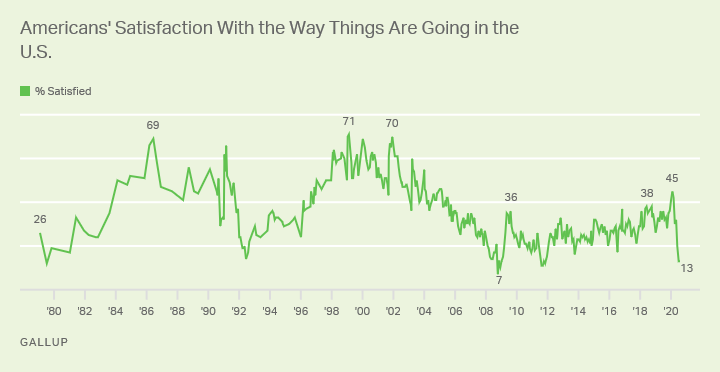
The numbers under Trump are awful. Americans are traumatized by his leadership and incredibly dissatisfied with the way things are going.  Trump is going to tell his loyal followers what he tells them about all facts: these are fake. He's going to tell the swing voters, these numbers are Biden's fault.

Image

The number of people who believe him is the most important number of all: that will determine in which direction these numbers go during the next four years.

05 May 2020

Why Trump is Re-Opening the Economy (And Why It Will End Badly)

You might be wondering why Trump announced the dissolution of the COVID task force on the day that we passed 70,000 deaths nationally. Every 3 to 4 days, another 10,000 Americans die. So why shift the focus to re-opening now?

He's got an election and he's trailing badly in the polls. How badly? Hoover is the last incumbent to trail by such a large margin. Trump has to turn things around and wants to look like he's addressing the economy before Friday's numbers come in.

Friday we will learn how many jobs were destroyed in the last month. It will be millions, dwarfing any previous month on record. The talking points for every politician and reporter will be, "Is this virus costing us too many jobs?" You watch. The fact that Trump shifted to reopening will actually make his poll numbers go up a couple of points.

But of course the virus could care less about his poll numbers. It will simply exploit more opportunities to spread as the country re-opens. Meanwhile, it will be tough to get people to shop, dine out, and mingle like they did in 2019 while the number dying is actually accelerating. Trump loves PR but hates actual executive responsibility. The PR boost he'll get for pushing to re-open the economy will fall as people realize that his impatience has given us the worst of both worlds: high death rates AND economic contraction. No healthy economy is going to emerge atop rampant spread of and fears of illness.

19 April 2020

A Post-Pandemic Stimulus Plan to Quickly Create Jobs


Adding to the trauma of deaths, illness, layoffs, and social isolation, at the end of this pandemic we will find ourselves with tens of millions unemployed. Without quick, bold policy initiatives, the post-pandemic economy will create even more trauma. The millennials in particular – a generation that began its career in the aftermath of the Great Recession and now face this economic wreckage only a decade into careers – are going to be badly hurt by this.
Unemployment has longer lasting negative impacts than does divorce, being widowed, or being laid off.[1] It’s traumatic and ruinous to someone’s long-term economic prospects and any policy we need to adopt to address tens of millions who are unemployed has to account for this.
What would quickly employ people and stimulate wage and productivity growth? Doing for entrepreneurship what policymakers did last century for capital and labor. That is, invest boldly, at unprecedented levels.
Prices tell you what markets think is abundant and what is scarce. Capital and labor aren’t scarce. Entrepreneurship is.
Proof that capital is no longer scarce is simply this: the price of capital has gone negative. How unusual is that? The Dutch have records on bond sales that go back 500 years. In all that time they never had negative interest rates until just a couple of years ago. Growing affluence means that there are more investors than ever looking to build portfolios. (And hundreds of millions more reliant on markets through investments in pension funds.) Because of this, trillions in capital move around the globe in search of returns.
Education seems to also be providing a lower return than it did half a century ago. The price for college graduates is dropping. The Fed recently reported that a college degree no longer offers a wealth premium.[2] Which is another way of saying that market prices for education – like capital – suggest that it isn’t that scarce. And many millennials, struggling to pay for housing in cities on wages that aren’t terribly higher than those from a decade or two earlier are wondering when their return on a college investment is going to yield a return. It might not.

Once upon a time capital and education were scarce, though, and investing in them gave the country phenomenal returns. A look at what past investments in what was scarce did for wages and job creation suggests what could happen if we make similar investments in what is scarce today. That is to say, to get some sense of what a startup stimulus might do for the economy, we can look at what past investments in capital, education and research did for the economy last century.

In his book, The Rise and Fall of American Growth, Robert Gordon reports that output per hour between 1920 and 1970 grew 2.82% a year. Between 1970 and 2014, it grew only 1.62%. If wages had grown at 2.82% between 1970 and 2019, median income would have been $88,000 rather than the $48,000 it actually was. Compounded over a lifetime, a difference of 1 to 2% is huge. You don’t get returns without making investments, though.
During World War 2, the government invested billions in capital equipment for factories building wartime equipment. Between 1940 and 1945, consumption of capital rose from $19 billion to $116 billion[3], much of that coming from the government.  Additionally, it sent experts on production and management – consultants like W. Edwards Deming and Peter Drucker – to help companies make best use of this capital.
The result was dramatic. On D-Day, June 6, 1944, the Germans could deploy only 319 aircraft. The United States and its allies deployed 12,837. American manufacturing was more powerful than a Nazi blitzkrieg.
When the war was over, the government let companies keep the manufacturing and intellectual capital it had funded. Rather than make tanks and planes, they began making cars and TVs – at rates as impressive as the preparation for D-Day.
Next, the government invested an unprecedented amount in education. Between 1944 and 1949, BA degrees conferred rose from 126,000 to 432,000. The rapid rise in the creation of knowledge workers was essential to the emergence of the information economy.
Finally, the government spent more on R&D, funding agencies like DARPA and the NSF. The innovations resulting from this research – as varied as the internet, communication satellites, and genetic engineering –helped to create hundreds of new technologies, thousands of new products, millions of new jobs and trillions in new wealth. Most R&D investments fail to generate any return. The ones that do, though, continue to compound over time to create value that dwarfs the initial investment. (In this way, investment in R&D is very similar to investments in startups: most fail and the few that succeed generate great returns.)

A startup stimulus could do two things. It could quickly create hundreds of thousands – even millions – of jobs. And it could yield returns as dramatic as the long-term returns to education and research made after World War 2.
While the price markets pay for capital and education seems to be falling, the the price of entrepreneurship – wealth created by successful entrepreneurs – is high and still rising.
In 1987, when he was 31, Bill Gates became the youngest self-made billionaire in history. About a generation later, in 2008, Mark Zuckerberg became the youngest self-made billionaire at age 23. Investments in entrepreneurship could offer high returns.
Big investment in startups – entrepreneurship – will pose as many challenges as big investments in education, research or infrastructure did for past generations. Anyone who knows how difficult it is to identify good startup ideas or to launch a company from scratch will realize that a startup stimulus will be at least as difficult as figuring out how to ramp up production in 1944 to complete one plane every five minutes, launch fifty merchant ships a day, and finish eight aircraft carriers a month. Or land on the moon or launch communication satellites. It won’t be easy but it will yield a great return.
This is a big challenge that promises a big reward. A hundred billion dollars could fund 50,000 startups that employ 700,000 people for 18 months; a half a trillion would fund about 250,000 startups and create 3.5 million jobs. There would be no question about whether a startup stimulus would create jobs. It would be designed for exactly that. We could begin funding startups even as people still shelter-in-place and – depending on how bad unemployment is – adjust the scope of this startup stimulus up or down.
Americans hit by this pandemic could quickly return to work. Rather than a gap in their resume and a hole in their savings, they would get valuable work experience and savings. The trauma of long-term unemployment would be mitigated and their lifetime earnings, productivity and wealth would be greatly different.
What would we get for our return? Tens of percent of these startups will fail as soon as their guaranteed funding is gone, but they will have provided employment at a critical point in the recovery. Tens of percent are likely to continue beyond their window of guaranteed funding for another year or three. Many will become great, viable companies. A few will even become iconic companies, the GE, GM or Apple of their generation. Successful companies mean better products and services for all of us, higher wages and more wealth.
Additionally, all sorts of unexpected benefits came from aggressively investing in capital, education and research. The NSF didn’t start with the idea of genetic engineering or a computer smaller than a pocket protector. The same will happen with great investments in entrepreneurship. As more people become more adept at entrepreneurship, as more communities can at will create new companies able to create jobs and wealth, economies will become more prosperous and less subject to long-term sluggish growth that breeds cynicism and helplessness.
Bold investments in entrepreneurship will not only immediately create jobs but could trigger a steady rise in productivity and wages at least as strong as that of the American economy before 1970. The short and long-term potential of such policy is huge. So is the risk of doing anything less.

Ron Davison lives in San Diego County, wrote The Fourth Economy: Inventing Western Civilization, and helps team within Fortune 500 companies and startups to accelerate product development. @iamrondavison

16 January 2020

Is the Future Non-Factory Jobs? (One Way to Understand the Jobs Numbers for Manufacturing)

Each month bls.gov releases the new jobs numbers. "The economy created 130,000 jobs last month." The technical title for this jobs number report includes the phrase, "nonfarm." Farming is such an insignificant and volatile portion of the nation's workforce that it is excluded from the official record of new jobs created or destroyed.

Once upon a time, farming was hugely important. Now it is not. We may eventually say something similar about manufacturing jobs.

The other day in the airport, I struck up a conversation with a guy from Wisconsin. He told me that his dad was one of 11 and his mom was one of 4. All 15 of that generation (we're talking about folks who started careers in the 1950s) were dairy farmers. There were 64 cousins in his generation. Of those, only one is a dairy farmer and he's going bankrupt. (This cousin has only hundreds of cows; the dairies that are surviving are big businesses with thousands of cows.) Nobody in that group of cousins is encouraging their children to prepare for life as dairy farmers.
Manufacturing jobs as a percentage of the total workforce are now where farm jobs were in 1963: 8.4%, suggesting that manufacturing is running about 60 years behind farming. Defining factory jobs is harder than defining farming jobs, though. I've seen a note at BLS.gov to the effect that an increasing number of jobs in manufacturing fall into the category of knowledge work. Programmers for the robots and process design experts are among the folks who now fall into the category of manufacturing; a decreasing percentage of the folks in manufacturing are not working on production lines as we classically envision it from pictures of the 1950s. They are as much a part of the information economy as are the programmers and analysts sitting in cubicles for software or service companies.

Of late I've seen an uptick in our consulting for projects that are production line transfers. The vast majority of our work is with companies developing new products. These production line transfers have literally gone from zero percent of what we do to about 10%.  What does it mean to transfer a production line? A factory line in, say, Pennsylvania is being transferred to Monterrey, Mexico. The savings are huge and irresistible and when the transfer is done, the US has fewer manufacturing jobs.

Trump has defined his presidency in large part by two things: radically slowing immigration and bringing back factory jobs. Immigration has dropped under his watch. Initially, factory jobs rose as well but there is a problem with that.

His sudden imposition of tariffs made domestic sources more favorable and seemed to have raised the percentage of jobs created in manufacturing to meet this uptick in demand. The problem is, though, that supply chains are complicated. If I bought cheaper steel from China to manufacture a car, say, a tariff on Chinese goods may cause me to shift over to an American supplier of steel within a month or so. Short-term, that would raise the number of manufacturing jobs. But given that ultimately I need to compete on the global market, this need to pay more for a key input might cause me to make a more dramatic change over the next year; I may shift my entire production line out of the US to where tariffs don't distort input costs and threaten my profit margins. Short-term, the tariffs may raise manufacturing in the US; longer-term, they may drive it out. And that seems to be what is happening.

When Trump was sworn in, manufacturing was 8.4% of the total workforce. As a percentage of new jobs created in the prior 12 months, that rose above 10%. For nearly a year. During the last twelve months, though, it has dropped to about 2%. During the last twelve months, manufacturing jobs as a percentage of new jobs created is about one-quarter of what it was when he took office.


This is not something to celebrate or to mourn. This is simply a fact. Once upon a time we were in an agricultural economy and children grew up expecting to work on farms. Decades later, that expectation shifted from farms to factories. A good society prepares its children for jobs that will keep them employed at good wages, though, and cares less about whether they will work on farms in factories or in cubicles or in the home office than if they are making good wages. A bad society forces traditions on its children and tries to prepare their children for jobs that were suitable for their grandparents but not for them.  It's not an agricultural or industrial economy any longer.

It is true that there are problems with the information economy and some evidence that we're getting diminishing returns from encouraging more children to get college degrees to prepare for work. That said, children are much more likely to grow up to work on a laptop than they are in a factory or on a farm. Promising to bring back factory jobs is like promising to make your skin look younger; it may work for a time but the long-term trend is against you.

24 August 2019

Contrasting the Districts that Supported and Opposed Trump: It Comes Down to a Divide Between Industrial vs. Information Economies

Nerd that I am, I collected some data on the 15 congressional districts where Trump won the largest percentage of votes and the 15 districts where he won the lowest percentage of votes. 30 districts out of the 535 lets us look at the contrast by looking at extremes.


The biggest difference is the ratio of folks with Bachelor's degrees or higher to the folks employed in manufacturing. (I still don't know of a simpler proxy for knowledge worker than a Bachelor's degree.)

In the least Trumpian districts, the ratio of folks with college degrees to folks working in manufacturing is 6 to 1. These are districts in the information economy. Not only are they more likely to be knowledge workers than factory workers but they create more jobs. There are 43 jobs for every 100 people living in such districts, 1.5X as many as found in the most Trumpian districts. The information economy is still growing even as the industrial economy shrinks. This not only explains the fact that districts in the information economy have more jobs but likely explains why they're 4 years younger, on average. The regions creating the most jobs are going to attract more people starting their careers.

In the most Trumpian districts, people are 3X more likely to work in manufacturing and household income is $22k lower. These are related. Generally, folks with a degree make about $22k more than folks without one.


Trump is the warrior chief for the folks in the waning industrial economy. It is just one of the ways that he is the opposite of Lincoln, the GOP's first president. In 1860, the industrial economy was cutting edge. Today it is on the wane, being eclipsed by the information economy just as the industrial economy eclipsed the agricultural economy during the time of the first Republican presidents. 

29 January 2019

Wage Growth After the Great Recession

In numerous posts I've argued that the first half of the teens (the years from 2010 to 2019) would repair the unemployment rate and the second half would repair wage growth. Stats on wage growth 2009 to 2017 help to illustrate that. First we have to get unemployment down and then wages start to grow.

From the end of 2009 and 2015, unemployment fell by half, from 9.9% to 5.0%. Since then it has continued to drop but 5.0% gets unemployment within fairly normal boundaries. (This century, unemployment has been over 5.5% about as often as it is below 5.5%, so 5.0% is pretty good.) At that point the labor market has tightened enough that employers have to offer higher wages and can't simply hire folks from among the unemployed.

You can see the sharp rise in the rate at which incomes began to rise since 2015 here.


Last week with a client in Orange County, I was with an executive team. The head of HR told me that two big changes in the last year are passive recruitment and a new California law that bars employers from asking what you made in your last job.

Demand is high enough for employees that companies increasingly recruit people who are not looking, a process they call "passive recruitment." A lot of this recruitment happens within LinkedIn.

Also, last year California made it illegal for employers about to offer you a job to ask what you made in your last job.

The consequence of these two phenomenon are that there are a chunk of people who are getting very cool raises by changing jobs. Across the country, household incomes are rising at their fastest rate since the Great Recession.

More broadly, though, low unemployment rate simply means more upward pressure on wages. And wages are now rising at a healthy rate and will continue to rise as long as the economy continues to create new jobs at this rate.

That's very cool.

Take note, though, that politicians trying to make the case for change will point to older data and argue that wage growth is not keeping pace with inflation. Senator Kamala Harris argued this week that wages are not keeping up with the cost of living. That was true early in the decade when the unemployment rate was higher than average but is no longer true.

We're going to hear a lot of nonsense about what policy changes we need but we need to be clear about why wage growth was so sluggish. We had a Great Recession. What are the implications? Regulate financial institutions so that they do not blow up the economy. The problem is not the economy the problem is its vulnerability to financial mischief. Just like sports competition is enhanced by good officiating, so is business and finance competition. The American economy is still a great game; it's just that we can't expect good results when we've put blindfolds on all the refs. 

06 January 2019

Two Lies to Support the Border Wall


In the late 1990s, illegal border crossings peaked. It was a crisis of near-apocalyptic proportions as immigrants streamed into the US in record numbers.

Wait. Wait. No. That did not happen.

In the late 1990s, illegal border crossing peaked. That's true. It's also true that from 1997 to 1999, the American economy created 3.2 million jobs per year (that's 824k more jobs a year than the economy has created in the last three years). Violent crime had fallen by a third from early in the decade. It was no crisis. No apocalypse. 

And illegal border crossings were 5X what they are now. 5X.

So, two lies in the claim that our current situation is a crisis for which we should close the government. The first lie is that illegal immigration is now high. It's not. The second lie is that illegal immigration drives a spike in unemployment and crime. It does not. 

04 January 2019

Job Creation and Market Returns for the Last 49 Years

This uses the compound annual growth rate (CAGR) calculation from the first to last day of the decade for the S&P 500 and simply averages annual job creation during each decade (using the first 9 years for this decade).


During the last half of the 20th century - 1950 to 2000 - CAGR was 9.4% a year. That's almost exactly what it's been this decade. But with the train wreck of the oughts, so far this century CAGR works out to 5.6%. So I guess one question is whether we'll ever make up for the last decade or whether the job and stock market just continue at the rate they were before it. Is that potential lost or still waiting to be realized?


My Report Card on the 2018 Economic Forecast

In December of 2017, I wrote an economic forecast for 2018. I got the stock market prediction right and the job creation forecast wrong.


2017 was a great year for stocks, the SnP 500 up 19.3%. Simply put, I thought that stocks would not do as well for two reasons: Trump's first year, nearly trillion dollar stimulus would not be repeated and after 8 years of recovery it seemed to me that folks had forgotten that the Dow is always just one keystroke away from down. That said, it seemed unlikely that anything catastrophic would hit before year end so I estimated a downturn of only 5% to 10%. It would be tough to land more precisely in the middle of that range, so I'll give myself an A+ on that metric.

I forecast that the job market would slow this year. I'm delighted to be wrong on this score and the economy created a stunning (particularly for 99 months into a recovery) 2,638,000 jobs. Mostly I was bitten by the wrong assumption about labor force participation rate.

Labor force participation rate (LFPR) rose 0.4% during 2018. In the last decade it has fallen closer to an average of 0.4% and had only once in the last decade risen more during the prior twelve months. If LFPR had been flat, the economy would have created 2 million jobs; if it had fallen by 0.4% as it has during the last eight plus years of the recovery, the economy would have created only 1.3 million jobs rather than 2.6 million. That's pretty close to my forecast of 1 million. (No, I don't recall why I failed to provide a range for the job creation as I did for the other two forecasts.)

And of course my assuming that the unemployment rate would rise by a couple of tenths of a point rather than fall by a couple of tenths compounded by forecasting error as well. Had the unemployment rate finished the year at 4.1% instead of 3.9%, job creation would have been lower by about 300k, which - combined with a typical fall in labor force participation rate - would have meant that I'd had hit my one million jobs created as precisely as I'd hit the SnP 500 forecast. But I didn't. 

This job market is amazing and I'm not embarrassed to have assumed that it would become more normal in 2018. That seemed reasonable. Again, given what it means for household incomes and wealth creation, I'm delighted that job creation continues to be so strong. 99 months of uninterrupted job creation is more than double the old record of 46 months set in the late 1980s (and triple the late 90s dot-com boom of 33 months). This is a fabulous way to miss a jobs forecast. Creating 2.6 million jobs with the unemployment rate under 3% is a wonderful kind of madness.

My forecast was good for the economic metric that was bad (the stock market) and was bad for the metric that was good (the job market). I'm sure that means something but I'm not sure what.


16 July 2018

Gales of Creative Destruction and the Stress of Progress

Since Oct-2010, the US economy has destroyed 475.6 million jobs (layoffs, retirements, firings, quits) and created 494.2 million jobs for net of 18.5 million jobs.

As of June, the labor force was 162.1 million.

So during the 8-year recovery the American economy has created 3X more jobs than there are people in the workforce and destroyed 3X more jobs than there are people in the workforce. 

244,000 jobs were created in May. More precisely, 5.8 million jobs were created and 5.5 million jobs were destroyed for a net of 244,000. It is not true that everyone kept his or her job except for 244,000 people who were newly hired. Every month people are laid off, fired, quit or retire; in May, 5.5 million people had such experiences. That's a lot of elation (those who retire), relief (those who quit), frustration and panic (those laid off and fired). We talk a lot about taxes but an economy this dynamic is emotionally taxing.

One of the challenges of the modern economy seems to be that given progress comes in the form of gales of creative destruction we have a high level of stress. Personally I think that just reinforces the necessity of things like universal healthcare, investments in job retraining and generous unemployment, etc. But regardless of the solution you'd advocate, you have to realize that anyone whose idea of the good life is a stable, predictable career is going to feel a continual level of stress and unease by progress.

Two things can be simultaneously true: we are creating better jobs and a lot of people end up with worse jobs. There are probably as many people laid off from manufacturing jobs paying $45,000 a year now working at Wal-Mart for $25,000 as there are people with new programming jobs making $75,000. (And of course that very dynamic is part of why median wages move upwards so slowly and why income inequality is increasing.)

This economy is wonderfully creative but it is increasingly disruptive. Entrepreneurship and social invention creates the new and obsoletes the old just as innovation does with products. We used to have marriage between one man and one woman and now we have same-sex marriage and polyamory. We used to have jobs with pensions and 40 hour workweeks and now we have 401(k)s and a gig-economy that offers us Uber-like jobs with both more freedom and uncertainty. We used to have an American economy and now we have NAFTA. If you find comfort in continuity you will actually find progress threatening because so often it forces us to act or be different. 

Innovation changes products while entrepreneurship and social invention changes people. That's unsettling.

It seems to me like the divide that doesn't get talked to enough is the divide between those who embrace progress and all its novelty and those who embrace tradition and all its familiarity. To the latter group, progress can actually feel like a threat.

07 March 2018

How Apps, Entrepreneurship and a Steady Boom Have Brought Unemployment Claims to an All-Time Low

The Facts

The 4-week moving average of initial unemployment claims is at an all-time low.

In raw numbers, it was actually lower in 1969 but at that point the labor force was exactly half (well, okay, 50.7%) what it is now. So as a percentage, it has never been lower in recorded history.

This statistic is a measure of how many people walk into an unemployment office to say, "I've lost my job and don't have another one to go to."

In April of 2009, 658,000 people filed for unemployment each week. That was the worst of the Great Recession. October of 1982 was even worse, with 671,750 walking into unemployment offices around the country during a single week.

But the American economy is always shedding and creating jobs, at a rate of about 2 million per month. It's remarkable that such a small number of folks laid off or quitting one job don't end up in an unemployment office before they get their next job.

The week of 24 February, only 220,500 people filed initial unemployment claims. The last time it was lower was 27 December 1969 - nearly 50 years ago - when it hit 219,750. As a percentage of the labor force, though, that 1969 number equated to about 1.1% of the labor force showing up in an unemployment office during the month whereas this latest number suggests only 0.5% of the labor force filed for unemployment in the month. It's a stunning number.

The Theories

The most obvious explanation is an uninterrupted rise in jobs created that has now gone on for 88 months (and counting). Every month that results in more jobs created than destroyed means that many fewer people unemployed or unable to find a job. I think there is more to even than that, though.

Simply put, the economy has never been more efficient at creating new jobs and then matching unemployed people to those new jobs. I don't know why but I have a theory that it is because of apps and entrepreneurship.

Uber, Lyft, Mechanical Turk, PostMates, and other apps quickly match people to tasks they can do. Even the websites like Monster, and Indeed have accelerated the time it takes for employers to find qualified employees to hire. Some apps quickly find someone to perform a task; other sites accelerate the time it takes to find a new employee.

Once upon a time, in small communities, you knew that Todd could help carry heavy loads and Melissa could repair fragile things. You could easily find help and they could find work. As the world got bigger and more advanced, it became harder to know who could program in Java vs. C, or who could design period-furniture and who could repair modern furniture. It took a long time for the unemployed to find jobs and for employers to find help. It would take months to find the right person for a job and for tasks that might take only minutes or days, you might never find a match. There was a lot of friction in job markets even a decade ago.

Now software lets a person who wants to drive you to the airport find the person who wants a ride to the airport within about 15 minutes. It's easier than ever to find a match and this makes for nearly friction-less labor markets. This means that more people are downloading an app to make money (I know, to qualify as an Uber driver is not as easy as downloading an app) rather than waiting for a person to hire them. One result is a lower number of folks who file for unemployment.

Another element is increased levels of entrepreneurship. It is easier than ever to start or expand a business. Once upon a time you had to get loans to buy a store or build a factory to start a business; now you can fund a software startup with six laptops. More than half of American employees now work at least part of the week at home. This suggests that the overhead for office space per person is dropping, one less barrier to starting or expanding a business. (I know. It's not THAT cheap or simple. Still, even renting a cubicle is cheaper than setting up a factory.) A great number of employees are hired as contractors; some because that is now how corporations are engaging employees and some because that is an increasingly common way to put someone through the equivalent of a probationary period. There is less commitment and expense in "hiring" an employee and thus less hesitancy to do so. Employees still face a great deal of uncertainty about particular contracts or income levels but less likely to go long stretches without some kind of income.

In this way it's a bit like the move from a bank account that offers 3% annual rate vs. a stock that could rise or fall 30% in a year. Income will fluctuate more but employment will not. People are less likely to turn to unemployment insurance than to another job or task that could mean a temporary rise or fall in pay. If not already, I suspect that fewer people will look back at the last ten years of employment as a steady rise of 4% in annual pay and will instead see rise and falls more akin to the performance of a 401(k).

What It Means

One thing that no one would suggest, though, is that the Uber drivers are fine with just their cars and Uber app. Among other things, they need roads to drive on. Why mention this obvious thing? As the economy and information systems become more adept at matching supply and demand, it's important to support the infrastructure that makes it work. In this case, it's not just roads. People who are more likely to be getting their income from contract jobs and apps need things like universal healthcare to replace the standard benefits once provided by corporate employers and job training programs to make them steadily more productive. The good news is that these more efficient markets will mean less reliance on government unemployment insurance; the bad news is that more tenuous income streams suggests a greater need for things like government health insurance and education.

Another implication of more efficient labor markets is the very real possibility that the natural rate of unemployment has dropped. The ideal rate of unemployment would not be zero for the simple fact that finding a great fit between employee and job is not an instantaneous process. Given it takes a little while to find a great match, it makes sense that somewhere between 2 to 5% of the labor force would be unemployed at any given time. If it is true that it's easier for people to find work, it makes sense that this rate has gone down. What that means is that if string of uninterrupted job creation continues another 6 to 24 months, the unemployment rate could approach 3%. [I've already forecast about a 33% chance of a recession but if that doesn't hit this year, unemployment could steadily trend downwards.]

In all, more efficient labor markets is yet another great sign of progress. It doesn't mean that business cycles are over but it does mean that in any given month fewer people face the prospect of unemployment. That's pretty cool.

06 February 2018

Shout it - Yellen was Flawless at the Fed (Hopefully It Won't Be Another Century Before Another Woman is Fed Chair)

This Monday was our first day with Janet Yellen as Fed Chair in four years. The market marked her departure with the biggest ever one day drop in the Dow. Now that's a send off.

The job of Federal Reserve Chair has become more important since Congress has become more dysfunctional. In an ideal world, the government has a mix of fiscal and monetary tools to use to help to smooth out the inevitable bubble and busts of an economy. Now we really have just monetary policy, the tool of the Fed. In the recovery from the Great Recession, when unemployment was still above 8%, the media and Republicans made a great deal of noise about deficits. Now that unemployment is only 4.1%, the Republicans have decided to add another trillion to the debt this year with no noise from Republicans (they're the ones creating this) and very little noise from the media. This is backwards and the Fed has had to work against Congress in their efforts to keep the economy from extremes during the recovery. Yellen has done that flawlessly.

For 100 years we had Fed Chairmen. Then, four years ago, Obama appointed Janet Yellen to succeed Ben Bernanke as Fed Chair. Here is how the economy has performed during her four-year term.

The uninterrupted streak - a new record
When Yellen took over as Fed Chair, the American economy had been creating jobs every month for 40 months. That's great but on two different occasions, the streak had lasted longer: 46 months in the mid-2000s and 48 months in the late 1980s.

Not once did the jobs report come in negative during her time as Fed Chair. The streak is now 88 months and counting; she set a new record each month for the last 40 months of her tenure, shattering the old record and bringing the unemployment rate down from 6.7% to 4.1%. No other Fed Chair presided over a time in which every single monthly jobs reports was positive.

Second best annual job growth
Uninterrupted job creation makes it easier to create a lot of jobs. During her four years the economy did. Only one Fed Chair - Miller who served for only 17 months during the 1970s - presided over a higher annual average job growth.  (And wasn't it curious how the media continued to whine about so-so job creation rates, as if they had any instances of it being better during a four year or longer Fed term?)

Second best annual rate of stock market return
The market returns during her tenure were also second to only one other Fed Chair - Volcker. It seems fitting that the market began falling spectacularly after her last meeting Wednesday and before Powell's first day of work Monday. (Speaking of which, Powell did have a miserable start in his first two days. After Monday's huge sell off, the market return for his first day worked out to a 99.9% annual return which would have made him the first Fed Chair to have lost the entire stock market in his first year on the job. "Where are the returns Jerome?" "I don't know. Yellen seems to have taken them when she cleared out her desk.")

Lowest Inflation
The Federal Reserve has two goals: keep unemployment and inflation low. No one presided over lower inflation rates than Yellen. The goal is 2%. Her highest year was 2.1%. Only Bernanke - who was dealing with horrendous unemployment rates - was close to her and most Chairs were more than double that.

Trump, unsurprisingly, decided that Yellen's performance wasn't good enough to warrant a second term and thus hers will be the shortest term of any Fed Chair since 1979 when Carter decided that inflation was too high and he needed to truncate G. William Miller's term and replace him with Volcker.*

Of course it was unsurprising that Trump would replace Yellen. In Trump's final campaign ad, he lumped Yellen with Clinton, Soros and other world leaders as "globalist" financiers "who don't have your good in mind."

As it turns out, for a woman who didn't have our good in mind, she did pretty good. I'd go so far as to say that her performance was flawless. Let's hope it's not another century before a president has the good sense to appoint the second woman to head the Fed.

----------------------
*(It's worth noting that when Carter interviewed Volcker for the job as Fed Chair, Volcker warned him that his approach to squeezing out inflation would hurt the economy short-term and about the time Carter was running for reelection the economy would be in bad shape. Carter said, But this is what we need to do. And sure enough, in November of 1980 when Americans elected Ronald Reagan to take Carter's place, unemployment was at 7.5% and continuing to rise.)


18 December 2017

Ron's Economic Forecast for 2018 - Highest Probability of a Recession in 8 Years

A Chinese recession? A bumbling Fed Chair? A downturn in stocks? Your blogger predicts a 33% chance of bad news for the American economy in 2018.

THE LAST SEVEN YEARS
As we were coming out of the Great Recession, people continued to fixate on threats. When you've been beaten you flinch even when someone raises a hand to wave at you, so this makes sense. The Great Recession was awful and it left people anxious about what might happen next. I've reported it before but it bears repeating: in the decades before and after, the economy created an average of 2 million new jobs each year: in the oughts, from 2000 to 2009, the economy did not create jobs but rather destroyed an average of 100,000 jobs per year. Rather than create 22 million jobs, that decade destroyed a million jobs. Just consider what a shortfall of 23 million jobs in a decade means for a moment.


In light of that, it only makes sense that early in this decade people were so aware of what all could go wrong that they lost track of what all could go right. I was cautiously but unrelentingly optimistic about the economy throughout the recovery and it has gone well; now the unemployment rate could soon fall below 4% and the S and P 500 is up nearly 4X (well, 3.6X) what it was when the market bottomed out in early 2009. Even last year, after the election of Trump, I put aside my disbelief and repugnance in his presidency to predict that he would likely preside over another great year for the economy. 

Now, for the first time since the end of the Great Recession, I'm pessimistic about the economy. It seems as though that 8 years of good have distracted people from the fact that bad things, too, can hit. Just as 7 years ago most people seemed skeptical that things can go well, most people now seem skeptical that things can blow up.

PERCEPTION AND POLICY
One thing that I've learned is that people mostly don't distinguish between the state of conditions (e.g., we have high or low unemployment), the rate of change in conditions (e.g., the unemployment rate is dropping) or the rate of change in the rate of change (e.g., the economy is still creating jobs but at a slower rate). Obama took office as the Great Recession was at its worst and to this day many people associate him with that state of terrible unemployment. Trump took office when the economy was mostly recovered and many people now associate him with that state of wonderful employment. I do believe that policy makes a difference but the most obvious complicating factors are simply this: it takes time to get policy passed, it takes even more time for that policy to impact the economy, and easily the clearest instance of when policy makes a difference is during a recession. Simply put, there are a variety of theories about how policy changes long-term economic conditions but the causation lag is long and filled with uncertainty. (For instance, most people would agree that early childhood education and wellness programs are positive but assuming those are targeted at kids under 7, it'll be half a century before those children reach their peak earning years and any number of complicating factors - from wars to the popularization of computers or robots - could exacerbate or mitigate the impact of this early childhood intervention. In any case, it's safe to assume that the president and members of congress who instigated such policy would be dead by then and most people will have forgotten them and their policies.)

And a further complication is that about two-thirds of Republicans and a third of Democrats can't see the good when the other party has the White House. 

WHAT IS POSITIVE
Debt levels in the US are relatively low; as a percentage of GDP, federal debt is up about ten percentage points, corporate debt is up about six percentage points and household debt is actually down about five percentage points in the last 5 years, making for a net change of about 11 percentage points. With less reason to pay down debt in 2018, households, corporations and even the government have reason to continue with - and potentially even increase - current levels of spending. This should have a positive impact on future spending.

Unemployment is 4.1% and has now been below 5% for two years. The impact of sustained low levels of unemployment not only include the fore-mentioned debt pay down but great increases in net worth. One of the most extraordinary statistics from the recovery? The net worth of households is up $42 trillion since the depth of the Great Recession and up $30 trillion from its pre-recession peak in 2Q 2007. When people are collecting regular paychecks they're able to save and invest in homes and stocks. This, too, is promising for 2018.

Further, as unemployment stays low companies have to offer higher wages to attract workers. Wages are growing. As an anecdote, at Thanksgiving we were with three young women all in their early thirties; within the prior four months all three had accepted new positions (two at new employers) for raises ranging from about 15% to 100%. This is the kind of thing that happens when unemployment threatens to drop below 4%.

Further, the Republican tax plan looks to be front-loaded in its impact. Some indications are that it will stimulate the economy the most in 2018 and then slightly less in each of the next few years. It has the potential to add another one percentage point to GDP growth in 2018; that impact is huge.

Finally, the popularization of entrepreneurship - the essence of my book The Fourth Economy - is continuing. Economic policy at the regional level is increasingly focused on entrepreneurship programs within universities and emulating Silicon Valley's success. (None of that will be easy but even mediocre efforts at things that matter a great deal pay off more than extraordinary effort on things that matter little.)

This is all great news and the most likely thing is that it will translate into another great year.

There is about a 67%  chance that the stock market will again rise by double-digits, unemployment will drop below - and stay below - 4%, and wages will rise faster than they have all century. 2018 could be one of the best years since the late 1990s and will likely start out that way. Among other things, this would mean a rise in household income at every level, including median and lower-income and not just those in the top 1 to 20%.


WHAT IS WORRISOME
There is about a 33% chance that the economy turns down in 2018. That turn would probably start some time between May and October.

There are a few reasons that it may turn down: China, a new Federal Reserve Chairman and monetary policy, Trump, and the nature of business cycles.

BUSINESS CYCLES
There are two common measures for these cycles: unemployment rates and the stock market. Sometimes an economy is creating jobs and wealth and sometimes it is destroying them. Since 1900, the US has had 23 recessions, including the Great Depression that began in 1929 and the Great Recession that began in 2008. The length of those downturns has varied from 6 months (the shortest period of downturn that can qualify as a recession) to 43 months (the Great Depression in the early 1930s).

If you were plunked down into a random month between January 1900 and December of 2017, the odds that you'd land in a month in which the economy is suffering from a recession is roughly 24%. Of course Keynesian economics made great advances in the aftermath of the Great Depression and since then the odds of any given month being in recession are 14%. (In the 33 years leading up to the end of the Great Depression, the odds of you landing in a recession plagued month were 48%.)

Curiously, the odds that you would have a month since 1948 in which the unemployment rate is as low - or lower - than it is now is 15%, nearly identical to the odds that you'd be in a recession. The odds that the unemployment rate is 4.1% or lower is the same as the odds that it is 7.4% or higher. (Which is to say that most - about 70% - of the time the unemployment rate bounces around between it's current rate of 4.1% and 7.4%.)

Why does the economy rise and fall? It's because good optimism eventually becomes bad optimism. The economy is bad and someone is optimistic enough to start a business that depends on rising sales. Their optimistic bet pays off, they get rich, and that optimism fuels more optimism. More businesses are started, more stocks bought, more employees hired ... and the economy expands. There comes a day, though, when the optimism is unfounded. New businesses fail at a little faster rate, old businesses expand more slowly or even contract, and the economy begins to destroy jobs and wealth. Now, pessimism is the wise bet and companies layoff and investors hold onto their money. In a bust the pessimists become the leaders. Until the cycle starts anew, as it has a dozen times since the end of the Great Depression in 1933. The booms help to create new things and the busts help to destroy the old; between them job and product markets transform over time, and what we buy and what we do for a living radically changes over a lifetime.

Why mention this? Well, if we're just betting on probabilities - putting aside reasons for optimism mentioned above - there is an 85% chance that unemployment goes up from 4.1% and only a 15% chance that it goes down from there. This claim is less scientific than simply based on data since 1948. Again, the unemployment rate of 4.1% or lower occurs only about 15% of the time. The next month we draw out of the hat is more likely to be higher than lower. Let me be clear: many of the fundamentals suggest that the economy will continue to do well in 2018; that said, economies do not expand without interruption and the odds that it will falter, that unemployment will tick up, are never zero.

Similar for stock prices. Since 2000, stock prices have fallen in five years, or 29% of the time.

ANOTHER REASON TO WORRY? TRUMP
Worst case, his stupid ideas become bad policy. It's not clear that anyone in the Republican Party will resist him and he has at least another year to run with a Republican led House and Senate. If he signs legislation that leads to the deportation of millions of illegal aliens, we'll have a recession. If he manages to jettison NAFTA, we'll have a recession. If he cuts funding for research, per capita GDP growth will slow and the steady increase in life expectancy that we've enjoyed for more than a century could stall. 

And of course the Mueller investigation could result in a number of Trump's administration - even Trump himself - facing charges that could force his resignation or even imprisonment. While the final resolution - him in jail or remaining in the White House with Mueller's investigation finally concluded - could stabilize or even rally markets, it's hard to imagine that in the space between when Mueller makes his big reveal and when there is a resolution won't be a time that rocks markets.

In the 10 months before Nixon resigned in the aftermath of the Watergate scandal, the S and P 500 fell 43%.


NEW FEDERAL RESERVE CHAIRMAN JEROME POWELL
Janet Yellen's replacement as head of the Fed (he'll take over in February) is Jerome Powell. I have two big concerns with him: he has no degree in economics and he will be responsible for tightening monetary policy, a delicate operation that can frighten markets.

Work experience - Powell has served in the Fed for years - helps a great deal when it is business as usual. Theory, though, is essential when things change and unlike Yellen and Bernanke who had studied, researched and published on the topics of recessions and recoveries, Powell has never published anything that would suggest he has thought deeply about these topics. The last Fed Chairman to lack an economics degree served in the 1970s but this disregard for expertise is, of course, characteristic of Trump.

The Fed has announced that it will raise interest rates. If it does this too quickly, it slows down the recovery. If it does this too slowly it fuels an asset bubble and / or inflation. Simply put, money pumped into the system helps encourage "real" economic activity (actual investment, consumer borrowing, and hiring) but also drives up prices. People have argued that since the emergence of the World Trade Organization, it is harder for that money to drive up the price of goods that can be imported but instead drives up the prices of assets like stocks and homes. They argue that loose monetary policy is less likely to drive up the price of apples than it is to drive up the price of Apple stock. 

Before the Great Recession, excess reserves in American banks ranged from about $1.5 to $3 billion. As the Fed pumped more money into the economy to counter the credit crash, excess reserves rose to $2.9 trillion, roughly 1,000X more. Yellen has quietly lowered that to $2.3 trillion but there is still a lot of money to pull out of the system. Related, the Fed is finally moving interest rates back up, something that will have a ripple effect on lending and all the hiring, expansion, and spending that accompanies low interest rates.

Unwinding loose monetary policy is somewhat like the game of operation, an attempt to remove something without setting off buzzers that suddenly send markets down or - worst case - cause a contraction in credit and a stutter in hiring or consumer spending. I simply trust a lawyer less than I do academics who have studied these matters extensively. I'd be much more comfortable with Yellen serving another term (as the men have for decades back) than I am with Powell learning this new position during a sensitive time in the transition of monetary policy. He's a risk.

AND FINALLY, CHINA
Ruchir Sharma has been worried about a global recession emanating from China for a year or two. He has a couple of plausible concerns, chief among them the amount of debt China has  recently created. 

Sharma cites thirty instances in which private debt over a 5-year period grew faster than GDP by at least 40 points. (Imagine in year 0 that a country's private debt is equal to 100% of of GDP and in year 5 it is equal to 140%.) In each of these cases, GDP growth fell by more than half over the next five years, occasionally slipping into recession. [See page 300-1 of Sharma's The Rise and Fall of Nations] Sharma is worried about China because over the last five years private sector debt as a percentage of GDP has gone up 56.5 points. It could be that China will escape a downturn as it pays down debt but, again, 30 of 30 countries have been caught in the consequences of rapidly growing debt.

His other concern has to do with a belief in the way business cycles purge the old and create the new. As mentioned, since the US has become the major economy in roughly 1900, it has had 23 recessions. By contrast, in the quarter century since China has begun its great ascent it has had 0 recessions. None. This is a long time to go without market correction.

My own concern with China has to do with my belief in the progress that communities make through four economies: agricultural, industrial, information and entrepreneurial. China - in my opinion - has successfully made the transition from agricultural to industrial economy. Its per capita GDP is now about $10,000, which is one mark for the transition to a new economy. Curiously, President Xi has recently assumed more power than any leader since Mao and is making sounds of a crackdown on dissent. It seems plausible to create an industrial economy coincident with tight government controls; it does not seem plausible to do that with the emergence of an information economy. Simply put, I'm dubious about the compatibility of government control and the emergence of an information economy reliant on knowledge workers who have easy access to information technology and - obviously - information.  I don't know how you create an information economy while limiting access to information. 

China has not only emerged as the second biggest economy in the globe but it has accounted for a huge portion of global GDP growth over the last quarter of a century. If it falters, it will have a ripple effect.

Finally, things happen that haven't been predicted. The price of mortgage backed securities suddenly falls. Terrorists fly planes into the World Trade Center. I've listed a variety of triggers for a recession but it could easily be something completely unforeseen that is the trigger.

THE FORECAST
For now I'm keeping my money in stocks until the end of the first quarter of 2018. I think the market will rise another 3% to 8% by May and the unemployment rate will go as low as 3.8%. Home construction will rise, as will business investment.

I'm worried, though, that the the market will turn down about mid-year, as will job creation. The market could finish the year down about 5% to 10% and while unemployment will still be decent (4%? 4.5%?) job creation will turn negative for the first time in 8 years. The total number of jobs created in 2018 will be about 1 million, give or take, about half what it has averaged during the recovery.

For the year:
S and P 500: down 5 to 10%
Jobs: up 1 million
Unemployment: Roughly unchanged or up slightly to somewhere between 4.0 to 4.5%

Finally, where we are as of when this was published:
S and P 500 is at 2,692.71
Unemployment is at 4.1%

15 December 2017

Your Blogger's Forecast Record for the Last 2 Years - 2016 and 2017

Some years I make forecasts for the coming year. This is a blog so there is nothing standard about what metrics I forecast but here is a recap for the last two years.

2016

I forecast that median household income would finally enjoy a strong rise and forecast it would hit $55, maybe $57k. It hit $57.7k.
I thought residential construction would rise between 10 to 15%; the monthly year over year rise varied from 8 to 13%.
I forecast a rise in personal consumption of 5%. It hit 5%.
I was bullish on job creation, predicting another 12 straight months of uninterrupted job gains that would total between 2 to 3 million. We got 12 moths of uninterrupted job gains and 2.2 million new jobs.
I forecast a rise in the rate at which wages would go up; they did rise more rapidly in 2016 than they did in 2015. 
Finally, I forecast an S&P 500 rise of 10% to 20%. The market rose 9.8%.


2017

Last year, I forecast a smaller number of statistics but predicted a very strong economy. (Prediction is here, A Stimulus, a Boom and White Men Dancing: an economic forecast to the end of the decade )

The forecast starts with:
"First of all, the economy is primed for take-off."
And then,
"The next four years will be great and it's perfectly plausible that unemployment will drop below 4% within two to three years. We might even see the uninterrupted run of positive job creation run out another four years, as absurd as that sounds."
Then, it adjusts for the just elected Trump.
"Short term, Trump changes this for the positive ... bump GDP growth .... driving stock prices up."

I tweeted out just two statistics:
Job creation of 2 million and unemployment just over 4%.

The actual numbers? With a month left we're 84,000 jobs short of 2 million and the unemployment rate is 4.1%. Also, the stock market is up 18.8% for the year with weeks to go.


Next post will be my forecast for 2018.