14 October 2013

San Francisco, Autonomy, and the Transformation of Business: Nathan Heller in the New Yorker

In The Fourth Economy I argue that a new economy is emerging, one as disruptive and transformational as the emergence of the Industrial and Information Economies.  The rise of the individual that transformed religion, politics, and finance will now change business. The corporation early in the 20th century will be transformed as much as was the church during the Protestant Revolution or the State was during the time of Democratic Revolution. 

Changing business to accommodate the individual - giving people more autonomy - is something that Nathan Heller reports on a piece about San Francisco in the New Yorker, Bay Watched: How San Francisco's New Entrepreneurial Culture is Changing the Country

People ... tend to regard success in terms of autonomy—designing your life as you want—rather than Napoleonic domination.“The ecosystem used to funnel lots of talented people into a few clear winners,” he told me that morning. “Now it’s funnelling lots of talented people into lots of experiments.” Why be Gordon Gekko when you could make enough to have a nice place and go paleo on local greens—and then take a day or two off to cycle out to Stinson Beach? Isn’t that freedom more distinguishing than cash or a C.E.O. title, which everybody in your field has access to? San Francisco’s young entrepreneurs appear less concerned about flaunting their earnings than about showing that they can act imaginatively, with conspicuously noble ethics.“The word ‘entrepreneur’ has undergone a redefinition,” Ben Casnocha told me over lunch one day at LinkedIn’s Mountain View campus, down the road from Google. “For a while, it was like you’re either running the laundromat or the coffee shop, or you’re trying to create the next Apple. But there’s been a whole flourishing of people who are starting different kinds of businesses—who are having pride in a small business that gives them autonomy.”

Heller looks at a variety of people who are creating businesses as a means to create a lifestyle, the sort of thing Timothy Ferriss explores in the 4-Hour Workweek.

Philosophers talk about three kinds of goods: goods to have, goods to do, and goods to be. When economists talk about economic goods the assumption is that they're only talking about economic goods to have: products. But as people become more interested in deeper happiness, as they move from a focus on goods to have to goods to do, then corporations too will need to evolve. 
The corporation has rather brilliantly learned how to make economic goods to have and make us want them. But as we have more goods, additional goods (to have) have less power to make us happy. The prosperity that corporations has helped us to attain is beginning to make the focus on goods (to have) obsolete. If so, corporations will have to change work as much as they changed products, shifting their expertise from just goods to have to goods to do. Corporations will be designed to created engaging, meaningful work. 
Curiously, corporations are becoming a more common option for entrepreneurs looking for startup funding. Heller touches on this, 
In recent years, the Bay Area has grown into a hunting ground for “strategic” venture capital: firms under the aegis of big corporations. That’s because funding a startup—maybe with an eye to acquiring its technology and users—has become more efficient than traditional R. & D.

But if corporations want to succeed with these acquisitions, they have to understand this fundamental impulse towards autonomy that has fueled progress and change since the Dark Ages. People want to choose the products they buy when they can afford them. They also want to choose the work they do - and how they do it - when they have the chance. Autonomy does not mean a lack of accountability or license to be irresponsible. It does mean a shift in control, though, and that is something corporations are as reluctant to give up as was the medieval Church.

The West defined itself by a series of institutional transformations. First it was freedom of worship, then political freedom, then freedom to pursue the American Dream through whatever mix of credit and investment a family could obtain from financial markets. Power over religion, politics, and finance has been taken from popes, monarchs, and bankers and given to the individual. The Fourth, Entrepreneurial Economy will do the same thing for business, giving autonomy to the individual as employee.The fact that employees will become increasingly entrepreneurial, as likely to focus on equity creation as product creation, will come to be seen as merely an enabler of this process, not the focus.

For a glimmer of what that future might look like, you would do well to read Heller's article about what's going on in San Francisco.


12 October 2013

Time for a Product Redesign of Congress

Last week I watched Romeo & Juliet at San Diego’s Old Globe Theater. It was considerably changed – new title, new actors, music and lyrics substituted for lines – but it still ended tragically. Which brings us to Congress.

We have a tendency to see personality as a cause of problems when often it is just another effect of a poorly designed system. People frustrated with products –from poorly designed schools to badly designed software – have bad attitudes.

We don’t normally think of social norms or institutions as inventions, much less as designed. But progress has depended not just on the technological inventions like steam engines and computers but also on social invention like banks and corporations.

The catch-22 of Congress is that while Americans hate Congress, most really like their representative. Only 17% of Americans are content with government while 77% are either angry or frustrated.  The approval level for Congress is not much higher than the margin of sampling error, so it is possible that no one is happy with this product. Dysfunctional government has surpassed the economy as Americans biggest concern. But if the problem is bad people in Congress, why does the average Congressperson win by 33%?

We can blame it on personalities but dysfunctional sounds more like a design problem. 

When a product works poorly and customers hate it, there are a couple of good options.

One is to find a new supplier. While it’s theoretically possible and oddly fascinating to consider outsourcing government to the popular Swedish Social Democrats or the economically successful Chinese Communists, that seems unlikely.

Another option is product redesign. For technological inventions like cars, we do this all the time. By contrast, such an approach is rare for social inventions. Car designers assume at least two things: Benz, Diesel and Ford were geniuses but in the century since they launched their vision onto the world, there have been technology and design advances worth incorporating. The intention of a car has changed little in the last century but its design and performance has. By contrast, Americans cling to social inventions centuries old. If Jefferson, Adams, and friends came forward to 2013 with the same intentions for a representative, modern government it is easy to believe that they would exploit technologies as varied as smart phones, instant polling, brainstorming, collaborative design, video conferencing, and systems simulation.  It is one of the more fascinating things about human nature that we laud revolutionaries who throw off convention and then show our respect for them through slavish imitation. Rather than imitate what they thought we could imitate how they thought.

Here are just a couple of product redesign ideas for Congress.  I’m sure there are dozens, maybe hundreds, of other possibilities and once we start a conversation about product redesign, ideas for redesign will become increasingly sophisticated and appealing.

One is that we’d get past budget stalemates by changing the process in Congress. With 435 members of the House of Representatives, each district should have about 0.2% influence on the final budget. Each representative could submit a budget (perhaps rounded to no more detail than a sum for each department or to the level of programs w/in departments) that would get averaged into the total. No representative or district would have more or less influence over the process than another. The congressman who voted to double defense spending might be offset by the congresswoman who voted to halve it. Every district – whether it represented views the rest of the nation considered radically right or left, anti-environment or anti-war, hugely generous or incredibly stingy – would have equal representation. A similar approach could be defined for taxes. Budget would simply be the product of the averages of each representative – whose votes would be public record. Budget stalemates would be impossible, as would any one district being ignored or getting special concessions.

Another, more radical, re-design possibility would be to go with the money.  Lobbyists rarely (never?) come from just one district. They represent groups who have a shared identity, from interfaith assemblies to pharmaceutical companies to construction workers. Perhaps we could give each American three groups they could elect to represent them, doing away with geographic districts in this age of globalization in which even spouses might live on opposite coasts. People might be better represented by shared interests or worldviews than they are by shared rainfall. We could all have a lobbyist and call them our representative.

The fact is, frustration with Congress is growing. It might be because they are all bums. Or it could be because our representative government is about the only technology we use from the 18th century. Our representative system was designed in a time when it took days for messages to travel from a district to DC. It’s not as though we’re in the political equivalent of a Model T. It’s worse. Our government design assumes we’re in horse drawn carriages.


Perhaps the reason Congress is dysfunctional is not because we keep electing the wrong people any more than Romeo and Juliet ends sadly because they keep casting the wrong actors.  It might be time to consider that Congress is an obsolete design.


11 October 2013

On the 100th Anniversary of Henry Ford's Doubling Wages, Here's a City That's Doing It Again

The bureau of Labor Statistics casually announced that wages in San Mateo are up 14.8% in the last year. That's huge. But a big reason for this is a really startling increase within the IT world. The BLS reports:
Within San Mateo, an average weekly wage gain of $2,996 or 104.1 percent in
information had the largest contribution to the increase in average weekly wages.

A weekly gain of $3,000 works out to an annual raise of over $150,000. These people, on average, doubled their annual salary from $150,000 to $300,000.

When Henry Ford doubled wages to $5 a day in 1914, he helped to ignite a revolution in work that helped to create a middle class. I'd say that on the anniversary of this momentous business history, San Mateo has found a great way to celebrate.

San Mateo, south of San Francisco and north of Palo Alto, is in the heart of Silicon Valley.  It's not as though there are just a handful of IT folks in that part of the world. Note, too, that this doubling of wages isn't speculative. It happened. And largely without fanfare. But what if this spread beyond the boundaries of Silicon Valley?

Imagine, 100 years after Henry Ford did it, communities again doubled prevailing wages within a year. What sort of class would that create?

----------
Note: This article in the San Jose Mercury News posted in July shows San Mateo County workers having an average weekly salary of $3,240. That includes everyone - not just IT. This is not just a 100% raise over the previous year. It is more than 50% higher than the next highest paid county (New York, which includes Manhattan and Wall Street).
Now it could be that average wages really went up that much and that within IT the average wage of $300,000 means that for everyone in tech making only $100k there is someone making $500k. It is also possible that for every 1,000 guys making only $100k there is someone who exercised stock options worth $200 million. And Facebook did go public, so something like that may have happened.
In any case, it seems further evidence that what Henry Ford did for manufacturing workers with the assembly line, Silicon Valley could do for knowledge workers with entrepreneurship and stock options.

LL GOP - Why the Country Has Come to Loathe Republicans

Last night there was another poll and another drop in approval for Republicans.

LL Cool J was the rapper name adopted by James Smith. It means Ladies Love Cool James but of course the beauty of the name is that it still applies whether they love him, merely like him, or come to loathe him. In the last quarter century, the country has gone from loving to liking to loathing the GOP.

The simple reason is revealed in the latest poll that shows a 24% favorable view of Republicans. (By contrast, Obama's approval rating just went up 2 points, from 45% to 47%.) At the heart of this disapproval is this: 70% of Americans believe that the Republicans are putting politics ahead of what is best for the country. 

The Republicans have made it clear that they want to defund Obamacare, voting at least 42 times to defund the law. 42. Think about the time wasted, as if the House had given itself over to interpretative dance engaged in a series of symbolic gestures that make rain dances look like a good use of time.

One gets the sense that negotiations would go more quickly if Obama skipped talking to the middlemen and just sat down directly with the Koch brothers, who plotted this government shutdown immediately after Obama was re-elected. Yesterday the Koch brothers announced that they didn't want a shutdown and by day's end Boehner had made his first proposal to at least extend the debt limit. Boehner had previously ignored the public in his refusal to open government and even fellow House Republicans (refusing to let them vote to re-open government). While Boehner is unresponsive to the public and his fellow Republicans, he is responsive to the Koch brothers. And for good reason: they are now worth more than the federal government has left in cash. (As of yesterday, the government's dwindling supply of money was down to $32 billion, which works out to about $100 per American. By contrast, the Koch brothers are worth $72 billion, which works out to about $36 billion per Koch brother.)

But with 70% of Americans convinced that Republicans are more intent on playing politics than caring for the country, it is no wonder that Republican approval has dropped to an historic low. Because the perception is real: what Republicans are doing in a desperate bid to stop Obamacare would put the country back into recession.

Quite simply, if we don't extend the debt ceiling, government spending will stop. There will not be enough money to pay social security, medicare, government contractors ... well, essentially every beneficiary of government, including bond holders. The treasury department, faced with a shortage of funds, does not have the authority to decide which bills to pay and which to ignore. A default on bond payments will roil international markets and most likely result in a rise in the interest rate for future government bonds, raising the deficit by raising the cost of government. And this will clearly be the result of politicians who are so intent on keeping the country unsullied by universal healthcare that they're willing to plunge us back into recession. 

Now apparently 30% of the country do not believe that Republicans care more about politics than the country they wish to govern. They are the ones who think that default on our debt is something benign, like failing to leave a tip at a restaurant. This sort of dismissal of consequences doesn't just show a lack of understanding of the economy; it shows a real disconnect between their strategy and their understanding. The strategy of threatening not to extend the debt limit depends on that being a credible threat; if it really were not a threat it would not be a leverage point. It is illogical to simultaneously believe there will be no harm in failing to extend the debt limit and use the threat of it to coerce Obama.

Bottom line, the Republicans have taken the economy hostage and are threatening to hurt it if Obama does not give in to their demands. As it turns out, while only a portion of the American people readily identify with Obama or Republicans, a huge swath of us identify with the economy. This is our livelihood. If you threaten that, you threaten us. The fact that Republicans have shown such disregard for the American Dream in their pursuit of their conservative mirage is the simplest reason that Americans have come to loathe Republicans.


10 October 2013

This Incredible Video Shows What It's Like to Win a Nobel Prize


Hard to imagine anything better than winning a Nobel Prize. If you want to get some sense of what a thrill it is, look at this reaction of Doris Lessing when she learns that she's won.


09 October 2013

What We Need is an Intervention - Iyeoka "Say Yes" (Official Video)

Hard to believe that if either Obama or Boehner had the sense to send Iyeoka to ask for a "Yes" this whole impasse wouldn't be over in about 3 1/2 minutes.
I love her voice.


08 October 2013

Why This Optimist Is So Pessimistic About DC Avoiding Economic Catastrophe

DC is going to screw this up. I hope I'm wrong but it seems to me inevitable.

One, Obama will not negotiate. 

There is a perfectly good reason for this. If Republicans can pass any legislation they want by shutting down government, they essentially run the whole government even though they have only one of three pieces traditionally needed for passing legislation. (The House can't pass legislation without the White House and Senate.) Republicans will have proven that they can dictate anything - even something as distasteful as dismantling Obama's signature legislation. It would be like asking FDR to give up the new deal or asking Reagan to give up on cutting taxes. Romney campaigned on exactly this (repealing Obamacare) and lost. To let House Republicans stop Obamacare would be the same as telling the American people that it doesn't matter if they voted for a Democratic Senate and President; the Republican agenda is what they'll get. 

If Obama negotiates he doesn't just turn over his agenda to the Republicans who have now turned their agenda over to the Tea Party. He would essentially be telling the American people that majorities no longer matter; the 18% of Congressional districts who voted Tea Party are now calling the shots, the rest of the country be damned.

Because of this, Obama is not bluffing. He won't negotiate. 

Two, the Republicans won't negotiate.

There is a perfectly good reason for this. Republicans believe government spending is bad for the economy. Shutting down government - in their minds - is a good thing, something that will liberate the economy like an Ayn Rand character freed from social obligations. Even the thought of not raising the debt limit sounds to them like a good idea. It's not that they don't care about the economy, it's that they don't understand how it works. The lesson they learned from the last debt ceiling negotiations was that we have too much debt, not that the threat of not paying their bills will make the stock market and larger economy stumble, perhaps even fall.

Rand Paul was named after a woman who proved her economic philosophy through novels. The Tea Party has no interest in an empirical method that suggests that abrupt changes in government spending could hurt the economy or that carbon emissions might cause climate change or that the earth actually circles the sun. They have beliefs and don't want them challenged. It's not even obvious that these social conservatives are any more interested in the economic progress that challenges their beliefs and traditions than are Afghan tribal leaders. Plus, economic catastrophe would prove that they were right about the dangers of debt.

The Republicans won't negotiate. They don't see any reason to fund government or pay their bills. You would think that with a 70% disapproval rate, they would care about re-election but they only run in their districts. While the rest of the nation is outraged, their constituents are cheering them on. 

I've read that the Republicans are so intent on drowning the captain that they'll sink the ship. I don't think they're that malicious. I just think that they've been on a ship for so long they have no idea what it means to be in water. The Tea Party is not evil, they're just clueless. To segue into another metaphor, right now, the nation is trying to talk a toddler into giving up the handgun its pointing around the room. The toddler has no idea what the gun could do and anyone who comes close is in danger.

Someone is getting shot. That seems certain. We can only hope that won't be a bloodbath before it's over.

04 October 2013

Obama - the Poor Communicator

Obama could take a lesson from FDR and get more done by simply communicating more.

In FDR’s era, the media was largely conservative. It has been estimated that in the New Deal years, editorial pages of about 60 to 80 percent of newspapers opposed him. Regions now liberal, such as New England, were reliably Republican in those days; not a single Boston newspaper endorsed him in 1932. (Two decades later, little had changed; before John Kennedy became the first post-Civil War Democratic senator from Massachusetts, only one Boston daily, to which his father had recently given a large donation, endorsed him. As JFK commented, “You know, we had to buy that fucking newspaper.”) [p. 136 of Nassir Ghaemi’s A First-Rate Madness: Uncovering the Links Between Leadership and Mental Illness]

Ghaemi goes on to mention that FDR held a couple of press conferences most weeks – an average of about 77 a year. 

By contrast, Obama held 79. For his entire first term.

Of course Reagan was considered the Great Communicator and he only had 27 press conferences during his first term. Reagan was a great communicator but he didn't get much done. Reagan promised to cut government and it took him 8 years to cut government spending from 23% to 22% of GDP. Meanwhile, FDR in just his first 100 days passed major legislation that included the right to unionize, the Glass-Steagall Banking bill, agricultural subsidies, suspension of various anti-trust laws, and even money to bring electricity to poor areas, his Tennessee Valley Authority Act. And that was just a portion of the 12 major bills passed in his first 100 days. (Obama, now, has been in office for more than 1,700 days.)

For my nickel, Obama is comparing himself to two Republican presidents when he should be comparing himself to two Democrats. In spite of being such a great speech maker, he has this tendency to simply declare things rather than explain them when challenged. In this way he is more like W. Bush than Clinton. Clinton is a master at including an audience in his reasoning and seems to love doing it. By contrast, Bush had this tendency to just declare things in a way that reassured his base but never really won over anyone else. And of course when it comes to quantity of press conferences, Obama is closer to Reagan than FDR. In fact, in his first term Obama held fewer press conferences than any president since Reagan.

Arguably no president got more done than FDR. That suggests that press conferences are not a distraction from the real work of a president; they are the real work of a president. Obama faces an obstructionist House, to be sure. But it's hard to believe that he wouldn't be more effective if he didn't follow FDR's example. With a 24-7 news cycle, the press would love him for twice weekly press conferences. And including the American people in his thinking might make all the difference to his ability to get things done. 

03 October 2013

This Amazing Political Secret Could Lower Your Blood Pressure and Cause Children to Like You

It was late in life before I had a blinding flash of the obvious: I'm just one of about 300 million people in this country and I ought to be amazed and delighted whenever the federal government does anything I approve of.

I think that one of the big problems in DC right now is that we have Congresspeople unclear on a simple fact: each representative only represents about 0.2% (that's not 20% or 2% but pt-2%) of the country. And then the House of Representative has to reconcile any legislation with the Senate. And the president could veto legislation even if the Senate and the House concur. A congressperson is not at all powerful. And of course that means his or her constituents are even less so.

The folks back home in West Texas or Marin County don't want to hear that they are unlikely to get what they want in life. So anyone who wants their vote has to tell them - perhaps even believe - that they can make a difference. 

Actually, the odds are pretty high they won't. And that little truth is something we struggle to accept. So we send off plane loads of cynics and dreamers to DC. The cynics know they have little or no influence but would never admit it; the dreamers think they do.

But trust me on this when I say that embracing the fact that you're powerless will actually lower your blood pressure. It does mine. The truth is that you aren't most people. You're unique. Nobody is quite like you. And because of that, it's going to be rare that the folks in Washington are doing just what you think they ought to be doing because they're trying to please everybody who, as we pointed out earlier in this paragraph, you aren't. 

So, instead of feeling incredulous about the fact that those idiots in DC are starting an invasion of Iraq or offering healthcare to everyone as if it were as affordable as social security numbers, just remember: you're outnumbered 312 million to one. Of course they're doing something you don't agree with. In fact, it's a wonder that you aren't continually outraged. For that reason alone you ought to look at the rare occasions when policy and you line up as if you'd just won at the slot machines. Even with odds that high against you, you still win from time to time. That ought to put some swagger in your walk as you head into the voting booth.

02 October 2013

UFO Sightings, Multiple Personalities and Where Ghosts Will Live in the Future

Bernard was animated.
"I think I've hit on something," he said in a voice tight enough with excitement that it nearly squeaked. 
"Helium?"
He looked blankly at me. "What?"
"Nothing. Go on," I said as I sat down across from him at our favorite restaurant.
Bernard is my octogenarian, invisible friend. And for invisible, he looked good. He was rather nattily attired and would have looked ready for a job interview at AARP had he not been interrupted in the middle of shaving. The entire left side of his face had a five o'clock shadow while the left side was clean shaven. Bernard;s mind was an active place and he was easily distracted.
"Well I was doing some thinking," he said, "about two phenomenon I never hear about any more."
Only Bernard would be thinking about what he was no longer hearing about. I raised an eyebrow. He continued.
"UFO sightings and multiple personality disorders. Those are two phenomenon that peaked in the decades after World War II and then just went off the radar."
"Well yeah. UFOs never did show up on radar."
He scowled, and then doodled in the white patch of sugar he'd spilled on the table. 
"Wait a minute. You put sugar in your coke Bernard?"
"It's not a regular coke," he said defensively. "It's a diet coke."
"So you put sugar in it?"
"It takes the edge off of the taste. Makes it smoother."
"Well then why wouldn't you just order regular coke?"
"Because regular has too many calories," he told me, as if that were incredibly obvious.
It was my turn to stare at him with a puzzled look. Finally I just waved my hand. "Fine. You were saying about UFOs and multiple personalities?" 
"Well it got me thinking about how they might be connected. And the most obvious thought occurred to me. Aliens weren't abducting people. That was nonsense."
"Of course," I agreed.
"They were cohabitating consciounessness with humans. It was their way of learning all about us. I mean, if you think about it, they wouldn't have physically traveled all those light years. It takes too long to send anything like a human being through space from any planet that would host intelligent life. So they would probably send something like neural networks that would substitute for, or imitate, their consciousness. And that could be beamed into human brains, if they got close enough, right? So suddenly, people are walking around with what doctors think is multiple personalities but what is actually the presence of an alien consciousness that is cohabitating with human consciousness."
"You really did retire too soon," I said. "You simply have too much free time. Could I read the menu?"
"No," he said. "You always order the same thing. A turkey Reuben."
"Yeah but I might order something different. I like to keep my options open," I told him as turned my attention from him to the menu.
Unperturbed, he continued. "Think about it. UFO sightings. Multiple personalities. Over thousands of years of human history those two events coincide within a few decades and then .." he made a magician's sort of sweep with his hands. "Poof! Vanished. Neither phenomenon to be seen or heard about again." 
"And all because of alien neural networks that can be implanted into consciousness wirelessly?"
"Yes. See, I knew that you'd see it my way." 
"I do?"
"Of course. And we're next. We're never that far behind the aliens. We just had a spacecraft leave our solar system. Soon we' will also have neural nets masquerading as human consciousness. But think about what will happen when we start using neural networks to simulate consciousness."
"We have computers that can beat Grand Master Chess Champions? We're doing that Bernard."
He paused. For just for instant. "But think about mimicking your consciousness. It would be like cloning your mind."
"Cloning my mind?"
"Sure. and then you could multiply consciousness so that instead of toggling between reading an email and reading a book and chatting with someone online and ... well you could assign these little consciousness bots to do online tasks for you. Think how much you could get done."
"So these little you's, these multipliers of your personality or consciousness would be out there on the Internet basically doing all the things you've got the inclination but not the time for?"
"Yes!" And Bernard threw up his arms excitedly, nearly knocking my Reuben out of the hands of the waitress as she approached our table.
"Hmm," I scratched my chin. "Couldn't that cause a problem with ghosts?"
"What?"
"Well let's say that you've sent all these little consciousness bots out into the Internet. And then you get hit by a truck. Wouldn't they still be out there reading things, leaving comments, chatting with your friends? Wouldn't that mean that you've essentially left behind ghosts on the Web?"
He was silent, contemplating this as he noisily slurped his matzo ball soup. "Well that couldn't explain ghosts," he finally said. "They were around long before the Internet." 
"But .." I started to protest and then decided to let it slide. "So, on a lighter note Bernard, who do you like for the World Series this year?"

30 September 2013

A Simple Process that Looks Less Like War and More Like Politics

Principled politics without compromise, or as they used to call it - war.

To me it is a failure of process that budgets could ever become an issue over which you could not compromise.

Senator A wants to spend $500 billion on defense and $0 on Obamacare.
Senator B wants to spend $300 billion on defense and $100 on Obamacare.

What could be easier than taking the average of those two and moving forward with a budget? $400 billion on defense and $50 billion on Obamacare.

Now of course there are 535 representatives not 2, but you can arrive at compromise with exactly the same process regardless of numbers.  (You could even do it with 300 million Americans.) With a process based on simple averages, each district and state gets represented. No one state, district or party gets a monopoly on determining budgets. And no one gets shut out of the process.

Additionally, every representative would have a budget made public. Their constituents would know if they voted to zero out social security or double taxes on it. You could see what each representative's deficit or surplus would be and who would be taxed more or less.

This transparency would force some sanity into the process. (Perhaps.) And it would make it impossible for any one group to hijack the process. Budgets would always be a simple average and the typical representative would have about 2/10th of a percent input into defining the budget.

Politics is compromise. It's hard to imagine a more clear highlight of the fact that our political process is failed than the fact that DC can't find a compromise on numbers.


Robin Williams on Why Language is Important

This is the sort of thing that gives bloggers an inflated sense of self. So of course we post it.


One More Step Towards Unlimited Energy

Saturday, Oregon played UC Berkeley. If you google "Oregon football cal" you will get 36,200 results. By contrast, if you google "nif break-even" you will get 2 results. Let me explain why that seems skewed.

1948 was a big year for information. That year the transistor was invented and Claude Shannon coined the term "bit," the first description of information as a unit of measure. A half century later, in 1998, the dot-com boom was underway and we now live in a world of essentially free and unlimited information. (And as drones and the NSA become more adept at spying, perhaps a world of unlimited knowledge about the world and even our neighbors.) It seems fair to say that this has changed things.

Saturday, the National Ignition Facility (NIF in the search term above) in Lawrence Livermore National Laboratory (located in Silicon Valley) hit a break-even point in their experiments towards creating nuclear fusion. Their goal is ignition, as their name would suggest. At ignition, they will have reached a point at which the process of nuclear fusion generates enough heat to sustain on its own. At break-even - the point they just reached - the energy generated from fusion is equal to the energy going into the process from a bombardment of 192 lasers. Break even is not self-sustaining but it is a huge step towards ignition. And its attainment is no longer a mere theoretical possibility but has actually been achieved. It can be added to the list of mankind's accomplishments along with the first strokes of a combustion engine. At this point they can measure the energy but not harness it - so in this sense it is not yet practical. But still it's a significant step.

Despite this progress, it is still uncertain whether anyone will ever achieve nuclear fusion. Still, the promise is mind boggling. Essentially, nuclear fusion would do for energy what the transistor did for information: make it, for all practical purposes, unlimited. 

Given its potential, you might think that this big milestone would warrant massive headlines. Or at least as many headlines as, say, Oregon football. Oregon's Saturday win may be a step towards a national championship. If so, that's cool. The NIF's break-even point may be a step towards a world of unlimited energy. If so, that's historic. 

27 September 2013

The Revolution Still Is Not Televised - Reports on Entre- and Intrapreneurship

Intrapreneurship - creating a new business from within a business - is getting more attention. Or my friend Norman is just better at spotting articles on this topic than me and is generous enough to send them my way.

Here are two articles on intrapreneurship and one on how venture capitalists are actually funding options to venture capital, potentially disrupting their own business with their investments. Entrepreneurship is the most important force in economics and intrapreneurship will become the most important force in business. These issues matter.

Steve Blank is my new favorite business thinker.* He's interviewed by J.J.Colao at Forbes in How to Turn Corporations Into Innovation Machines.  This interview is worth watching and Colao does a nice job of not only drawing out Blank but succinctly articulating his main points in the accompanying article. Put simply, Blank argues that the 20th century model of executing well is simply not enough; companies that can't innovate and create new businesses will only last about a decade before becoming obsolete. Innovation in the form of creating new products, technologies, and businesses has to be the focus of a business now.

Obviously I like Blank in large part because his own view of corporations aligns so with mine. But it's more than that. Blank is far down a path of making this vision of companies becoming more entrepreneurial operational.

Key Steve Blank quotes:
“The solution is actually blowing up the architecture completely and figuring out how to make continuous innovation an integral part of the organization.”
“Rather than understanding that this is a systemic problem common among all corporations, every company is trying to solve it tactically themselves.” 
“Companies in the 21st century are facing continuous disruption. The 20th century rules don’t apply anymore.”

The second article, Recognize Intrapreneurs Before They Leave, in Harvard Business Review, apparently represents the state of the art in thinking about entrepreneurship. If so, we still have some fundamental shifts to make.

One interesting claim they make is that about 0.5% of employees in a large organization are "great intrapreneurs who can build the next business for your firm." They've learned some things about these intrapreneurs that they describe in six patterns.
"Pattern #1: Money Is Not the Measurement. The primary motivation for intrapreneurs is influence with freedom. They want to be rewarded fairly, but money is not the starting point for them. Reward and compensation are a scorecard of how well they are playing the game of intrapreneurship."

There is so much to say about this matter of not being motivated by money. I will just say this. Imagine a modern country devising policy for entrepreneurs and saying that entrepreneurs want autonomy more than money (which might have a measure of truth) and that therefore this country won't let it's entrepreneurs actually get rich but will instead give them "influence with freedom." One of the ways we know that modern corporations are not as serious about encouraging innovation as are modern nations is because they give little opportunity for their employees to become rich. In the US, citizens can make more than the president. About 6 million did last year. By contrast, it's almost unheard of for employees in Fortune 500 firms to make more than the CEO. Entrepreneurs prefer a country where they can turn their innovation into financial independence (which some use as a means to become serial entrepreneurs). Intrapreneurs will too - once they have that option. The first companies to acknowledge this simple truth have the opportunity to outstrip their competition in innovation.

Finally, venture capitalists are apparently investing in options to venture capital. That, to me, is abundantly cool. Ari Levy at Bloomberg  wrote Are VCs Investing in Their own Disruption? Venture investing is gravitating towards the Web. Naval Ravikant is the entrepreneur behind AngelList
"Since its launch, more than 1,300 startups have raised a total of $200 million on AngelList. That’s still a tiny sliver of the industry: Venture capitalists invested $27 billion in almost 3,800 deals last year, according to the National Venture Capital Association."

I love the notion of democratizing venture capital; in the last century, that is what happened for credit markets and stock markets (think credit cards and mutual funds). Democratization is a powerful force, popularizing what was once reserved for the elite. 

Google is among the companies investing in AngelList, and in a typically prescient comment one would expect of a Google executive, we get this.
“In the past it was kind of like a mafia,” said Wesley Chan, a partner at Google Ventures in Mountain View, California, the biggest investor in the round. “Folks had secret access to companies and it was all relationship-based. Naval is at the forefront of disrupting and democratizing access.”
So why did Google Ventures invest in its own potential disruption?
“I’d rather be on the right side of history than the wrong side,” Chan said.
The key question of the Information Economy was how do we create more knowledge workers and make them more productive. The key question of this new Entrepreneurial Economy is how do we create more entrepreneurs and make more employees entrepreneurial? Find good answers to that question and you'll most definitely be on the right side of history.


* Blank is the first person I've heard cleanly and simply articulate the need to distinguish between the stage of startup that is simply a proof of plan vs. execution of a plan. For instance, he advocates that you first determine if their is a market for x or that your plan to make y more efficiently is viable and THEN put together the traditional business plan. it is not until you've done the first step - tested the hypothesis in its earliest articulation - that you can move into the business plan and execution that so many people expect to start with.

21 September 2013

Are Beliefs Just a Gamble or Can They be Tested? Pascal, William James, and Religion

The cashier at Trader Joe's confessed his pessimism about life to me, and the fact that he didn't believe in God. He said, "You don't choose your beliefs. Your beliefs choose you." And if he's right - and he just may be - than the following ideas may be fairly irrelevant, assuming as they do that people actually have a choice about what they believe.

Blaise Pascal (1623 - 1662) and William James (1842 - 1910) were products of two very different centuries, but both took a thinking man's approach to religion. It is - perhaps unsurprisingly - James' approach that still has relevance.

Blaise Pascal was still a teenager when he invented the first mechanical calculator and before he died in 1662, he made great advances in probability, math, and science. Probably his most famous intellectual innovation, though, came in a rare field we might call theological probability, in the form of Pascal's Wager.
Pascal's 17th Century Calculator

Pascal might have been the first to defend a belief in God through an appeal to probability. His calculation was something like this:
(Probability of God's Existence) X (eternal bliss) is greater than (1-Probability of God's Existence) X (temporal joys of this life).
He said that we could not prove God's existence but felt that even a small probability of his existing meant that nothing in this life could compare. Life is short (Pascal proved this by dying just weeks after his 39th birthday) and there is no pleasure in this present world that could compare with the promise of eternal bliss, no matter how low that probability is. The latest innovations (probability in particular, which Pascal helped to pioneer) only confirmed ancient wisdom: it was worth believing in God.

But this equation has been made obsolete in the same way that his calculator is now obsolete, for at least two reasons.

First, Pascal was a good Catholic. He dismissed even the Protestant's religion. He would have scoffed at the notion that the religions of American Indians, Hindus, Muslim, Jews, Cathars, Scientologists, Mormons, Baptists, Amish, Hare Krishna, Wiccans, and thousands of other denominations and religions would have had any validity. As it turns out, their claims of unique access to eternal bliss (at least the religions that offer that prospect) are equally hard to prove and, if like Pascal we're simply accepting claims as having some probability greater than zero, then we would have to include them all.

Second, this temporal life is actually evolving towards something longer and more luxurious than what poor Pascal could have imagined. There are people who claim that we'll soon hit an inflection point, what Aubrey de Grey calls Longevity Escape Velocity. de Grey argues that advances in longevity are increasing at an exponential, not arithmetic rate. Last century, life expectancy increased by 30 years; that works out to an increase in longevity of about 8 hours every 24 hours. If we could increase that rate of increase in lifespan by 24 hours every 24 hours, we'll have hit de Grey's escape velocity and effectively deferred death. It's like immortality. Add to that an increase in joy one could take in life as we become more prosperous and better understand human psychology, and suddenly the expected value of the joy of this life goes up.

Pascal's great-great-great-great (roughly 10 to 20 generations later) granddaughter, using exactly his logic and approach would have to update his equation as this:

(Probability of any one religion being right) X (eternal bliss) has an uncertain but possibly lower value than (1-Probability of any one religion being right) X (temporal joys of this life).

Pascal's calculation has given way to William James' paradox. Like Pascal, James didn't think there was any way to prove any religious claims about life after death or access to heaven. What James did believe, though, was that you could objectively measure what belief did for people's joy in this life, how much it changed their levels of empathy and compassion, their ability to be good neighbors and family members.

Belief changes people. If you believe that what it means to be a child of God is to show compassion on people who have no way to ever repay you for kindness, you might actually raise the level of joy in this lifetime, for you and the recipient of your kindness. You might yourself feel more calm about a universe presided over by a loving God who never gives us burdens bigger than we can bear. And your belief that you'll be judged after this life is over might cause you to make decisions on behalf of a future you won't even experience (whether risking your life to save a child from a burning building or giving to a charity).

We can't just assume probabilities over zero and proceed towards religious belief. Pascal's wager in modern times just invites skepticism. But we can judge the relative impact of different beliefs.

Ultimately, a good society depends on good beliefs - only some of which can be proven outright, or even within our life times. To drive onto the freeway is an act of faith. James' believed that the efficacy of beliefs could be assessed and after a period of depression, he made a choice that showed his belief in beliefs.

In 1870, James famously declared himself for free will. In a diary entry for April 30, he wrote, “I think that yesterday was a crisis in my life. I finished the first part of Renouvier’s [French philosopher Charles Renouvier, 1815-1903] second Essais and see no reason why his definition of free will—‘the sustaining of a thought because I choose to when I might have other thoughts’—need be the definition of an illusion. At any rate, I will assume for the present—until next year—that it is no illusion. My first act of free will shall be to believe in free will.”

It seems to me that in a similar way, a person can choose to believe that her life makes a difference and then observe what difference that belief makes. What we believe in may not be real but beliefs are real, and they can have real consequences. James' paradox of belief might be to post-20th century believers what Pascal's wager was to post-17th century believers.

And I guess that I'll side with the beautiful human being William James and say that we do have a choice about our beliefs. Regardless of whether beliefs include God or not, it's probably worth taking James' approach and looking for the proof of what we believe in the difference it makes in our day to living.

20 September 2013

Like Cockroaches, Progress is Hard to Eradicate

In the late sixties in Connecticut, condoms were illegal. It wasn't until 1975 that a woman could open a checking account without her husband's signature. And it was not until 1967 that the Supreme Court ruled that no state could make inter-racial marriage illegal. (And that decision was opposed by 70% of Americans.)

As I'm reading Elizabeth Gilbert's fascinating book Committed and encountering odd facts like this, I feel incredibly heartened. It seems to me that even social progress has a ratcheting effect. That is, not only do things move forward but they seem to do so in a way that suggests it would be difficult - if not improbable - to ever reverse them. Imagine trying to tell young wives today that they didn't have the legal authority to open their own checking account, much less not own property (the situation only generations earlier). Try to tell anyone that they're breaking the law by possessing or using condoms. And try to tell young people who think that same-sex marriage is perfectly acceptable that inter-racial marriage is not. It takes a fairly dystopian imagination to see a future in which minorities are ever again slaves or married women are ever considered non-persons, each losing their legal rights, the slave to his owner, the wife to her husband.

Ideas like religious freedom, democracy, the freedom to take on debt without fear of the debtor's prison, and gender equality come very, very slowly. But once they're adopted, they would be about as hard to eradicate as homo sapiens.

The great Oliver Wendell Holmes once said that a man's mind, once its been stretched by a new idea, never goes back to its original dimension. If he were alive today, he might have modified that only slightly. It's possible that he would have said, "a woman's life, once its been stretched by new freedoms, never goes back to its original dimension.

And that, it seems to me, is reason for optimism. Progress seems to ratchet up, not only moving forward when it can but rarely letting that acquired freedom slip once it is firmly in place.

17 September 2013

ESPCNN - Political Commentary as Sports Metaphors

ESPN has become the wallpaper of many lunch spots. And of course during the day it's an curious thing to show because - as near as I can tell - they're silently playing analysis of games and teams and players. I don't think that anyone asked for silent commentary but it's what we've got. Odd.

But what I really wanted to say is that I got an idea for a cable news channel. It would have the talking heads analyzing events - just as so many news and sports stations do. But it would blend the worlds of sports and politics. For instance, it could have a video of a punt return guy who forgets to signal fair catch getting hit with a tsunami wave of special teams tacklers while pundits say things like, "This is how Obama must have felt today when House Republicans voted no on his proposal to attack Assad's forces." 

It would be a way for men to catch up on two worlds at once, and of course part of the debate between the pundits would now include which plays during the week better represented their side's performance. Perhaps the pundits themselves could re-enact scenes from Mixed Martial Arts fights as they hurled insults. 

Frank Zappa once quipped that "Politics is just the entertainment arm of the Military Industrial Complex." I suspect that this sort of coverage would take us back to the days when we didn't need politics or sports because we had war. Coverage like this could bring back the physicality of political differences, turning abstract policy issues into vivid scenes of open-field rugby runs, broken bats, injured players, and balls that everyone just turns to watch as they clear the fence. 

ESPCNN. Stay tuned. This is going to be huge.


14 September 2013

Scout, not a Leader. Predicting a New Role for Organizations

Have you every noticed how deliberately Clinton, Bush, and Obama speak? You have to talk slowly and predictably when you're trying to lead a nation of 300 million. Leaders can't wander.

Scouts, by contrast, can wander into places they've no intention of settling or go far ahead or far behind. The old wagon trains had scouts who looked ahead of where the group was going. A scout's job is to know the terrain, identify threats and opportunities, and suggest strategies and new locations.

Funny how so many people are keen to lead organizations when, really, that role is so constraining. You have to be careful not to make sudden movements or get too far ahead when you're leading. It seems to me that the role of scout would be more interesting.

Maybe it's time to appoint scouts to work with organizations. The CS, of Chief Scout, could be the one who shows less regard for the group and their realities than fascination trends and possibilities. Such a role has to be even more valuable as change accelerates and becomes more complex.

You've read it here first. Within the next year or two, at least one Fortune 500 firm will announce the appointment of a CS.

12 September 2013

My Invisible Friend Bernard, Freud, Repressed Sexuality, and the Power of Pop Stars to Save Humanity

It had been a terribly long time since I'd had lunch with Bernard. He was animated, his eyes twinkling as he greeted me. When Bernard had an idea, he dismissed preliminaries that others used. No "hello's," no "how are you's." He simply launched into sharing his latest theories.

"Did you know that as early as the 1930s, Freud worried that our repression of our natural sexuality was threatening to make us extinct?"
"What?" I should have been ready for Bernard but still he surprised me. An eighty-some year old man should - at some point - give into social conventions if only out of a weariness from pushing against them. Of course Bernard would have to have noticed social norms to feel such weariness. This did not seem to be the case.

I shook my head. "Bernard, we'll never go extinct. Babies are too cute and sex is too much fun." He looked hurt that I would so quickly dismiss his new ideas. So I started again, "You're saying that Freud was trying to free us from repressed sexuality because he was worried about the future of the human race?"

"Yes! Exactly!" Bernard chuckled. "You're certainly quick this afternoon. You've obviously been spending less time traveling between time zones. I can always tell when you're sleep deprived because you get so cranky and resistant to new ideas." He actually grinned and did a little shake. "Oh boy. This could be a great lunch."

"Talking with an octogenarian about repressed sexuality over a Turkey Reuben? That's your idea of a great lunch?" And as soon as I heard myself say it, I thought, "Yeah. That is a great lunch." But I didn't say that out loud. What I said was, "So where do you get this?"

"Well, I've been reading Freud. And surfing the 'net. I'm working on a theory that applies his notions of the Id, Ego, and Super-ego to the Internet. As it turns out, even though the Internet would - on the surface - seems like a tool for expanding consciousness, a cerebral tool, it is instead the Id that it most appeals to. Mostly people like things that make them feel more secure. The Internet doesn't so much inform us as comfort us. We watch videos of puppies and read sometime poignant, sometimes sappy quotes. We read all the sites that reinforce our own worldviews and opinions. But nobody is reading Freud on the Internet."

"Well if he had a TED talk," I retorted.
"What?"
"Nothing," I lied. I knew that if I told Bernard about TED talks he'd disappear into the Internet for weeks and when he emerged I'd be subjected to hours of tangential thought inspired by speakers who probably wouldn't recognize their own ideas coming out of Bernard's pinball brain that created connections between so many seemingly disparate things. Bernard on any topic was like watching a man in dress shoes walk across ice; you had no idea where he'd land. "So you're reading Freud on the Internet?"

"No. I'm reading his books." He paused to sip his water. "I'm reading his book on jokes and their relationship to the unconscious and as near as I can tell, he's not very funny. Don't you think it's funny that his jokes aren't?"
"Well maybe once you've taken away all the repression you no longer have jokes. You just have clinical descriptions. It's like taking all the tension out of a drama. It's more relaxing but it's no longer drama." Bernard looked at me quizzically, as if he was seriously considering heading off on this new tangent. Before he could, I spoke again.

"So your reading of Freud has led you to conclude that he was right to worry about the coming extinction of our race?"
"Yes! Think about it! Educated women are no longer having kids. All the secular humanists are busily worrying about careers and global warming, and don't have the time or optimism to bring children into this world. Meanwhile, on the other end of the spectrum, we have the religious right who are carefully shielding themselves from wicked thoughts, abstaining from sex as a means of protecting religious ideals. Nobody is procreating! Freud was right."

"So we're dying out?"
"No. But only because of the work of people who get dismissed by the religious right and the secular humanists alike."
"Oh? Who is that?"
"People like Miley Cyrus, Madonna, Brittney Spears, Janet Jackson."
"Pop divas? What?"
"You call them pop diviners if you want. They are the modern fertility goddesses. I haven't read much Jung but I'm sure he probably predicted their emergence. Freud would watch one of their music videos and take hope that we'll procreate our way out of this century."
"Janet Jackson? You found Janet Jackson on the Internet? Wasn't she a radio thing?"
"No. She is a beautiful women. You should see her."

"Bernard," I start to protest his silly idea that future generations will deify the pop stars who so often introduced kids and teenagers to ideas of sexuality. And then two thoughts occurred to me at once. One, it seemed petty to squelch his joy in such odd ideas. Two, he might might be right. It could be that Miley Cyrus was more powerful than the promise of careers or salvation and might just be enough to bring one more life onto this already crowded planet. As hard as it was to believe that birth rates would ever drop enough to make people look back wistfully at past generations of high birth rates, what did I know about the future? This could happen. After all, birth rates had dropped a lot since the time Freud predicted this problem. Maybe there will be future generations who trace their lineage back to impulsive procreation and feel grateful to Janet.

So instead of contesting his ideas, I just said, "That sounds amazing." And then I opened my menu for the first time. "So, what are you having?"
"I'm on a neo-paleo Atkins' diet," Bernard said excitedly. "I'm having just the meat from three different sandwiches. No condiments. No bread. Not even a pickle."
"That sounds amazing," I said as I scanned the menu. And I meant it.


11 September 2013

Greatness as a Fascinating Alternative to Suicide (or what you can gain when you have nothing to lose)

Gandhi and Martin Luther King attempted suicide in their teens. Abraham Lincoln was so suicidal at one point in his life that friends brought him home and put him under watch. He confessed to a friend later in life that he didn't even trust himself with a pocket knife for fear of what he might do to himself.

Yesterday was suicide prevention day. More American soldiers now die of suicide than in battle. Among teens, suicide is the third leading cause of death. It might be interesting to consider what could be done with the feelings of hopelessness and despair that provoke the reckless disregard for one's own life, not so much trying to numb them with positive thinking or drugs but instead channeling them into a different kind of life. Before talking about what that might mean, I'll tell one of my favorite stories, the story about how  Buckminister Fuller convinced himself not to commit suicide.

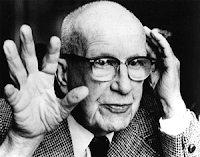
In 1927, a 32 year-old man stood on the edge of Lake Michigan, ready to throw himself into the freezing waters. He was bankrupt, the result of his third business failure in a row. He’d been drinking heavily and was grief stricken over the death of his first child. He didn’t know how he would support his wife and newborn daughter. At that moment, his life seemed like a pattern of failures to him. Before the bankruptcies, years earlier, he’d been expelled from Harvard during his freshman year and never did complete his degree.

But fortunately, in this moment of drunken grief, Buckminster Fuller had the presence of mind to make an extraordinary decision. He realized that he was about to throw his life away and decided that if he was contemplating that, why not take half a step back and do something unorthodox. Rather than throw his life away, why not throw away his old notions of goals and achievement? He decided to turn his life into an experiment – an experiment to see how much difference one ordinary person could make. [1]

The difference that Fuller’s life made has yet to be fully understood or felt. He was a pioneer of ecological thinking and sustainability – balancing economic and environmental needs. His influence spreads as a growing number of people adopt the thinking that he helped to introduce. Although he never did complete his degree at Harvard, Fuller was awarded 44 honorary doctoral degrees, granted 25 US patents, and authored 28 books.

When Buckminster Fuller turned his life into an experiment (many called him Bucky, but he referred to himself as Guinea Pig B), he created the conditions for an extraordinary life. Perhaps best of all, his failures were feedback for an experiment, not a reflection of who he was, not something to take personally, not a reason to jump. Turning his life into an experiment gave him the best of both worlds: he ended his life even more accomplished than someone driven to achieve to prove something and remained more sanguine than someone who avoided risks altogether.

Perhaps Mohandas Gandhi, Martin Luther King, and Abraham Lincoln did something similar, made a similar sort of commitment. Gandhi pioneered and King popularized non-violent resistance. Letting racists cops or British soldiers do with you what they will is reckless. It's nearly suicidal. Lincoln angered both abolitionists and slave holders by trying to negotiate a compromise that would allow slavery to die out over decades rather than in a violent war. 

Gandhi, King, and Lincoln may well have - like Fuller - decided that they had little to lose and an enormous amount to gain by giving themselves over to causes that were dangerous but could change the world. Where people who felt more careful of life may have shied away from such challenges, they seemed to embrace them. (King and Gandhi, who actually did attempt suicide rather than threaten it, seemed more inclined to embrace dangerous causes than Lincoln.) 

Maybe one route to suicide prevention is to embrace the realization that fighting to protect a life is doomed to eventual failure whereas fighting to protect an ideal is not. Maybe there are worse things than feeling reckless about one's own life, if the risk taken is for some greater good.

One last note. King, Gandhi, and Lincoln were all assassinated. I wonder if this doesn't just confirm the degree to which they channeled their own suicidal feelings into a sort of courage that reflected a sort of reckless disregard for their own lives.


09 September 2013

Syria and the Shrinking Limits of National Sovereignty

The really interesting question about Syria is one of national sovereignty in the 21st century.

Imagine that you think family is the most important social institution. Imagine further that the family next door is in turmoil. Your neighbor - exercising his authority as head of the house - is beating his wife. The question is, do local authorities have any right to intercede?

That's not a hypothetical question. "Rule of thumb," came from a law that a man was not allowed to beat his wife with a rod any thicker than his thumb. That was the beginning of intervention in the sanctity of the family. The community finally decided that the right of the "man of the house" to rule as abusively as he wanted was not as important as the rights and safety of his wife and children. The state now intervenes. (And even that is complicated if the wife doesn't want to press charges.)

Now the man of the house whose authority is being questioned is the head of state.

After the Treaty of Westphalia in 1648, the prince was able to rule without interference. National sovereignty was the new authority, the nation-state becoming the ultimate authority to replace the church in that role. Whether the prince was a despot or benign (or even was deposed and replaced with a democracy), the rest of the world was to respect his right as the ruler. Nations were sovereign and were free to work out their own issues and decide for themselves how best to treat or abuse or even kill their citizens. Nations could put down revolts, practice genocide, let the homeless die on the street, refuse medical care to the unemployed, allow abortions, practice capital punishment, kill religious outlaws,or  gas the citizens in neighborhoods that harbor rebels. Whatever the state chose to do, outside nations had no say. And of course as long as one respects national sovereignty, none of the above are crimes. Each nation determines its own laws, and therefore what is legal is whatever its rulers say is legal.

Two things have changed that. One, global media and the Internet mean that all stories are local. The deportation and killing of Jews was a distant rumor; today's attacks on citizens are rarely hidden from the world community. Second, the economy is now international. It's a global village, even if every head of house is - for now - free to beat his wife as he wants.

Globalization has given us more international laws. A country that wants to trade freely with other nations can't, for instance, simply subsidize an industry at the expense of companies in other countries. Slowly, national sovereignty has been increasingly challenged when it comes to economic policy. Some things - like trade and pollution - are obviously issues that spill across borders and can't be left to national sovereignty. The sewage that spills from San Diego drains into the ocean that breaks on the shores of Baja California.

The question is, at what point do international norms become more important than national sovereignty? At what point do you say that you don't care whether a man believes that he has the right to beat his wife or a ruler has the right to kill his people?

This is not a question of whether or not we approve of violence. The situation in Syria is already violent. The police aren't starting the violence but merely trying to end it, whether they're dragging off the husband or fighting against national forces. The question is not violence but authority.

In the last half of the 15th century, the Gutenberg Press made the Bible property of households, not just the church. At that point, the Vatican lost its monopoly as the authority in the West. In the first half of the 16th century, Protestants like Martin Luther finalized the challenge to the Vatican's authority, creating new churches. But this triggered about a century of religious wars as communities tried to work out who had the authority to enforce laws - particularly about what people could believe. It was not until the Treaty of Westphalia in 1648 that communities agreed on national authority as the new norm, officially displacing the Vatican or the new Protestant churches as the authorities who could decide such issues.

We are living through a similar change today, the nation in the same place as the church was in the 16th century.

National sovereignty has been consistently eroding for at least a half century. From multi-national corporations to international trade agreements, the WTO and World Bank, the UN, and the simple fact of the international media and world opinion, national sovereignty is being challenged from every side.

Syria is just one in a series of specific questions that stem from a larger, more general question: what are the limits of national sovereignty? And that raises an even more fascinating question. When the church lost its authority, it took a century or two to define who now had that. Now, if the nation-state has lost its place as the ultimate authority, how long will it take us to re-assign that authority? And what will take its place? Because if history is any guide, that can trigger a century of turmoil.


03 September 2013

OBIT: Ronald Coase, Nobel-Prize Winning Economist, May Have Predicted the Coming Transformation of the Corporation

Ronald Coase died Monday. He was 102 and had just published a book last year. Nice life.

Here is my mention of him in my book, The Fourth Economy. He explained the rise of the corporation as a function of high information costs. Now that information costs are so much lower, I suspect that the corporation will be transformed.


First, how Coase's theory explains why the corporation became so important.

As Alfred Chandler points out, the corporation grew in response to the complication of work that came along with the evolution from manufacturing work into knowledge work. Rather than the invisible hand of markets coordinating this work, it was the visible hand of management that now coordinated work.

Ronald Coase won a Nobel Prize in economics for explaining why organizations rather than markets emerged as a means to organize work. Simply put, his theory is that the information costs were too high to justify one-on-one transactions, and it was more efficient to establish companies as a means to organize work instead. Take the example of the guy who wants to buy a burrito. Imagine that each time he wanted to get a burrito for lunch he had to find the guy who made and sold tortillas, then the guy who made and sold beans, and so on for carnitas, guacamole, salsa, and whatever other ingredients he wanted. And then to top it all off, he had to hire someone to assemble all of this into a burrito. Not only would this be a terribly complex task to perform over the course of his lunch break, but the guy who would have to perform the few minutes of burrito assembly would likely charge him for a full hour’s work, since it would take him that long to get there and back—and this does not even factor in the place and the tools (the capital) that would be needed to perform all this. A burrito in this scenario might cost hundreds of dollars and take hours to procure. It is much simpler for a customer to just go to the local taco shop, where all the knowledge, the labor, and the capital are pooled into one place, under one manager, and where our hungry hero can buy the burrito for, say, $6 instead. The cost to find each person and item involved in making the burrito is too high. And of course, the average person can actually assemble a burrito (assuming that he doesn’t have to raise the chickens, grow the beans and rice, etc.), something he can’t do with a really complex product like, say, a number 2 pencil. By about 1900, many products had become too complex for any one person to make. By early in the twenty-first century, many products had become too complex for any one company to make, as outsourcing became more and more common.  Complexity makes it challenging to coordinate production through one-off market exchanges, or single transactions. It is easier to set up a company and then manage such tasks and transactions (or as they are called within the corporation, process steps).  Coase’s thesis is that information and transaction costs were higher than the cost of institutionalizing these activities. So, instead of market transactions for each task or project, organizations were formed to turn potentially sporadic transactions into relatively stable processes.


In 1800, individual farmers or artisans conducted most economic activity. By 2000, corporations conducted most economic activity. Rather than being left to markets, work was managed. It was, as shown by Coases’s analyses, too expensive to orchestrate all of this by market forces alone.

Then, this excerpt from later in the book, arguing that if Coase is right, the corporation could be dissolved by lowered information costs.

It seems likely that the Internet will do for the corporation what the Guttenberg press did for the church. That is, it’ll break up structures we had always assumed were permanent: it’ll render temporal what we thought was timeless.

Ronald Coase won a Nobel Prize in Economics for his work on the firm. The question he asked is, “Why, if markets are so effective, do companies have employees?” The simple answer is that information costs are too high to turn every task into a transaction, making it cheaper to rely on contracts than markets. That is, it is simply too hard to coordinate the work that goes on inside of a company any way other than through job descriptions and assignments. Yet Coase’s work was largely done long before the Internet as we know it. Information costs have plummeted in the last couple of decades. One consequence of these falling information costs may be a growth in the portion of the economy that is managed by the invisible hand of markets rather than the visible hand of management. Savvy corporations might tap this potential to create a growth in market forces within corporations.

What does this mean in practical terms? If a programmer in the Ukraine should get an idea and can find a designer in Italy and an assistant in India, the work can be done through informal arrangements that may or may not include a corporation. I actually think that one of the social inventions of savvy communities will be the simplification of what is required to form a multinational corporation, if only to make issues of ownership more clear and simple. (It is one thing to say that people from different countries collaborated to create something and quite another to say that everyone is clear and happy about the way its success is shared.) Regardless of how many and what type of social inventions will be necessary for this to work, however, the fact is simply this: technology around the planet has never before so lent itself to self-organizing activities. The Internet could replace organizational structures. This alone could revolutionize the corporation.

What's Particularly Uncomfortable About Syria

Syria is a mess. Assad is killing rebels who - to be fair - are doing their best to kill Assad. And of course the killing is not limited to Syrians who have taken a side. If the US intervenes, it could kill even more people and then support the installation of a government that might be worse than Assad's. If the US does not intervene, it could be standing by while the immoral equivalent of the genocide in Rwanda or the Holocaust takes place.  To further compound it, the world community could be facing more situations like this in more countries than it could ever hope to properly address. Anyone who says that it is obvious what should be done .. well, they have more confidence than me.

What is particularly distasteful about this mess from the standpoint of citizens and pundits, though, is that it forces Americans to think. Not just because of the conundrums above but because it defies the traditional divisions. Liberals typically oppose war and conservatives embrace it. In this case, Obama is for intervention and the GOP pundits are against it.

The only good thing about this tragedy is that it seems to be forcing Americans to think for themselves. And for many Americans, that is nearly as uncomfortable as the thought of complete strangers dying.

P.S. For me, the predecessor to a Syrian intervention is a statement of doctrine about when we do and don't get involved in these issues. What conditions would keep us out and which would draw us in? I don't like approaching this as a one-off. During the next couple of decades, I'm convinced that the Internet is going to topple dozens of bad regimes. Any policy we have should anticipate this.