05 February 2016

Obama's First Ever "Great" Month

For the first time in 95 months, the unemployment rate has dropped below 5%, which is great. In this decade, we've had a lot of misery and very, very little great.

Unemployment rates mostly bounce between 5% to 8%. About 15% of the time the economy is bad enough to drive rates above 8% and about 15% of the time the unemployment rate drops below 5%. I think that it's fair to say that above 8% the economy is miserable and below 5% it is great.

By that definition, Obama has now had 1 month of great and 42 months of miserable.

By contrast, Clinton had 44 months of great and not a single month of miserable.

And George W.? He had 32 months of great and also did not have a single month of miserable. Although the Great Recession had begun months before he left office, the unemployment rate did not go above 8% until the month after George left office, where it stayed for 42 months. Workers in the Midwest and Syrians and Iraqis didn't start streaming into unemployment offices and refugee camps until after he'd gone back to Texas. 

You'd like to think that change in the unemployment rate counts for something, and apparently it does. Reagan had 27 months of miserable and no months of great, but the unemployment rate fell 2.1 percentage points from when he came into office to when he left. He finished with an approval rating over 60%. (Plus, more than any president before or sense, Reagan just looked like a made-for-TV president.)

George H. Bush had a tepid presidency that didn't include a single miserable or great month, and he finished with an approval rate over 50% in spite of presiding over a 1.9 percentage point uptick in the unemployment rate. The economy got worse during his presidency but not that much worse.

Not only did Clinton preside over 44 months of great, but the unemployment rate fell 3.1 percentage points during his time in office. Bill finished with the an approval rating of about 65%, the highest of any president in generations. Hard not to love a guy who presided over unemployment rates under 5% for nearly half his presidency. (And all the months during which unemployment dropped below 4%.)

Where does this leave Obama? It's hard to tell. Reagan had zero months of great and 27 months of miserable and is beloved by all Republicans and many Democrats and George W. had 32 months of great and no months of miserable and is hated by all Democrats and many Republicans. It's hard to tell how this will affect Obama's legacy but it does set up something that could drive the GOP crazy.

If Hillary Clinton wins the presidency, she might just come into office with the unemployment rate under 5%. In other words, when she gets into the Oval Office, the economy might already be great. If it stays there and Hillary is able to post numbers as impressive as Bill's... the Clinton legacy might be golden enough that Chelsea could win elections she doesn't even campaign for.


Months of Unemployment
Administration Above 8% (Miserable) Below 5% (Great) months in office bad great
Reagan 27 0 96 28.1% 0.0%
H. Bush 0 0 48 0.0% 0.0%
Clinton 44 96 0.0% 45.8%
W. Bush 32 96 0.0% 33.3%
Obama 42 1 85 49.4% 1.2%


The Most Curious Thing About the Labor Market

While the stock market continues to worsen, the labor market continues to improve. But that is not the most curious thing about it.

Unemployment is down to 4.9% from 5.7% last January. Since 2011, the Jan-Jan drop has averaged 0.8%, so the recovery continues at exactly the same rate it has averaged over the last six years.

Wages are up more than 2.5%, a rate of gain that's higher than what it averaged throughout the 1900s when steady wage growth of roughly 2.+% made wages about 6 to 8X higher in 2000 than they were in 1900. 

The number of employed is up 2.44 million from a year ago. Where did these people come from? 1.3 million came from a growth in the labor force (millennials and others entering the workforce) and 1.1 million came off of the list of the unemployed. 

The number of discouraged workers is down 8.7% and the number working part-time for economic reasons (that is, they are working part-time simply because they can't find full-time employment) is down 11.7%.

The average number of jobs created in the last 5 years was 2.5 million. By comparison, during the best five-year streaks in the late 1990s and mid-1980s, job creation averaged 2.9 million jobs a year. Job creation is not as strong as during the best five years of those recoveries, but it is more steady. No job creation streak has gone this long without a temporary dip. We now have 64 months of uninterrupted job creation, a period during which 13.1 million jobs have been created. The streak could end this year but there's at least as much reason to believe it will continue as finally stumble. 

Curiously, as the stock market becomes more volatile, the labor market has become more stable. The stock market rarely goes three months without an alarming downturn, whereas the labor market has ticked up every month for more than five years. And to highlight that contrast, the NASDAQ is down about 3% the same day that unemployment falls below 5% for the first time in 8 years.

 Curious indeed.

01 February 2016

Confessions of a Political Guy Who is Made Wildly Uneasy by Political Rallies

I'm sure that most people would think me political and religious. And yet ....

Watching the candidates tonight give their speeches (I saw Rubio, Trump, Cruz, Clinton and Sanders), I realize once again that political and religious people in large groups make me really uneasy. This matter of wildly cheering for a candidate just strikes me as so odd. To get people all fired up about their beliefs, to hoot and holler about abstract ideas and policies, strikes me as something as awkward as having sex in public. Actually, I think it might be more awkward.

These are just people with ideas, some more promising than others. It seems required, though, that their supporters have to hail them like they're the Messiah. That's just weird.

31 January 2016

Susan B. Anthony and What History Reminds Us

Here's a picture of Susan B. Anthony from History in Pictures. After they beat her, they arrested and fined her for trying to vote in 1872.


 It seems to me this sort of thing should instill optimism and humility. Optimism about the future to know that we've come this far. Humility to realize that there are a number of things we're doing now that people in 150 years will likely find odd and horrifying.  We've come a long ways and we're not there yet.

30 January 2016

What if the Real Question is not Why Are Oil Prices Falling? but instead, Why Did They Start Rising in 2003?

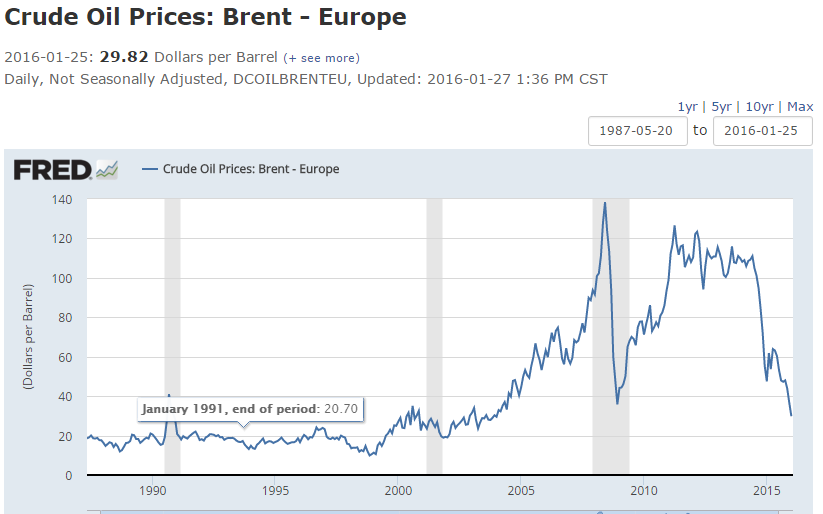
It's an open question as to why oil prices have fallen so much so quickly. In June of 2014, oil prices were $111. They are now about $30.

Some of the explanations for the fall sound conspiratorial. Countries like Russia and Iran that the West has reason to weaken, are hurt by low oil prices. It might be that Western countries are engineering oil price manipulations to weaken Putin but of course this glosses over the fact that Western countries have trouble even managing their own currencies, much less the global price of oil.

Another, very interesting theory, is that solar and alternative energy sources are becoming cheaper. Some people believe that solar panels may follow the path of computer chips, becoming cheaper and more effective at a rate that mirrors chips doubling in capability every 18 months. Couple that with continued advances in fusion power and it may be that oil prices would have to drop to stay competitive with alternative energy. If oil producers believe this might happen, it would make sense that oil producers would work to sell off inventory before it becomes obsolete, driving down prices now before the great collapse in oil prices later. In this scenario, oil producers are like FAX salesmen scrambling to sell machines before email marginalizes their product.

It's also true that more incremental advances have brought down oil prices. Fracking, shale oil, and new methods of extracting oil from previously unattainable places has increased the global supply of oil and driven down prices.

But maybe the question, "Why are oil prices falling," is the wrong question. Perhaps a better question is, "Why did oil prices jump?" Because while oil prices are as low as they have been since the end of 2003, they aren't much different than what they were before 2003.

From 1987 to about May of 2003, oil prices averaged just under $20. From May of 2003 through the middle of 2014, oil prices averaged $79, 4X higher than what they'd been before 2003. So far this year, oil prices have averaged a little over $30, closer to the pre-May 2003 period than after.

What happened in 2003? The US invaded Iraq. And it didn't take the market long to realize that rather than stabilize the Middle East, ensuring a steady supply of oil, this was likely to destabilize markets by threatening oil supplies. When retreating Iraqi forces set fire to 40-some oil fields, it made for fairly spectacular footage. 

When the US invaded Iraq, oil prices were about $23 to $34. After that, they began to steadily rise until peaking at nearly $140 in June of 2008, when the Great Recession had begun. (Everyone points to mortgage markets as cause of the Great Recession, and for good reason. Oddly, no one points to incredibly high oil prices in spite of the fact that high oil prices have started recessions before.) From the month the US invaded Iraq to June of 2008, oil prices rose $115.

It might be that oil prices that range from $20 to $40 is not the exception but instead, oil prices that ranged from $100 to $140 were the exception. As the market realizes that even radicals as ideological as ISIS are willing to sell oil, perhaps the market is now seeing less risk to oil supplies and thus, is pricing oil at less of a premium.

Oil prices peaked at nearly $140 in June of 2008, about $115 higher than they had been when the US invaded Iraq in 2003.
The question is not, Why are oil prices falling. The question is, Why did oil prices rise? The answer to that question may well be complex and debatable. It might also be that the answer is as simple as this was just one more price paid for bad US foreign policy. It was a policy based on the simplistic notion that the bright shining light created by this invasion would radiate from democracy in the Middle East rather than burning oil fields.

29 January 2016

What if this new economy drives less investment and consumption? Would we still call it progress?

Last year, "investment in mining exploration, wells, and shafts fell 35 percent." With oil prices down, there is less reason to invest in finding and tapping new sources of oil. Unless oil prices fall another 50%, this represents a one-time drop. It is also a reminder that we might be moving into a less capital intensive period of economic development.

If you are starting an oil drilling or mining company, you have to spend a lot of money on capital. A mining company client I worked with in the Upper Peninsula of Michigan had trucks the size of two-story houses, trucks able to move 320 tons of ore in a single trip. Not only do these trucks costs millions to purchase but they burn 1,000 gallons of diesel fuel a day. Replacing a tire costs $52,000. The custom built shovels that fill these trucks scoop 70 tons of rock at a time and cost $20 million. This sort of industry is capital intensive. You have to invest big in order to compete. And this sort of capital-intensive industry defined the economy of 50 years ago.

The investments of the new economy firms are different, more public. It's not unusual to see a group of employees in tight work areas all on computers. It's rare that those computers would cost more than $4,000, often considerably less. The investment in that room was likely made in their education, money spent out of private household investments in tuition or private endowments of prestigious schools or public funding of state universities. The capital equipment spending is often low. (That's obviously not true of all knowledge workers. Folks working at the Hadron Collider, for instance, are working with a billion dollar a year expense.)

And on the consumption side, there are two trends that might keep spending down.

One is that millennials are less prone to go to the mall to buy things. They seem to be more deliberate about how they spend and they see conspicuous consumption as a moral failing, reliant as it often is on sweat shops, waste, and unsustainable production techniques. If 50 years ago having a closet bulging with clothes was a sign of affluence, it is now a sign of poor judgment, in the same way that in a time of frequent famine a belly is a sign of affluence and in a time of abundance, a belly is just a sign that one lacks self-restraint. While such lifestyle choices could still result in comparable levels of spending (one hand-crafted, quality sweater might cost as much as half a dozen cheap sweatshirts), it isn't likely. This sort of lifestyle may well bring down consumption levels.

Related, the sharing economy could result in less spending  as well. Uber and Airbnb are cheaper than traditional taxis and hotels. Operating these businesses doesn't require explicit capital outlays (back to the notion that the new economy is less capital-intensive), using information to identify slack in capacity of cars and homes and people's schedules. Not only does this mean less investment (it's unclear that someone who lets out their home to Airbnb guests 6 times a month can expense their personal home construction as investment in the same way that the Marriott could expense hotel construction as an investment), it means less consumption. People spend less to get from one place to the next or to sleep overnight.

The economy is changing in a variety of ways and it is worth remembering that only in the wake of the Great Depression in the 1930s did Simon Kuznets develop GDP as a measure of economic activity. GDP is a measure that we didn't have in the 1800s and is a measure of economic progress and well being that we may radically change by the 2100s.

The economy is still evolving. To capture reality, so must our measures of it.

26 January 2016

Venture Capital Spending Up 16% in 2015 - And That's Great News for Wages

In 2015, $58 billion of venture capital was invested in the US. [All of these numbers come from the Price Waterhouse Coopers / National Venture Capital Association found here.] This is the highest dollar amount since 2000, and up about $8 billion or 16% from 2014. 2015 VC investments ran nearly double the rate they had run from 2002 to 2013.


Early stage financing rose at a similar rate, suggesting that the pipeline of new businesses is strong. (The companies in this early or seed stage are rarely expanding quickly. Yet. The flurry of hiring and wealth creation - if it happens at all - will typically happen one to four years later.)


Silicon Valley - home of Sand Hill Road, which is to VCs what Wall Street is to brokerage firms - still dominates as a recipient of venture capital. In 2015, Silicon Valley attracted $27.3 billion in VC, far more than LA / Orange County's $5.1 billion and San Diego's $1.2 billion, and nearly half the nation's total VC investment.

Wages nationally in the fourth quarter of 2015 were up 3.3% (inflation was 0.5%), a healthy gain compared to early in the decade. What does this have to do with venture capital? You could argue that the more VC invested, the more upwards pressure there is on wages.

Here, we can look at the latest data by county (which is through the second quarter of 2015), to see if there is any link between the amount of VC investment and wage growth. 

Silicon Valley includes San Francisco, Santa Clara, San Mateo, Marin, and Alameda counties. Among the 343 largest counties in the US, wage growth for these counties was ranked as follows:

Santa Clara, ranked 2nd w/ wage growth of 11.3%,
San Francisco, ranked  5th, w/ 8.6% wage growth,
Marin ranked 9th, w/ 6.6%,
San Mateo, ranked 10th, w/ 6.5%, and
Alameda ranked 19th, w/ 5% wage growth

Silicon Valley, the place where nearly half of VC money was invested, had 4 counties in the nation's top 10 and 5 in the top 20. Again, this is out of 343 counties.

By contrast, 
Orange County was ranked 21st w/ 4.9% wage growth and
LA was ranked 69th w/ 3.6%.

San Diego, a place with considerably less VC money than Silicon Valley and LA / Orange County, was ranked only 105th w/ wage growth of 3.1%. (Although it's worth noting that 105th still puts even laggard San Diego County in the top 30% nationwide for year over year wage growth in that 2nd quarter of 2015.)

This suggests that the more venture capital pouring into a region, the more likely wages are to be pushed up. If so, it's great news for the country that VC spending is on the rise. As this continues, it suggests that - as previously forecast here at R World - the first half of this decade will be known for a big reduction in unemployment rate and the second half of this decade will be known for strong wage growth. This seems further proof that we've entered a Fourth Economy in which the new limit to progress is entrepreneurship. It's not enough to nurture education or capital markets (although that is certainly critical): communities have to nurture entrepreneurship in order to move into the next economy.

Addendum 1:. I think the news is even better than this. I'm currently working with a startup funded by - not traditional VCs but - a couple of Fortune 10 companies. As far as I know, the money they're investing into this particular venture is not actually counted as part of this PWC/NVCA report. In other words, there is more going on than reflected here and as more companies become more entrepreneurial, we'll see even more job and wealth creation.

Addendum 2: While I argue here that venture capital helps to drive wage growth, it's worth noting that the number one ranked county for the most recent quarter is Ventura County, on the California coast just north of LA and south of Santa Barbara. So, maybe I should revise my claim from "venture capital funding drives wage growth" to "venture capital funding - or the name Ventura - drives wage growth." Presumably, if you were really serious about wage growth you'd just name your county Venture Capital County.

23 January 2016

Trump as Loki: How He Might Save the GOP

Sometimes progress doesn't look like progress at the time. Getting fit is an ugly business that involves panting and profuse sweating. Throughout the course of human history, disruptive events as cataclysmic as rising sea levels and barbarian raids have actually prompted changes that - over the long run - made life better, forcing as they did innovations as varied as irrigation and compassionate religions.

In various cultures, they have gods of mischief who disrupt the status quo. Thanks to Marvel comics, the Scandinavian god Loki is the most popular of these. The gods of mischief show a lack of respect for the existing order and disrupt it in ways that can either leave in its wake destruction (like a tornado going through a neighborhood) or creation (like snow melting into streams and rivers, feeding plants and animals downstream). Loki sweeps the table clean and lets you rebuild without undue concern for what was before. He's the graffiti artist who gives you reason for a fresh coat of paint, perhaps even a new design.

Donald Trump might just be the GOP Loki, purging the GOP of some really dangerous ideas.

For instance, he's the first mainstream candidate to point out that the Bush / Cheney notion of building a democracy in Iraq was a bad idea. After Donald, it's hard to imagine that any GOP candidate will be as able to blithely dismiss criticism of this policy. That will make the GOP better.

Donald's New York sensibility that so alarms Ted Cruz, Donald's loose hold on social norms that are waning even in the Bible belt, is something that also offers hope for the relevance of the GOP. Legalizing same-sex marriage, for instance, is a form of religious freedom in that it allows that people might engage in practices that you disapprove of. Donald realizes that he has to win over evangelicals but when he tries, the effect is comical. (My favorite so far came when he addressed the students at Liberty, where evangelicals send their young adults. He read one verse and managed to reveal his ignorance of Biblical norms by referring to Second Corinthians (II Corinthians) as "Two Corinthians." That distinction only seems subtle to people who don't read the Bible. If you hear someone say "Second Corinthians" you expect to hear a verse. When you hear "Two Corinthians" you expect to hear a joke. "Two Corinthians walk into a bar ..." Religion is a beautiful thing ... as long as it isn't something imposed on others. And the segment of the GOP that continues to confuse what they believe with what everyone else should do need to be marginalized in order for the GOP to remain relevant. Donald offers a route towards that.

Donald's foreign and domestic policy is at turns vague and incoherent. He's racist and feeds the fears of GOP voters. But for all that, he is disrupting the GOP right now. He's playing the role of Loki and whether he leaves in his wake a GOP that never again has a chance at the White House or a GOP that is forced to remake itself into something better and more modern - like a town rebuilding from an earthquake - is uncertain. What is certain is that the GOP will be very different in the post-Trump era. And given its direction over the last couple of decades, it needs that.

This country needs a clear choice each election: do we rely more on markets and less on regulations or more on social safety nets and government programs? There are ideologues who believe there is always just one answer to that question but in fact history rewards the communities able to alternate between those two broad directions. A healthy country needs parties on the left and right who are reasonable and safe choices in spite of ideological differences. The GOP of Bush and Cheney was not and in order to get better, it had to be disrupted and re-made. Trump might just be the catalyst for that change.

22 January 2016

Vonnegut's Worst Year and Best Novel: His Mother, Dresden, and the Price of Art

Kurt Vonnegut's family had money until the Great Depression. Then they didn't. His mother never seemed to reconcile herself to the depressing reality of living without wealth and was particularly devastated when Kurt dropped out of college to enlist in the army as a private.

In May of 1944 - when Kurt was 21 - he came home to visit his family. When he and and his sister went to wake his mother, they discovered that she'd killed herself. On Mother's Day.

In November of 1944, he turned 22. The next month, he was taken prisoner of war by the Nazis and spent Christmas day jammed into a boxcar, traveling to Dresden.

In February, the allies fire bombed Dresden, killing tens of thousands. When he emerged from underground, this is the city he would have walked into. When he first got there, he called it the fanciest city he had ever seen. Then this.


It is hard to imagine a more traumatic year, or one that could end in a way that would so belittle his own personal tragedies. This experience became the basis for his novel Slaughterhouse-Five. It was an fabulous novel but that seems likes too high a price to pay for art.

Should you ever hear someone talk about paying a high price for art, just reply, "Well, yeah. But you only had to pay with money."

11 January 2016

From Pensions to 401(k)s - One of the Less Reported Reasons For Growing Wealth Inequality

There are two kinds of retirement plans: defined benefit and defined contribution. While not technically correct, you can think of it as the move from pensions to 401(k)s. This move from defined benefits to defined contribution is one of the least reported reasons for growing wealth inequality.

If you have a defined benefits plan, your retirement benefit is defined. "If you work 30 years, your pension will be equal to 60% of the average of your last three years of income," might be one simple formula. With a defined benefits plan, you are guaranteed a monthly income - often adjusted for cost of living - until you die. Nobody gets rich with a defined benefits plan but they are fairly safe and reliable.

By contrast, if you have a defined contributions plan, you can't be sure what amount you'll have in retirement. You define your contribution - say 10% of your pay - and your employer may match this (sometimes they'll match your contribution by 25, 50 or 100%). You know that you're putting $300 a month into your retirement account each month. What you can't know is how that investment will do. By the time you've worked 30 years, your investment may have grown to $3.1 million or be worth only $31,000. It will depend on how your investments have done.  You can get rich with a defined contribution plan but they aren't safe or reliable.

Defined benefits plans minimize differences in wealth and retirement income. Defined contribution plans exacerbate differences. As more people move (or are moved) into defined contribution plans, we would expect to see more disparity in wealth.

This graph from Employee Benefits Research Institute:


Since the late 1970s, there has been a dramatic change in the use of defined contribution and defined benefits plans. Looking just at just employees with retirement plans, the percentage with defined benefits plans has dropped from 62% to 7%. Meanwhile, the percentage with defined contribution plans has gone up from 16% to 69%.

Unsurprisingly, wealth inequality has gone up as defined benefits programs have gone down. The growth in the use of defined contributions plan is by no means the only reason for growing wealth inequality but it is a very real one.

And one of the many ways that it shows up is that even as wealth goes up, a growing number of people feel vulnerable in retirement. If you have a set income every month, you may not feel rich but you'll feel secure. By contrast, even if your investments do well and you are considered "well-to-do," you might still feel vulnerable because you know that one big market move could change your situation.

It's not clear that employees or employers will reverse the trend of the last quarter century. It is clear that the price for this change has included more wealth and income inequality and more feelings of vulnerability.

07 January 2016

Thoughts on Trump, Progress, Congress, the Gap Between Experienced Reality and Global Reality, and Bad News

Donald Trump sometimes says very reasonable things. "We spent $4 trillion in Iraq, lost the lives of thousands of our soldiers and caused those people terrible grief. I'd rather have spent the money here on roads and bridges." That's actually pretty reasonable. The fact that he sometimes makes reasonable points doesn't make him a reasonable candidate, though.

Killers are sometimes nice to the vast majority of the people they meet. That doesn't make them nice people.

Donald doesn't have to say too many unconstitutional and loony things to be unreasonable, just as someone doesn't have to kill too many people to be a killer.

******************

It's called progress. Not perfection.

It's easy to be critical of the economy and it is right to point out what is still missing, unjust, and inadequate. That sort of commentary should never be confused with metrics that show we're getting better. When the economy is creating new jobs, wealth, and products and reducing rates of poverty globally, that's progress. And that's pretty good.

*********************

Congress is severely criticized for being ineffective. It doesn't pass many bills.

I don't know that it's ineffective. It might just be representative. If you have to find issues that rural voters in Kentucky agree on with urban voters in San Francisco, it's going to be a short-list of initiatives. It might just be that Congress doesn't do much because there is not that much that Americans agree on.

********************

So many of the really divisive political issues are abstractly experienced. Unemployment is awful at 10% but great at 5%. The difference in whether you have a job or not in those two scenarios is 90% or 95%. "You" probably have a job when unemployment is high and when it is low. The difference is what you hear about in the media, or from friends. Similarly, nobody experiences global warming. If global temps rise 2 degrees, no one person experiences just that. One place might actually be colder, another wetter, another hotter .... but the experience of climate change is something we hear about rather than directly experience.

Given this gap between immediate experiences and reported on experiences, there is room for a variety of worldviews that are - at best - loosely connected to larger realities. Unemployment is up? I don't think so. I've got a job and so do all of my friends who really want a job and aren't afraid to get their hands dirty. Unemployment is down? I don't think so. My spouse has a graduate degree and is only an assistant manager at Olive Garden. Global warming? Oh yeah. So why are we having record colds and a polar vortex? The connection between global realities and local realities can be random enough to let any number of odd theories emerge as credible.

The more that some outside agency has to play intermediary between our experience and what is happening globally, the more that role is subject to hijacking by ideologues.

*********************

The news is dominated by systems failures.  A water main breaks, flooding an area. A house bursts into flame. Someone walks into a mall to shoot strangers. It's predominantly bad news. It's not the failure of systems that ultimately defines history, though. It's their evolution.

What if there were sources of news that focused instead on progress, on systems getting better rather than on their moments of failure? People who lived through auto accidents who would have been killed decades earlier before air bags, or procedures or medicines that obsolete certain kinds of death?  Schools that offer new ways to learn for more people. It might actually improve quality of life simply by letting people focus on the positive rather than the negative. And improve it again by inspiring more progress through example and a reminder of how things can get better.


20 December 2015

Liechtenstein: World's Most Curious Country or the Future?

Liechtenstein might be the most curious country in the West.

It disbanded its army in 1868 and hasn't had a military since. Then, in 2007, the Swiss army accidentally "invaded" Liechtenstein after they got lost. The Swiss infantry unit conquered nothing during their brief invasion and later sent an apology.
Andreas Kieber, last surviving soldier of Liechtenstein, posing in the Vaduz Castle in the 1930s. The country abolished its armed foces in 1868. [From reddit, found on historicaltimes]

Liechtenstein  has put its trust in corporations instead of the military and the result is a remarkable ratio. Because it offers a corporate tax rate of 12.5% and made it easy to incorporate, about 73,000 corporations have incorporated there. That's not remarkable until you realize that this works out to 2 corporations for each citizen: Liechtenstein's population is only 36,000.

By putting their trust in corporations rather than traditional armies, Liechtenstein has done well. It's per capita GDP of nearly $90,000 is the third highest in the world and its literacy rate is 100%. (Imagine the pressure you'd feel if you were raising the one child in this small country who just couldn't get the hang of reading.)

No army for nearly 150 years, 2 corporations per citizen and 3rd highest per capita GDP in the world. It's not a formula that could work for everyone, or at least not until the popularization of entrepreneurship has gone much further than I've previously imagined. For the world to do what Liechtenstein has would mean that each person is, on average, running two corporations (presumably with robots). There was a time, of course, when the idea of two cars per household was unimaginable so just maybe ....

18 December 2015

What the Universe Wants

If the universe wants for there to be tragedy or boredom in your life, there is no choice. You will have tragedy and boredom.
Fortunately, as best we can tell, the universe if a place of possibility and it doesn’t want anything. You have to bring your own desire to it.

15 December 2015

Lines I Wish I Had Heard in Tonight's GOP Debate

Moderator: Donald Trump, you say that America doesn't win at anything anymore. Have you heard of Charlie Sheen? He's winning.
Donald Trump: I have. And that's why I'm naming Charlie Sheen as my running mate.'

Moderator: Why is it you hate terrorists so much?
GOP Candidate: Because people get us confused. We are the terroizers whose job it is to assure you that you should not feel safe and should vote for us to protect you. They're the terrorists. We're the terrorizers. They make you unsafe. We make you feel unsafe. There is a very real difference.

Moderator: Speaking of foreign policy, what about the Trans-Pacific Partnership, an agreement we have with 11 other Pacific Rim countries that will, among other things, eliminate more than 18,000 taxes and trade barriers? What do you think about that?
GOP Candidate (any GOP candidate): A response (any response).

Moderator: Speaking of foreign policy, what do you think is the right policy for dealing with Climate Change?
GOP Candidate (any GOP candidate): A response (any response).

Moderator: Governor Christie, you've expressed a willingness to go to war with Russia, Iran, and Syria in just the last 49 seconds. Why are you so angry?
Christie: Honestly? I'm so hungry I could punch a cow. I've had nothing but kale and tofu in the last 2 months. I'm starving.

Moderator: Senator Cruz, is there any particular reason you opted to pose like Napoleon during the opening song?
Cruz: Like Napoleon, I do think that we should export our revolution to other countries. Also, I think that can best be done by making me emperor.

14 December 2015

The Middle Class Isn't Disappearing. They're Becoming More Affluent.


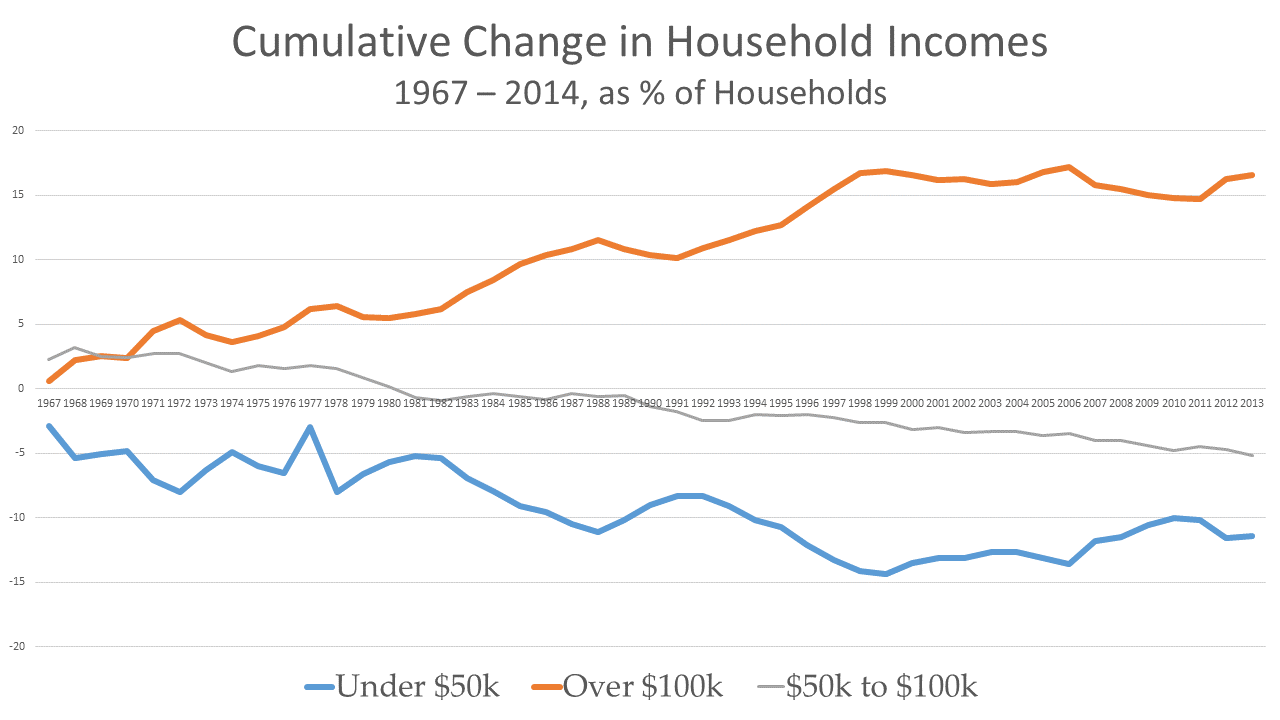
The most absurd claims are being made about the above graph, made from census data found here. Simply put, people are claiming that this is further evidence that the middle class is disappearing. It's not.

What this data actually shows is that the middle class is getting richer. A lot richer. 

This data goes back to 1967 and it clearly shows two things: more people are rich and fewer people are poor.

The percentage of households making more than $100,000 a year has tripled. Tripled. (And yes. All of this data is inflation adjusted.)  In 1967, only 8.1% of households had incomes over $100,000 a year. By 2014, another 16.6% of the population had joined them, bringing their total to 24.7%.

The percentage of households making less than $50,000 has dropped from over half to well under half, from 58.2% of the population to only 46.8%, a drop of 11.4%. That, too, is progress.

Finally, the percentage of households making $50,000 to $100,000 has also dropped, from 33.7% to 28.5%. That 5.2% of households joined the folks making more than $100,000, not the ones making less than $50,000. 

You can see in the above graph what's happened in the last half century. This graph focuses on cumulative change over time. 

The orange line - households making more than $100,000 a year - rose to include 16.6% more households than it did at the start. (And just before the Great Recession, it was up to 17.2% more.) 

The blue line - households making less than $50,000 a year - dropped by 11.4%. 

During that time, median household income rose from $44,284 to $53,657 and average income rose from $49,529 to $75.738 a year, increases of 20% and 50%. This even when the size of the average household has dropped by more than 12%. (From 1975 to 2014, household size has dropped from 2.89 persons per household to 2.54.)

I'm not sure how you misconstrue this sort of data into proof that things are getting worse but of course pundits on the right and left have done just that. I'm beginning to believe that there is no such thing as good news when your career depends on alarming the polity.

13 December 2015

In Donald Trump We Have a Great Example for the World


I don't doubt Ben Casnocha's sincerity here. In Eurasia, where multiple languages, peoples and cultures are interacting in regions smaller than some midwest states, the paranoia about anything foreign in some American circles is nearly incomprehensible. And Trump has to seem baffling to most thoughtful people around the world.

But I do think that we can make Donald a beautiful example. We can show the world that in the US we allow free speech. In fact, we're so committed to it that we don't just let people with bad ideas talk. We let them run for office. We don't shut them up. We give them a microphone and TV appearances. So in this, we're different from other countries but even better, it doesn't end there.

We don't hide bad ideas or let their owners take office by force. We put bad ideas out into the market place of ideas and reveal just how bad they are. Donald Trump's ideas have to compete with other ideas and, in the end, show themselves better. Nobody is talking about shooting or censoring or imprisoning Donald Trump. Instead, his ideas are getting air play and they are being exposed as ridiculous. He's safe in the US. His ideas aren't. They're grounded in fear not facts and this becomes more obvious to more people every day.

I know this can be confusing for people but it's hard for me to imagine a better example of how to deal with bad ideas and offensive people than this.

09 December 2015

Bernard Delights in the Trump Candidacy

My friend Bernard was chuckling even before I sat down.
"Ha! Donald Trump has won the bet!"
"What?"
"Donald! This whole campaign of his has to be based on some crazy bet. He has to have bet someone that he could enter the race and lead in the polls."
It had been a long time since I'd met Bernard for lunch and I was surprised to see him looking so animated. Apparently the Trump campaign had got his blood flowing.
"Um, so many questions Bernard. First, are you a Trump fan? Second, have you ordered?"
"Of course I'm a fan! What other country could create a Donald Trump? He's a phenomenon!"
"You think this ... this ... um, man, should be president?"
"Of course not! You didn't ask me if I was voting for him. You asked me if I was a fan." As we were talking, the waiter brought his sandwich and he hastily stuffed a bite of Reuben into his cheek and began to talk. I was partly interested in what he had to say and partly distracted by the question of whether he would manage to swallow the bite rather than spray it across the table. "Did you hear about the origins of the dada movement?"
"It was nonsense, right?"
"Sort of," Bernard answered. "They actually began as a satire of politics and it morphed into an art movement. They were attacking the rationality and nationality that had just given the world the Great War. What we call World War I. But their attempts at nonsense as an alternative to the rationality that led to the madness of war actually resulted in a somewhat coherent art movement. Their whole point was that there was no point, a point they actually made quite well."
"And .... "
"This is Trump! The man is art! He's an art movement! He's mocking American values by embodying them and taking them to their extremes. His Trump Towers, these incredibly phallic symbols that tower over their surroundings. His fear of anyone you're unlikely to see in a WalMart. His insistence on appearing in reality shows and now campaigns, the only places in American society in which it's considered appropriate to wax rhapsodic about your own virtues and denigrate everyone else. In the past, someone like Sinclair Lewis had to create a character like Elmer Gantry for us to understand American culture. Donald Trump is like Elmer Gantry and Sinclair Lewis in one! He's the author and the character. He's the dada movement personified and delivered a century after the dada movement. He's a genius!"
"Well," I hesitated, not really in the mood for a fight but still not sure whether criticizing Donald would launch Bernard into a rant against me or just make his point, "he certainly tells us often of how smart he is."
"Haha! He is! He's brilliant! I don't think that even he is smart enough to understand how brilliant he is! There are 7 billion people on this planet and he gets more coverage than any 1 billion of them. He is the idiot savant of modern culture."
"But who is supporting him?"
"Well, everyone has that one crazy uncle at Thanksgiving who says such outrageous things that no one quite knows how to respond. Now, thanks to polling, we know how many crazy uncles there are."
"Enough to win an election?"
"No! Of course not! But the fact that he's doing so much better than anyone thought is enough to make everyone alarmed. He's like a one-man voting awareness campaign. At this point, the odds that he wins the Oval Office and that he admits that all of this was the most elaborate prank ever played on American voters are about equal."
"You think that he's going to jump out and say, 'Candid Camera!'?"
"You think he's going to win," Bernard rebutted.
"Er, no," I responded.
"That's it! That's the beauty of it! Everyone on the right is running around scared to death that they'll die in a terrorist attack. There's a nearly zero probability that you - or any one American - will die in a terrorist attack. In 2011, about as many Americans were killed by terrorists as were killed by their own furniture. Someone will likely die in a terrorist attack in the next few months but it won't be you or the guy worked up about it at a Trump rally. "
"But it could happen."
"Sure! Could.  Few events have a zero percent probability. Which brings us to Trump."
"You think there is a zero percent chance that he'll win?"
"No! And the fact that there's a non-zero chance terrifies everyone on the left in the same way that being killed by terrorists terrifies those on the right. The whole chattering class of pundits and voters is terrified. Political discourse is now driven by two near-zero probability fears: being killed by a terrorist and living under a Trump presidency. It's better than the plot for a Marx Brothers film."
"You find all this amusing?"
"What's the alternative?"
"Find it alarming," I asked. He shook his head.
"You think that my being alarmed is going to make any difference to anything but my blood pressure? At my age I can't afford to be alarmed by improbable events. I could keel over at any minute and I should worry that a reality-TV star is going to win votes? No! I'll just enjoy this spectacle."
"So Donald is now your favorite show?"
"Donald is a show for the ages. I can hardly wait for the musical to come out. Donald singing, 'Donald! I love ya!'"
"There's a musical coming out?"
"Oh! That! That is a high-probability hope of mine and that trumps two near-zero probability fears." He paused. "Trumps! Get it?"
I still didn't but it made Bernard happy so I decided to just follow his lead and order a sandwich, shake my head at the improbability of so much energy going into such low-probability events, and join Bernard in brainstorming about the lyrics for the Trump musical.

2016 Economic Prediction

I will start with three certain predictions for 2016: the year will have 366 days and it will include a summer Olympics and presidential election. Now for things less certain.

2016 is going to be a great year for the American economy.

There are a number of reasons why. One reason is that Paul Ryan negotiated a deal with Obama to avoid another October standoff on the budget. It's good for everyone to know that 20% of the economy (roughly the size of the federal government) is not going to suddenly grind to a halt.

On a related note, spending at every level of government - federal, state, and local - should rise the most it has since the start of this decade. This is going to help with GDP growth rather than hinder it, as it did in the beginning of the recovery. Not since the Great Depression has a recovery relied less on government spending and starting now, the private sector won't be the only engine that needs to pull this train.

Another positive is that the largest age group in the population is 20 to 24 year olds (see Bill McBride's great post here on this and other reasons to optimistic). That age group is making the transition from college to work now and will be one reason that the decline in labor participation rate will start to rise again.

This will help to drive up household income. By the end of 2016, household income should be back up to its 2008 level of $55k, perhaps even $57k, where it was in 2007 and in the late 1990s. (One rarely mentioned reason it has fallen in this century is simply that household sizes are trending downwards.)


The birthrate rose in 2014 for the first time since 2007. That's good for the economy for a number of reasons. It shows optimism and babies drive new purchases of clothes, cars and homes.

That's one of the reasons that residential construction spending will continue to rise, going up by double-digits (10% to 15%). This drives the purchase of furniture and household appliances and so many other things. That is, it drives up consumption.


Personal consumption will go up by at least 5%. The debt service costs for households is at a record low. People are quitting jobs about 2X faster than they are losing them, showing growing confidence in the job market. More confidence about future income and less worry about old debt will contribute to consumer spending rising at the rate that it did before the Great Recession (which is to say, above 5% rather than below it). This is going to help GDP growth and company profits.


Speaking of job growth, there is a great chance that the American economy will create more than 2 million jobs and a decent chance that it will create more than 3 million. In either case, the years 2014-2016 will mark the best three year total for job creation since 1997-1999. Oh, and this absurd streak of uninterrupted job growth might even extend from 63 months (what it'll be at the end of this year) to 75 months. Again, the old record was 48 months of consecutive job growth.

This job growth will do two things. There is a very good chance that it will bring down the unemployment rate to 4.5%. It will also will raise wages, as demand for new employees does once unemployment drops below 5%. (When unemployment is above 5%, it is easier to hire out of the ranks of the unemployed and there is little reason to offer high wages. Once unemployment drops below 5%, job offers more often have to entice employees away from current jobs, driving wages up.)

Wages are a little tricky, though. As you can see in the graph below, wage growth has been considerably lower than it was before the turn of the century but it is also true that inflation is much lower. So, nominal wage growth hasn't been too impressive but after-inflation wage growth is actually pretty strong. If wage growth rises a bit more even as inflation stays low, households will experience real increases in spending power, one more reason that consumption is likely to rise.


Finally, I think there is a great chance that the S&P 500 will rise over 10% and perhaps even over 20%. Why? For a host of reasons. There are still trillions of dollars in search of returns and there are not a great number of options for good returns. People have paid down debt and as they continue to make money their concern will shift from near term financial issues to longer-term issues (like retirement accounts). The US will continue to standout in the global economy. Also, it's been a really weak century for stocks for all of the talk about a bubble. From 1975 to 2000, the S&P 500 rose nearly 14% per year on average. From 2000 to 2015, it has been up less than 4% per year on average. The zero percent return of 2015 will turn positive in 2016, and rarely is market movement tepid in any one year. A correction like we had in the summer is pretty normal in a bull market that goes on this long but given the underlying economy will be strong, there is no reason to believe the market will stall or fall a second year in a row. Extended bull markets are typically the product of economic downturns.

Finally, the driver that is hardest to predict but that looks so positive is the uptick in early stage entrepreneurial activity. This may well be the biggest reason to be optimistic about 2016. This early stage activity is the ultimate in leading indicators. Why? It takes years to make business plans real. If it takes a few years for early stage entrepreneurial activity to translate into significant growth in GDP and jobs, this indicator looks promising for 2016 - 2018. Between 2010 and 2014, early stage entrepreneurial activity nearly doubled. Even if it leveled off in 2015, this sort of activity is the most promising indicator of all; successful entrepreneurs are the ones who create new jobs and wealth.


Painful memories of the Great Recession may have receded far enough into the past that people are less reluctant to use their credit cards to shop and their savings to invest. Gallup forecasts Christmas spending will rise significantly this year and that may well put everyone - from manufacturers and retailers to households and employers - in a more generous, positive mood from the very first week of the new year.

Happy (about to be) new year everyone!

07 December 2015

You Can't Fault Pro-Life Protesters. They Have No Choice

At the moment of conception, the microscopic life that will become a bawling infant is only 2 cells. You cannot see it with the naked eye.

The two people who made this little zygote are composed of about 15 to 70 trillion cells each. That's trillions.

The difference between 2 cells and 40 trillion cells is fairly significant.

When does life begin?
The first choice is at the moment of conception.
The second choice is at some arbitrary point in time and development after that moment of conception.

The first choice is clean. It doesn't involve any judgment in terms of starting point. It is simple.

It is also absurd because it suggests that two microscopic cells deserve legal rights. Surprisingly, the folks protesting abortion are supporting a life that they can't see and that can't see them. Unsurprisingly, the folks who protest abortion tend to have religious objections; it is this group that is used to advocating on behalf of the unseen.But if you're going to protect life from the moment of conception, why not make contraception illegal? Why not protect the sanctity of "human" life at the instant before conception as well as the moment after?

The second choice is reasonable. It acknowledges the silliness of arguing that two microscopic cells are human in the same way that a baby in a high chair is human.

It is also just as bad. It involves all sorts of judgments about a starting point. At what point might this life be viable? When might a mother first realize that she's pregnant? When is the fetus conscious? Conscious by what standard? Are you just going to pick some day at random out of this string of 266 days? Why day 112 but not 113? Or day 199 instead of 200? This is unconscionably murky about the starting point for something as important as life. Get it wrong by even a day and we are killing human beings rather than terminating a pregnancy.

I find the notion that life begins at conception emotionally appealing. It is clean. It's almost romantic, certainly spiritual to imagine "life" begins in an instant, an instant when it is scarcely corporeal.

I also think that it is more rational to acknowledge that "life" at the moment of conception is not really different from the "life" of living egg and sperm cells. There is nothing human about sperm or eggs except for the DNA, DNA that can be found in skin cells or saliva. Again, you can't even see it. It makes more sense to refrain from equating mere cells with a human being until some development threshold has been reached.

It is a choice between the heart and head, the romantic or rational.

So what to believe? Whatever you'd like. At least with current laws.

The beauty of current laws is that a person can go with the rational decision that "life" is something we'll never precisely time and the visceral decision that "life" is something that transcends our normal powers of perception. We're not forced to live by someone else's indefensible standards. And this is fitting because the only thing more absurd than having to defend either of these choices is having one of them forced on you.

If the Beginning of the End Times Marks the End Then Would the End of the End Times Mark a Beginning?

I've been surprised lately that so many people I know are convinced that the shootings in San Bernardino and Colorado Springs are proof that these are awful times to be alive. I don't question that these events are tragedies. I do challenge the notion that these events make today a worse time to be alive than in the past. 

Every 50 to 100 years, life gets remarkably better. And the rate at which it gets better is improving.

50 years ago, in 1965, people on the left were convinced that the world was being ruined by the military industrial complex and people on the right were convinced that it was being ruined by hippies and communists. Everyone had his reasons to believe that the world was getting worse and plenty of good data to prove it was bad.
  • Civil Rights demonstrations included hundreds of Alabama State Troopers attacking demonstrators, and the KKK killing activists. 
  • US involvement in Vietnam escalated. The rate at which men were drafted doubled. The rate  at which soldiers were dying quadrupled. This, too, triggered demonstrations that included LBJ being hung in effigy at Berkeley and at least one man lighting himself on fire.
  • In terms of social progress, in most states, a woman could not open a checking account without her husband's signature and segregation was still common throughout the south.

100 years ago was much worse. In 1915, World War I was well under way. 

  • Before it was over, WWI killed 17 million people and wounded another 20 million. If you couldn't find reason to suppose this "Great War" marked the last days, you probably didn't have much of an imagination.
  • Life expectancy for men in the US was 52 and for women was 57, about 2 decades less than it would be at the close of the century
  • In terms of social progress, there were no federal laws banning child labor and the six day workweek was still the norm
The simplest measure of whether things really are getting worse is this: would you rather live in those earlier times when lives were shorter and work weeks were longer, when we were at war with countries and not concepts? I'll let you discuss that among yourselves.


05 December 2015

Comparing the Surprisingly Similar Recoveries of the 1980s and 2010s

As it turns out, the recovery since 2010 is fairly similar to the recovery between 1982 and 1989.

In 2010 and 1982, unemployment rates were nearly identical (9.6% and 9.7% respectively). Those years represented the peak unemployment rate for that recession. During this decade's recovery, it took 5 years for unemployment to drop from its peak to 5.3%.  During the 1980s, it took 7 years for unemployment to hit 5.3%.

It is true, though, that this recovery is lowering the unemployment rate faster than it is creating jobs. Five years in, the 1980s and 2010s recovery had created roughly the same number of jobs: 12.9 million in the 1980s and 13.3 million in this decade.


This suggests that as people come back into the job market during the next couple of years, unemployment won't drop at the same rate that it has for the first five years of this recovery. That is, even if we keep creating 2 to 3 million jobs a year, the unemployment rate is unlikely to keep dropping by more than 0.5 percentage point a year.

The stock market did better in the 1980s. Through the first five years of that recovery, stocks were up 114%, and rose a total of 186% by 1989. By contrast, five years in the S&P 500 is up 95% (and of course that could change by 1 to 6% in either direction before December 31). The suggestion from this (simplistic comparison) is that markets still have room to rise over the next couple of years.


These simple measures suggest that this recovery is not so very different from the recovery of the 1980s, playing out over roughly the same time frame to largely the same effect. We've lowered unemployment faster than in the 1980s but because people are dropping out of the job market faster, not because we're creating jobs faster. 

And on that note, for whatever reason, people seem to be leaving work more rapidly than they're losing work, as can be seen in this graph below. It could be as simple as baby boomers retiring. It might be the rise of "free agents," folks like Uber drivers and Makers who don't count as entrepreneurs or employees. It might be a rise in education levels (people leaving the work force for degrees) or stay-at-home parents. In any case, people are still leaving the workforce even as layoffs are slowing.


Finally, the great news is that this recovery still shows no signs of stalling. Not yet. Our streak of uninterrupted months of job creation is now at 62 months and counting (the old record was 48 months). Next year could be the best year yet of this recovery and in 1989, unemployment of 5.3% represented the best it would get until 1997. By contrast, unemployment will likely stay below 5.0% all of next year. At year 7, the recovery of the 1980s was stalling. At year 5, this recovery still has steam left. Or, to update to a more contemporary metaphor, there is still charge left in this battery. 

04 December 2015

As a country, we really are vindictive towards children stupid enough to be born into poverty.


03 December 2015

An Immodest Proposal for Reducing Gun-Related Violence

17th Century Dutch guns in Rijksmuseum, Amsterdam
I've recently heard conservative friends make the point that these mass shooters never attack folks who are armed. "You don't see them going into gun shows," they say.

There is so much about this reasoning that is mis-guided. My first response is, "Yeah. If American history has taught us anything, it is that no one was shot at the OK Corral." There was a time when everyone was armed and ready to shoot to defend themselves. As it turns out, the folks who are best at shooting and / or most ready to pull the trigger are not necessarily the best human beings, most committed to creating a world safe for women and children. As it turns out, they are violent and a world that depends on the victors being more violent than those they defeat will be violent and so will the world they "protect."

And of course if it was right that more guns made us more safe, we wouldn't have 40X the number of gun-related deaths as the UK or 175X as many as Japan. We have more guns than the UK and Japan and we have more gun-related deaths. Since Obama has taken office, the paranoid right has bought guns at record numbers. According to their logic, that should make us safer. It has not.

Death dominates the news. Not, of course, the main causes of death like old age, heart attacks and cancer. Instead, we get a litany of violent tales, from bombs dropped in the middle east to guns fired here at home.

Perhaps the closest thing I have to magical thinking is this: what we focus on, what we meditate on, what we obsess over comes to define us. It might be mystical, the result of meditations manifest as our reality, the power of imagination to - for good or bad - shape reality. More likely it is akin to a child learning to ride a bike who can't help but steer in the direction he's looking. As a society, we stare at these mass shootings and all of us gravitate towards them. The mentally ill imagine themselves as Rambo, with the power to get everyone's attention. The fearful imagine themselves as victims and make their guns easy to grab, putting them in places where they turn out to be just as convenient for toddlers and their depressed selves in their darkest moments as they are for stopping mass killers.

So we obsess over this virus of mass killings, seeming to spread it with our obsession. Perhaps the starting point in bringing these numbers down is to simply look away, to stop giving it so much of our energy and attention. Let it go out of style like zoot suits and bell bottoms, its popularity diffusing as attention moves on to something new.

And maybe we could help this along by leaking reports that one shocking revelation about the shooters has come to light. As it turns out, this group of massassins that includes atheists and Muslims, Christians and satanists have only one thing in common: each one had an incredibly small penis.

01 December 2015

Bertrand Russell on Fools and Fanatics

Bertrand Russell once said that, "The whole problem with the world is that fools and fanatics are always so certain of themselves and wiser people so full of doubts."

Maybe.

Or maybe the real problem is that fools and fanatics aren't afraid to use guns to win an argument.