30 November 2006

What Happened to the Stocks?


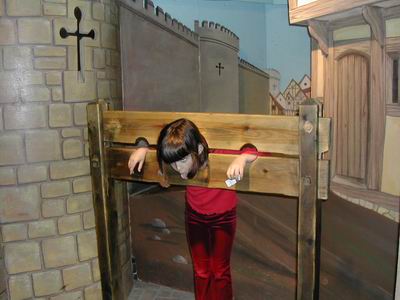
I am not referring to technology stocks. Rather, those wooden platforms used by our founding fathers to shame someone who had behaved badly. Head and hands were locked in place and the townspeople could stop by to lob a few inedible vegetables at your head.

Now that the general population and media alike have finally seemed to acknowledge that Iraq was the kind of bad idea usually excused only by heavy drinking, it is time to put some folks in the stocks. My nomination for the first session in the stocks? Bill Kristol, editor of the Weekly Standard and man so clueless that he doesn't know that he's clueless - the media's biggest cheerleader for wars of invasion and occupation.


What Nobody Says About Social Security


One of the reasons that social security is projected to be a problem is that our population is aging. This problem of more retirees per working person is even worse in places like Italy and Japan. Whereas as one point about 7 - 10 people all chipped in to fund the social security payments of the retired, the projection is that once baby boomers retire the ratio will be more like 4 - 5. Obviously this strains the system.

But system boundaries can be redefined. If you instead define the problem of one of working to non-working population, the problem is less onerous. It is not just those over, say, 65 who working people have to carry; they also carry those under, say, 20. It is worth remembering that as the number of children drops, the ratio of working people to children will raise. If at one point there were about 4 - 5 working people chipping in for the schooling, etc., of every minor, the projection is that it'll be more like 7-10 in the future.

Looked at as a problem of working age population to not-working population (a group made up of school-age children and Winnebago-driving seniors alike), the problem is easier to solve.

(Blogger's note - I'm quickly writing this note in between breakfast and the start of my work day. My researcher has yet to show up for work (and I'm not sure what year they are scheduled to start but apparently it isn't this year), so the numbers I've used are for purposes of illustration only and would match reality only by coincidence. Further, the cost of funding retirement is greater than the cost of funding schooling, so the ratio doesn't have to neatly flip in order for the funding to neatly flip. The point is, you get the point.)

Conservatives don't point this out because they don't want to save social security. Like a man who doesn't wake up his wife in a house fire - not because it would have been too dangerous but because he already had his eye on a younger, sexier wife - conservatives are hell-bent on private accounts (a bad idea that deserves its own posting).

Liberals don't point this out because it suggests shifting money from education to retirement, a budget change that sounds like they're giving up on the future - or at least it sounds like they are giving up on the teacher's unions, one of their stronger supporters.

29 November 2006

Two Evils

“Our discontent begins by finding false villains whom we can accuse of deceiving us. Next we find false heroes whom we expect to liberate us. The hardest, most discomfiting discovery is that each of us must emancipate himself.”
- Daniel J. Boorstin

There are two evil yet alluring philosophies offered in the world of politics. One is the allure of offering strong leadership under which we can be safe; we give up our freedoms and rights and in return we are protected. The other offers supposed freedom that is really just disconnection from consequences, irresponsibility under the guise of freedom. The first is the tyranny of an abusive father. The second is the tyranny of spoiled children. In neither is there room or expectation that the individual will create a life of consequence.

My Nomination for the 2006 Campaign's Most Amazing Moment


At one point during his campaign, Arnold Schwarzenegger was standing in Chinatown in LA, surrounded by the delightful buildings and sights made to look like China. Arnold - the Austrian immigrant who thinks he governs a place called Callie-forn-ya. And he says, The key to success as an immigrant is to assimilate.

Rather than comment, I will resort to another quote, this one by Bill Moyers, from an interview he did for Salon in April of 2003.

"I just did a six-hour series, five years in the making, on the Chinese in America. I thought the timing would be unfortunate, but it turned out to be fortuitous. This is the first series I've ever done, in 30 years, in which I actually found the answer to the question that provoked me to do it. I wanted to find out what the Chinese had to say about becoming American, about the American dream.

"One woman I interviewed, out of the dozens of people I spoke with while making that series, explained it all to me. She began to talk to me about eating chicken feet. You've seen chicken feet in Chinese restaurants, right?"

"Yeah. They're terrifying."

"Well, yes, they're ugly, they don't look particularly nutritious, people are squeamish about them. She said to me, 'As an American, I can eat chicken feet. But I don't have to eat chicken feet. I can turn around and eat at McDonald's and nobody questions me.' I said to her, 'What the hell does that have to do with the American dream?' She says, 'That is the American dream! That I can compose my own life. That I can invent who I want to be.'

"We are creating a new American identity, and to take our identity as being opposed to the world, instead of being of the world, is the greatest mistake that George W. Bush has made."

28 November 2006

Las Vegas is Your Future


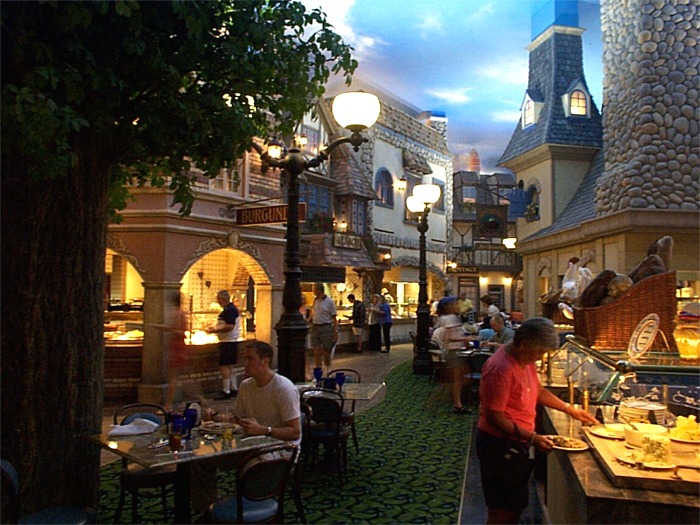
I went to Las Vegas last week and am always fascinated by the place. I can't help but wonder whether Vegas is your city's future.

It's not hard to imagine that as we become more anxious about avoiding boredom we'll adopt the themes that garnish their places of commerce. Our restaurants, shops, and public places may be modeled after great sites like the Pyramids, Paris, or Mecca (okay, maybe not Mecca).

If you were to fly someone around in a hot air balloon 100 years ago, floating above the earth's surface, what are the odds that they would have chosen the site of Las Vegas as the world's most popular tourist destination by the year 2000? There is a certain kind of genius there that even I, a guy who has yet to gamble a total of $20 in my entire life, can admire.

What are they marketing besides fascinating sites? Hope. We are creatures of hope and without it life is hopeless. The casinos are merchants of hope and we accept risk in return for hope. And this is the inescapable equation of life -embrace risk to get hope. We see it when we chose a major in school, a partner in life, start a business, or simply plan a vacation. Risk and hope come as a package deal.

And in this Las Vegas offers acceleration for those impatient with how gradually their lives are unfolding. Life is a game of chance but it can take decades for the dice to land. In Vegas, the frenetic energy translates into acceleration: results - good or bad - are played out instantly, the feedback immediate.

In 30 years, you may be wandering through a public place that looks like Stonehenge, complete with Druids chanting poems, and you'll know by then how the dice have fallen for your life. Wherever you are, you'll find yourself in Vegas - either a winner or loser or having oddly broke even and inexplicably caught in a strange place and time that looks vaguely reminiscent of a place you've never been.

Recycling Politicians

The US seems stuck. We can't get out of Iraq and we can't stay in. The Iraqis are rejecting American-sponsored democracy, seeming to favor something more absolute, less given to the vagaries of public opinion - something like the religious leadership and political stability offered by a caliphate. Meanwhile, the Republican Party suffered defeat this month in no small part because it was seen to be too intent on ignoring reason and science in favor of religious beliefs. As a result, a number of Republican politicians are unemployed.

Once again, the very juxtaposition of these problems immediately suggests a solution. We don't leave or stay in Iraq. That is, our troops leave but we exchange them for our leftover politicians. Republicans could offer the religious rule that many Iraqis seem to prefer to democracy. The Iraqis have stability. The politicians who gambled their very careers to bring good government to Iraqis have a chance to be that government. The US is free to move on, continually buffeted by the inevitable turbulence and uncertainty that characterizes this wonderful mess we call religious freedom and democracy. And should he accept the role as Iraq's Defense Secretary, Rumsfeld would finally have the lean military he has wanted for decades.

At last, the happy ending the world has been craving.

At Least This Pope Has a Crazy Sense of Humor

Today's News, courtesy of the AP: "Pope Benedict is calling on leaders of all religions to turn their backs on any form of violence in the name of faith."

From 1981 until he was elected pope, the former Cardinal Ratzinger was head of the Congregation for the Doctrine of the Faith - once known as the Holy Office of the Inquisition.

What does it mean to turn your back on violence? Apparently it means to ignore it. So often religious leaders get so self-important and somber that it's good to see that this pope has an appreciation for the absurd.

What OJ Tells us About the Media

Once upon a time, in a land not so very far away, the media had a particular role. Its business objectives included making a profit, yes, but its purpose was to make this a better country.

In today's world, the health of the Republic is subordinated to profits. Fox demonstrated their commitment to this principle of profits first when they decided to broadcast OJ explaining how he would have murdered his children's mother if he had. The fact that Fox chose not to go through with this plan says nothing about their conscience and everything about their awareness of the power of consumer boycott.

The enlightened person realizes that one's own fate is always bound up in the community she's a part of. We exist only in a web of relationships and to ignore the health of this web is to ignore any credible definition of self. Yet what are the prospects for a community when their very media forgets this?

Business guru Peter Drucker said that a business's purpose is never to make a profit anymore than a person's purpose is to breathe. Profit is necessary for a business but it is not a purpose. One wonders how well, if at all, the modern media could articulate such a purpose if unable to use the words "ratings" or "profit."

Perhaps the saddest thing about this is how keenly so many journalists realize this and how well they could articulate a mission. Yet one of the things that I repeatedly see as I go into organizations - from medium-size companies to Fortune 10 companies - is that leadership, sadly, sets the bounds for ambition and rarely can any individuals within an organization sustain efforts that transcend the bounds set by management.

27 November 2006

Wages at an All-Time Low - and that could be a good thing


Wages and salaries constituted only 45% of the GDP last year - the lowest it has been since records were kept in 1929. I think that could be a good thing.

How could a populist applaud the erosion of the working man's wages? Well, one other large component of the GDP is corporate profit. And the fact that everyone keeps forgetting is that in just the last few decades, the ownership of corporations has been rapidly dispersed to a wider and wider group of people. As corporate profits account for a higher percentage of GDP, profit-sharing can be more widely dispersed. Lower wages doesn't necessarily translate into lower household incomes.

The return to knowledge work is wages and salaries. The return to entrepreneurship is profit. As we manage to popularize entrepreneurship (one component of which is the dispersion of corporate ownership), we should encourage the fact of households getting a higher percentage of income from profits.

The point is not to bemoan a decrease in incomes as a percentage of GDP. The point is to insist on an increase in profit sharing so that individuals' goals are aligned with their employers and so that the resultant increase in shared profits and wealth more than compensates for a relative decline in wages.

el goog - the reverse search engine

Google works by pointing us to the most popular sites. It basically encourages conformity of thought by herding us all in one particular direction on any given topic. It has become the new traffic cop of thought and research.

Because of this, I propose a reverse google - "el goog" - as a means to counter its force. El Goog would point you in the direction of fringe theories, dissident opinions, and marginalized thinkers. Where google might begin with a refernce to Wikipedia or the BBC, El Goog would point you to sites that explain conspiracy theories. It might simply sort the sites returned by means of a random priority algorithm.

El Goog! Resist the herd mentality.

The End of Education as We Know it


I once did a calculation, projecting that we'd increase the level of education as much in this century as we did in the last. In the last century, only a small percentage of 13 year-olds were in school and even a smaller percentage of the twenty-something population was. By 2000, about 97% of the 13-17 year-old population was engaged in formal education and about 20-some percentage of adult population had a college degree. This has helped to fuel a huge increase in productivity and economic growth and the importance of education is widely accepted. The problem is, we can't continue with the same model of more formal education for more people as a means for continued economic growth.

If we continued to increase education as much in this century as we did in the last, we'd have a generation of 50 year-old graduates in 2100. Barring some wild innovation in student loan programs, this is probably not feasible.

So given that education is so vital, how do we improve it as much in this century as the last? The answer will probably take a century to articulate, but I suspect that it will start with an observation made by one of our great thinkers.

Russell Ackoff points out that we've taken a classically analytic view of work, play, and learning - approaching them each as separate. We build schools where people are expected to learn but not play or work. We build stadiums and playgrounds for play. Factories where people are not expected to play or learn. Although the human experience defies such neat boundaries - play, work, and productivity are not so neatly contained within proscribed environments - we nonetheless pretend that it is.

Perhaps the answer to learning is to break down the walls between work and learning and play, changing our expectations of all institutions. Montessori's high schools are much rarer than Montessori preschools. Why? Perhaps part of the reason is that she felt that teens were ready to run businesses as a means to both feel productive and to learn. Imagine how much that could benefit communities? And what of requiring any MBA grad actually manage a community improvement project - some activity directed at addressing a problem of road salt dumped into creeks reducing the number of trout spawned? or homeless populations that lower property values? or intersections with accidents? or creating a voice for residents trying to influence local government? Imagine a work place that actually awarded a group of employees a degree for deciphering the code of their culture and how to change it for the better - a task that may involve a blend of formal education, assessment and practical changes to policy?

25 November 2006

How to Measure Fair?

I recently read that the world's two richest men - Bill Gates and Warren Buffet - said that the most important issue facing communities was the issue of economic fairness. To my thinking, there are at least two measures of economic fairness: distribution of income and social mobility.

The first, income distribution, is fairly straightforward. People are born with a variety of skill sets and abilities. Some are able to make millions per year and some can barely tie their shoes. It seems as though a fair economic system would let the folks who make lots of money keep lots (but not all) of their money and would make sure that everyone has at least the first two levels of Maslow's hierarchy (physiological needs and safety needs) met. Communism in its purest form is not fair because it doesn't let those who work harder or smarter or better keep more money. Capitalism in its purest form is not fair because it ignores the plight of the inevitable losers.

The second measure of fairness is social mobility - the degree to which those born to poor parents can and do become rich or those born to rich can and do become poor (and the middle class rise or fall as well). We want an economic system that rewards initiative, creativity, intelligence, and hard work. These character traits are not limited to second and third-generation wealthy, so we would expect to see some variation from generation to generation.

In an economy so dependent on knowledge work, a fair economic system depends on a fair school system - giving each child, no matter how poor his neighborhood, the chance to gain academic and vocational skills that could enable him to make as much money as someone born to affluent parents.

24 November 2006

Finally - A Plan for Iraq

Here's a plan that would save us money and lives and might even gain us friends in Iraq. Only Halliburton might lose in this plan.

First, it is worth noting that before the invasion, Iraq's total GDP was $22 billion. We are now spending $100 billion a year on the occupation. The plan follows almost automatically from the juxtaposition of these two facts.

Pull out the troops. In its place, put in a plan to pay each Iraqi a sum that would total up to about $55 billion - about $1,000 per Iraqi and more than twice as much as they had before the invasion. This plan suggests a variety of questions, but it would be an opportunity for the conservatives who so strongly supported the invasion to show their faith in markets.

How to rebuild Iraq? Let every family have money to pay for contractors to repair their portion of the country. This might well prime the pump, stimulating construction projects and new businesses. We could have a plan to pay the sum for, say, two years, and after that draw down the sum by about 20% a year until it reaches a stable point.

What would be the result? We'd save money and lives. Iraqis would have resources to help themselves. And the 50% plus unemployment might even drop as the economy was infused with money that could be used to buy goods and services.

What is the old bumper sticker? Tourists go home (and leave your daughters). This could be similar. Troops go home (and leave your budget). It's time that the conservatives remembered that they don't trust government programs and do trust markets. Let their policy reflect this.

Ugly Residue of Protestant Faith

Martin Luther was able to form a new religion in no small part because he appealed to the desire of German princes for independence from Rome. At one point he wrote "Some have estimated that every year more than 300,000 gulden find their way from Germany to Italy … We here come to the heart of the matter. … How comes it that we Germans must put up with such robbery and such extortion of our property at the hands of the pope?"

The Protestant movement coincided with the emergence of nation-states as the new dominant institution in the West. Having a state religion made it easier for the head of state to maintain control. It also became a catalyst for centuries of wars that were fought by parties who saw little difference between religious affliation and patriotism.

In this is the still unfortunate residue of the Protestant innovation in religion. At its best, the Protestant faith shows an independence from church dogma that characterized centuries of the Roman Catholic monopoly on thought. At its worst, it becomes an adjunct to the feelings of national superiority that justify violence or injustice.

At its best, religion transcends national boundaries. At its worst, it becomes apologist for the meanest of nationalist feelings.

The Invention of Santa Claus

In the late 1800s, factory output soared. Suddenly, factory owners no longer limited by how much they could make were limited instead by how much they could sell. Capitalists had learned to rapidly make products; in order for this new economy to work, consumers had to learn how to rapidly consume them.

One key to this was retail. Department stores emerged about this time – Marshall Field’s in Chicago and Macy’s in New York were doing business during the Civil War. But the success of consumerism depended on two fascinating social inventions that helped make the new retailers successful: window displays and Santa Claus.

Advertising was not new to this period. But a particular form of it was. Department stores had to stimulate interest and one way that was done was through store window displays. In the late 1800s, it was considered rude to stare into windows, so stores hired professional gawkers whose job it was to stare into store display windows and induce others to do the same. A pioneer in store window displays was L. Frank Baum (1856 to 1919) – better known as the author of The Wizard of Oz (1900). Both his books and displays invited observers into a magical world that promised delight.

The second social invention has become as ubiquitous: Santa Claus as we know him was an invention that helped to transform this period of mass production into one of mass consumption. It is no coincidence that Christmas gift giving emerged from this period. “In 1867, Macy’s department store remained open until midnight Christmas Eve, setting a one-day record of $6,000 in receipts.” Around 1870, Christmas made “December retail sales more than twice those of any other month.”[1] Santa Claus and window displays were simply forms of a new and important activity – marketing - changing people's minds about what they considered normal purchases.

In the words of children, what did Santa Claus bring us? By 1870, the United States had the largest economy in the world. “For the first time in history, even ordinary folks could aspire to ownership of those hard goods – watches, clocks, bicycles, telephones, radios, domestic machines, above all the automobile – that were seen in traditional societies as the appropriate privilege of the few. All of this was facilitated in turn by innovations in marketing ... Mass consumption made mass production feasible and profitable; and vice versa.[2]”

Merry Christmas and Happy Shopping.

[1] James R. Beniger, The Control Revolution: Technological and Economic Origins of the Information Society (Cambridge, MA: Harvard University Press, 1986) 260.
[2] David S. Landes, The Wealth and Poverty of Nations: Why some are so rich and some so poor (New York: Norton, 1999) 307.

23 November 2006

Fourteen Categories of People

There are a variety of reasons that my politics tend left. One is my sincere confusion about the absolutes that seem so absolutely clear to so many on the right.

For instance, the conservative may think that some are worthy of some kind of public assistance - perhaps orphans and widows - and others should fend for themselves. That is not so clear to me. It seems to me that there is, instead, a spectrum and the lines one draws, the categories that are useful, depends on the situation.

I don't consider myself needy but there was a stage in life when I greatly benefited from public assistance. My parents provided for me. I have no obvious physical handicaps (you have to watch me engage in sports before my lack of celerity, coordination, and skill become glaringly apparent). To a certain brand of conservative, I would likely be an example of someone who needed no public assistance. And yet I could have never afforded to pay for college myself - not private college that is. I was only able to get university degrees because my education was subsidized by the government. Could I have made a living without university degrees? Yes, but I doubt that I would have done as well.

To neatly categorize people as those who need help and those who do not is to set arbitrary categories that ignore the subtleties and grays of reality. As I listen to some conservatives offer their stark truths I think of the delightful (and fictional) Chinese encyclopedia, the Celestial Emporium of Benevolent Knowledge that Jorge Luis Borges pretends to quote, as follows:

"For your consideration, friends, the fourteen kinds of animals: those that belong to the Emperor, embalmed ones, those that are trained, suckling pigs, mermaids, fabulous ones, stray dogs, those included in the present classification, those that tremble as if they were mad, innumerable ones, those drawn with a very fine camelhair brush, others, those that have just broken a flower vase, those that from a long way off look like flies."

I realize that much of liberal policy can seem wishy-washy, to come in shades of gray rather than black and white. I suppose that if the world seemed to me more clearly black and white, I would more readily embrace a philosophical stance that was less nuanced, less full of caveats. But I do know that there are about as many categories of things as there are people to categorize them. Some people look embalmed, some are trained, some are pigs, and some tremble when they are mad. Along this spectrum of people one has to draw the line differently for different reasons.

If we are serious about freedom, we have to allow each individual this most personal of freedoms – the freedom to categorize the world as he or she sees fit. It is this element of freedom of religion that still so few understand. In such a world, to have one group stand up and pretend to talk for everyone is not just scary – it seems as though their description of reality is as odd as Borges’ fourteen categories of animals.

21 November 2006

Wealth and Power in the Attention Economy

In the attention economy, there are three classes: those who depend on others for the structuring of their attention, those who are independent, and those who structure the attention of others.

Wealth and power in this attention economy suggests control over the attention of others. You may run the company in which thousands work, able to direct the attention of the company towards a particular market or emphasis. You may control the media that directs the attention of viewers, listeners, or readers. You may write influential books or TV shows that change how people think or write sofware programs that define how they work.

Poverty in this attention economy suggests dependence on others for the structuring of attention. You may depend on a boss to tell you what tasks to think about and how to think about them. You may depend on TV programming to decide where to focus for the evening or weekend.

Who controls your attention? Whose attention do you control? The answer to those questions suggests a great deal about the resources you have command over. Because until you have control over your own attention, you can’t control much else.

17 November 2006

Airport Security Made Simple

As a frequent flyer, I spend too much time in airport security lines. I've put time in line to good use and thought up a simple solution for the problems of having to repeatedly show ID: wear a simple t-shirt that has an arrow pointing up to my face and just below it text that says, "Yep, it's me."

Two Paradigms Walk Into a Bar

Two paradigms walk into a bar. The one paradigm says,
“I’m right and can quote myself to prove it.”
The other paradigm sits stunned, looking at his drink. He finally looks up, dazed. “You are a reliable source?”

Paradigm 1 says, “As I was saying just yesterday.”
Bartender: “You’re quoting yourself?”
Paradigm 1: “Sure. Who else can I trust?”

Bartender: “But you aren’t always consistent.”
Paradigm 1: “It seems to me that I am.”
The bartender turns to the second paradigm. “How about you? Do you trust your memory?”
Paradigm 2: “Sure. I mean, what I remember always seems to jibe with everything I can remember.”
Bartender: “Don’t you ever forget?”
Paradigm 2: “Not that I remember.”
Bartender: “What if I could point out to you times when you forgot?”
Paradigm 2: “You have apparently forgotten that I don’t trust anyone else's memory.”

The bartender asks, “You really don’t refer to any other sources?”
“I don’t trust any sources other than me,” say paradigm 1 and 2 simultaneously.
They look at each other, surprised.
“At last,” says the bartender. “Something you two agree on.” He smiles. “You finally have some basis for agreement.”
“I’m not so sure,” say the paradigms, once again in unison.
After staring incredulously, the bartender finally admits, “You may be right.”

16 November 2006

A Life of Faith

Faith is a fragile but vital thing. Lives are acts of faith. Relationships require faith. Learning suggests faith in the future relevance of what you’re learning. Many of us are aided through life by faith in a God of love. But one of the hardest things to retain faith in is the self you have yet to become.

Faith is the evidence of things not seen. That is, it is evidence that is created because the individual undertook a task or project not prompted by evidence but, rather, by hope or expectation. A life of faith need not require faith in the supernatural, metaphysical, or God.

All of us have some notion of what we aspire to become. To lose faith in some variation of that is to accept that our life will never be different than what it has been. At best this prospect is tiring. And oddly, such resignation is itself an act of faith – faith that things will never change.

The beauty of faith is that it doesn’t require past evidence. The beauty of faith lived is that it will eventually create its own evidence. If even one person has faith that a God of love works through individuals to show care, there will be evidence that a God of love works through individuals to show care. If you have faith in the you who has yet to be, you will eventually create evidence of that self. Faith is a fragile but vital thing. Nurture your faith until it reaches the point that it has produced its own evidence.

I’ve grown convinced of two things. Most people have little sense of their own potential, of what they could become, of the impact they could have, of the fullness with which they could live life. And almost no one realizes how much work it will be to realize that potential. Getting through it all requires faith. Don’t mock your own sense of potential, no matter how ill-formed or unrealistic it may be. Nurture it, grow it, create something real with it. It just might return the favor, because this is, ultimately, a reciprocal relationship: first we nurture our faith and then it nurtures us.