The first amendment is among the great inventions of history.
"Congress shall make no law respecting an establishment of religion, or prohibiting the free exercise thereof; or abridging the freedom of speech, or of the press; or the right of the people peaceably to assemble, and to petition the Government for a redress of grievances."
It has five parts:
1. Freedom of religion or belief
2. Freedom to speak out in defense of or attack on beliefs
3. Freedom of the press to reach a wider audience
4. Freedom to assemble – or organize – around those beliefs
5. Freedom to take your cause to the government in order to effect change, through laws or budget.
It offers freedom of religion and freedom from religion. Just a century before, Europe had been torn apart by religious war and the result was 10 to 30% of folks on the continent killed. Our founding fathers knew the absurdity of legislating religion, whether trying to force someone to not believe something or force them to believe something.
But the first amendment is more important than that. Much more important. And it is brilliantly constructed to result in perpetual progress.
What freedom of religion really means is freedom of belief. The US can’t pass any laws to legislate what you believe. So essentially this is like giving 330 million Americans a license to generate all sorts of wild theories – some folks tales, some religious, some that - if taken seriously - will create great wealth and some that - if taken seriously - will result in death and destruction, some conspiratorial and some downright scientific.
But it doesn’t end there. You can speak about your belief and even go to press with your belief. You can argue for your own belief or against someone with a different belief. The first amendment says that you have a right to believe the earth is flat. It also says that everyone around you – from your neighbor to the nightly newscaster – has the right to tell you how stupid that is. And here is the really amazing thing about you going to press with your belief: it becomes something a little different in the mind of each reader. Your idea becomes the community’s idea. It changes. Your idea becomes bigger than you. In the same way that a gene can be passed on to someone else, an idea, a meme, can be passed on to others and - blended with other ideas - create something new. Someone once wrote, a city is where ideas come to have sex. Once it enters into other people's minds, becomes a part of the community's discussion, your idea will become something different than how it was born in your head.
What’s next? People can organize around this idea, this belief. The most obvious thing is that you can assemble and protest. Less obviously, you can engage in social invention and entrepreneurship to institutionalize your belief. Women organize to become suffragettes, arguing that they have the right to vote. Those groups are the first bit of organizing and then that takes us to the fifth bit of institutionalization.
You can bring your cause – your belief – to the government and work to have it translated into a new bit of legislation. The organized group of suffragettes who argued that women had the right to vote dissolved because they pulled off an even better bit of social invention: they changed the constitution so that women could vote. The reality girls are born into is now different because of their success.
The first amendment traces the trajectory of progress: you have an idea or belief, you talk about it with others, you even publish it, sending it out into the world to become something independent of you, and then people protest the status quo, arguing for this new belief to be made into a new reality and then …. It becomes the status quo for the next generation. It is not enough that Isaac Newton knows the calculus he has invented. What is really powerful is that we teach calculus to teenagers and it simply becomes a common tool for them to model and manipulate reality. At that point – the point at which your idea is institutionalized – the status quo becomes something very different.
This is how progress is made. And that may well be the most beautiful and remarkable thing about the first amendment. It actually traces a thought in your brain into a new, shared reality babies are born into. Each child does not have to start civilization from scratch. We simply don’t have time for that. What we’ve institutionalized becomes the starting platform for the next generation … who begin this process of creating new beliefs that have to go through the stage of challenging and spreading and then becoming the next thing that is institutionalized. The first amendment is so much but to me perhaps the coolest thing is that it is a description of progress.
The first amendment is not about demanding respect for old ideas and traditions. It is about demanding respect for new ideas and innovation. The first amendment is the social invention that itself generates new social inventions. That’s something to shout about. And thanks to the first amendment, you can.

R World (Ron Davison muses aloud)
Showing posts with label progress. Show all posts
Showing posts with label progress. Show all posts
18 September 2020


09 September 2020
The Catastrophic Bug in Nationalism and Why Trump is Working to Remove The Globalization Code that Fixes It
A bug can cause a piece of software - or even a civilization - to crash.
The Mexican War and the Louisiana Purchase of the 1800s had left the US with large numbers of people who spoke Spanish and French. That variety persists. In California, 220 languages are spoken and 44% of Californians speak a language other than English at home. Some states have declared English as their official language; the US never has.
For the West, nationalism had become normal about 1900. And then the West discovered that nationalism contained a catastrophic bug.
World War 1 killed 10 million soldiers and 10 million civilians. (And the pandemic that spread as soldiers came back home at war’s end – the Spanish Flu – killed another 50 million around the world.)
The second world war killed four times as many people as the first, leaving 80 million dead.
One world war might be an accident. Two world wars suggest a terrible bug in this new phenomenon of nationalism.
Nationalism could work, world leaders realized, if they created global organizations like the United Nations, NATO, the World Bank, and GATT. These institutions greatly decreased wars and increased prosperity. Since 1950, only 100,000 people have died in warfare in Europe, about 1% of the total killed in the two world wars. And GDP growth accelerated. Between 1900 and 1950, GDP in England grew 50%. Between 1950 and 2000, it grew 234%.
It bothers me that people are not more bothered by Trump’s focus on dismantling globalization. Who benefits from his vandalism? Well, Putin certainly would. Russia is no match for NATO but Russia can easily match any single country within Europe. If we’re back to nationalism, Putin is far more powerful.
But I don’t think that Trump’s nationalism is all about helping his buddy Putin. It is a way to rally the base. Talk about international law or trade deals and normal people will glaze over and conspiracy theorists will light up. Globalization may let people live in peace and prosperity but – oddly – it is not going to win any elections. Now talk about how “they” are rapists and murderers or our stealing our jobs and you’ll rally the base. Nationalism excites tribal impulses.
We have instincts for sex and violence; folks who write scripts exploit that to get higher ratings. We have instincts for tribalism and nationalism; folks who run campaigns exploit that to get more votes. Those impulses make for terrible guides to actual behavior, though. They can create chaos. We’ve seen the chaos that the worst impulses of nationalism and tribalism could create in the first half of the 20th century. If we don’t protect the project of globalization, we could see it again.
The new invention of the nation-state spread throughout the West during the 1800s. Inspired by Americans breaking away from the British Empire and French decapitating royalty, Europeans began turning themselves into nationalists. This new software of nationalism was largely installed by about 1900, but also had some catastrophic bugs that resulted in two tragic world wars between 1900 and 1950.
The West found out that nationalism worked great with the addition of new code called globalization, creating institutions like the UN, NATO, and the World Bank. Now neo-nationalists like Trump, Duda in Poland and Orban in Hungary are trying to un-install the globalists code. If they’re successful, it could repeat some of the catastrophes of the early 1900s.
The idea behind nationalism was to align a people with a government. Sometimes that meant breaking away: Czechoslovakia could break away from the Austro-Hungarian Empire. Sometimes it meant consolidating: isolated, feuding regions could be combined into a nation state like Italy, Germany or the United States. (The American Civil War ended in 1865, turning a confederation into a union. In 1870 and 1871, Italy and Germany became nation-states.)
As a concept, nationalism is a great idea. In practice, it’s messy. At one point, Czechoslovakia is part of an Austro-Hungarian Empire, at another it is a country and at another point it is two countries - Czech and Slovak. And of course, no one can tell you which is “real.”
It took a long time to make nationalism real for everyday people. One bureaucrat who went out into the French countryside in the late 1800s asked a room full of school children what country they lived in. None could tell him. At the time of the French Revolution 75% of the country spoke a language other than French; a century later it was still a third.
In the US, the variety of language and cultures were even greater than it was in France. By 1900, 20% of Iceland had moved to the US and the US was home to more people who’d been born in Ireland than still lived in Ireland. Another 5 million had come from Germany. Immigrants weren't just coming from Europe. By 1870, Chinese immigrants and their children made up nearly 9 percent of California's population, and one-quarter of the state's wage earners, and one-third of Idaho's settlers. These new immigrants merely added to the variety of cultures and languages already here.
The West found out that nationalism worked great with the addition of new code called globalization, creating institutions like the UN, NATO, and the World Bank. Now neo-nationalists like Trump, Duda in Poland and Orban in Hungary are trying to un-install the globalists code. If they’re successful, it could repeat some of the catastrophes of the early 1900s.
*********
The idea behind nationalism was to align a people with a government. Sometimes that meant breaking away: Czechoslovakia could break away from the Austro-Hungarian Empire. Sometimes it meant consolidating: isolated, feuding regions could be combined into a nation state like Italy, Germany or the United States. (The American Civil War ended in 1865, turning a confederation into a union. In 1870 and 1871, Italy and Germany became nation-states.)
As a concept, nationalism is a great idea. In practice, it’s messy. At one point, Czechoslovakia is part of an Austro-Hungarian Empire, at another it is a country and at another point it is two countries - Czech and Slovak. And of course, no one can tell you which is “real.”
It took a long time to make nationalism real for everyday people. One bureaucrat who went out into the French countryside in the late 1800s asked a room full of school children what country they lived in. None could tell him. At the time of the French Revolution 75% of the country spoke a language other than French; a century later it was still a third.
In the US, the variety of language and cultures were even greater than it was in France. By 1900, 20% of Iceland had moved to the US and the US was home to more people who’d been born in Ireland than still lived in Ireland. Another 5 million had come from Germany. Immigrants weren't just coming from Europe. By 1870, Chinese immigrants and their children made up nearly 9 percent of California's population, and one-quarter of the state's wage earners, and one-third of Idaho's settlers. These new immigrants merely added to the variety of cultures and languages already here.
The Mexican War and the Louisiana Purchase of the 1800s had left the US with large numbers of people who spoke Spanish and French. That variety persists. In California, 220 languages are spoken and 44% of Californians speak a language other than English at home. Some states have declared English as their official language; the US never has.
For the West, nationalism had become normal about 1900. And then the West discovered that nationalism contained a catastrophic bug.
World War 1 killed 10 million soldiers and 10 million civilians. (And the pandemic that spread as soldiers came back home at war’s end – the Spanish Flu – killed another 50 million around the world.)
The second world war killed four times as many people as the first, leaving 80 million dead.
One world war might be an accident. Two world wars suggest a terrible bug in this new phenomenon of nationalism.
Nationalism could work, world leaders realized, if they created global organizations like the United Nations, NATO, the World Bank, and GATT. These institutions greatly decreased wars and increased prosperity. Since 1950, only 100,000 people have died in warfare in Europe, about 1% of the total killed in the two world wars. And GDP growth accelerated. Between 1900 and 1950, GDP in England grew 50%. Between 1950 and 2000, it grew 234%.
It bothers me that people are not more bothered by Trump’s focus on dismantling globalization. Who benefits from his vandalism? Well, Putin certainly would. Russia is no match for NATO but Russia can easily match any single country within Europe. If we’re back to nationalism, Putin is far more powerful.
But I don’t think that Trump’s nationalism is all about helping his buddy Putin. It is a way to rally the base. Talk about international law or trade deals and normal people will glaze over and conspiracy theorists will light up. Globalization may let people live in peace and prosperity but – oddly – it is not going to win any elections. Now talk about how “they” are rapists and murderers or our stealing our jobs and you’ll rally the base. Nationalism excites tribal impulses.
We have instincts for sex and violence; folks who write scripts exploit that to get higher ratings. We have instincts for tribalism and nationalism; folks who run campaigns exploit that to get more votes. Those impulses make for terrible guides to actual behavior, though. They can create chaos. We’ve seen the chaos that the worst impulses of nationalism and tribalism could create in the first half of the 20th century. If we don’t protect the project of globalization, we could see it again.
28 August 2020
Why Jeff Bezos is Worth $200 Billion
Bill Gates became the richest man in the world in 1995 for creating a platform (in the form of Word, Excel, Outlook, Project) that enabled knowledge workers to be more productive.
Jeff Bezos became the richest man in the world in 2018 for creating a platform that enabled entrepreneurs to be more productive.
Not only does Amazon have more than 500,000 employees, it has "2 million sellers, hundreds of thousands of authors, [and] millions of Amazon Web Services developers.” And, Bezos reports, "In 2017, for the first time in history, more than half of units sold on Amazon worldwide were from third-party sellers."
Bezos' wealth reached $200 billion yesterday, further evidence to me that we're transitioning from an information to an entrepreneurial economy. Meanwhile, we have a president still assuring his base that he'll make America great again again by getting them back into an industrial economy.
Every second the software that drives the Amazon platform is updated multiple times. The software in our head that defines our worldview gets updated far more slowly than that. The latter has created a crisis; the former more than a trillion in wealth.
27 August 2020
How Our Technology Continually Expands Our Notion of Us: An argument for globalization
In 1968, this iconic shot of earth was broadcast by NASA. Inspired by this new perspective, earthlings quickly organized themselves differently
"In three remarkable years between 1969 and 1971, Friends of the Earth, the National Resources Defense Council, Greenpeace, and U.S. Environmental Protection Agency (EPA) were created and the first Earth Day was proclaimed." [from Jamie Metzel's Hacking Darwin.]
What is globalization?

The music you listen to is your own concern. The volume and time at which you listen to it is of concern to your entire apartment complex.
Some issues will always be personal. Your favorite music, for instance. Technology - like a stereo that can play at 100 decibels - can turn personal issues into community issues.
Factories that made enough goods to sell across state lines, trains to carry those goods across state lines, and telegraph lines to rapidly communicate across state lines changed us from a confederation of states into a union. Before Lincoln, nearly all communication stated, "The United States are ..." After Lincoln, it stated, "The United States is ...." Technology changed states' issues into national issues.
Today, container ships have driven down the price of transportation to effectively make ours one global market. The marginal cost to transport one can of beer or soda 3,000 miles is one cent. A sweater is 3.5 cents. The internet lets you have a video conference with someone in Croatia as easily as you would talk to your neighbor. The technology of the late 1800s made us a nation. The technology of the early 2000s has made us a globe.
You will hear - you have heard - a lot of nonsense about globalization from nationalists who want you to believe that those globalists in the apartment complex want to dictate what music you listen to. Nobody cares about your taste in music but they do want to sleep uninterrupted at 2 AM. The fact that you find it exasperating to think about how dependent we are on foreigners and they are on us doesn't mean that it is effective policy to ignore it. Globalization is not about 7.5 billion people dictating how you live; it is about acknowledging how many people depend on you - and how many people you depend on - to live.
It is likely cliche and probably minimally helpful to say that some issues are truly personal, some involve your family, some the folks in your neighborhood, some the people in your state and some are global. Where the proper boundaries lie for determining whose concern those are will shift and be subject to debate. That's true. But what is also true is that just as our space program let us see the earth as a whole, our technology continues to make our world larger, making us increasingly dependent on faraway people. Just as you can't un-see this picture, you can't undo the inter dependencies that define our world. Globalization isn't about creating those inter dependencies; it is about having mechanisms - like the UN and WTO - to address them.
19 August 2020
The Middle Class is Shrinking - And That's a Good Thing
The middle-class shrunk between 1967 and 2016. And that's a good thing.


The middle-class, lower middle-class and poor made up 94% of the population in 1967. (Yes. These numbers are adjusted for inflation.) By 2016, they were only 65% of the population.
The upper middle-class and rich rose from only 6% of the population to 35%.
Nearly a third of the population (well, 29%) moved from middle-class and below to upper middle-class and above.

Class matters to class. Go to class if you want to move up in the income ladder. Knowledge workers - folks with a BA - have gained the most from advances in information technology in the last generation.
Income gains have slowed in the last generation. Between 1967 and 1981, incomes rose 27%; between 2002 and 2016, incomes rose only 8%. My theory is that by the end of the last century we had effectively broke the code on how to raise the productivity and incomes with the popularization of knowledge work but now at the dawn of this new economy we've yet to figure out how to popularize entrepreneurship to continue that trajectory.
All this suggests some simple policy recommendations. Invest even more in creating knowledge workers and entrepreneurs (investment that includes massive increases in R&D spending as well as policies like proliferating the number of incubators in communities as we did the number of libraries, schools and universities in past generations) and watch the percentage of rich continue to rise. Tax the rich and upper middle-class to both fund all those investments and to subsidize the poor so that they enjoy some of the fruits of this prosperity. So, make more people rich and the poor less poor. That seems like progress to me.
Stephen Rose's study Squeezing the Middle Class: Income trajectories from 1967 to 2016 is here.
18 August 2020
100 Years Ago Today Women Got the Right to Vote - and Reinvented What It Meant to be a Woman
100 years ago today women gained the right to vote in national elections. Two points about that.
One, product and social invention are often intertwined.
20 years before 1900, a woman would carry about 10 tons of fuel (wood and coal) and 40 tons of water in and out of the house each year. The invention of running water and electricity made it easy for more women to shift their focus outside the home. The woman as a political force was born.
In 1960, the Pill was approved and women could decide whether and when to have children. In 1968, Yale began to admit women. Today, more women than men earn university degrees. The woman as an economic force was born.
Two, progress has a clear direction: it gives more people more ability to live a life of their own choosing.
There is a simple question to determine to ask of a policy question: will this ultimately give more people more options? Healthcare coverage that lets more people live longer, healthier lives is progress. A population that lives to an average age of 85 has more options about what to do with a life than one that lives an average of 55 years. Educational policies that give more kids more options about what to do for a living or how to shape or make sense of their world is progress. Making it easier for more people in a community to vote is progress. Environmental policies and technology that promise to give the billions of people who will be living here in 100, 300, and 500 years just as many (or more) options to enjoy nature and affluence are progress.
Giving women the right to vote - like ending slavery or radically reducing greenhouse gas emissions - will never be considered radical by future generations. It is the sort of thing that makes future generations think that "they" (that "we") must have been a different species.
Communication and transportation technology is continually being reinvented. So is what it means to be a woman. Progress moves forward on a series of inventions, some technical, some social and all with the potential to disrupt.
100 years ago, women got the right to vote. And given how differently they vote, it was none too soon.
One, product and social invention are often intertwined.
20 years before 1900, a woman would carry about 10 tons of fuel (wood and coal) and 40 tons of water in and out of the house each year. The invention of running water and electricity made it easy for more women to shift their focus outside the home. The woman as a political force was born.
In 1960, the Pill was approved and women could decide whether and when to have children. In 1968, Yale began to admit women. Today, more women than men earn university degrees. The woman as an economic force was born.
Two, progress has a clear direction: it gives more people more ability to live a life of their own choosing.
There is a simple question to determine to ask of a policy question: will this ultimately give more people more options? Healthcare coverage that lets more people live longer, healthier lives is progress. A population that lives to an average age of 85 has more options about what to do with a life than one that lives an average of 55 years. Educational policies that give more kids more options about what to do for a living or how to shape or make sense of their world is progress. Making it easier for more people in a community to vote is progress. Environmental policies and technology that promise to give the billions of people who will be living here in 100, 300, and 500 years just as many (or more) options to enjoy nature and affluence are progress.
Giving women the right to vote - like ending slavery or radically reducing greenhouse gas emissions - will never be considered radical by future generations. It is the sort of thing that makes future generations think that "they" (that "we") must have been a different species.
Communication and transportation technology is continually being reinvented. So is what it means to be a woman. Progress moves forward on a series of inventions, some technical, some social and all with the potential to disrupt.
100 years ago, women got the right to vote. And given how differently they vote, it was none too soon.
10 August 2020
Understanding the Republican and Democratic Party Divide Today as a Divide Between an Industrial and Information Economy
The last time I was on Google's campus, I was training 7 project managers. At one point it came out that 6 of the 7 had gone to Saturday school for years to study language and get religious / cultural education. Mandarin, Hindi, Hebrew, Nubian-Muslim (the Nubian tribe is divided by the Egyptian / Sudanese border) and Korean are five of the six that I remember. Another time, I was in a room with about a dozen engineers at Intel and every single one had a story about green cards.
That sort of diversity is pretty normal for the tech and pharmaceutical companies I work with. If you are hiring and want the best and brightest, you hire from around the world. Even if China and India's universities turn out great engineers at half the rate of US universities, they will still turn out two times as many given their populations are four times ours.
One thing that I've concluded from decades of working with engineers and scientists is that creating a team able to win in a global market without first or second-generation immigrants on your team is about as tough as trying to win MLB, NBA or NFL championships without players of color. Given how talent shows so little regard for race or nationality, you’d be a fool to exclude any group if you’re serious about conquering a global market or world championship. You’re not going to find the talent you need within your local zip code.
Anti-immigrant and free-trade nationalists inevitably argue for the importance of an industrial economy. Why? Industrial capital is in a place. By contrast, intellectual capital is in people’s heads and hands. You can put up walls around industrial capital. Look at a place like North Korea to see that walls are an obstacle to the creation of intellectual capital – something created through the exchange of ideas rather than their suppression.
The two economies - industrial and information - have been created by two kinds of politics. And that brings us to the divide we have today.
The Republican Party under Trump is championing a set of policies that are fitting for an industrial economy. People who consider themselves part of this economy feel threatened by immigrants, free trade and universities.
That sort of diversity is pretty normal for the tech and pharmaceutical companies I work with. If you are hiring and want the best and brightest, you hire from around the world. Even if China and India's universities turn out great engineers at half the rate of US universities, they will still turn out two times as many given their populations are four times ours.
One thing that I've concluded from decades of working with engineers and scientists is that creating a team able to win in a global market without first or second-generation immigrants on your team is about as tough as trying to win MLB, NBA or NFL championships without players of color. Given how talent shows so little regard for race or nationality, you’d be a fool to exclude any group if you’re serious about conquering a global market or world championship. You’re not going to find the talent you need within your local zip code.
Anti-immigrant and free-trade nationalists inevitably argue for the importance of an industrial economy. Why? Industrial capital is in a place. By contrast, intellectual capital is in people’s heads and hands. You can put up walls around industrial capital. Look at a place like North Korea to see that walls are an obstacle to the creation of intellectual capital – something created through the exchange of ideas rather than their suppression.
The two economies - industrial and information - have been created by two kinds of politics. And that brings us to the divide we have today.
The Republican Party under Trump is championing a set of policies that are fitting for an industrial economy. People who consider themselves part of this economy feel threatened by immigrants, free trade and universities.
The Democratic Party - as it has been since about the time of Kennedy or Clinton - has a set of policies that are fitting for the information economy. People who consider themselves part of this economy see immigrants, free trade, and universities as essential.
To not understand the sharp divide in American politics is to not understand how much of the cultural war actually comes out of a perception of which economy livelihoods depend on. Whether something is essential or a threat is a question of which economy people consider themselves members of. And these two groups bring about as much passion to the topic as one might expect of people who see their livelihoods caught up in a particular set of policies.
Progress does have a direction, though.
William F. Buckley was one of the Republican Party's most respected intellectuals. He wrote, "A conservative is someone who stands athwart history, yelling 'Stop!'" To attempt to undermine the universities, immigration and trade that causes our information economy to thrive in order to protect the industrial economy is to do exactly that: yell stop to progress.
Republicans are fighting to protect the past, not create it. Since 1950, factory workers as a percentage of the workforce has dropped each decade and college grads a percentage of the workforce has gone up. Whatever economy we create in the future, it will be beyond the information economy, not back in time into the industrial economy.
To not understand the sharp divide in American politics is to not understand how much of the cultural war actually comes out of a perception of which economy livelihoods depend on. Whether something is essential or a threat is a question of which economy people consider themselves members of. And these two groups bring about as much passion to the topic as one might expect of people who see their livelihoods caught up in a particular set of policies.
Progress does have a direction, though.
William F. Buckley was one of the Republican Party's most respected intellectuals. He wrote, "A conservative is someone who stands athwart history, yelling 'Stop!'" To attempt to undermine the universities, immigration and trade that causes our information economy to thrive in order to protect the industrial economy is to do exactly that: yell stop to progress.
Republicans are fighting to protect the past, not create it. Since 1950, factory workers as a percentage of the workforce has dropped each decade and college grads a percentage of the workforce has gone up. Whatever economy we create in the future, it will be beyond the information economy, not back in time into the industrial economy.
08 August 2020
How Life Transformed in the 20th Century - and is likely to transform again in the 21st
A curious thing happened through the course of the 20th century: companies shifted their focus from making things to making money.
This may sound cliche but it is important. In 1900, the average home did not have running water, electricity, a car, a radio, telephone, TV, computer, store-bought clothes, frozen food, takeout, aspirin, a refrigerator, microwave oven, canned goods, sneakers, safety razors, shampoo, or credit cards.
Fortunes were made by the various companies able to produce those goods at affordable prices.
And then our curious thing happened: given these companies had gone public, they rather inadvertently created a new product: wealth. If you owned shares of a company that became successful, you could have one of the more curious products of all: financial independence.
And then our curious thing happened: given these companies had gone public, they rather inadvertently created a new product: wealth. If you owned shares of a company that became successful, you could have one of the more curious products of all: financial independence.
Between 1900 and 2000, life expectancy rose from 47 to 77. (And no, this was not all due to infant mortality rates dropping. Your odds of dying at any age - from six months to 20 to 50 to 70 - steadily dropped during the 20th century.) Old age was popularized in the 20th century and retirement was invented.
Pension plans and 401(k) accounts took advantage of decades of compound interest over these newly long lives to create enough wealth to fund retirements. People no longer had to work until they died or rely on the generosity of their children. And of course there is variation in all things and as it turns out, some people don't have enough to retire at 85, some have enough by 65 and some have enough to retire by 45.
At a certain point, more goods have less appeal. Your closet has more clothes than you'll wear, your freezer and pantry has more food than you'll eat, and your garage had more things than you use.
An amazing, unprecedented economy emerged in the 20th century, providing goods that past generations could not have imagined. Of all the goods it made, though, perhaps the most alluring was its promise of financial independence. Of all the things that companies could make that people were eager to buy, wealth ranked highest.
An amazing, unprecedented economy emerged in the 20th century, providing goods that past generations could not have imagined. Of all the goods it made, though, perhaps the most alluring was its promise of financial independence. Of all the things that companies could make that people were eager to buy, wealth ranked highest.
It it difficult to properly understand modern companies if you still understand them as institutions focused on making things. That was largely true a century ago. Now, they are largely focused on making people rich. (What does Google "make?" Well, they have made a lot of people rich.)
Henry Ford became famous for making cars affordable for normal people. Previously, they were something only the very few, very wealthy could afford. The challenge of the early part of this century is to do something similar with companies' most interesting product yet: make ownership of wealth more widespread, more common.
05 August 2020
The 20th Century as the Century of Labor: the invention of retirement, knowledge work and the worker as capitalist
In the early 1900s, labor followed capital. Specifically, workers came off of the farm to work in factories. By the late 1900s, capital followed labor.
Workers used to need the industrial capital that increased their productivity; investors now need intellectual capital that increases their returns. Four companies are now worth more than a trillion dollars, making thousands - possibly hundreds of thousands - of investors rich. Those four - Apple, Microsoft, Amazon and Alphabet (Google) - have leveraged the efforts of knowledge workers via the design of software, processes, and processes.
In the same way that workers once brought their labor to factories that made things in places like Manchester or Detroit to enhance the return to their efforts, investors now bring their capital to these companies that manipulate the symbols of things to enhance the returns to their capital.
The Labour Party was founded in 1900 in the UK. At about that same time, the Democratic Party was struggling to reinvent itself from the farmers' party to a labor party. These changes in political realities followed from changes in economic realities.
The 20th century was the century of labor, which got its workweek reduced from 60 to 40 hours, gained safer working conditions, got children out of factories and into schools, and invented retirement, something made possible by extending life expectancy from 47 to 77 and making labor the new bourgeois, investors in their own and other companies' stocks as they built up retirement portfolios.
And this reality of making more and needing to prepare for a retirement also made financial capital more eager to invest in the companies that hired knowledge workers.
And this reality of making more and needing to prepare for a retirement also made financial capital more eager to invest in the companies that hired knowledge workers.
Employees at companies like IBM and Eastman Kodak in the 1960s began to buy stocks in their own companies as their salaries grew. They saw surprising returns from this and informed family and friends. Investing became more popular. In 4Q of 1969, mutual funds were worth $48 billion. By 4Q 2019, mutual funds were worth $17.7 trillion.
One of the reasons that financial capital is no longer scarce is because there are so many capitalists now. An increasing percentage of employees are also investors. This new abundance of capital has driven down its price; the returns to capital measured by the interest rates on bonds has moved close to zero. It's no wonder that everyone - even labor itself - is now placing bets on the returns to labor and entrepreneurship in the form of stock in the companies that employ the most iconic of today's knowledge workers.
31 May 2020
Exclusion: What the Black Lives Matter and Trump Supporters Have in Common
I've read a ton of history and it has made me think that I know something about the dominoes that fall across a generation. Even history has a history and things in one generation define another. For example, Sir Edward Coke introduced patent law in 1624, a Brit invented the first steam engine in 1699 and by 1800 the West was in the midst of an industrial revolution that raised productivity and wages for the first time since the ancient Greeks. A string of dominoes that fell across generations.
It goes the other way as well. John Maynard Keynes protested the Treaty of Versailles that ended WWI. He was British but knew that the allies' insistence that Germany pay for World War One would be an impossible burden for Germany and would devastate its economy. A big reason Hitler came to power was because Germans were impoverished and humiliated by their defeat and were susceptible to the rantings of a madman who promised a return to greatness. A string of dominoes that fell across a generation.
The people who elected Donald Trump and the Black Lives Matter protesters have something in common. Both are protesting exclusion, showing disdain for systems they think don't benefit them.
Globalization - the shift away from the nationalism that fueled two world wars - has been a clear success. It has made rich nations richer and drastically lowered poverty in poor nations and dramatically reduced deaths from war.
Globalization - the shift away from the nationalism that fueled two world wars - has been a clear success. It has made rich nations richer and drastically lowered poverty in poor nations and dramatically reduced deaths from war.
But progress is always disruptive and while globalization has made goods cheaper for everyone and profits and wages higher for some, it has also meant the loss of jobs and industries for some people and regions. Globalization is wonderful but we have not done enough to make its benefits widespread. Trump supporters protest this globalization that they feel excluded from.
Our law enforcement and legal system has been a clear success. Crime rates are lower than at any time in history. The odds that you will be killed go down every decade. But these benefits have not been evenly shared. Blacks still disproportionately get arrested and even killed by police. This weekend people have protested this legal and law enforcement protection from which they feel excluded.
I am so upset when I see Trump destroy, vandalize or attack another institution that supports globalization, that makes the world and not just our country better. Last week he announced - in the middle of a pandemic - that he would stop funding the World Health Organization. Nothing could be more destructive and stupid and yet his supporters cheered him on. Same when he has attacked the WTO, NAFTA, NATO and the UN. He's wantonly destroying these international alliances that support a better world in which we trade goods rather than bullets across borders. As I mentioned, I have a strong opinion about how dominoes fall. Unchecked, his vandalizing international organizations will mean less prosperity and more warfare in the future. It might happen within a year or two. It may take a generation. It will lead to tragedy. You either move in the direction of more harmony between nations or less. Nothing is static. I know that almost no one believes me in this but I'm horrified and gut sick at what Trump is doing and even more so by the fact that all the Trumpbros are cheering him on.
I am so upset when I see Trump destroy, vandalize or attack another institution that supports globalization, that makes the world and not just our country better. Last week he announced - in the middle of a pandemic - that he would stop funding the World Health Organization. Nothing could be more destructive and stupid and yet his supporters cheered him on. Same when he has attacked the WTO, NAFTA, NATO and the UN. He's wantonly destroying these international alliances that support a better world in which we trade goods rather than bullets across borders. As I mentioned, I have a strong opinion about how dominoes fall. Unchecked, his vandalizing international organizations will mean less prosperity and more warfare in the future. It might happen within a year or two. It may take a generation. It will lead to tragedy. You either move in the direction of more harmony between nations or less. Nothing is static. I know that almost no one believes me in this but I'm horrified and gut sick at what Trump is doing and even more so by the fact that all the Trumpbros are cheering him on.
To a lesser extent - because riots and a few buildings is so much less destructive than war and the cost to national economies from trade wars - I'm horrified by the looting and rioting in cities this weekend. But it comes from the same place. People who don't feel like they are benefiting from something don't care if it burns. Trumpbros cheer the destruction of international institutions and some protesters cheer the destruction of businesses or police stations.
We have to do a better job of inclusion. The difference between how fast I can run and how fast you can run is trivial compared to how much faster we both can go riding in a car or plane. Prosperity is not about individual self-reliance. It is about the systems individuals are included in, from education and financial systems to business and legal systems. When a country does better from trade, it needs to do more to include the communities hurt by trade, to heavily subsidize their re-training, re-location and even pump huge sums into the area in the form of startup funding to let that community of talent find a new market, new set of products that can provide wages and a sense of pride.
The same thing needs to occur within our minority communities. These communities need to feel like this is "our police force," not a group of strangers who view them suspiciously and treat them badly.
The same thing with the courts.
When people feel excluded from an institution or a privilege or a system, they won't care if it gets destroyed. They might even cheer as it burns down.
My visceral reaction to Trump supporters and protesters destroying things is one of incredulity and anger. I'm trying to change that, to figure out what we need to do to make those people feel included in the story of progress that transformed our grandparents' lives and will transform our grandchildren's lives. Progress is a beautiful thing. Rather than get angry at the people who are angry about not being included in it, I need to figure out how we better include them in it rather than tell them that they should care about the systems they don't believe care about them.
30 May 2020
A Tough Trick: Giving People a Sense of Autonomy When Their Work is So Defined by Systems
Political turmoil always comes with economic progress because identity and the work we do is so intertwined.
I think that one of the tricks of the next economy that will be hardest to pull off is this: give people a sense of agency even though their productivity is defined by systems.
Machines automate more and more manual work every year. Algorithms are going to automate more and knowledge work every year.
Factory workers thought that their productivity was about them and not the factories they worked in. Knowledge workers think their productivity has something to do with them and not the educational and information systems they work in. It has been - and will be - tough to realize that's not the case.
We haven't evolved biologically in the last few thousands years but our productivity has gone up enormously. And continues to rise.
I think that one of the tricks of the next economy that will be hardest to pull off is this: give people a sense of agency even though their productivity is defined by systems.
Right now almost no one I knows thinks that their salary has anything to do with dozens, hundreds of systems they have nothing to do with and yet what we make is 95% defined by systems rather than our own effort.
Machines automate more and more manual work every year. Algorithms are going to automate more and knowledge work every year.
Factory workers thought that their productivity was about them and not the factories they worked in. Knowledge workers think their productivity has something to do with them and not the educational and information systems they work in. It has been - and will be - tough to realize that's not the case.
We haven't evolved biologically in the last few thousands years but our productivity has gone up enormously. And continues to rise.
What are the systems that let the exact same animals be so much more productive?
Roads and highways and railroads and airports that let us send and get products and services from a broader region.
Educational institutions, unions, companies that have processes that make people more productive.
Information systems that let knowledge workers work more efficiently.
Laws and law enforcement that protect property and extend those principles to things like patents so that investors and innovators will invest in new products and technologies with the hope of returns.
The electrical grid and the appliances that work off it.
The fossil fuels and engines that require(d) thousands of innovators and inventors and that let a guy with a chain saw cut down more trees in one day than his great grandpa could in a month.
The social norms of employer and employee (Between 1800 and 2000, the percentage of workers employed by someone else rose from 20 to 90. By 2000, over half of employees worked for organizations with 500 or more employees; in 1800, none had.)
Language. Writing. Email. Software.
And so on, and so on, and so on.
The systems that most fascinate me appear at the level of economies. An agricultural economy has its own set of principles, practices, beliefs, and technologies. An industrial economy another. Those evolve and change and farmers and factory workers and knowledge workers in an information economy think that is who they are rather than just who people become in order to be productive. That identity, that definition of what it means to be productive, evolves and changes over time as the systems we live and work in evolve and change.
This is a big reason why social invention fascinates me. It means stepping outside of systems to shape them rather than let them shape us. (Okay. That's absurd. Our systems will always shape us.)
Everything is made up and everything matters. Polygamy or monogamy? Made up. But it matters. The 10 most violent nations in the world practice polygamy which means lots of young men without partners wandering around angry. Dictatorship or democracy? Totally made up. But it matters. The 10 richest nations in the world are democracies.
One big obstacle to progress is that people defend the systems that define them even when those systems - like an agricultural economy for instance - are gradually made obsolete.
Progress comes from challenging and improving and inventing systems. That's tough work. Particularly when people define themselves by those systems. But here's the trick. Here is how you give people agency when their productivity is defined by the systems they live in and work with. You make them systems thinkers and social inventors. You make their work the work of defining and shaping those systems.
Progress comes from challenging and improving and inventing systems. That's tough work. Particularly when people define themselves by those systems. But here's the trick. Here is how you give people agency when their productivity is defined by the systems they live in and work with. You make them systems thinkers and social inventors. You make their work the work of defining and shaping those systems.
22 March 2020
Where Progress Comes From - and what we had best not blow up
In a time of crisis, everything is questioned. That makes sense but the West has made progress in certain ways that should never be undone. These things should not be questioned.
1. Freedom of religion and freedom from religion
Martin Luther's declaration that "We are all priests," is the claim that freed us from theocracy. There was a time when people looked to the church to explain causation and looked to supernatural causes rather than natural causes as reasons for why people got sick, crops failed or ships wrecked.
The Enlightenment thinkers who founded the US were among the first to free the community from the tyranny of one religious voice, allowing us all to freely choose how - and whether - worship. One of the biggest benefits of this is that it shifted the basis for social cohesion from dogma to science. Science builds on testable hypotheses and regularly generates new understanding. Scientific thinking is the stuff of progress.
The first amendment to the US Constitution captures beautifully the dimensions of this:
Congress shall make no law respecting an establishment of religion, or prohibiting the free exercise thereof; or abridging the freedom of speech, or of the press; or the right of the people peaceably to assemble, and to petition the Government for a redress of grievances.
2. Democracy
The notion that a community should be for all its members and not just the aristocracy is another essential layer to the prosperity of our modern world. Theocracies and democracies are just made up but the consequences are real. Of the 10 most prosperous countries in the world, 10 are democracies.
3. The American Dream
Retirement income. The possibility of early retirement. Owning one's own home. Time and money for vacations. Most importantly, enough affluence to choose what career and what company - perhaps even one's own company - to work at.
The notion that people can freely and easily participate in job markets, credit and stock markets, and be consumers in a world with millions of products and services is another foundation stone to progress.
These three are foundations to the world in which we now live. They do need continual improvement and refinement. They need to be offered more broadly. (We need to continue efforts to make it easier for everyone to vote and lift more people out of poverty.) We will not make progress by having less of these three; we will have progress by having more them, more independence of thought and reliance on scientific rather than superstitious thought, more ability for communities to define the laws and policies that define their world, and more widely shared affluence.
These three also represent a transformation of the dominant institution from a tool for the elites into a tool for the masses. "We are all priests," and "We the people," made church and state tools for the individual, overturning theocracies and monarchies. The 20th century story of how the average person was given access to credit and investment markets and department stores and online shopping is a story of widespread poverty giving way to widespread affluence. The 20th century included the story of how financial markets - like church and state before them - became a tool for the masses and not just elites. Progress will never come from blowing these up, or reversing any of these three major institutional changes. It will come from furthering them.
More dramatic than incremental improvements on these three previous victories, though, is a transformation of the corporation. Like church, state, and bank before it, the corporation is now the dominant institution.
In the early 20th century, we made dramatic gains as corporations learned how to mass manufacture goods, giving the common person goods that had previously reserved for elites. Ford's Model T might be the most dramatic example of this.
Year - Number Sold - Price
1910 19,050 $900
1910 19,050 $900
1925 1,911,705 $260
This is a wonderful example of the American Dream in action, a good once out of reach becoming accessible. A broad swath of people were able to enjoy what only a few had earlier been able to enjoy.
Today's corporation is less about making products than creating value. In the company of 1920 succeeded by making products that benefited more people, the company of 2020 succeeds by making value that more benefits more people. Because of the transformation that has come from the American Dream, every year more Americans are benefiting from this latter promise of modern companies.
What does this mean for the corporation? For it to become a tool for the common person, it needs to build mechanisms that allow its employees to more easily create - and share in - wealth through forms of entrepreneurship. Like church, state and bank before it, the corporation needs to be made the tool of the common person and not just elites.
Progress won't blow up the three freedoms that have come from making church, state, and bank our tools to be used for us rather than we for them. Progress will come from extending that pattern of progress once more into yet another dominant institution.
07 September 2019
The Economics Behind the 3 Waves of Feminism
Robert Wright's Nonzero forms one of the foundations to my worldview. The other day he interviewed Kat Rosenfield and Phoebe Maltz Bovy on the Wright Show. One of the topics that came up was the three waves of feminism. As Rosenfield and Maltz Bovy defined it, it seemed to me that these three waves of feminism could be defined through economics.
1. Wave one feminism most easily characterized by a woman's right to vote came in the wake of industrialization. (It was 100 years ago that women got the right to vote.) As labor was less about muscle and more about the mind, women could less easily be ignored as equals.
2. If wave two feminism came after the Pill - approved in 1960 - maybe it was about pointing out that with family planning a woman had even more control over how she timed her entry and engagement in the job market. She had the option to take a role more traditionally associated with men. Her biology no longer kept her home raising children.
3. If wave 3 feminism is happening now, it may be coincident with what I see happening: the beginning of the shift from an information to entrepreneurial economy. If the early 1900s was about a rise in product invention, I think that the early 2000s will be seen as a time of a rise in social invention: changing and inventing institutions to accommodate who we are or aspire to be. The old quip about the Model T, "You can have any color you want as long as it is black," in the early 1900s has given way to UX research that tailors the product to the customers. We judge products by how they perform when we use them; curiously, we still judge students and employees by how well they use schools and workplaces rather than judging schools and workplaces by how well they perform for students and employees. What does this have to do with anything? There are institutional changes that need to be made to accommodate (most? some?) women and it's not enough to say to women, "You just adapt to these institutions and social norms that have been made for men." The most obvious of these is that a woman who does want to raise a couple of children will find herself carrying a heavier load in child raising than a man simply because of the biological reality of pregnancy and nursing, etc. One option is to pretend this away, another is to say that women should just revise their ambitions to accept the fact that they can't engage in the same way as men and a third way is to insist on change to institutions to accommodate both their biological realities and their ambitions. I think one element of social invention will be intentionally adapting our institutions to the people we are rather than the people our grandfathers imagined themselves to be. What I'd call social invention or entrepreneurship.
Put more succinctly,
1. Wave one feminism most easily characterized by a woman's right to vote came in the wake of industrialization. (It was 100 years ago that women got the right to vote.) As labor was less about muscle and more about the mind, women could less easily be ignored as equals.
2. If wave two feminism came after the Pill - approved in 1960 - maybe it was about pointing out that with family planning a woman had even more control over how she timed her entry and engagement in the job market. She had the option to take a role more traditionally associated with men. Her biology no longer kept her home raising children.
3. If wave 3 feminism is happening now, it may be coincident with what I see happening: the beginning of the shift from an information to entrepreneurial economy. If the early 1900s was about a rise in product invention, I think that the early 2000s will be seen as a time of a rise in social invention: changing and inventing institutions to accommodate who we are or aspire to be. The old quip about the Model T, "You can have any color you want as long as it is black," in the early 1900s has given way to UX research that tailors the product to the customers. We judge products by how they perform when we use them; curiously, we still judge students and employees by how well they use schools and workplaces rather than judging schools and workplaces by how well they perform for students and employees. What does this have to do with anything? There are institutional changes that need to be made to accommodate (most? some?) women and it's not enough to say to women, "You just adapt to these institutions and social norms that have been made for men." The most obvious of these is that a woman who does want to raise a couple of children will find herself carrying a heavier load in child raising than a man simply because of the biological reality of pregnancy and nursing, etc. One option is to pretend this away, another is to say that women should just revise their ambitions to accept the fact that they can't engage in the same way as men and a third way is to insist on change to institutions to accommodate both their biological realities and their ambitions. I think one element of social invention will be intentionally adapting our institutions to the people we are rather than the people our grandfathers imagined themselves to be. What I'd call social invention or entrepreneurship.
Put more succinctly,
3. Wave 3 feminism is not just about women's right to participate fully but changing defining institutions to adapt to who women are and aspire to be. It's about shifting the burden of adaptation from women to institutions and social norms.
25 August 2019
It's Time to Stop Pretending That Both Sides are Equal: Trump's Parade is Leading Backwards on Progress
From about 1830 to about 1900, the Democratic party was all madness and defense of the agricultural economy and the Republicans were the progressives. While Democrats were defending slavery, Republicans were figuring out capitalism. Now the Republican Party under Trump has gone full bore mad, fighting for the waning industrial economy the way Democrats once fought for the waning agricultural party. While Trump is fighting trade wars, Democrats are trying to figure out how to finance education and R-n-D for projects like global warming.
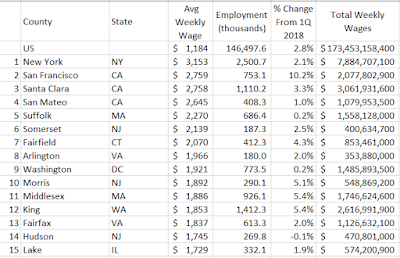
This divide between defending an old economy and trying to navigate a new one is why Democratic support is so high everywhere that the economy is strong and Republican support is so strong everywhere the economy is weak. (In the regions with the highest wages, Hillary Clinton won twice as many votes as Trump. (See below for details.)) Communities whose policies support the information economy are more prosperous than those still defending the industrial economy.
One of the many things absurd about this current battle between information and industrial economies is that rather than engage in a really great conversation about policies that better support an information or entrepreneurial economy and how to transition into the latter, we're debating something settled decades ago ... whether we should give preference to policies to support an information or an industrial economy. It is a complete waste of time to defend Trump's 1950s vision of the world and yet that is exactly what you have to do if you're a Republican. It's the political equivalent of selling rotary dial phones. There was no legitimate "both sides are equal" argument in 1870 and there is no both sides are equal argument today.
One of the many things absurd about this current battle between information and industrial economies is that rather than engage in a really great conversation about policies that better support an information or entrepreneurial economy and how to transition into the latter, we're debating something settled decades ago ... whether we should give preference to policies to support an information or an industrial economy. It is a complete waste of time to defend Trump's 1950s vision of the world and yet that is exactly what you have to do if you're a Republican. It's the political equivalent of selling rotary dial phones. There was no legitimate "both sides are equal" argument in 1870 and there is no both sides are equal argument today.
Progress is heading in a particular direction and that's not the direction Trump is leading his parade.
-----------
The claim that the most prosperous areas voted most strongly against Trump's call to defend the industrial economy is based on facts. Among them is this fact: the 15 counties with the highest average weekly wages voted 2-to-1 for Clinton and against Trump.

The average vote for Clinton in these regions was 66% . (Details here.)
09 August 2019
How Hosting or Squelching Science Determines Where Progress Goes Next
In 1642, Galileo died and Newton was born. That's still a poignant symbol of the hand off from Italy to Britain for progress.
In 1500, Italy's per capita GDP was about 50% higher than Britain's. By 1820, Britain's per capita GDP was about 50% higher than Italy's.
Galileo was arguing that the earth rotated around the sun. The church had the authority of Joshua 10:13, a verse that made it clear that it was in fact the sun that orbited the earth. They put Galileo under house arrest and made it clear that developing theories based on observation was not to be tolerated as long as Italy had the church's authority.
Science traveled north. The Protestants of Northern Europe accommodated Galileo's theories and became host to the scientific method that the Italians had helped revive from Greek and Roman time. Newton went further than Galileo, developing a set of laws to explain what Galileo observed. Newton's science and math became a foundation for the Enlightenment and that, in turn, became a foundation for the Industrial Revolution and Democracy. Italy protected its past and the UK created a new future.

Today, we have a similar inflection point in the transition from fossil fuels to alternative energy. China now leads in the production of wind turbines and solar panels. Meanwhile, we Americans have elected a president intent on protecting coal - an industry that dates back to the time of Newton. Trump - like so many of his supporters - denies climate change in the same way that the Catholic Church denied we orbit around the sun. And science, less interested in the vested interests of coal industry profits or old testament prophets than reality, is shifting away from the greatest home to science since, well, Italy during the Renaissance or the UK during the Enlightenment.
Economic growth and prosperity follows science. It has for centuries. If we continue to deny the reality of climate change and what that means for a shift in strategies and the source of prosperity, we will play the role of Italy in the 1600s. It's not a good role. Shakespeare - born the same year as Galileo - set half his tragedies there.
In 1500, Italy's per capita GDP was about 50% higher than Britain's. By 1820, Britain's per capita GDP was about 50% higher than Italy's.
Galileo was arguing that the earth rotated around the sun. The church had the authority of Joshua 10:13, a verse that made it clear that it was in fact the sun that orbited the earth. They put Galileo under house arrest and made it clear that developing theories based on observation was not to be tolerated as long as Italy had the church's authority.
Science traveled north. The Protestants of Northern Europe accommodated Galileo's theories and became host to the scientific method that the Italians had helped revive from Greek and Roman time. Newton went further than Galileo, developing a set of laws to explain what Galileo observed. Newton's science and math became a foundation for the Enlightenment and that, in turn, became a foundation for the Industrial Revolution and Democracy. Italy protected its past and the UK created a new future.

Today, we have a similar inflection point in the transition from fossil fuels to alternative energy. China now leads in the production of wind turbines and solar panels. Meanwhile, we Americans have elected a president intent on protecting coal - an industry that dates back to the time of Newton. Trump - like so many of his supporters - denies climate change in the same way that the Catholic Church denied we orbit around the sun. And science, less interested in the vested interests of coal industry profits or old testament prophets than reality, is shifting away from the greatest home to science since, well, Italy during the Renaissance or the UK during the Enlightenment.
Economic growth and prosperity follows science. It has for centuries. If we continue to deny the reality of climate change and what that means for a shift in strategies and the source of prosperity, we will play the role of Italy in the 1600s. It's not a good role. Shakespeare - born the same year as Galileo - set half his tragedies there.
25 July 2019
Progress Has a Direction
When it comes to politics, there are a lot of people who believe that the truth lies somewhere in the middle and that if only we listened to each side we'd find the truth there.
It is true that for some issues, the best resolution is in the middle. Progress, though, is not somewhere in the middle but further along.
I actually agree with this on one dimension. Imagine a scale of 0 to 100. 0 is a world in which not a dollar of income is taxed, not a dollar of government money is spent, and not a single activity is regulated. 100 is a world where every dollar of income is taxed, every dollar spent is government money, and every activity is regulated. (And you could make this more complex and have three scales for the tax, spending, and regulation.) I have my own opinions about where we should be on this scale and so do you. (Mine involves more hand waving than precision.) It might be a simple thing to have democracy by averages in this instance and simply let every single American pick a value from 0 to 100 and let the tyranny of the average (or median) define our policy. We now have the technology for this. If every voter's opinion matters, we could easily weight every opinion equally and find our truth in the middle and let it move around over time as awareness of problems and possibilities changed.
(And it annoys me that we spend so much time debating this. Again, we have the technology that would let people quickly express their values and opinions on this. Once in place, we could know the answer to the question of where Americans think we should be on this scale in an instant.)
(And it annoys me that we spend so much time debating this. Again, we have the technology that would let people quickly express their values and opinions on this. Once in place, we could know the answer to the question of where Americans think we should be on this scale in an instant.)
But some policies are not subject to average. Is slavery legal or illegal? Abortion? Do we make schooling mandatory for every child? Do we make child labor illegal? Or more relevant to my own obsession with economic progress, do we put in place policies that assume and support a national industrial economy or a global information economy? Or even better, an economy that popularizes entrepreneurship?
Progress has a particular direction and for me it can be captured along these four dimensions or scales. Progress isn't found in some average on these scales but always in one direction.
Greater Interdependence and Specialization
Progress steadily makes us part of larger groups. Progress is coincident with greater levels of complexity and interdependence. One of the simpler ways that shows up is that we move from economies largely bound by tribes to city-states to states to nation-states to global markets. Individuals specialize more and more and their work is coordinated with bigger groups (partly through management and partly through markets and partly through platforms like Fiverr). When you are self-sufficient, you have to be a generalist rather than specialist and your living standard is very low. When you are interdependent, you specialize and your living standard has the potential to be very high. Nobody on a deserted island is living a life of luxury; some people in big cities are.
Autonomy Supportive vs. Control or Abandonment
William Deci makes really great distinctions for parents, teachers and managers. You can control a child or employee, driving them towards the fulfillment of your own goals. At the other end of the spectrum you can abandon them, leaving them to do what they want without your control, influence or help. He advocates instead supporting their autonomy by enabling them to define and pursue their own goals. Rather than dictate goals you help them to articulate their own. Rather than shrug and say, "Good luck with that," you help to develop their ability to pursue those goals.
Autonomy supportive is relevant in so many dimensions but for now I'll simply say that it applies in this matter of greater interdependence. Empire is one way to expand the circle of people upon whom we depend. In that sense it is progress. A global market is even better than an empire as a mechanism for increasing our level of interdependence. And of course even better than free markets is a world in which government enables individuals to succeed in markets, is autonomy supportive. What does that look like? Regulating health and safety so that the person can trust the water and transportation systems they depend on. Providing lots of research and education so that the individual has the benefit of a steady parade of new knowledge and best practices. Education and training so the person knows how to be productive. The government neither dictates nor abandons its citizens but instead is autonomy supportive.
Greater Inclusion
At one level of progress, white, male, land-owning Protestants are able to use government as a tool for their goals. At another level of progress, minority women atheists who rent are able to use the government as a tool for their goals. One dimension of progress is Carl Benz inventing the car. Another dimension of progress is Henry Ford applying the concept of the assembly line to building cars and making them affordable for 90% of households. It is the same concept for our government, laws, and institutions. The more people able to use them and call them their own the better.
More Inventive
As we make progress, our world becomes more inventive. We invent computers and canned goods as well as banks and corporations. The speed with which we travel across town is less defined by how fast we can run than it is by whether we have access to a bike, car or subway. Our level of affluence is less dependent on our ability to hunt or build our own hut than our access to great schools or venture capital markets or table saws and nail guns. Progress means increasing reliance on inventions - social and technological. This can be disruptive.
Given the above, progress clearly has a direction. Policies that are autonomy supportive rather than controlling or abandoning represent progress. Policies that help us to become more specialized and more reliant on a larger group are progress. Policies that are more inclusive, that allow more and different kinds of people to have the same access to the institutions - institutions like credit markets, courtrooms and schools - we rely on is progress. Policies that encourage more invention - technological and social - is progress.
There will be times when we move backwards on these scales. Such movement might even be necessary. For instance, during war we no longer trade with some group of people we were formerly reliant upon. There are people we will have to imprison, to control. Again, that is not progress but is instead a breakdown at the individual level from what is ideal to what is necessary. Moving backwards on these scales is not progress. It is - at best - an interruption to progress.
It is true that for some issues, the best resolution is in the middle. Progress, though, is not somewhere in the middle but further along.
10 July 2019
What are the Odds? The Conservative's Unique Place in History
The women's soccer team is fighting for equal pay. A conservative friend thinks this is silly.
It's a curious thing. This friend is not a troglodyte. He does not support keeping women at home and out of the workplace like conservatives would have in, say, the 1960s. He also does not support efforts to get women equal pay now that they are in the workplace.
This is the belief of conservatives. Today, the natural evolution of "We deserve to be admitted to universities and corporate workplaces," to "and it makes no sense that we regularly make tens of percent less than men" gets the first part right and the second part wrong. In their eyes, conservatives who tried to keep women out of universities and the workplace were overly repressive decades ago and progressives who today would push for equal pay are overly progressive.
Think about the odds of this. For thousands of years before the current conservative became an adult, society was too repressive. Societies that have pushed further and now ask for equal pay for men and women have gone too far. Out of thousands of years of history and thousands of years of future, only the society they discovered at the time they became an adult got it just right. Progress had neatly deposited the conservative in just the right place in history and no further.
You would think that conservatives would be happier people. Had they been born even a generation earlier, they'd be outraged at the inequity of repressive conservatives around them not enlightened enough to give women equal opportunity. And had they been born even a generation later, they'd be outraged at the inequity of all the progressives who were stupid enough to insist on equal pay. There was only one generation in history to get it just right and it happened to be theirs. You'd think that would make them feel happy and proud.
"50 years before I was born, the world was in the Dark Ages. 50 years after I turned 18, the world had gone mad. What a joy that I found just the right time to live in, a glorious golden age in which the golden mean was achieved. What bliss. What luck. What perfect timing."
"A conservative is someone who stands athwart history, yelling Stop, at a time when no one is inclined to do so, or to have much patience with those who so urge it."
- William F. Buckley, Jr.
It's a curious thing. This friend is not a troglodyte. He does not support keeping women at home and out of the workplace like conservatives would have in, say, the 1960s. He also does not support efforts to get women equal pay now that they are in the workplace.
This is the belief of conservatives. Today, the natural evolution of "We deserve to be admitted to universities and corporate workplaces," to "and it makes no sense that we regularly make tens of percent less than men" gets the first part right and the second part wrong. In their eyes, conservatives who tried to keep women out of universities and the workplace were overly repressive decades ago and progressives who today would push for equal pay are overly progressive.
Think about the odds of this. For thousands of years before the current conservative became an adult, society was too repressive. Societies that have pushed further and now ask for equal pay for men and women have gone too far. Out of thousands of years of history and thousands of years of future, only the society they discovered at the time they became an adult got it just right. Progress had neatly deposited the conservative in just the right place in history and no further.
You would think that conservatives would be happier people. Had they been born even a generation earlier, they'd be outraged at the inequity of repressive conservatives around them not enlightened enough to give women equal opportunity. And had they been born even a generation later, they'd be outraged at the inequity of all the progressives who were stupid enough to insist on equal pay. There was only one generation in history to get it just right and it happened to be theirs. You'd think that would make them feel happy and proud.
"50 years before I was born, the world was in the Dark Ages. 50 years after I turned 18, the world had gone mad. What a joy that I found just the right time to live in, a glorious golden age in which the golden mean was achieved. What bliss. What luck. What perfect timing."
"A conservative is someone who stands athwart history, yelling Stop, at a time when no one is inclined to do so, or to have much patience with those who so urge it."
- William F. Buckley, Jr.
27 June 2019
Bigger is Better
It seems a requirement of modern
politics that Democrats criticize big business and Republicans criticize big
government.
There is one problem with these
shibboleths, these tests of the faithful: they ignore how the interplay between
big government and big business has made us prosperous. History suggests that
any politician successful at impeding either government or business will
effectively slow economic progress.
Some people know the amazing story of
Elisha Gray arriving at the patent office just hours after Alexander Graham
Bell with his patent application for the phone. Bell went on to fame and
fortune and Gray to a life of anonymity. There’s more to it, though. Our
founding fathers were intent on creating an accessible, affordable patent
system. One might even say it was democratic. Fewer people know that the
Italian Antonio Meucci had invented the telephone years – not just hours –
before Bell but could not afford to patent it through Italy’s expensive patent
system. Had Italy been more visionary about subsidizing the work of its
inventors by making it cheaper to file for a patent, it may have hosted the
myriad, great inventions that defined the decades around 1900 or had the
equivalent of Bell Labs from which communication satellites and transistors
emerged as catalyst for huge industries. Our government enabled invention.
In his book The Rise and Fall
of American Growth, Robert Gordon shares this story of Bell, Gray and
Meucci and gives a host of other examples of government and business
interacting to create prosperity.
During the second world war, the
federal government led initiatives to increase industrial capacity. The
government invested capital equal to half the capital that existed at the start
of the war, capital in the form of factories and machine tools (which doubled
during the war). Even better was the problem-solving that resulted in better
production methods. During the war, Kaiser initially took 8 months to complete
a ship; they accelerated that to just a few weeks by the next year. A plane
factory of Ford's increased its rate of 75 planes per month in February of 1943
to 432 per month by August of 1944. By D-Day, the Germans could launch only 319
aircraft; the US and its allies launched 12,837. American factories won the war.
After the war, the government turned
all this over to private companies. Armed with these investments in capital and
knowledge, these companies began making consumer products like cars and TVs.
Before the second world war, the economy had lurched in and out of recession.
After, it took off. Government regulations helped raise wages and government investment
helped raise productivity. Workers both made and bought these new products.
Eisenhower had been a solider during
the first world war and was part of a group transporting vehicles across the
US. It took them 62 days to go from coast to coast. Head of the Allies’
conquering army, he experienced first-hand the German autobahn and was amazed
at the contrast. The interstate highway legislation Eisenhower signed increased
American productivity by tens of percent. Like the railroads the
government subsidized a century earlier, the highway system gave customers and
producers easier, more affordable access to products and markets. Decades
earlier, life expectancy had gone up as a result of similar, local efforts to
build out the infrastructure that brought safe water into homes and piped
sewage out, another initiative dependent on the cooperation of government and
business.
Another outcome of the second world
war was increased investment in research and education. In WWII we didn't just
pump unprecedented amounts of money into research but FDR asked Vannevar Bush
to institutionalize that, which he did with what become the NSF (National
Science Foundation) and DARPA (the Defense
Advanced Research Projects Agency). From DARPA we got the
Internet which has enabled the creation of trillions in new wealth and millions
of new jobs. The GI Bill was another product of the second world war and it led
to a huge increase in college enrollment, creating a new generation of better
educated, more productive workers.
Possibly the most
important interplay between big government and big corporations comes in
R&D. Research is hugely uncertain and most of it results in nothing. If
it does result in something cool it may happen a decade or three later than
expected. Also, not every cool thing becomes profitable. Because of this,
corporations rarely finance basic research and it needs to be heavily funded by
institutions like DARPA or the University of California. This research is
crucial to corporations' later developments. "The parts of the smart phone that make it smart—GPS,
touch screens, the Internet—were advanced by the Defense Department," as
Mariana Mazzucato points out in her book The Entrepreneurial State. Corporations try to find a way to translate research that has taken one
to two decades into development that
takes two to four years. It's a great system and at its best we tax successful
corporations to fund the next round of research which could be transformed into
new products by corporations. Symantec and
Qualcomm were among the new companies funded by The Small Business Innovation
Research program - a program started by Ronald Reagan. Google's basic algorithm
was funded with a NSF grant.
Of late, our
policies seem less reflective of this interdependence. As corporations pay less
in taxes the government has less money for initiatives that could help the next
generation of companies and workers to prosper. Our productivity, wages and GDP
were growing faster during a time when corporate tax rates were maxed out at
about 50% and personal income tax rates maxed out at about 70%. The trick is to
tax what is successful now to fund what will become successful next.
Government has an important job as a
referee, a role Elizabeth Warren articulates well. Government has an important
job of moderating wealth and income inequality. (Trump looked at the world with the biggest gap between rich and poor in history and concluded that the rich were not rich enough and the poor were not poor enough, giving the first a tax break and cutting assistance to the second. Few people would reach such a conclusion.) Those jobs of referee and moderator are important but
over the long term, they are not as important as the job of collaborating with
business and labor to create the next generation of technologies, products,
industries and companies. It is in that direction that lies the kind of
progress we had from 1900 to 2000 that increased real incomes by 8X and let us
buy myriad objects like airplane tickets, personal computers and antibiotics
that did not even exist at the start of the century.
The world is full of communities who
would love our problem of big government and big business. Big projects are not
done by small organizations. It should be a cliché to say what is too rarely
said: progress is not a product of markets or democracies but rather their
interaction. Strong companies and strong government go together in vibrant
economies. Even within the US, the states that keep taxes and investment lower
and have few big companies have lower household income and create fewer jobs.
Big businesses and government agencies are not a sign that we’re off the rails.
They are, instead, the way we got both the rails and the trains.
14 June 2019
Your Money for Nothing - When Capital is Free
File under: things that mostly just fascinate me but really do affect everyone:
"$20 trillion of the $55 trillion in global sovereign bonds currently yield zero percent or less." From here.
"$20 trillion of the $55 trillion in global sovereign bonds currently yield zero percent or less." From here.
Why does it fascinate me? In our new reality, money is free for countries.
Why does this affect you? It means that we're under-investing in infrastructure, education and most importantly of all, research. All of that can essentially be conducted by nation-states with zero percent loans. A return of even 1% on that investment covers the cost of capital. A lot of what passes for returns to capital now are actually winning bets on entrepreneurship.
We're going to look back on the first decades of the 21st century as a lost opportunity for massive investments in projects - public sector and private sector (in the form of startups and corporate initiatives) - given that capital was free and we had more university graduates than we were fully employing.
Future generations' assessment of us will be that what we lacked in imagination we more than made up for in risk-aversion. And instead of funding grand projects, we used this free capital to bid up the price of art, stocks and other pre-existing assets.
13 June 2019
Father's Day: How Dad and I Were Just Alike (and so very different) in Our Politics
In late January of 2009, I got a call from mom. Dad was in ER. About 90 minutes later, after midnight, I got up there.
I was chatting with mom after we'd been in to talk to him. I could not figure out what was going on. Finally, mom said, "I think your dad might just be having a stress attack of some kind. He can't believe that we have a black, Muslim socialist in the White House." At that I said, "Oh." And promptly drove back home, leaving him to his self-induced drama.
Growing up, I don't remember hearing about politics much. My parents had a lot of drama in their life and politics wasn't part of it. I read a lot and, as I got older, wrote a lot. It turns out that the combination of reading and writing resulted in a set of ideas that are little connected to my parents'. My dad and I probably cancelled each other's votes 90% of the time.
And yet I have become like my father in how I think about politics. Sort of.
Dad worked for Caltrans in highway design. In his last 5 or 10 years, he worked in traffic safety. They would simply identify dangerous sections of roads and highways based on statistics. On one section of road, accidents are 2X more likely. In another, someone is 20% more likely to die. And so on. They would analyze the data and then the section and redesign it so that accidents, injury and fatalities were less likely.
Police would identify individuals more likely to get in an accident. Lawyers would determine blame. That was not dad's job. His job was to make a section of road safer for everyone.
In that way, my sensibilities are very similar. I have a lot of conservative friends and even recessions they are likely to blame on individuals. I remember one conversation with conservative friends at the height of the Great Recession when the unemployment rate was nearly triple what it is now and they were discussing how someone's brother-in-law had taken a week's vacation (from looking for work) with his family in the midst of his unemployment. As if an outbreak of laziness somehow explained this outbreak of unemployment. They were the cops and lawyers, trying to figure out who was to blame and who to arrest.
I know that individual differences do make a difference. I just don't think those differences are very interesting or relevant. People worked 60 hours a week in 1900 and made about 1/8th of what we do. You might get excited explaining why one guy made 30% more than another in 1900 but that is incidental compared to the difference between that guy and his grandson who makes 800% more. That's fascinating. And relevant. And something you can aspire to "design" with a set of policies and technological and social inventions.
The questions that intrigue me are not the questions of the police about why someone got in an accident. My question is how we design the economy to lower the incidence of those accidents while still letting people drive faster. It turns out that even while I felt such a huge wave of relief to have Obama and Biden in to replace Bush and Cheney and my father thought it was a sign of the apocalypse, our perspectives are similar. (Well, his perspective on highways and mine on economies anyway.)
This Sunday will be my sixth Father's Day without dad. It is a curious thing how every generation knows what they'll reject from the previous generation but takes longer to realize the ways in which they are just like them.
Subscribe to:
Posts (Atom)