Wikipedia lists dozens and dozens of end of world prophecies. Oddly, the alarm and attention raised by these prophecies works like advertising, attracting new members, and the failure to come true doesn't seem to much alienate followers. (There are, for instance, a great number of Jehovah Witnesses in spite of their getting the dates wrong for the apocalypse on more than one occasion.)
I think that there's likely a good overlap between Ron Paul's constituents and the folks susceptible to end of world religious prophecies. There are folks primed for truly catastrophic news. It just feels right to them. For decades Ron Paul has been warning of a coming economic apocalypse, one brought on by loose monetary policy that will trigger great inflation before causing markets to crash. At times it seems as though the audience for such apocalyptic news is larger than the audience for boring and esoteric talk of fiscal stimulus.
Does Ron Paul have great economic insight or is he more like a religious messiah with a vision?
Well, the great inflation has not yet happened. And Ron Paul has been (mostly) in office since 1976 - nearly 40 years. This absence of economic apocalypse suggests there may be some flaws in his predictive models. In spite of this, it is hard to think of a politician the Tea Party more admires.
Yesterday Fed Chairman Ben Bernanke asked Congress to avoid the Sequester because the economy is still struggling. Senator Bob Corker, a Republican from Tennessee, accused Bernanke of being soft on inflation. As Bernanke pointed out, inflation on his watch has been the lowest of any Fed Chairman since WWII.
Corker and his ilk don't need the numbers to prove that Bernanke's loose policy causes inflation. They've got a prophet who has warned them of doom. Poor Bernanke is so caught up in book learning that he misses this deeper truth and thinks that inflation is not a problem because it is low. Once the prophecies of doom have gathered the faithful, they're not easily disbanded. And right now, they're no marginal faction: in fact, they are about to give us a sequester.

R World (Ron Davison muses aloud)
27 February 2013


The Sequester Explained - Or, How to Shoot Your Cat Out of the Tree
Once upon a time, a cat lover was shocked to learn that his cat had climbed high into a tree. Terrified of what this might mean for the cat's health, he did everything he could to get the cat back onto the ground. He coaxed. He pleaded. He offered tuna. Nothing seemed to work. Eventually, he forgot how all this got started and simply fixated on this: the cat had to come down. So, he finally shot the cat out of the tree.
The deficit was huge. It still is. But the deficit was the lesser of evils in tough economic times. The only option to a larger deficit in a downturn is to raise taxes and / or cut spending when unemployment is already high, when GDP growth is already faltering. Had we cut the deficit to zero last year we'd have to raise taxes and / or cut government spending by $1.3 trillion. That would be about 8 or 9% of GDP. That approach - favored by Eric Cantor and the Tea Party who refused to raise the debt ceiling - is the equivalent of shooting the cat out of the tree because you're nervous about it. The only reason the deficit matters is because it is not sustainable and it could eventually be bad for the economy. To suddenly take 8% of GDP away is not an eventually bad for the economy - it is an immediately bad for the economy.
To recap. Big debt - eventually and possibly bad for the economy. Abrupt contraction of economy - immediately and definitely bad. Cat high in the tree - possibly bad. Shooting cat out of the tree - definitely bad.
This will be a slower year for growth because these frequent budget standoffs have worn down the American people who find it increasingly difficult to sustain outrage or interest in congressional deadlock. As the private sector is recovering and growing, the public sector will be further shrinking, and the net effect will be sluggish growth, perhaps even another dip. Unemployment will remain too high. The good news is that the sequester is not quite like shooting your cat out of the tree; it is, instead, just like wounding it. (Cantor's charge to freeze spending, by contrast, would have been like a head shot.)
The right path is to bring down the deficit as the economy improves, but certainly not faster than the economy improves. And it is worth noting that the deficit is currently projected to halve between 2012 and 2014, from $1.3 trillion to $668 billion. [Seen here.] That, it seems to me, is probably faster than is optimal for GDP growth (and for lowering unemployment) over the next couple of years but not bad for longer-term investment markets. This is not a trivial sum, amounting to nearly 4% of GDP in the space of two years, a deficit reduction of $659 billion. To approach the deficit more aggressively is to forget about the health of the cat and get fixated on its place in the tree.
But give the Republicans credit. They know how to work the media. Just as they got everyone fixated on the invasion of Iraq, getting the media and the American people convinced that this was such an urgent task that nothing else mattered - especially questions about "What's next?" - they've now gotten everyone fixated on the deficit and its reduction, as if nothing else matters and convinced people that rapidly reducing the deficit won't bring about a slew of further complications. And there's a sort of evil genius in their approach. To the extent that budget stalemates and government spending cuts and tax hikes make the economy falter, they have further proof that the economy is in bad shape and we need to take desperate measures.
It's fine to worry about getting the cat out the tree. Just don't let anyone convince you that this is so important or urgent that you need to reach for a gun.
26 February 2013
When Corporations Get Smart Enough to Become Venture Capitalists (or How to Make Employees Very Happy)
Daniel Kahneman is the only psychology professor to have won
a Nobel Prize in Economics. His studies on how people value things are one of
the reasons. They suggest something counter-intuitive about the design of
incentives.
In the study, Kahneman ran a few scenarios with coffee mugs
from a person’s alma mater. In one scenario he gave people the mug and let them
“take ownership” before offering to buy it back from them. In the other study,
he let people with money buy the mug that was not yet in their possession. On the
surface, you’d think that they would value the mug the same way in both
instances, but they didn’t. He had to pay, on average, $7 and some change to
buy the mugs back from people. By contrast, he had to sell the mug for about $3
and change to get them to buy. Kahneman’s conclusion was that people put a
higher price on loss than they do gain. It is more painful to lose what you
have than never get something comparable. He had to pay people twice as much to give up their
mugs as they thought they were worth when they simply bought them.
And this makes sense. You might feel the pang of a
relationship that fails to materialize but that is nowhere near as devastating
as a divorce. Not getting the job is rarely as painful as getting laid off.
Loss is painful and we put a premium on avoiding the loss of valuable things.
This is one reason that Warren Buffet is worth so much. He sells
insurance. People pay to avoid loss.
I think that this explains one reason that corporations have
the opportunity to profit from entrepreneurship more than venture capitalists,
investment bankers, or traditional investors.
The prime candidates for entrepreneurial ventures are
actually people in their 30s and 40s. Their startups are less likely to fail
and reasonably so. They’ve got experience. They know processes and products and
people. But they have one major disadvantage in comparison to the
twenty-something crowd: they have so much to lose.
Imagine a 40 year old who has been in the industry – any industry
– long enough to have a potentially lucrative idea. He knows a cheaper way to
make an old product or has an idea for an innovative new idea or how to tap an untapped
market. He also knows that executing this idea will require capital. And
leaving his job. And working at risk for at least 6 months – more often about 3
to 7 years. It’s not hard to imagine that at 40, he’s been married for 10 or 12
years. His children are 9 and 7 and he has a small amount saved for their
college. He is 8 years into his 30 year mortgage. He is 10 years into his job
and now gets 4 weeks of vacation and is fully vested in the 401(k), which is
just starting to seem sizeable – but still not enough for retirement. The man
has a lot to lose. And if Kahneman’s studies are correct, he puts more weight
on the value of that potential loss than he does the potential gain from his
entrepreneurial venture.
The twenty-five year old, by contrast, has almost nothing to
lose and for this reason alone might be the better candidate for
entrepreneurship.
If Kahneman’s studies are right, our 40 year old values what
he has now vs. what he could have about twice as much as he should. The
emotional cost of losing what he has – waking up at 47 with no 401(k), no
business, no money for college for the 16 and 14 year olds, no equity in a home
– is so much greater than the emotional boost from gaining what he doesn’t have
– waking up at 47 to a net worth of $5 million and prospects of doubling that
every 2 to 5 years. His preference for the second scenario is not as great as his
desire to avoid the first.
This suggests that corporations have a great deal to make by
offering entrepreneurial opportunities to their employees. Countless employees who could be great entrepreneurs shy away from the prospect because they have something to lose. What a corporation would
have to offer as a percentage of returns would be less – perhaps considerably
less – than what a venture capitalist or traditional banker would have to offer.
A successful venture could return considerably more to the corporation than it
might to the venture capitalists.
Regular readers of this blog or readers of my book know that
I think one of the big shifts that will occur during the next ten to twenty
years is the re-definition of employee to something more entrepreneurial. This matter
of valuing loss more than gain is just one of the reasons why I
believe that.
It’s time to give employees the chance to make more money
than they ever could in any position but a C – CEO, CFO, CTO – position, but
still less than they could if they were traditional entrepreneurs. Given how
much of a higher price we place on loss than gain, there’s a huge difference
through which you could drive a whole business. Or two. And a way to make both employees
and stockholders much happier.
12 February 2013
Cut Spending on Alzheimer's by 10%? Or 100%
Idea junkie that I am, I was watching Robert Wright and James Pinkerton talk about Obama's Inauguration Speech. Pinkerton, a Fox News contributor, casually tossed out a fairly brilliant observation that reminds us of what matters.
[not verbatim ... but close enough]
"If Alzheimer's is going to cost us a trillion dollars, we could start cutting aid to medicare now. Or we could pump up research for Alzheimer's to try to accelerate a cure so that we don't incur those additional costs. It's pretty clear which is a greater social good: a cure for Alzheimer's or a balanced budget."
It's easy to create a panic about the deficit. But it's also worth remembering that if we decide that no other goal matters as much as deficit reduction, we miss a great number of other great possibilities. And possibilities that could either lower future costs or raise future incomes are typically much better than strategies for deficit reduction.
[not verbatim ... but close enough]
"If Alzheimer's is going to cost us a trillion dollars, we could start cutting aid to medicare now. Or we could pump up research for Alzheimer's to try to accelerate a cure so that we don't incur those additional costs. It's pretty clear which is a greater social good: a cure for Alzheimer's or a balanced budget."
It's easy to create a panic about the deficit. But it's also worth remembering that if we decide that no other goal matters as much as deficit reduction, we miss a great number of other great possibilities. And possibilities that could either lower future costs or raise future incomes are typically much better than strategies for deficit reduction.
11 February 2013
The Real Reason the Pope Retired (is probably not included here)
For the first time in 600 years, a pope has retired. In all seriousness, that is stunning news, something more truly historical than another snow storm in New York, even if it won't get as much coverage. A story of this magnitude deserves wild speculation. So, in the spirit of revelation that can't be contested, I'm offering a few, er, theories about why the pope is stepping down. If they don't get accepted as explanations, perhaps they could be fleshed out into screenplays.

The money angle.
1. The pope began selling pieces of priceless art, using the money to feed the poor. Appalled, the cardinals maneuvered to force him out before the Vatican came to look as dowdy as a Church of Christ building.
Romance
2. He's fallen in love and is, like King Edward in 1936, sacrificing his position for marriage.
Apostasy - a loss of faith is, of course, an even juicier angle than romance.
3. Benedict was previously head of the Congregation for the Doctrine of the Faith. This office had earlier been known as the Congregation of ... the Inquisition. As in The Spanish Inquisition. Seriously.
One rather fancies the notion that as protector of church secrets from before the time of the Inquisition, he probably had access to documentation that could undermine any number of church claims. Or proof of abuse to much beloved figures of history. Or even geniuses who had been completely shut down by the Church but who have since been proven by the advances of modern science - or perhaps even geniuses who are ahead of where we are today. That is to say, Benedict may well have discovered evidence that even Dan Brown would have dismissed as ludicrous. Let's assume, in any case, that he knows things. And as he nears the end of his life, his conscience is making him feel compelled to announce what he knows, a terrible revelation that could shatter the church. As church officials learned of this, they intervened, getting him to turn away from the church rather than turn on it.
4. He has scheduled an appointment to be cleared at a Scientology office, hoping to exorcise demons that have haunted him since his youth.
5. Caught up in the heat of a recent inter-faith conference, he agreed to be baptized by Mormon missionaries as a show of solidarity with Protestant churches.
6. Wantied to rename the New Testament as the "Not Really that New Testament" and add an "Actually Quite New Testament" that would include a number of more contemporary sermons the pope enjoyed as well as a number of Buddhist koans, bumper stickers and really interesting t-shirt sayings he'd seen worn by Vatican tourists.
7. He could think of no reason to ban women from the priesthood.

The money angle.
1. The pope began selling pieces of priceless art, using the money to feed the poor. Appalled, the cardinals maneuvered to force him out before the Vatican came to look as dowdy as a Church of Christ building.
Romance
2. He's fallen in love and is, like King Edward in 1936, sacrificing his position for marriage.
Apostasy - a loss of faith is, of course, an even juicier angle than romance.
3. Benedict was previously head of the Congregation for the Doctrine of the Faith. This office had earlier been known as the Congregation of ... the Inquisition. As in The Spanish Inquisition. Seriously.
One rather fancies the notion that as protector of church secrets from before the time of the Inquisition, he probably had access to documentation that could undermine any number of church claims. Or proof of abuse to much beloved figures of history. Or even geniuses who had been completely shut down by the Church but who have since been proven by the advances of modern science - or perhaps even geniuses who are ahead of where we are today. That is to say, Benedict may well have discovered evidence that even Dan Brown would have dismissed as ludicrous. Let's assume, in any case, that he knows things. And as he nears the end of his life, his conscience is making him feel compelled to announce what he knows, a terrible revelation that could shatter the church. As church officials learned of this, they intervened, getting him to turn away from the church rather than turn on it.
4. He has scheduled an appointment to be cleared at a Scientology office, hoping to exorcise demons that have haunted him since his youth.
5. Caught up in the heat of a recent inter-faith conference, he agreed to be baptized by Mormon missionaries as a show of solidarity with Protestant churches.
6. Wantied to rename the New Testament as the "Not Really that New Testament" and add an "Actually Quite New Testament" that would include a number of more contemporary sermons the pope enjoyed as well as a number of Buddhist koans, bumper stickers and really interesting t-shirt sayings he'd seen worn by Vatican tourists.
7. He could think of no reason to ban women from the priesthood.
08 February 2013
You Can Clearly Hear Just How Good This Band Is
Even if you're blind.
This might be my favorite (new to me) song from 2012. Might be. What's certain is that it is Friday. That's reason enough to post some delightful music.
This might be my favorite (new to me) song from 2012. Might be. What's certain is that it is Friday. That's reason enough to post some delightful music.
03 February 2013
Has the Market Peaked at 14,000?
Dow at 14,010: Market peak or new leg up?
One hardly knows what to find more amusing: the thought that something as impersonal as a measure of stock value would somehow pause or stall at a round number like 14,000 ("Doc! His fever has hit 100. Does this mean he'll die?") or that, given human psychology, it is legitimate to ask such a question.
Actually, it's worth clicking through on the above article. It has some interesting facts, including these:
Siegel (a finance professor at the Wharton School of Business at the University of Pennsylvania) says with cash yielding 0% and 10-year U.S. Treasury notes paying roughly 2% in interest, investors have little alternative other than to buy stocks in search of bigger gains. "Where else are they going to go for returns," says Siegel.
Main Street investors now have $2.4 trillion parked in money market funds, $6.7 trillion in bank savings accounts and $633 billion in low-yielding certificates of deposit, according to Peter Crane, publisher of Money Fund Intelligence, citing Federal Reserve data.
The Dow also looks attractive from a valuation standpoint, as the stock market is now trading at 14.5 times its trailing four-quarter earnings, a slightly cheaper price-to-earnings ratio than at its prior top in 2007. It sports a P-E that is 50% below where it was during the prior peak in 2000, according to S&P Capital IQ data.
01 February 2013
A Comprehensive Ranking of the (Luck & Efficacy of the) Last 7 Elected Presidents
I've compiled a table that rather comprehensively measures the sum of presidential luck and efficacy. (You get to decide just how those two are mixed.) It ranks presidential performance for the first term of presidents from Nixon to Obama, who just finished his first term.
This seems to me a fairly comprehensive measure. It includes net new wars, changes in murder rates, GDP growth, changes in unemployment rates, changes in the Dow Jones Industrial Average, and end of term approval ratings. By this ranking, Clinton and Reagan dominate but Obama and HW Bush do surprisingly well. (I'll leave the reader to decide if Obama is to Clinton what HW Bush was to Reagan. Personally, I think that's a loaded comparison unlikely to leave anyone particularly happy.)

[A note about this comprehensive measurement. I'm happier with this table now that the numbers are scaled but am still open to suggestions about how to improve or what more to include.]
This seems to me a fairly comprehensive measure. It includes net new wars, changes in murder rates, GDP growth, changes in unemployment rates, changes in the Dow Jones Industrial Average, and end of term approval ratings. By this ranking, Clinton and Reagan dominate but Obama and HW Bush do surprisingly well. (I'll leave the reader to decide if Obama is to Clinton what HW Bush was to Reagan. Personally, I think that's a loaded comparison unlikely to leave anyone particularly happy.)

| -75 |
I didn't just capture presidential performance. I scaled it against all the other presidents' performance in their first term. For instance, Reagan's approval rating in February after his re-election was 60%, which was 11% better than average. So, in the approval rating column he got a 111%. Murder rates went down about 2.4% during the average first term so Obama's drop of 4% in the murder rate got him a score of 166% (66% better than average). I wanted all the numbers on the same scale (although obviously numbers with wider swings give presidents more opportunity for piling on points).
Some numbers we want to go up (like GDP growth and changes in the Dow) and some we want to go down (like murder rates, unemployment rates, and net new wars). The total tallies the negatives and the positives into a comprehensive score, using absolute values for all.
Some numbers we want to go up (like GDP growth and changes in the Dow) and some we want to go down (like murder rates, unemployment rates, and net new wars). The total tallies the negatives and the positives into a comprehensive score, using absolute values for all.
I'm sure that others could do better but this is a pretty telling table even without the sum of positive effects column. One fascinating thing is that while approval ratings tend to determine whether you get re-elected, this comprehensive score seems to better forecast legacy. Clinton and Reagan are easily the most popular modern presidents. George W Bush and Nixon are not popular in spite of being re-elected (Nixon by a landslide). Nixon's score was killed by the sharp rise in murder and unemployment rates and fairly anemic stock market performance. He may not have fared well in the history books even without Watergate.
Perhaps we'll never know whether these presidents were all more like fleas made to feel frightened or triumphant by the behavior of the elephant they were riding or were mahouts (elephant jockeys) able to actually influence the speed and direction of this unwieldy mass we call America. I do believe that while presidents have only a small amount of influence it is still more than any other person in the country. Further, I think that the choice of a president reflects something about the mood and direction of the country, a preference for policies that do have a very big influence on outcomes. A country that chooses a Reagan is expressing very different intentions than one that chooses an FDR or Carter. Presidents may not make a big difference but they do reveal moods and a direction that can lead the country to very different places.
Finally, while I don't believe in grades, I'll nonetheless translate the table into the following grades:
Clinton, A
Reagan, B
Obama, C
HW Bush, C
Carter, D
W Bush, F
Nixon, F
Perhaps we'll never know whether these presidents were all more like fleas made to feel frightened or triumphant by the behavior of the elephant they were riding or were mahouts (elephant jockeys) able to actually influence the speed and direction of this unwieldy mass we call America. I do believe that while presidents have only a small amount of influence it is still more than any other person in the country. Further, I think that the choice of a president reflects something about the mood and direction of the country, a preference for policies that do have a very big influence on outcomes. A country that chooses a Reagan is expressing very different intentions than one that chooses an FDR or Carter. Presidents may not make a big difference but they do reveal moods and a direction that can lead the country to very different places.
Finally, while I don't believe in grades, I'll nonetheless translate the table into the following grades:
Clinton, A
Reagan, B
Obama, C
HW Bush, C
Carter, D
W Bush, F
Nixon, F
[A note about this comprehensive measurement. I'm happier with this table now that the numbers are scaled but am still open to suggestions about how to improve or what more to include.]
BLS Reports 755,000 New Jobs Today
Today, the Bureau of Labor announced that 755,000 new jobs had been created. Well, not exactly new, just new to their data set. Their best estimate for January was that 157,000 new jobs were added but they revised numbers from the last couple of years upwards as well.
At the end of each month, the Bureau of Labor announces how many jobs were created. It obviously doesn't really know, not exactly. It's a sprawl of an economy in which about 12.3 million people don't have jobs and the bureau is reporting job changes in the thousands, an amount that's pretty much a rounding error on the total. Further, the Bureau is estimating based on sampling. But then more substantial numbers eventually come in and from that the Bureau does two things: it adjusts past numbers that had been calculated from sampling and it tweaks its estimation processes for on-going sampling.
All that to say that - by my count - today the Bureau announced an extra 755,000 jobs. In addition to the 157,000 jobs for January, they bumped the 2012 numbers up by 335,000 and the 2011 numbers up by 263,000. That totals 755,000 jobs more jobs than had been counted just a week ago.
So once again, things were better than we thought at the time. It turns out that you were happier, thinner, and better looking than you realized in your past. So it is, apparently, with the economy. Except, of course, none of this lowered the unemployment rate. Go figure.
At the end of each month, the Bureau of Labor announces how many jobs were created. It obviously doesn't really know, not exactly. It's a sprawl of an economy in which about 12.3 million people don't have jobs and the bureau is reporting job changes in the thousands, an amount that's pretty much a rounding error on the total. Further, the Bureau is estimating based on sampling. But then more substantial numbers eventually come in and from that the Bureau does two things: it adjusts past numbers that had been calculated from sampling and it tweaks its estimation processes for on-going sampling.
All that to say that - by my count - today the Bureau announced an extra 755,000 jobs. In addition to the 157,000 jobs for January, they bumped the 2012 numbers up by 335,000 and the 2011 numbers up by 263,000. That totals 755,000 jobs more jobs than had been counted just a week ago.
So once again, things were better than we thought at the time. It turns out that you were happier, thinner, and better looking than you realized in your past. So it is, apparently, with the economy. Except, of course, none of this lowered the unemployment rate. Go figure.
31 January 2013
John Updike In Praise of the Art of Advertising (preparing for the Super Bowl)
Media is fragmenting into smaller, niche audiences. People have netflix and tivo and don't have to watch ads in order to watch their favorite programs. So advertisers are paying nearly $4 million for one 30 second Super Bowl ad this Sunday. This is an event that needs to be watched in real time and that garners huge swaths of the American public. And once corporate America has our attention, it treats it as something valuable. Worth, well, in excess of $7 million per minute.
With that in mind, here's the late John Updike in praise of TV commercials in his novel Terrorists.
Bush complains about Putin turning into Stalin, but we’re worse than the poor old clunky Kremlin ever was. The Commies just wanted to brainwash you. The new powers that be, the international corporations, want to wash your brains away, period. They want to turn you into machines for consuming – the chicken-coop society. All this entertainment – Madam, it’s crap, the same crap that kept the masses zombified in the Depression, only then you stood in line and paid a quarter for the movie, where today they hand it to you free, with the advertisers paying a million a minute for the chance to mess with your heads. ...
[the programming – sports and comedies and talk shows] It’s slop. And Leno and Letterman, more slop. But the commercials, they are fantastic. They’re like Faberge eggs. When somebody in this country wants to sell you something, they really buckle down. They get intense. You watch the same commercial twenty times, you see how every second has been weighed out in gold. They’re full of what physicists call information.
30 January 2013
Your Blogger's Sweeping Proposals to Lessen Gun Violence
It's tough arguing against the folks who oppose regulations on guns. I'm always a little worried that they might pull out a gun after losing the argument. Nonetheless, I have to assume that Obama and the House Republicans are waiting for us bloggers to weigh in before they decide how to respond to gun violence. So, here are my suggestions for mitigating gun violence. (And yes. I'm serious about them all.)
Entertainment
1. Change our movie ratings. We rather hope that our children grow up to engage in acts of explicit sex but not acts of explicit violence. So why is explicit sex rated X and explicit violence rated R? Reverse that. Or make them both X. Just stop sending the message that violence is more acceptable than sex.
2. New rule for shooter video games: when your character dies, the console shuts down. Each time he dies, the console shuts down for a longer period. (Perhaps the 100th time a character dies, your console permanently dies.) Yes this is sad. So is death. You want realistic simulations? Feel some sorrow when someone dies.
Parenting and Community
3. More males in schools. Teachers are these amazing people who have to provide education on academics and hygiene, life skills, and nutrition as well as provide comfort. And - at the elementary school level - they're disproportionately female. Whether through volunteer efforts, special relationships with more male dominated industries (like accounting, management, construction, and auto repair), or different hiring practices, we should work to bring more males into schools. Boys without fathers are more likely - significantly more likely - to end up in jail for any of a variety of crimes, including shooting someone. More males in their life could help.
4. Give birth to a child with fetal alcohol syndrome and lose your right to reproduce. One strike and you are out. You've just handicapped a child for life through negligence and abuse. Be glad that you aren't incarcerated for this.
5. Double or triple payments to children in poverty. In the last decade, the percentage of children receiving payments has dropped from 68% to 34%. This is criminal and you have to have either a cold heart or intent on raising a generation who show as little regard for their community as their community has seemed to show for them. You want adult criminals? Ignore children.
Schools
6. Change the curriculum. Stop pretending that everyone has the capacity to become a university professor or professional. (See, for instance, the children born with fetal alcohol syndrome mentioned above.) Don't hold schools to silly academic standards. Instead, hold them responsible for preparing their graduates for job offers and start-ups.
7.Change the curriculum. Ask members of the community what is most important to a happy and productive life. Few will mention times tables or split infinitives. Many will mention instead the importance of sustaining relationships, finding meaning, managing cash flow, and defining and pursuing goals. The community that simply depends on parents and the media to do that is inviting a lot of the frustration and failure that occasionally finds its expression in tragic suicides and homicides.
Guns
8. Require background checks for all gun purchases, whether or not they're sold at a gun show.
9. Subject all gun purchases to a 30 day waiting period. This alone could lower the rate of suicides enough to save hundreds of lives each year.
10. Ban the sale of guns designed to kill armored personnel or unarmored crowds.
11. Require education for the purchase of a gun, a certification process akin to what we require of new drivers.
12. Require a payment of one million dollars to the family of each gun victim. This would come from liquidating the assets of the shooter (not a group notorious for its wealth) and then a fine on the gun manufacturer. Let the gun manufacturers pass along these costs in their prices (and / or do what they could to lower the probability of such a fine through design, distribution, and marketing practices).
Entertainment
1. Change our movie ratings. We rather hope that our children grow up to engage in acts of explicit sex but not acts of explicit violence. So why is explicit sex rated X and explicit violence rated R? Reverse that. Or make them both X. Just stop sending the message that violence is more acceptable than sex.
2. New rule for shooter video games: when your character dies, the console shuts down. Each time he dies, the console shuts down for a longer period. (Perhaps the 100th time a character dies, your console permanently dies.) Yes this is sad. So is death. You want realistic simulations? Feel some sorrow when someone dies.
Parenting and Community
3. More males in schools. Teachers are these amazing people who have to provide education on academics and hygiene, life skills, and nutrition as well as provide comfort. And - at the elementary school level - they're disproportionately female. Whether through volunteer efforts, special relationships with more male dominated industries (like accounting, management, construction, and auto repair), or different hiring practices, we should work to bring more males into schools. Boys without fathers are more likely - significantly more likely - to end up in jail for any of a variety of crimes, including shooting someone. More males in their life could help.
4. Give birth to a child with fetal alcohol syndrome and lose your right to reproduce. One strike and you are out. You've just handicapped a child for life through negligence and abuse. Be glad that you aren't incarcerated for this.
5. Double or triple payments to children in poverty. In the last decade, the percentage of children receiving payments has dropped from 68% to 34%. This is criminal and you have to have either a cold heart or intent on raising a generation who show as little regard for their community as their community has seemed to show for them. You want adult criminals? Ignore children.
Schools
6. Change the curriculum. Stop pretending that everyone has the capacity to become a university professor or professional. (See, for instance, the children born with fetal alcohol syndrome mentioned above.) Don't hold schools to silly academic standards. Instead, hold them responsible for preparing their graduates for job offers and start-ups.
7.Change the curriculum. Ask members of the community what is most important to a happy and productive life. Few will mention times tables or split infinitives. Many will mention instead the importance of sustaining relationships, finding meaning, managing cash flow, and defining and pursuing goals. The community that simply depends on parents and the media to do that is inviting a lot of the frustration and failure that occasionally finds its expression in tragic suicides and homicides.
Guns
8. Require background checks for all gun purchases, whether or not they're sold at a gun show.
9. Subject all gun purchases to a 30 day waiting period. This alone could lower the rate of suicides enough to save hundreds of lives each year.
10. Ban the sale of guns designed to kill armored personnel or unarmored crowds.
11. Require education for the purchase of a gun, a certification process akin to what we require of new drivers.
12. Require a payment of one million dollars to the family of each gun victim. This would come from liquidating the assets of the shooter (not a group notorious for its wealth) and then a fine on the gun manufacturer. Let the gun manufacturers pass along these costs in their prices (and / or do what they could to lower the probability of such a fine through design, distribution, and marketing practices).
28 January 2013
Who Thought That Bond Markets Might Address Climate Change Before Governments and Corporations?
Amita Sharma at KPBS did some fascinating reporting on how rising sea levels will impact a planned expansion of San Diego's convention center. She rather deftly turned climate change into an investment issue.
Maps generated by researcher Daniel Cayan at Scripps Institution of Oceanography and Richard Gersberg at SDSU suggest that by 2050, sea levels will rise between 18 inches to 4 feet along San Diego Bay, causing flooding in areas that include the convention center. Because of this, investment markets may curiously enough offer a way to begin addressing climate change, something that governments and corporations have been slow to do. This, from Sharma's report:
The King of Prussia Bows to Nathan Rothschild
Commission planner Diana Lilly says she's aware of the maps and doesn't think they should be dismissed.
"We certainly are concerned about the issue of sea level rise and how it affects the convention center expansion," she said.
The market may also care. The $520 million project would be financed by bond investors. And they like to know when there are risks.
"In a securities offering you must disclose all material facts that could conceivably affect an investor in a transaction," said Gary Aguirre, a securities attorney in San Diego."Let me ask you would it affect an investor? Would it be valuable information to know the project for which the funds are being raised could be underwater before the bond was paid off? To ask the question is to answer it. Yes, that should be disclosed."
Per Aguirre's point, if you buy a bond that won't be paid back for 30 years, you'd like to know that the project you're funding will last at least 30 years. To invest in a project that might be forced to close after, say, 10 to 20 years is to lose money. As investors shy away from such projects, this could force communities to coordinate to arrive at solutions that address reality rather than deny it.
As odd at it may seem to some that the bond market - an engine of capitalism - may help to address climate change, it's worth remembering that bond markets helped to bring us democracy. Here's a section from my book, The Fourth Economy, that tells the story of how bond markets changed European governments in the early 19th century.
The King of Prussia Bows to Nathan Rothschild
Investors had a bad track record with absolute monarchs.
Monarchs were too likely to spend money on unproductive causes (like huge
palaces, for instance) and to default rather than submit themselves to
moneylenders. Investors soon realized that parliamentary governments were more
reliable than monarchs in terms of repayment. They therefore charged absolute
monarchies higher interest rates. Often during the eighteenth century, Britain
was able to borrow money at half the rate that investors demanded of the more
frequently defaulting French.
In 1815, Napoleon was defeated at Waterloo and a king once
again took the French throne.[1]
Nonetheless, France had created an arms race among Europeans and unease among
royalty, and this put a great strain on some of the more traditional economies,
like those of Prussia and Russia. These countries were forced to seek financing
for both modernization and armaments.
After the war, the Prussian king, Friedrich Wilhelm III,
turned to the Rothschilds for a loan. Prussia was a great power. It was the
country that would eventually bring about the union of Germany, and Prussia was
home to the city of Berlin, which would become the German capital. The King of
Prussia was no petty aristocrat when he came to Nathan Rothschild in the wake
of the Napoleonic wars, asking for financing to modernize his country and army.
Prussia was one of the great powers in Europe.
Yet Nathan Rothschild’s response to Wilhelm’s request for a
loan was symbolic of the great shift in power that had occurred. In a letter dated 1818, Nathan Rothschild
explained to the Prussian King:
…the late investments by British subjects in the French
funds have proceeded upon the general belief that in consequence of the
representative system now established in that Country, the sanction of the
Chamber to the national debt incurred by the Government affords a guarantee to
the Public Creditor which could not be found in a Contract with any Sovereign
uncontrolled in the exercise of the executive powers.[2]
Rothschild basically said that investors preferred
parliaments to absolute monarchies, and he was defining terms for the loan in
this initial negotiation, as any lender might do. What was highly unusual and
completely remarkable was that a mere banker could dictate the terms of the
loan to a king in this stage of negotiations. And these were not just any
terms. He was requesting that Friedrich Wilhelm III submit to a parliamentary
form of government in order to qualify for the loan he had requested. Through
negotiations this clause was modified, but not by much. The finalized contract
included a clause that basically demanded constitutional reform as a
precondition for any further borrowing. This, perhaps more than any other act,
signaled a watershed moment: a banker was now dictating terms to a king. Before
the King of Prussia could borrow his next round of financing, he would have to
share power with parliament. Just consider what this says about the rise of the
banker in relation to the state. Nathan Rothschild, member of a group who in
one generation could be forced off of the sidewalk by children, was now
ordering one of Europe’s most powerful kings to give up power to Parliament.
Step off the sidewalk indeed. The French armies wanted to topple kings and
institute republics in their place. What the great General Napoleon was unable
to do in Prussia with military force, Nathan Rothschild the banker was able to
do with capital.
Investment markets force us to look forward. Right now, that future looks warm and soggy. Apparently, that's easier to ignore when we're talking about the abstract affect on future generations than when we're talking about the concrete affect on investment bonds we're selling today.
Amita Sharma's full report on how climate change is impacting plans for the convention center is here.
25 January 2013
Alternatives to Marriage
Weeks ago, I flew beside an attractive young mother who told me that she got married even though she didn't want to. "I don't intend to leave my husband. We have two children. But I didn't like the idea of being married."
"Why did you do it then," I asked her.
"My mother is very traditional She's Chinese and once our first boy was born it drove her nuts that we weren't married. I did it, really, for her."
"What difference does it make," I asked. "Why would you have rather not married?"
"I heard guys at work talk about their wives and they would talk about them as if they were some duty, some burden. I did not want to be that. I wanted more than that."
I was left thinking again that this generation has such a fascinating row ahead of it as it creates and navigates new kinds of arrangements, new social inventions, in domains as varied as boardrooms and bedrooms. It confirmed for me that we're living in a time of great change in that category.
And then we watched the century-old play by George Bernard Shaw and I heard this dialogue between Pickering -a gentlemen higher up in society - and Doolittle, who is part of the working poor. I realized that this is not a new thing, this matter of various kinds of departures from the "traditional" marriage. In fact, ad hoc relationships are at least as traditional in the sense that they've been around for as long.
Perhaps this young mother I thought of as so modern had gained her insight from reading Shaw's dialogue from a century earlier. Force the man to "be agreeable to her" by being a slave to her, knowing that she is free to leave if she's displeased. It turns out that I'm not only not up with the times - I'm at least a century behind them.
Here's a song you can hum as you contemplate this.
"Why did you do it then," I asked her.
"My mother is very traditional She's Chinese and once our first boy was born it drove her nuts that we weren't married. I did it, really, for her."
"What difference does it make," I asked. "Why would you have rather not married?"
"I heard guys at work talk about their wives and they would talk about them as if they were some duty, some burden. I did not want to be that. I wanted more than that."
I was left thinking again that this generation has such a fascinating row ahead of it as it creates and navigates new kinds of arrangements, new social inventions, in domains as varied as boardrooms and bedrooms. It confirmed for me that we're living in a time of great change in that category.
And then we watched the century-old play by George Bernard Shaw and I heard this dialogue between Pickering -a gentlemen higher up in society - and Doolittle, who is part of the working poor. I realized that this is not a new thing, this matter of various kinds of departures from the "traditional" marriage. In fact, ad hoc relationships are at least as traditional in the sense that they've been around for as long.
| PICKERING. Why don't you marry that missus of yours? I rather draw the line at encouraging that sort of immorality. | |
| DOOLITTLE. Tell her so, Governor: tell her so. I'm willing. It's me that suffers by it. I've no hold on her. I got to be agreeable to her. I got to give her presents. I got to buy her clothes something sinful. I'm a slave to that woman, Governor, just because I'm not her lawful husband. And she knows it too. Catch her marrying me! Take my advice, Governor: marry Eliza while she's young and don't know no better. If you don't you'll be sorry for it after. If you do, she'll be sorry for it after; but better you than her, because you're a man, and shes only a woman and don't know how to be happy anyhow. - George Bernard Shaw, Pygmalion |
Here's a song you can hum as you contemplate this.
24 January 2013
The Missing Dynamic in DC
What's missing in Washington is not a dialogue between Republicans and Democrats. What's missing is a dialogue between wild optimism and brutal facts, between faith and reality.
"Leadership does not just begin with vision. It begins with getting people to confront the brutal facts and to act on the implications."
- Jim Collins
Robert Samuelson writes about President Make-Believe in the Washington Post today, in response to Obama's rhetoric in his inaugural speech Monday.
Of course, there are conflicts between the young and old. In 2000, there were 45 million Social Security recipients; by 2025, the Social Security Administration projects the number at 79 million. Already, paying for retirees is the largest source of federal spending....
On climate change, the difficulty is greater. Environmentalists argue that emissions from fossil fuels (coal, oil, natural gas) need to be cut 50 percent to 80 percent by mid-century to avoid a ruinous warming. The problem is that there’s simply no plausible way to get from here to there without, in effect, shutting down the world economy.
Consider a recent study by the International Energy Agency in Paris. Under current policies, it forecasts that world energy demand will rise 47 percent between 2010 and 2035 and the increase in emissions of carbon dioxide — the largest greenhouse gas — will be almost the same.
Whether the topic is as long-term as climate change, as seemingly intractable as Middle East politics, or as inevitable as eventual shortfalls in social security and medicare funding, reality is going to win over any distortions of it.
I'm not advocating gloom or doom. Far from it. Jim Collins in his Good to Great book also adds a context for his quote about confronting brutal facts, and it lays out the tension between facts and optimism, a tension from which it seems anything grand emerges.
"A key psychology for leading from good to great is the Stockdale Paradox: Retain absolute faith that you can and will prevail in the end, regardless of the difficulties, AND at the same time confront the most brutal facts of your current reality, whatever they might be."
We're not going to create anything good by clinging to just blind faith or just brutal facts. In the same way that neither man nor woman can conceive a baby by themselves, so it is with facts and faith: any new and great creation will come from the dynamic between the two. Neither works particularly well in isolation.
21 January 2013
Those Wildly Symbolic Americans
Today, Martin Luther King's Birthday (well, holiday commemorating same), Barack Obama was sworn in for his second term. And January marks the 150th anniversary of the passage of the 13th amendment that freed slaves. That is delightfully symbolic.
So given Americans' seeming penchant for symbolism, it's hard to imagine that they'll be able to resist voting in a woman in the 2020 election, the year that will mark the 100th anniversary of the passage of the 19th amendment that gave women the right to vote.
It takes us awhile, but we might just get past these silly prejudices yet. And isn't that cool?
So given Americans' seeming penchant for symbolism, it's hard to imagine that they'll be able to resist voting in a woman in the 2020 election, the year that will mark the 100th anniversary of the passage of the 19th amendment that gave women the right to vote.
It takes us awhile, but we might just get past these silly prejudices yet. And isn't that cool?
20 January 2013
Freedom is Not the Same as Empowerment (or, It's Not What You Spend, It's What You Invest)
The Legatum 2012 Index has just been released. It ranks countries
by a rich set of variables to measure prosperity. It doesn't just measure
things like GDP and unemployment but also health, education, safety, personal
freedoms, and entrepreneurship and opportunity.
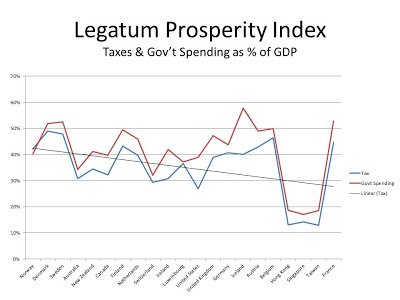
Norway, Denmark,
and Sweden top the list. These three countries spend and tax a great deal (tax rates an average of 46% of GDP and government spending an average of 48% - nearly half - of GDP). In the following chart, you can see the top 21 countries,
ranked from left to right. The lines measure taxes and government spending as a
percentage of GDP. Further, there is a simple trend line
that shows that as national ranking drops, so do spending and taxes.

Spending seems neither good or evil but instead necessary for the creation of a prosperous nation.
The Legatum Institute’s measure of prosperity is both complex and reasonable. If a country’s people have high incomes but few freedoms, it gets a lower score. The score also drops if its economic prosperity comes at the expense of health. The index makes an attempt to measure future prospects. Education is one obvious way to measure that but one of the more interesting variables is that of entrepreneurship and opportunity; if your people currently have high incomes but there is little entrepreneurial opportunity or activity, your ranking drops. (It doesn't seem as though they included environment, though. It seems that a measure of prosperity should take account for the loss of natural resources that comes from drawing down oil or fresh water reserves or polluting air and water.)
The Legatum Institute’s measure of prosperity is both complex and reasonable. If a country’s people have high incomes but few freedoms, it gets a lower score. The score also drops if its economic prosperity comes at the expense of health. The index makes an attempt to measure future prospects. Education is one obvious way to measure that but one of the more interesting variables is that of entrepreneurship and opportunity; if your people currently have high incomes but there is little entrepreneurial opportunity or activity, your ranking drops. (It doesn't seem as though they included environment, though. It seems that a measure of prosperity should take account for the loss of natural resources that comes from drawing down oil or fresh water reserves or polluting air and water.)
This seems to affirm that prosperity is more complicated than just declaring freedoms.
"You are free to learn what you would like" is not nearly as
empowering as "You will have access to free education, education that we
will hold to a particular standard. And not only are your parents required to
send you to school but we have laws that prohibit child labor." And
this may be the simplest explanation for why cutting government spending and
taxes does not simply lead to more prosperity and may actually diminish it. Freedom is not the same as empowerment.
Edward Deci
distinguished between three different styles of parenting or managing. I would
say that the styles also apply to governing. The first style is controlling,
dictating to children, employees or citizens what to do. The second style is
abandonment, or freedom, letting children, employees, or citizens do whatever
they want. Deci's third and recommended style is what he called
autonomy-supportive. In this model, children and employees and citizens alike
are the one's - ultimately - who have the power to choose and decide what to
do. But rather than just given freedom to do what they want, they are supported by parents,
teachers, and governments who enable them to realize their goals with a combination of education and resources.
Deci's third style
of governing suggests that a government that enables its people by helping them
to be healthier, better educated, and to have better access to capital,
information technology and a fair legal system will be more prosperous. And Legatum’s prosperity index seems to support that very claim. Empowerment is not the same as freedom nor is it free.
High tax rates and government
spending can inhibit prosperity but not nearly as much as a failure to
invest in quality healthcare, education and governance. Prosperity depends on investment and that is just as true of nations as it is individuals.
16 January 2013
Jedi, Wiccans, and Scientologists
From a fascinating article on the fundraising behind Scientology's recent cathedral building here:
That's kind of interesting.
And the ranks of the faithful are dropping. In 2008, there were 25,000 self-identifying American Scientologists, down by over a half from 55,000 in 2001, according to the American Religious Identification Survey. (Over the same time period, the number of Wiccans more than doubled from 134,000 to 342,000.) The 2011 British census showed a total of 2,418 Scientologists across England and Wales; about 73 times as many Brits identified themselves as "Jedi."
That's kind of interesting.
15 January 2013
Wanna Bet? Because I'm Tired of Arguing
I'm done arguing. As part of a new year's experiment (my variant on new year's resolutions) for the next few months, I'm going to make bets instead of arguing.
Arguments have so many problems. They alienate and anger people. They tire spectators on the sideline. They are a way to assert a worldview but more often a worldview that can't be tested but instead can only be tolerated or enjoyed like a familiar story.
By contrast, a bet demands a certain amount of precision and can be proven right or wrong. It demands prediction. And it allows you to quickly silence those who are just playing devil's advocate and merely want to tire you with petty, inconsequential probabilities.
I don't know how this is going to work but here's how I imagine it.
Old world argument ...
"We have the right to bear arms. It's in the constitution."
"But we could put in place some regulations that protect the right to own guns without pretending that anyone anywhere can have any kind of gun."
"Hitler confiscated guns. If you regulate firearms it's not only against the constitution, it makes you just like Hitler. (Plus did you know that he was a vegetarian?)"
"You don't think that gun regulations could help?"
"You can't outlaw guns! That ..."
And so it goes. Tiresome. Imprecise. A mix of rational and irrational claims all tumbled together like turds and chocolate. Here's how I imagine it could go instead.
New world bet ...
"We have to reduce the deficit. And we have to do it with spending cuts because taxes are already too high."
"You think that we can cut military spending and entitlements enough to close a trillion dollar gap?"
"No. We shouldn't cut defense. We should only cut welfare and entitlements."
"Okay. I'll bet you $20 that you can't balance next year's budget without touching the military or raising taxes, listing specific cuts that you honestly believe we should make. And if you win that bet, I bet you $2,000 that you can't get 6 out of 10 random people on the street to agree to your cuts. And if you win that bet, I bet you $100,000 that you can't get your Congressmen or Senator to publicly agree with your cuts. They'll just be too afraid to alienate constituents and would never vote for those cuts."
"What?"
"You have a conviction that we should reduce the deficit and that we don't need to raise taxes to get there. I could say things about how taxes as a percentage of GDP are the lowest they've been in 50 years. I could say that we've never had more retired people as a percentage of the population, thereby driving higher costs for retirement. I could point out that never has it been so expensive to prepare for a career,making education more expensive. I could argue that while people hate how much government costs they mostly agree with the expenses that drive its costs. I could make all sorts of points about how spending can only compress so far but you won't listen to any of it, dismissing me as misinformed and delusional. So instead, here's a chance to either admit that you were wishing government was cheap in the same way that 16 year olds wish that a BMW was affordable or demonstrate the real conviction about your beliefs and cash in on the fact that you are right and I'm wrong. So, which bet do you want?"
"Those are ridiculous bets."
"Well then tell me which of your convictions you'd place money on."
"That's stupid."
"So you don't believe in your own beliefs. Fine by me. What do you think about those Padres?"
"They've got a great, young team."
"So, do you want to bet against me when I say they'll lose the division?"
Now I may be caught up in my own imagination in ways that are unhealthy, but I somehow see this new "bet, don't argue" policy as making life more interesting. Don't believe in climate change? Think that the scientists are wrong and the oil companies, politicians, and talk show hosts are more objective about this topic, have more understanding than the scientists? Fine. Let's bet about the weather over the next decade. I'll bet you $10,000 that big storms and average temps don't go down and $1,000 that they go up. You think that Iran is stupid enough to bomb Israel? I'll bet you that it won't happen over the next decade. And so on.
Also, people with money on the line are more likely to be precise in their arguments than people who have nothing at stake. A bet has to have a measurable outcome: someone wins an election, a poll comes in a certain way, the stock market moves in a particular direction, job creation does or doesn't materialize - and at a certain rate (or not). Among other things, if you can't define the conditions that would enable you to win or lose your bet, you don't really have a coherent argument anyway.
I think this is going to be interesting. I suspect, though, that fewer people are willing to bet than argue. I'm willing to bet on it.
Arguments have so many problems. They alienate and anger people. They tire spectators on the sideline. They are a way to assert a worldview but more often a worldview that can't be tested but instead can only be tolerated or enjoyed like a familiar story.
By contrast, a bet demands a certain amount of precision and can be proven right or wrong. It demands prediction. And it allows you to quickly silence those who are just playing devil's advocate and merely want to tire you with petty, inconsequential probabilities.
I don't know how this is going to work but here's how I imagine it.
Old world argument ...
"We have the right to bear arms. It's in the constitution."
"But we could put in place some regulations that protect the right to own guns without pretending that anyone anywhere can have any kind of gun."
"Hitler confiscated guns. If you regulate firearms it's not only against the constitution, it makes you just like Hitler. (Plus did you know that he was a vegetarian?)"
"You don't think that gun regulations could help?"
"You can't outlaw guns! That ..."
And so it goes. Tiresome. Imprecise. A mix of rational and irrational claims all tumbled together like turds and chocolate. Here's how I imagine it could go instead.
New world bet ...
"We have to reduce the deficit. And we have to do it with spending cuts because taxes are already too high."
"You think that we can cut military spending and entitlements enough to close a trillion dollar gap?"
"No. We shouldn't cut defense. We should only cut welfare and entitlements."
"Okay. I'll bet you $20 that you can't balance next year's budget without touching the military or raising taxes, listing specific cuts that you honestly believe we should make. And if you win that bet, I bet you $2,000 that you can't get 6 out of 10 random people on the street to agree to your cuts. And if you win that bet, I bet you $100,000 that you can't get your Congressmen or Senator to publicly agree with your cuts. They'll just be too afraid to alienate constituents and would never vote for those cuts."
"What?"
"You have a conviction that we should reduce the deficit and that we don't need to raise taxes to get there. I could say things about how taxes as a percentage of GDP are the lowest they've been in 50 years. I could say that we've never had more retired people as a percentage of the population, thereby driving higher costs for retirement. I could point out that never has it been so expensive to prepare for a career,making education more expensive. I could argue that while people hate how much government costs they mostly agree with the expenses that drive its costs. I could make all sorts of points about how spending can only compress so far but you won't listen to any of it, dismissing me as misinformed and delusional. So instead, here's a chance to either admit that you were wishing government was cheap in the same way that 16 year olds wish that a BMW was affordable or demonstrate the real conviction about your beliefs and cash in on the fact that you are right and I'm wrong. So, which bet do you want?"
"Those are ridiculous bets."
"Well then tell me which of your convictions you'd place money on."
"That's stupid."
"So you don't believe in your own beliefs. Fine by me. What do you think about those Padres?"
"They've got a great, young team."
"So, do you want to bet against me when I say they'll lose the division?"
Now I may be caught up in my own imagination in ways that are unhealthy, but I somehow see this new "bet, don't argue" policy as making life more interesting. Don't believe in climate change? Think that the scientists are wrong and the oil companies, politicians, and talk show hosts are more objective about this topic, have more understanding than the scientists? Fine. Let's bet about the weather over the next decade. I'll bet you $10,000 that big storms and average temps don't go down and $1,000 that they go up. You think that Iran is stupid enough to bomb Israel? I'll bet you that it won't happen over the next decade. And so on.
Also, people with money on the line are more likely to be precise in their arguments than people who have nothing at stake. A bet has to have a measurable outcome: someone wins an election, a poll comes in a certain way, the stock market moves in a particular direction, job creation does or doesn't materialize - and at a certain rate (or not). Among other things, if you can't define the conditions that would enable you to win or lose your bet, you don't really have a coherent argument anyway.
I think this is going to be interesting. I suspect, though, that fewer people are willing to bet than argue. I'm willing to bet on it.
13 January 2013
China's Eugenics Program: A Billion Person Experiment to Create Humanity 2.0
China is creating its next generation through eugenics. Geoffrey Miller reports at the Edge that,
The BGI Cognitive
Genomics Project is currently doing whole-genome sequencing of 1,000
very-high-IQ people around the world, hunting for sets of sets of IQ-predicting
alleles. These IQ gene-sets will be found eventually—but will probably be used
mostly in China, for China. Potentially, the results would allow all Chinese
couples to maximize the intelligence of their offspring by selecting among
their own fertilized eggs for the one or two that include the highest
likelihood of the highest intelligence. Given the Mendelian genetic lottery,
the kids produced by any one couple typically differ by 5 to 15 IQ points. So
this method of "preimplantation embryo selection" might allow IQ
within every Chinese family to increase by 5 to 15 IQ points per generation.
After a couple of generations, it would be game over for Western global
competitiveness.
Is this a matter of parents and society doing what is best for their children? Could this result in some Utopian future in which no one has genetic defects and everyone represents a vast improvement on their parents, the generational equivalent of new product releases - "brighter! harder working! better looking!"? Is it a natural evolution of evolution from something random to something intentional?
Or are we heading towards a Dystopia in which future people are the product of past ideals? (Imagine trying something like the miracle of Silicon Valley with males genetically engineered by Romans to be the perfect gladiator.) Perhaps random is the only really safe way to prepare for an unknown future.
It is hard to believe that as methods for "choosing" your best off-spring become better known that people throughout the West won't adopt these methods as well. I see no reason why that ought not to make you both very excited and very afraid for the future.
11 January 2013
Dwindling Labor Share of Company Output is not a Profit Problem - It's a Power Problem
Liberals are concerned about this chart:
 Their problem is, labor is not getting as much of the money generated by US companies. The fear is, capital is getting too much, leading to growing income inequality.
I don't buy it. And I'm what most Americans would consider a liberal (or as they would describe me in the UK, a moderate). I think that it is wonderful that profits are rising relative to wages. To the extent that this is driving inequality in incomes (and it is) that is not a problem with increased profit. It is a problem with profit-sharing.
In an ideal world, we could hire someone to work for a few months, after which the software or movie or product they created would continue to sell for years, turning a huge profit. In this ideal world of intense (but intensely short duration) work towards the creation of something that would create an on-going profit steam (for a prolonged period), profit would be huge relative to wages.
Profit is a great signal that you are employing resources well. No profit means that you made just enough to pay labor and resources and capital (interest, for instance, on loans). When profit is zero, you are not really adding value to the inputs that were already there. Now by contrast, if you make a lot of profit, you are adding value. You brought together inputs that cost, say, only a million and turned it into profit worth, say, one hundred million. You transformed something that was worth just a little into something worth a lot. You didn't just shift money. You created it.
The problem is not that companies are generating more profit. That's wonderful. The problem is that we still don't have good mechanisms for sharing company profit to the Indians and not just the Chiefs (as in Chief Executive Officer, Chief Financial Officer, Chief Operating Officer ...).
In terms of business evolution, the right thing is happening: companies are becoming continually more effective at creating profits. In terms of the politics of business - how work and wealth is shared - the corporation still more closely resembles a fiefdom than a democracy. Once businesses better determine how to share incentives and power over decision-making and wealth-creation, they'll not only become even more profitable but the distribution of that profit will less dramatically contribute to income inequality. The problem is not profit. The problem is that we've yet to get to the next stage of business evolution to better share that profit.

I don't buy it. And I'm what most Americans would consider a liberal (or as they would describe me in the UK, a moderate). I think that it is wonderful that profits are rising relative to wages. To the extent that this is driving inequality in incomes (and it is) that is not a problem with increased profit. It is a problem with profit-sharing.
In an ideal world, we could hire someone to work for a few months, after which the software or movie or product they created would continue to sell for years, turning a huge profit. In this ideal world of intense (but intensely short duration) work towards the creation of something that would create an on-going profit steam (for a prolonged period), profit would be huge relative to wages.
Profit is a great signal that you are employing resources well. No profit means that you made just enough to pay labor and resources and capital (interest, for instance, on loans). When profit is zero, you are not really adding value to the inputs that were already there. Now by contrast, if you make a lot of profit, you are adding value. You brought together inputs that cost, say, only a million and turned it into profit worth, say, one hundred million. You transformed something that was worth just a little into something worth a lot. You didn't just shift money. You created it.
The problem is not that companies are generating more profit. That's wonderful. The problem is that we still don't have good mechanisms for sharing company profit to the Indians and not just the Chiefs (as in Chief Executive Officer, Chief Financial Officer, Chief Operating Officer ...).
In terms of business evolution, the right thing is happening: companies are becoming continually more effective at creating profits. In terms of the politics of business - how work and wealth is shared - the corporation still more closely resembles a fiefdom than a democracy. Once businesses better determine how to share incentives and power over decision-making and wealth-creation, they'll not only become even more profitable but the distribution of that profit will less dramatically contribute to income inequality. The problem is not profit. The problem is that we've yet to get to the next stage of business evolution to better share that profit.
Subscribe to:
Posts (Atom)