White males are Donald Trump's base. No other group supports him As an old white male who is friends with many similarly old white males, I can tell you that most of us never stop to question whether we'd have similar levels of income and wealth if we were female or a minority. There seems to be a simple belief among us that if "we" were suddenly made black or Hispanic or female - or even, say, an Hispanic female - that we would do just as well, in spite of all the evidence to the contrary. It's tough to imagine ourselves as the other.
************
This is the time of the election cycle when conversations and Facebook posts are cluttered with cries of dismay about how we get such poor choices for our elections, as if it reveals some shortcoming in our candidates. In fact, this lament reveals a shortcoming among our voters. In a nation of 300 million people who are growing more diverse every year, there simply is no way that the candidate who emerges from the primaries will be someone everyone is happy with.
Imagine that the only time you could hear music is in public places and we had to vote for the music we'd listen to over the next four years. You might love rock but even so you'd feel badly about choosing that to the exclusion of jazz or even the easy listening you campaign against. We have such diverse tastes in music that we'd never pretend to agree to one style of music even for ourselves, much less everyone. We'd finally agree on Frank Sinatra (again) or Bach (again) but none of us would be very happy about it.
There are two problems. One is that none of us are always conservative or liberal or federalists or states-rights people. The other is that whoever we elect will have to find a way to represent the uneducated, rural voter in Kentucky as well as the over-educated, urban voter in San Francisco. This guarantees that whoever wins 51% of the votes of this country will leave about 85% of voters feeling like the winner doesn't really represent them.
In a nation of 300 million, you can't get it your way. You are different from everyone else and so are they. Everyone feels like an outsider, so at least you have that in common with everyone else. You're not one in a million. You're one in three hundred million.
***************
As the father of an adult woman, I have a new perspective on feminism. From one angle it is very simple. It's true that women are sexual beings who love romance and sex and babies. Just like men. But it's also true that men get to be who they are outside of that. Men get to be accountants or mechanics or project managers without their sexuality ever being an issue. One simple take on feminism is that women have exactly the same deal, getting to be a person who is only incidentally sexual or female. It's simply about being a person first.
***************
The Republican Party is making its biggest gamble ever. The party is showing its refusal to support evolution by devolving from Lincoln to Eisenhower to Reagan to Bush to Trump. More than that, most of the party has decided to support Donald Trump. There is so much to say about this but I'll simply say this: when you've decided that religious freedom is negotiable, you've thrown in the towel on any claim of having principles. Trump has declared clearly that he wants to ban Muslims, effectively declaring his desire to end religious freedom. It would be incredibly comical to think that someone who doesn't know the difference between "second Corinthians," and "two Corinthians" (which sounds like the setup to a joke) would take it upon himself to decide which religions should be allowed. Would be if it weren't for the fact that Republicans actually support this candidate.
Republicans know that if they don't support Donald, they're handing the presidency to the Democrats and - quite possibly - the Senate as well. But the big gamble is that if they support him, they could still lose the presidency and then tar their reputation completely with millennials and most anyone under 60. Of course given that so many of them are old, the prospect of leaving behind an obsolete party apparently worries them about as much as leaving behind melting ice caps.

R World (Ron Davison muses aloud)
29 May 2016


28 May 2016
What We Do for Love
Maybe we raise children, pursue romantic entanglements, join churches or movements and form friendships because we never feel as alive or as fully realized as when we love. We create reasons for love that are incompatible with the facts in order to unharness this mad impulse to love. "Isn't she perfect!" we say of the woman who so obviously isn't. "Isn't he adorable!" we say of the toddler who will begin to drive us crazy in one, two, three .... seconds.
We fabricate stories in order to justify what feels most alive for us, this feeling of love. And thank goodness that for all of the fatigue and exasperation of raising children, it is one of the most unvarnished and raw expressions of love a person will experience. Thank goodness because it makes us happily enter into something that puts so many demands on us. The heart needs love in the same way that the brain needs sleep and whatever self-delusion or sacrifice it takes, we will pay that price because whatever the price it is cheap compared to its value.
We fabricate stories in order to justify what feels most alive for us, this feeling of love. And thank goodness that for all of the fatigue and exasperation of raising children, it is one of the most unvarnished and raw expressions of love a person will experience. Thank goodness because it makes us happily enter into something that puts so many demands on us. The heart needs love in the same way that the brain needs sleep and whatever self-delusion or sacrifice it takes, we will pay that price because whatever the price it is cheap compared to its value.
What the History of Income Inequality Has to Do with Christ, Buddha, and Dickens
Within a few centuries, the traditions and teachers that defined the Jewish, Hindu, Confucian and Buddhist faiths emerged. Most contemporary religions evolved from those early thinkers.

Curiously, these religious traditions emerged at a time when innovations like cities were creating unprecedented wealth. In hunter gatherer times, it's tough to accumulate wealth. When you domesticate crops and begin to trade and specialize in cities, it is easier to accumulate wealth. And, of course, wealth accumulates at different rates which means that while the community was getting wealthier, not everyone was getting wealthier. These religious traditions emerged as a way to offset the pure market forces that would have left the poor impoverished and each tradition introduced (or more likely, codified) morals and norms that would show respect for the poor and weak and not just conform to the rich and powerful. Jesus made it clear that we'd be judged by an all-powerful God based on how we treat those with no power.
The Industrial Revolution stimulated another round of social awareness, this time in the form of government programs. There is nothing novel about our time in this respect. We're once again living through an inflection point in the creation of wealth akin to the one that inspired Dickens to write so movingly about the poor and disenfranchised. Dickens helped to stimulate new policies for the poor like the abolition of debtors' prisons.
The Industrial Revolution stimulated another round of social awareness, this time in the form of government programs. There is nothing novel about our time in this respect. We're once again living through an inflection point in the creation of wealth akin to the one that inspired Dickens to write so movingly about the poor and disenfranchised. Dickens helped to stimulate new policies for the poor like the abolition of debtors' prisons.
At each point in history when big economic changes have created new wealth, one outcome is poverty. There are two dimensions to this. One dimension is absolute. People who made a living farming became displaced as factories emerged and agriculture jobs disappeared. Some people can't adjust and as a result they really are worse off by this supposed economic progress. Another dimension is relative. Because there are people now able to buy manufactured goods, you might now feel poor because you can't - even though you never could before either.
Today's income inequality is partly about poverty resulting from a loss of jobs to overseas and negative consequences from the Great Recession. It's more broadly about another inflection point in history, though, in which it is possible to create new wealth that the median worker is not yet pulled along by.
Entrepreneurship is creating a crazy amount of wealth and income in the US. Nowhere does this seem more apparent than in Silicon Valley where the ten most valuable companies (e.g., Apple, Alphabet (nee Google), Facebook, Oracle, Intel, etc.) are worth more than $2 trillion. A GDP of $2 trillion would put a country in the top ten in the world, ahead of Canada, Russia, and India. The wealth concentrated in Silicon Valley has driven up median home prices to over a million dollars and is unprecedented in history. This doesn't just create wealth; it reveals and creates poverty. In Silicon Valley there are tales of people making $80,000 a year who are homeless. That's a distinct kind of poverty.
But it's worth examining the reality of this new, entrepreneurial economy in which incomes are growing more than ever. A higher percentage of households are making income over $100,000 than ever in history.
But it's worth examining the reality of this new, entrepreneurial economy in which incomes are growing more than ever. A higher percentage of households are making income over $100,000 than ever in history.

Meanwhile, there has been a drop in the percentage of households making under $100k.
Income is going up. Not for everyone but for a growing percentage of Americans. This is not an impossible problem to solve. Policies that would please Dickens and the religious leaders from Confucius to Christ are simple enough. We take some portion of that new wealth and income and use it to mitigate the poverty of those who haven't been brought along by the gains of the new economy.
For some this is offensive, suggesting that we're rewarding those who can't find their own reward in the market. It's naive, though, to believe that we live in the first period in history in which poverty has disappeared.
Whether this new economy will drive changes as sweeping as those defined by Dickens and Buddha or simply affirm the relevance of their insistence on compassion in the midst of progress has yet to be seen.
19 May 2016
Donald Trump - Brought to You by the 24-7 Media
Donald Trump is a media creation.
 First, they created him by focusing on all that is bad and alarming. Outrage is good for ratings and they've kept anyone who will pay attention outraged since the emergence of 24-7 news. When you are outraged, the only thing you can agree on is that the status quo has to go and that even an outrageous candidate is better than none at all.
Second, they've enabled him by taking him seriously. Trump hasn't a clue about anything and yet they report on his candidacy as if it were a serious thing worthy not just of consideration but incessant focus. They've learned that the only thing better for ratings than alarm is Trump and so have focused on him as a ratings bonanza.
Our understanding of our world outside of our immediate experience is mediated by the media. There is no good reason that a reality-show star should become president except that he's already shown his ability to get ratings. Shows that get good ratings get renewed and shows with bad ratings are cancelled. The rest of the Republican field was cancelled and Donald has each month been renewed because he is best for ratings. Given the media's focus, the American people have decided that he must be the real deal.
It has become increasingly clear that Trump is going to become president and there is absolutely no good reason for this except for what he does for ratings.
 First, they created him by focusing on all that is bad and alarming. Outrage is good for ratings and they've kept anyone who will pay attention outraged since the emergence of 24-7 news. When you are outraged, the only thing you can agree on is that the status quo has to go and that even an outrageous candidate is better than none at all.
Second, they've enabled him by taking him seriously. Trump hasn't a clue about anything and yet they report on his candidacy as if it were a serious thing worthy not just of consideration but incessant focus. They've learned that the only thing better for ratings than alarm is Trump and so have focused on him as a ratings bonanza.
Our understanding of our world outside of our immediate experience is mediated by the media. There is no good reason that a reality-show star should become president except that he's already shown his ability to get ratings. Shows that get good ratings get renewed and shows with bad ratings are cancelled. The rest of the Republican field was cancelled and Donald has each month been renewed because he is best for ratings. Given the media's focus, the American people have decided that he must be the real deal.
It has become increasingly clear that Trump is going to become president and there is absolutely no good reason for this except for what he does for ratings.
16 May 2016
Where is My Robot? What Long-term Trends in Male Labor Participation Rates Suggest About the Future
In the late 1940s, the labor participation rate for men was nearly 87%. For every 100 men working, there were only 37 women.
By last month, after declining for 7 decades, the labor participation rate for men was 69.3%. Now, for every 100 men working there are 82 women working.
You can see that in this graph. The blue bar - men's participation rate - slowly falls over time. Meanwhile, until about the start of this century, women were gaining on men.

Curiously, women's participation rate as a percentage of men's has seemed to level off at about 80%. It hasn't moved much since the turn of the century and it seems plausible that it won't ever catch men's rate of labor participation.
So that raises a question. Has the steady decline of men's labor participation rate been because of women entering the labor force or do we simply need fewer workers as a percentage of the population? Will women's participation rate as a percentage of men's stabilize and if so, will their rates of participation join men's in slow, gradual decline? Will households - and not just men - need to work less in the future?
I don't know enough about why men's rate of labor participation has fallen so steadily for nearly 70 years to say. I do think it's a remarkably steady fall and it might just be a leading indicator of labor participation rates for men and women.
Now we need another line that shows robots' labor participation rate. Because maybe - just maybe - that rate will climb as women join men in gradual liberation from work.
By last month, after declining for 7 decades, the labor participation rate for men was 69.3%. Now, for every 100 men working there are 82 women working.
You can see that in this graph. The blue bar - men's participation rate - slowly falls over time. Meanwhile, until about the start of this century, women were gaining on men.

Curiously, women's participation rate as a percentage of men's has seemed to level off at about 80%. It hasn't moved much since the turn of the century and it seems plausible that it won't ever catch men's rate of labor participation.
So that raises a question. Has the steady decline of men's labor participation rate been because of women entering the labor force or do we simply need fewer workers as a percentage of the population? Will women's participation rate as a percentage of men's stabilize and if so, will their rates of participation join men's in slow, gradual decline? Will households - and not just men - need to work less in the future?
I don't know enough about why men's rate of labor participation has fallen so steadily for nearly 70 years to say. I do think it's a remarkably steady fall and it might just be a leading indicator of labor participation rates for men and women.
Now we need another line that shows robots' labor participation rate. Because maybe - just maybe - that rate will climb as women join men in gradual liberation from work.
15 May 2016
Why More Americans Over 65 Are Still Working
Nearly 20% of Americans over 65 are working, which is the highest it has been since the early 1960s.


Meanwhile, job participation rate is at its lowest since the early 1970s.
This seems contradictory on the surface. As more people work longer, you would expect labor participation rate to rise.
What if these two facts are related by a common cause?
The 1960s and 1970s saw the beginning of Johnson's Great Society, the introduction of medicare and the strengthening of social security that made retirement easier and more certain for more people. Before FDR introduced social security, the population of retired people was low in part because life expectancy was lower and in part because many people could not afford to stop working. Starting in the late 1960s, people could afford to retire even if they were working class. The percentage of people over 65 who were still working steadily declined from that time. Until, that is, about the 1980s when it leveled off and then in the early 2000s when it began to rise again.
(As a separate factor, it's worth noting that participation rates rose in the 1960s as more women entered the workforce. Their participation rate doubled from 1950 to 2000.)
(As a separate factor, it's worth noting that participation rates rose in the 1960s as more women entered the workforce. Their participation rate doubled from 1950 to 2000.)

In the 1960s, two things happened that made retirement possible and smoothed out some of the variation in retirement income. Social security and medicare, obviously, helped in this regard. Additionally, more Americans were retiring from corporations that offered pension plans. So many Americans had access to two retirement streams - social security and pension payments - that saved them from poverty but could not make them rich.
In the 1980s, the model shifted from pensions to 401(k) accounts. Given a 401(k) can be managed by an individual and given that returns can vary so much from one investor to another, retirees were suddenly dependent on a sum of money that could make them rich or leave them poor. If your average return is 2%, you might struggle to save enough to retire. If your average annual return is 20%, you might be rich. Pensions didn't make anyone rich but lowered the chance someone might be poor; by contrast, 401(k)s could make you rich or leave you poor.
And then of course in the 2000s, investments took a huge hit. Not just stocks but even homes which some people used as retirement backup. (It's not unusual for people to own a home where jobs are and then sell that at retirement to move to where jobs are not and where home prices are lower, making equity in a home another source of retirement money.)
If so, reliance on 401(k)s would lead to two things: more people retiring early, which would lower labor participation rates, and more people having to work past the age of 65, which would raise the percentage of folks over 65. And of course both of these things have happened.
[Before someone points out that the Great Recession and a slow recovery from it have greatly contributed to the lower labor participation rate, let me say that they're right. The Great Recession did knock labor participation rates for a loop from which they haven't fully recovered. But studies suggest that the Great Recession doesn't account for the entirety of the drop. Between a third to a half of the drop seems to be the result of something else going on, something that could be attributed to more people retiring sooner.]
Donald Trump's Subconscious Cries Out a Warning

11 May 2016
The Straight and Narrow Path to Progress
In last night's debate between California's senate candidates, front-runner Kamala Harris was asked by a San Diego State University student how she would make college more affordable. She responded on how, as the state's Attorney General, she'd gone after Corinthian College for charging students for an education that left them with debt payment but not much in the way of job prospects. It's good that she went after Corinthian. It's bad that a previous attack on a for-profit institution was all that she could muster in a state with a $30 billion college and university system. (In her defense, a one-minute response on a topic like this is laughable. Almost by definition, any response will sound more like a bumper sticker than an op-ed.) The impression I was left with was that in her mind the real problem is the for-profit sector, and that made me wince.
I hesitated to write this post because what I have to say seems so very obvious. It's like saying, "everybody is different." Duh. But then I watch national GOP debates and hear a messianic belief in markets and hear California Democrats who seem to have at best a grudging acknowledgement of the power of markets and I think, perhaps this is not so obvious at all. What is this? The path to progress is a straight and narrow one that involves continuously balancing free markets and free elections.
About a century ago, people began to realize the incredible power of governments to do good. The nation-state as a democratic institution was still largely novel around 1900 and citizens were just becoming aware of its power for good. Bismarck in Germany in the late 1800s was one of the first to institute things like old-age pensions and in various places unemployment and welfare programs were coming into practice. In the 20th century it became increasingly clear that governments could do amazing things like educate everyone, build roads and highways, put in place electric grids and dams, and even land on the moon. Anyone unimpressed with governments simply was not paying attention.
So along came communists who did not just rightfully feel delighted at the power of government but had decided that they didn't need markets to create the perfect society. What resulted was impressive in some ways (it's worth remembering that the Soviet Union's Sputnik got into space before anything out of the US) but a disaster in most. It wasn't that communists weren't right to be a little intoxicated by the power of government to transform lives. It was that they were wrong to think it was enough.
Now, roughly 100 years later, we have people who rightfully feel intoxicated by the power of markets and wrongfully see in them a panacea for progress. This would describe the GOP's presidential candidates. And these people are sort of right. Markets bring so many great products and innovations. While government seems able to bloat budgets, markets often make things cheaper. Markets are engines that create new jobs, wealth, and products. Anyone unimpressed with markets simply isn't paying attention.
Jon Stewart recently said of the Republican Party that they have a great thing going. The argue that government is unable to do anything good and then prove their thesis by obstructing government. At the national level, the GOP is slowly making itself harmful by its blind faith in markets that is akin to communists' blind faith in governments Ted Cruz wanted to eliminate the Environmental Protection Agency and dozens of other agencies and departments, so pure was his belief in the power of markets to even protect us from anyone who would disregard health in search of profits. And it's worth remembering that Cruz was the candidate who the party elders (reluctantly) supported in the final contest with Trump.
Maybe it's because the League of Women Voters decades ago decided that there was no topic so complex that it couldn't benefit from a 1 to 2 minute answer. At that point, debates between experts and politicians who had memorized sound bites tilted in favor of the master of sound bites rather than the master of the topic. And gradually, it became important to have answers like "Government programs!" or "Markets!" and then we drifted away from the notion that what made our country great was not a reliance on one or the other but a continual balancing between these two amazing, transformative forces for good. And while the first generation of politicians forced into sound bite debates realized they were simplifying complex topics, the generation raised on such debates began to think that these sound bites were the topics.
Ideally, we have two parties who both believe in markets and government and we as voters simply choose whether we want to - in this election - steer more to the right with fewer regulations and taxes or to the left with more regulations and government programs. Instead, we have a Republican Party that preaches about the invisible hand of markets as if it were the left hand of God. And we have too many Democrats who - as Kamala Harris apparently does - can't even see the $30 billion problem before her for her because she's focused on the failings of a (relatively) small private business. At the national level, the GOP swears allegiance to markets and just swears at government. Here in California where Democrats have a super-majority, I have the suspicion that too many Democrats are more clear about the market's flaws than its strengths.
The iPhone is possibly the most profitable product in history. It relies on a host of products - from touch screen and GPS to chips and small memory devices - that emerged from government research labs. Such technologies take too long to develop and are too uncertain to be funded by the private sector. If you love your smart phone, you love the fact that you live in a world where strong government funding is coupled with strong private investment. That is, you love a world where smart people are doing what they can to strengthen governments and markets.
And this, finally, is the punchline. We are not hindered by our institutions, however frustrated we might feel with government or corporations. We are made by them. Without institutions, we're little different than apes. Forced to compete with an ape one-on-one - whether in hand to hand combat or simply to compete for resources and ability to survive in the wild - you would lose. Forced to compete in groups of a hundred or a million, the ape loses. We don't live the way we do because of our individual abilities. We live this way because of our ability to coordinate through institutions. And the meta-institutions of our time are democracies and markets, the two forces that have - more or less - brought us the modern world. It's a straight and narrow path to progress and it involves continuously strengthening and improving our markets and governments but never running mindlessly towards either one as if in that direction we will find utopia.
It would be nice to feel more confident that something this obvious really were that obvious.
I hesitated to write this post because what I have to say seems so very obvious. It's like saying, "everybody is different." Duh. But then I watch national GOP debates and hear a messianic belief in markets and hear California Democrats who seem to have at best a grudging acknowledgement of the power of markets and I think, perhaps this is not so obvious at all. What is this? The path to progress is a straight and narrow one that involves continuously balancing free markets and free elections.
About a century ago, people began to realize the incredible power of governments to do good. The nation-state as a democratic institution was still largely novel around 1900 and citizens were just becoming aware of its power for good. Bismarck in Germany in the late 1800s was one of the first to institute things like old-age pensions and in various places unemployment and welfare programs were coming into practice. In the 20th century it became increasingly clear that governments could do amazing things like educate everyone, build roads and highways, put in place electric grids and dams, and even land on the moon. Anyone unimpressed with governments simply was not paying attention.
So along came communists who did not just rightfully feel delighted at the power of government but had decided that they didn't need markets to create the perfect society. What resulted was impressive in some ways (it's worth remembering that the Soviet Union's Sputnik got into space before anything out of the US) but a disaster in most. It wasn't that communists weren't right to be a little intoxicated by the power of government to transform lives. It was that they were wrong to think it was enough.
Now, roughly 100 years later, we have people who rightfully feel intoxicated by the power of markets and wrongfully see in them a panacea for progress. This would describe the GOP's presidential candidates. And these people are sort of right. Markets bring so many great products and innovations. While government seems able to bloat budgets, markets often make things cheaper. Markets are engines that create new jobs, wealth, and products. Anyone unimpressed with markets simply isn't paying attention.
Jon Stewart recently said of the Republican Party that they have a great thing going. The argue that government is unable to do anything good and then prove their thesis by obstructing government. At the national level, the GOP is slowly making itself harmful by its blind faith in markets that is akin to communists' blind faith in governments Ted Cruz wanted to eliminate the Environmental Protection Agency and dozens of other agencies and departments, so pure was his belief in the power of markets to even protect us from anyone who would disregard health in search of profits. And it's worth remembering that Cruz was the candidate who the party elders (reluctantly) supported in the final contest with Trump.
Maybe it's because the League of Women Voters decades ago decided that there was no topic so complex that it couldn't benefit from a 1 to 2 minute answer. At that point, debates between experts and politicians who had memorized sound bites tilted in favor of the master of sound bites rather than the master of the topic. And gradually, it became important to have answers like "Government programs!" or "Markets!" and then we drifted away from the notion that what made our country great was not a reliance on one or the other but a continual balancing between these two amazing, transformative forces for good. And while the first generation of politicians forced into sound bite debates realized they were simplifying complex topics, the generation raised on such debates began to think that these sound bites were the topics.
Ideally, we have two parties who both believe in markets and government and we as voters simply choose whether we want to - in this election - steer more to the right with fewer regulations and taxes or to the left with more regulations and government programs. Instead, we have a Republican Party that preaches about the invisible hand of markets as if it were the left hand of God. And we have too many Democrats who - as Kamala Harris apparently does - can't even see the $30 billion problem before her for her because she's focused on the failings of a (relatively) small private business. At the national level, the GOP swears allegiance to markets and just swears at government. Here in California where Democrats have a super-majority, I have the suspicion that too many Democrats are more clear about the market's flaws than its strengths.
The iPhone is possibly the most profitable product in history. It relies on a host of products - from touch screen and GPS to chips and small memory devices - that emerged from government research labs. Such technologies take too long to develop and are too uncertain to be funded by the private sector. If you love your smart phone, you love the fact that you live in a world where strong government funding is coupled with strong private investment. That is, you love a world where smart people are doing what they can to strengthen governments and markets.
And this, finally, is the punchline. We are not hindered by our institutions, however frustrated we might feel with government or corporations. We are made by them. Without institutions, we're little different than apes. Forced to compete with an ape one-on-one - whether in hand to hand combat or simply to compete for resources and ability to survive in the wild - you would lose. Forced to compete in groups of a hundred or a million, the ape loses. We don't live the way we do because of our individual abilities. We live this way because of our ability to coordinate through institutions. And the meta-institutions of our time are democracies and markets, the two forces that have - more or less - brought us the modern world. It's a straight and narrow path to progress and it involves continuously strengthening and improving our markets and governments but never running mindlessly towards either one as if in that direction we will find utopia.
It would be nice to feel more confident that something this obvious really were that obvious.
10 May 2016
Trump as Evidence of the Failure of a For-Profit Media
I think that Donald Trump's success in the Republican primary is evidence suggesting that a for-profit news media with incentive to gratuitously alarm the polity in order to drive ratings is incompatible with a functioning democracy. For-profit can be great for entertainment. It doesn't seem to work for informing voters or helping to distinguish between real issues and non-issues, between actual risks to life and perceived ones.
08 May 2016
Trump as Guy Fawkes (is that an explosion we hear in the distance?)
This week, Trump said that he'd default on US debt. This would, quite simply, blow up the economy. This isn't conjecture. It's just a fact. And it's one more way that Donald is showing himself to be an idiot savant, a man who is brilliant at getting media attention but wildly incoherent with policy. It's hard to imagine a more dangerous combination. He could blow up the economy once elected or just blow up the GOP in the general.
I have a simple question. If Trump were intent on exposing the Republican Party's dependence on racism and on engineering a loss not just for the presidential election but of the Senate, how would his behavior to this point be any different than what we've seen so far?
I have a simple question. If Trump were intent on exposing the Republican Party's dependence on racism and on engineering a loss not just for the presidential election but of the Senate, how would his behavior to this point be any different than what we've seen so far?
30 April 2016
Job Creation and Presidential Approval - How Obama Compares to Bush and Clinton
There is so much more to a president's approval rating than just the rate at which the economy created jobs during his term. His looks, for instance. Or his committing criminal acts, starting wars, giving speeches, or kicking off popular or unpopular programs. The graph below ignores all of that and just plots approval rating at the end of an administration (or, obviously, most recently for Obama) against the average annual job creation rate.
 If you draw a line from George W. Bush's low approval rating and low job creation average to Bill Clinton's high approval rating and high job creation average, Obama pretty much lands neatly on that line between them. Judging just from how well the economy did at creating jobs, Carter's approval seems unjustly low and George H. Bush's approval seems unfairly high.
What can you say about America's opinion of Obama? Just based on this simple metric, it seems fair enough, even if the job creation numbers would be closer to what they were under Reagan had he not taken office just as the worst recession in a century was gaining momentum.

What can you say about America's opinion of Obama? Just based on this simple metric, it seems fair enough, even if the job creation numbers would be closer to what they were under Reagan had he not taken office just as the worst recession in a century was gaining momentum.
What if the Republican Party is Simply Obsolete?
Republicans continue to fantasize about a last-minute candidate emerging from the Republican convention who the country will love. As if they didn't have quite a smattering of strong candidates among their original 17.
The problem is not that they don't have good and decent people with proven legislative and governing experience. The problem is that the policies that excite them are going the way of opposition to women voting and regulating pollution.
What beliefs define Republicans? Belief that the rich need more tax breaks and the poor need less help. Belief that women should not be the ones to make a decision about whether to terminate a pregnancy or even use contraceptives. Belief that climate change is a huge conspiracy. Belief that businesses are unduly burdened by regulations that make it difficult for them to pollute. (Cruz wants to eliminate the EPA.) Belief that the government should be cut by about half, made less effective at educating a workforce as education is becoming increasingly important, made less effective at offering a social safety net as the population becomes older than ever and as the economy becomes more risky than ever. Belief that American bombs and boots on the ground are the solution for so many of the problems facing regions like the Middle East that are going through huge and often violent change. Belief that morality is inseparable from religion.
Now you might share all of these beliefs and convictions. If you do, you're likely old and will likely vote in only two or three more presidential elections. The Silent generation (now age 69 to 86) tilts Republican by about 4 points. By contrast, the Millennial generation (age 18 to 33) tilts Democrat by 16 points. Every presidential election, 2016 to 2020 to 2024 ... this will make it harder for Republicans to win.
To raise voter turnout, Republicans have made an even bigger deal about their beliefs in recent elections. Higher turnouts helped them to elect and re-elect George W. Bush but it also solidified their position as the party with these beliefs. Both in branding and execution. When the Bush / Cheney tax cuts failed to create jobs, their de-regulation failed to make the economy more robust, and their military invasions failed to create a shining example of democracy in the Middle East, those beliefs were called into question. Napoleon gets credited with the quip, "Tell me what the world was like when you were 18 and I'll tell you your worldview." Polls suggest that Millennials were not impressed with the world they came into as young adults, or the beliefs that shaped it.
So the question is, does the Republican Party have a hope of changing their beliefs and their image for Millennials Or more precisely, will it be easier for them to make this change than it will be for a new party to emerge. Because no matter how strongly you believe in the beliefs of the party represented by Ted Cruz and Donald Trump, you are in a dwindling minority. The only question is whether the Republican Party of 2032 will have become a regional party with just pockets of success in the south and midwest or whether it will look radically different than it does now, espousing very different beliefs than those that Cruz and Trump are using to rally their followers.
The problem is not that they don't have good and decent people with proven legislative and governing experience. The problem is that the policies that excite them are going the way of opposition to women voting and regulating pollution.
What beliefs define Republicans? Belief that the rich need more tax breaks and the poor need less help. Belief that women should not be the ones to make a decision about whether to terminate a pregnancy or even use contraceptives. Belief that climate change is a huge conspiracy. Belief that businesses are unduly burdened by regulations that make it difficult for them to pollute. (Cruz wants to eliminate the EPA.) Belief that the government should be cut by about half, made less effective at educating a workforce as education is becoming increasingly important, made less effective at offering a social safety net as the population becomes older than ever and as the economy becomes more risky than ever. Belief that American bombs and boots on the ground are the solution for so many of the problems facing regions like the Middle East that are going through huge and often violent change. Belief that morality is inseparable from religion.
Now you might share all of these beliefs and convictions. If you do, you're likely old and will likely vote in only two or three more presidential elections. The Silent generation (now age 69 to 86) tilts Republican by about 4 points. By contrast, the Millennial generation (age 18 to 33) tilts Democrat by 16 points. Every presidential election, 2016 to 2020 to 2024 ... this will make it harder for Republicans to win.
To raise voter turnout, Republicans have made an even bigger deal about their beliefs in recent elections. Higher turnouts helped them to elect and re-elect George W. Bush but it also solidified their position as the party with these beliefs. Both in branding and execution. When the Bush / Cheney tax cuts failed to create jobs, their de-regulation failed to make the economy more robust, and their military invasions failed to create a shining example of democracy in the Middle East, those beliefs were called into question. Napoleon gets credited with the quip, "Tell me what the world was like when you were 18 and I'll tell you your worldview." Polls suggest that Millennials were not impressed with the world they came into as young adults, or the beliefs that shaped it.
So the question is, does the Republican Party have a hope of changing their beliefs and their image for Millennials Or more precisely, will it be easier for them to make this change than it will be for a new party to emerge. Because no matter how strongly you believe in the beliefs of the party represented by Ted Cruz and Donald Trump, you are in a dwindling minority. The only question is whether the Republican Party of 2032 will have become a regional party with just pockets of success in the south and midwest or whether it will look radically different than it does now, espousing very different beliefs than those that Cruz and Trump are using to rally their followers.
Sweden Stops Wrinkling its Nose at Entrepreneurship
I rode home beside a lovely man from Sweden the other day. He now lives in San Diego, helping to manage a start-up.
He told me that even ten or fifteen years ago, people in Sweden wrinkled up their nose at entrepreneurship. "Oh. You couldn't get a real job, eh?"
Now he says, the success of Skype and Spotify have changed their opinion. "It's a country of only 9 million, so it doesn't take long to change popular opinion."
And to my ears, this is just one more example of how the West is slowly popularizing entrepreneurship.
He told me that even ten or fifteen years ago, people in Sweden wrinkled up their nose at entrepreneurship. "Oh. You couldn't get a real job, eh?"
Now he says, the success of Skype and Spotify have changed their opinion. "It's a country of only 9 million, so it doesn't take long to change popular opinion."
And to my ears, this is just one more example of how the West is slowly popularizing entrepreneurship.
An Excerpt from The Fourth Economy (on this, Claude Shannon's 100th birthday)
My book The Fourth Economy includes the stories of Henry VIII and Henry Ford, Pope Boniface and Andrew Carnegie, Galileo and Wilhelm Humboldt. To be mentioned in this book that covers 700+ years of history is a big deal. Claude Shannon - who today Google is honoring for his 100th birthday - made the cut. Here's an excerpt from the book in a section explaining the third, information economy, that includes mention of Shannon.
Knowledge Workers Create IT for Knowledge Workers
The Summer of Pocket Protectors
Knowledge Workers Create IT for Knowledge Workers
Bell Labs – named after AT&T founder Alexander Graham
– employed 25,000 employees at its peak, including 3,300 PhDs.[1]
Bell Labs was a paragon of knowledge work, a place where people were paid to
think. In 1947, the lab produced two innovations that became the paragon of
information technology.
The first innovation was conceptual. Claude Shannon coined
the word “bit” in an attempt to do something no one had ever done. His was the
first attempt to quantify information. With the right pattern, 1 and 0 could be
used to describe any letter or number (a combination that would come to be
known as a byte). This was interesting.
Then, in that same year, Bell Labs produced another
innovation that would – when coupled with Shannon’s bit – enable the computer.
Three of its employees would eventually share a Noble
Prize for inventing a product Bell Labs thought might might “have far-reaching
significance in electronics and electrical communication."[2]
The transistor was a simple replacement for the bulky vacuum tubes and given it
could easily be turned on or off, it could easily be made to represent a 1 or 0
– a bit.
By the 1960s, multiple transistors were joined together on
a computer chip, the heart of a computer. No invention would better define
information technology.
Yet even with the advent of this new technology, something
was missing. Technological invention alone is rarely enough; to make real gains
from the computer chip required social invention, a change in corporate
culture.
One of the three co-inventors of the transistor began a
company to exploit this new technology.
William Shockley (1910-1989) was co-inventor of the
solid-state transistor and literally wrote the book on semiconductors that the
first generation of inventers and engineers would use to advance this new
technology. He had graduated from the best technical schools in the nation (BS
from Cal Tech and PhD from MIT), and was the epitome of the modern knowledge
worker.
Shockley hired the best and brightest university graduates
to staff his Shockley Semiconductor Laboratory. Yet things were not quite right.
It was not technology, intelligence, or money that his company lacked. It was
something else.
To answer what it was leads us to the question of why
information has so much value.
One of the beliefs of pragmatism is that knowledge has
meaning only in its consequences. This suggests that information has value only
if it is acted upon. Information that is stored in secret has no consequences.
By contrast, information that informs action needs to be both known and acted
upon. The more people who have access to this information and can act on it,
the more value it has.
What was missing from Shockley’s approach to this brand
new technology was a management style that took advantage of an abundance of
information. He did not like to give up control or information but that was
exactly what this new computer chip he’d helped to invent was perfectly made
for. Largely because of this, it was not Shockley who would become a
billionaire from computer chips. Instead, it would be a few of his employees.
The Summer of Pocket Protectors
1968 was the kind of year that would have made even
today’s 24-7 news coverage seem insufficient. In January, the North Vietnamese
launched the Tet offensive, making it all the way to the U.S. Embassy in
Saigon; this might have been the first indication that those unbeatable Americans
could be beaten. Civil rights demonstrations that devolved into deadly riots
were the backdrop for Lyndon Johnson’s signing of the Civil Rights Act. Martin
Luther King, Jr. and Robert Kennedy - iconic figures even in life - were
assassinated within months of each other. The musical Hair opened on Broadway
and Yale announced that it would begin to admit women. For the first time in history,
someone saw the earth from space: astronauts Frank Borman, Jim Lovell, and
William Anders became the first humans to see the dark side of the moon and the
earth as a whole, an image that transcended differences of borders and even
continents. Any one of these stories could have been enough to change modern
society. Yet in the midst of all these incredible events, two entrepreneurs
quietly began a company that would transform technology and business, a company
that would do as much to define Silicon Valley as any other.
Gordon Moore (b. 1929) and Robert Noyce (1927-1990) founded
Intel in July 1968. Moore gave his name to “Moore’s Law,” a prediction that the
power of computer chips would double every eighteen months. Here was something
akin to the magic of compound interest applied to technology or, more
specifically, information processing.
Moore and Noyce had originally worked for Shockley, but
they left his laboratory because they did not like his tyrannical management.
They then went to work for Fairchild Semiconductor, but left again, because,
“Fairchild was steeped in an East Coast, old-fashioned, hierarchical business
structure,” Noyce said in a 1988 interview. "I never wanted to be a part
of a company like that."[3]
It is worth noting that Moore and Noyce did not leave
their former employers because of technology or funding issues. They left
because of differences in management philosophy.
Once when I was at Intel, one of the employees asked if I
wanted to see the CEO’s cubicle. Note that this was an invitation to see his
cubicle, not his office. We walked over to a wall that was - like every other
wall on the floor - about five feet high, and I was able to look over the wall
into an office area complete with pictures of CEO Craig Barrett with people
like President Clinton. In most companies, one can quickly discern the
hierarchy based on dynamics in a meeting. The level of deference and the ease
of winning arguments are pretty clear indicators of who is where in the
organizational chart. By contrast, I have never been inside a company where it
was more difficult to discern rank than Intel. Depending on the topic,
completely different people could be assertive or deferential. One of Intel’s
values is something like “constructive confrontation,” and this certainly
played out in more than one meeting I attended. When a company makes
investments in the billions, it cannot afford to make a mistake simply because
people have quaint notions about respect for authority. Intel’s culture seems
to do everything to drive facts and reasons ahead of position and formal
authority. This egalitarian style probably traces back to its founders rejection
of the management style of their former employer, Shockley.
Shockley Labs no longer exists. Intel has a market cap of
more than $150 billion.[4]
Intel’s net profit in the most recent year was over $11 billion, and it employs
more than 100,000 people worldwide. Moore and Noyce’s open culture made a
difference.
Information technology has little value in a culture that
hoards information. Information technology makes sense as a means to store,
distribute, and give access to information and has value as tool for problem
solving and decision-making.
The pioneers of information technology, like Moore and
Noyce, understood this and realized - at some level - that it made little or no
sense to create hierarchies where information was held and decisions were made
at one level and people were merely instructed at another. The knowledge worker
needed information technology as a basis for decisions and action. Before 1830,
up until the time of the railroad, the information sector of the American
workforce was less than 1 percent.[5]
By the close of the 20th century, nearly everyone seemed to need technology for
storing and processing information.
By paying double typical wages, Henry Ford created a new
generation of consumers for his car. Moore and Noyce did not just help to create
information technology; they helped to popularize a management culture that took
advantage of this amazing new technology.
[1]
Time, Jon Gertner, “How Bell Labs Invented the World We Live in Today,” March
21, 2012. http://business.time.com/2012/03/21/how-bell-labs-invented-the-world-we-live-in-today/
[3]
Daniel Gross, ed., Forbes: Greatest Business
Stories of All Time (New
York: John Wiley &
Sons, 1996), 251.
[4]
This taken from stock market quotes at end of 2014.
[5]
Beniger, The Control Revolution, 23.
Income Inequality and Living in the Top 1%
Whether it offends you or delights you, consider for a moment the political debate about the top 1%. They should be taxed more, the argument goes, and more of their income should go to those at the bottom. Let's say for a moment that you agree and that you think - for example - that the top 1% should pay another 5% of their income in taxes.
If you make $32,400 a year, you are in the top 1%. That's $16 an hour, working full-time. In some parts of the US, $15 will soon be the minimum wage. $16 an hour may not seem like a lot but it makes your income higher than 99% of the world's population. Do you feel an obligation to pay 5% more of your taxes to help those at the bottom? Would you send another $1,620 a year to help the world's poor?
Now you might argue that you have to live in a place where $32,400 barely covers your expenses. Housing alone would eat up a big chunk of your income, and this gets to one problem with examining high-income in the US. With median home prices of one million, the Bay Area (including Marin, San Francisco, and San Mateo counties) is a place from which we get reports of homeless people making $80,000 a year. Palo Alto - home to Stanford's campus and neighbor to Google, Apple and Facebook campuses - is considering a proposal that would help to subsidize housing for households making only $150,000 to $250,000 a year.
The differences between what it costs to live in San Francisco (where median home prices are $1,129,800) and Gary Indiana (where median home prices are $47,500) are so great as to render national discussions about income disparity almost meaningless.
If you lived in rural Wyoming or Mississippi, $100,000 would feel very different than it would in Manhattan or Bethesda, MA. And most of the good jobs are being created in places where home prices are high. Whether you are an American making $32,400 or a New Yorker making $100,000, your income relative to people outside of your community (whether you define the community as the US or as New York) says little about your lifestyle. From afar you might appear rich but your reality might be barely getting by. Partly this is because so many of our expenses are set by market prices determined by the people around us. Partly it is because our expectations of normal are set by the folks around us.
And this is one fascinating thing about relative wealth and income. We rarely think of ourselves as rich when we're living among people with roughly the same income. And we do tend to live among people in our demographic group. I was chatting with someone who lived in a neighborhood with multi-million dollar homes and they were talking about how rich their neighbors were. Steve Jobs used to socialize with Larry Ellison - who has been on the top ten richest people list a number of years. Jobs' son called Ellison "our rich friend." Even the rich know someone they consider rich. Every group - even groups who are themselves in someone else's 1% - know someone in their 1% and to them, that guy is the rich one.
And later in the day after writing this, I find this article on how much $100 is worth in different states.
If you make $32,400 a year, you are in the top 1%. That's $16 an hour, working full-time. In some parts of the US, $15 will soon be the minimum wage. $16 an hour may not seem like a lot but it makes your income higher than 99% of the world's population. Do you feel an obligation to pay 5% more of your taxes to help those at the bottom? Would you send another $1,620 a year to help the world's poor?
Now you might argue that you have to live in a place where $32,400 barely covers your expenses. Housing alone would eat up a big chunk of your income, and this gets to one problem with examining high-income in the US. With median home prices of one million, the Bay Area (including Marin, San Francisco, and San Mateo counties) is a place from which we get reports of homeless people making $80,000 a year. Palo Alto - home to Stanford's campus and neighbor to Google, Apple and Facebook campuses - is considering a proposal that would help to subsidize housing for households making only $150,000 to $250,000 a year.
The differences between what it costs to live in San Francisco (where median home prices are $1,129,800) and Gary Indiana (where median home prices are $47,500) are so great as to render national discussions about income disparity almost meaningless.
If you lived in rural Wyoming or Mississippi, $100,000 would feel very different than it would in Manhattan or Bethesda, MA. And most of the good jobs are being created in places where home prices are high. Whether you are an American making $32,400 or a New Yorker making $100,000, your income relative to people outside of your community (whether you define the community as the US or as New York) says little about your lifestyle. From afar you might appear rich but your reality might be barely getting by. Partly this is because so many of our expenses are set by market prices determined by the people around us. Partly it is because our expectations of normal are set by the folks around us.
And this is one fascinating thing about relative wealth and income. We rarely think of ourselves as rich when we're living among people with roughly the same income. And we do tend to live among people in our demographic group. I was chatting with someone who lived in a neighborhood with multi-million dollar homes and they were talking about how rich their neighbors were. Steve Jobs used to socialize with Larry Ellison - who has been on the top ten richest people list a number of years. Jobs' son called Ellison "our rich friend." Even the rich know someone they consider rich. Every group - even groups who are themselves in someone else's 1% - know someone in their 1% and to them, that guy is the rich one.
And later in the day after writing this, I find this article on how much $100 is worth in different states.
29 April 2016
M is for Mother - the letter that predated the alphabet by millennia
Mother's Day is in about a week. The "mmm" sound babies make so naturally lends itself to "ma," or "mom," one of their earliest sounds morphing into one of their earliest words.

I recently read Peter Watson's Great Divide, the story of how human cultures evolved separately in the Americas and Eurasia after the Bering Strait closed about 16,000 years ago, and came across this fascinating tidbit about the letter M.

I recently read Peter Watson's Great Divide, the story of how human cultures evolved separately in the Americas and Eurasia after the Bering Strait closed about 16,000 years ago, and came across this fascinating tidbit about the letter M.
“The ‘birth-giving Goddess,’ with parted legs and pubic triangle, became a form of shorthand, as the capital letter M as ‘the ideogram of the Great Goddess.’”
This thousands of years before linear writing. Kind of fascinating to think that the birth of the alphabet was itself a symbol for birth. That seems fitting.
Happy (almost) Mother's Day.
Happy (almost) Mother's Day.
24 April 2016
Bad Job Markets Kill People
Everyone knows that bad foreign policy kills. Failure to intervene can essentially sanction genocide and willingness to intervene can mean prolonging or exacerbating a civil war.
Domestic policy kills as well. Business cycles are inevitable but they can be made more severe or more prolonged by bad policy. And when unemployment goes up, so do suicide rates.
Suicide rates rose 24% from 1999 to 2014. The biggest jump was from 2006 to 2014, when so many lives were financially devastated.
Anyone puzzled over Sanders' or Trump's support fails to appreciate the emotional toll of the last decade. This is not something people recover from easily or quickly.
Last decade was devastating in terms of job growth.

Domestic policy kills as well. Business cycles are inevitable but they can be made more severe or more prolonged by bad policy. And when unemployment goes up, so do suicide rates.
Suicide rates rose 24% from 1999 to 2014. The biggest jump was from 2006 to 2014, when so many lives were financially devastated.
Anyone puzzled over Sanders' or Trump's support fails to appreciate the emotional toll of the last decade. This is not something people recover from easily or quickly.
Last decade was devastating in terms of job growth.

In the last three decades of the 20th century, the American economy created roughly 20 million jobs per decade, a rate equal to about 9% of the population. In the first decade of this century, the economy LOST 1.1 million jobs. And now in this second decade, it's on pace to create nearly 23 million jobs, but a number equal to only 7% of the population. We're on track for a good but not great decade. The rate of job creation is decent but the state of the job market is still impacted by this awful decade defined by a dot-com bust, a 9/11 recession, and the Great Recession. It looks like it will take at least a decade to recover from the last decade and of course even that glosses over hundreds of thousands of lives that will never fully recover from lost pensions, homes, and years of employment.
As mentioned, business cycles are inevitable. Still, policies can make the difference between long or short, deep or shallow recessions. And it's not just abstract numbers like unemployment that are impacted when we get these policies wrong. It's actual lives.
21 April 2016
Inventions Breed More Inventions - Just Another Reason for Optimism
Invention begets new invention. Patents are steadily going up and even the rate of patents seems to be steadily going up.
Here's a graph of data from the US Patent Office.
 As you can see, patent numbers have almost shifted to a new plateau in this decade. Although it has dropped off a bit in the last couple of years, I don't think that it will level off.
When talking about something like economic progress and innovation, the comparison with last year is less important than the comparison with last decade. Within this data set, there are four years - 2012 through 2015 - that can be compared with the previous decade. That is impressive for two reasons. One, this decade is significantly higher than last. Two, the rate at which it is getting higher is getting higher.
In 2012, there were 39% more patents than in 2002. In 2013, there were 52% more than in 2003. In 2014, there were 72% more patents than there were in 2004. And last year, there were nearly 90% more (almost double) the number of patents that there were in 2005.

Here's a graph of data from the US Patent Office.

When talking about something like economic progress and innovation, the comparison with last year is less important than the comparison with last decade. Within this data set, there are four years - 2012 through 2015 - that can be compared with the previous decade. That is impressive for two reasons. One, this decade is significantly higher than last. Two, the rate at which it is getting higher is getting higher.
| 2012 | 2013 | 2014 | 2015 |
| 39.2% | 52.0% | 71.6% | 88.9% |
In 2012, there were 39% more patents than in 2002. In 2013, there were 52% more than in 2003. In 2014, there were 72% more patents than there were in 2004. And last year, there were nearly 90% more (almost double) the number of patents that there were in 2005.
One reason I think that this rate of innovation will continue to accelerate is that innovation is a function of interaction. You see a carriage behind a horse and you see a combustion engine with a certain amount of horse power and you get the idea to combine the carriage and the engine into a horseless carriage. You see a mouth piece and a telegraph cable and you get an idea of sending voices down wires, turning the telegraph infrastructure into a telephone system.
As we innovate more, there is a bigger foundation for further innovation. Benjamin Franklin once said, "Money makes money and the money money makes makes money too." This remains one of the more whimsically accurate descriptions of compound interest. Your $100 makes $5 by year end. Next year, that $5 also makes money. The money your money makes also makes money.
Innovations work in a similar way. Once you invent a carriage and invent an engine, you have the possibility of innovations that combine those. Once you invent a car and a smart phone, innovations like Uber are possible. And as the number of inventions in the world go up, the number of inventions that can be added to the world goes up. The rate at which inventions are getting higher will get higher as there are more inventions in the world.
And as impressive as US growth is, the rate of growth in foreign patents is even better. This exchange of ideas and innovations across the planet is becoming even more pronounced.

Here you can see that foreign patents in 2015 are more than double what they were in 2005.
| 2012 | 2013 | 2014 | 2015 |
| 64.4% | 77.8% | 95.0% | 127.6% |
As the developed world comes online and education levels rise, there is plenty of reason to think that this rate of innovation will continue to rise. The first car might have been invented in one place but cars are now everywhere. Good innovations spread, which means that as more parts of the world are innovating, more cool products will be everywhere. If you want a reason for optimism, this is as solid as any.
06 April 2016
Endorsing Hillary Clinton
In spite of all the criticism it has received, it is possible that the Republican Party is getting better aligned with the American people. Both the American people and the GOP establishment now agree that the GOP presidential candidates are awful.
Oddly, Trump's behavior has been so atrocious that it has distracted from what is most notable about this campaign: there are stark differences between the remaining candidates. Clinton very much represents a continuation of the status quo (her policies are the most like Obama's of any candidate), Sanders represent a serious move to the left, Cruz an even more serious move to the right, and Trump a serious leap into fantasy.
Cruz wants to get rid of the Environmental Protection Agency, for example. And the Education Department, the IRS, the Department of Commerce, and HUD - housing and urban development. In addition, he would eliminate another 25 agencies such as the corporation for public broadcasting, national endowment for the arts, and any agency attempting to regulate greenhouse gases or climate change. (If there were a Galileo of climate change, Cruz would put him under house arrest.) And then he would cut government spending another trillion dollars a year. His policies represent an unwinding of a century of change and a return to 1916 policies. Or perhaps 1816.
One simple way to think about Sanders proposals is that he simply wants to make our policies more like Europe's. A client I was talking with from Italy said that Sanders policies, while considered so liberal here, are what European candidates on even the furthest right agree on: universal healthcare, for instance, is not even questioned in Europe. I think that by the time millennials are my age - that is, in roughly a generation - most of what Bernie is proposing will be normal. About a century ago this country made a push to finance public education for K-12. It seems reasonable that university education has become as essential to a career now as high school education had become then and should be funded similarly. Bernie has a protectionist edge, though, that could reverse economic progress in poorer regions of the world. He has mentioned that fair trade probably means avoiding trade with countries where prevailing wages are lower than the US. The percentage of the global population living in absolute poverty (defined as $1 a day) has dropped by roughly 90% since the 1980s. This is a wonderful thing and refusal of the world's biggest economy to trade with any region poorer than ours could be a serious setback to this. Bernie's economic and military isolationism would better match a country the size of, say, Vermont, than the world's biggest economy. Eugene Debs ran as a socialist three or four times roughly a century ago. By one count he was wildly unsuccessful: he never came close to winning the presidency. By another count, he was wildly successful: so many of his policy proposals - like social security and women voting - were adopted. I think that Sanders will have a similar influence over future policies. GOP supporters are very old and Sanders supporters are very young. Many of his policy proposals do seem inevitable. But for now, the fact that Sanders tax plan would raise taxes on median household income by a startling amount (as in, I'm sure the average household would be startled by the fact that their taxes would go up by roughly $500 a month) is enough to doom his campaign.
And Trump's policies are simply incoherent. I've wondered if he's stupid or just hopes that 51% of the American people are but it seems increasingly clear that his mind is a dangerous waste. Unlike Cruz, Clinton, or Sanders, he hasn't really put forward any coherent policies that could be seriously analyzed. For this reason alone, he ought not to be seriously considered.
Hillary Clinton is easily the most sophisticated thinker in the bunch. She's the only candidate who seems able to include "if, then" considerations that include everything from nuanced policy considerations to the personalities of various world leaders. Her model of reality is as complex and rich with nuance as Cruz's model is simplistic and barren of details. Putting aside the fact that she's a centrist similar in many ways to her husband and Obama, one simple fact that is too rarely mentioned is that none of the candidates could begin to compare with her on an understanding of the latest research and policy options on issues as varied as climate change, child development, poverty, terrorism, Russia's geopolitics or China's economy.
For a host of reasons I support Hillary Clinton. I know the sophisticated thing to say is that I do so with reluctance but I do so happily. I think that, like Obama, Hillary is a wonderfully qualified and good person who we are lucky to have competing for our top office. Within the S and P 500, average CEO pay was $13.8 million in 2014. We pay our presidents $400,000. About what a high-level corporate director can make. We are lucky to get someone of her caliber. Her model of the world is at least twice as sophisticated as that of her opponents. (It's worth remembering that the original IQ tests were developed to cut the population in half at 100. For every person with an IQ of 130, there is one with an IQ of 70. Half of all people are below average. Her intelligence is a definite plus for policy. It's not obviously a plus for politics. I suspect that quite a few people hear "blah, blah, blah" when she talks about the middle east or income inequality.) Even if Hillary were only as good as the 17 men she has run against in this election, though, I would vote for her. Why? Even if all else were equal, it is time for a woman president. And of course Hillary Clinton is more than their equal.
Maybe the next time we elect a woman it could be someone just as smart - rather than twice as smart - as the men she is running against. It would be nice for girls growing up to think that they don't have to be twice as good to compete.
Finally, the big reason to do something dramatic - like vote for candidates who represent a huge departure from the status quo - is because things are terrible. After a record 66 months of uninterrupted job creation that has halved the unemployment rate and a tripling of the S and P 500 since March of Obama's first year, it's hard to make the argument that we're on the wrong path. Wages are rising now, as happens once the labor market tightens. We're on the right track even though we had to dig ourselves out of a huge hole left by the Great Recession. After the great economy we'd enjoyed under Bill Clinton, voters thought it was time for a real change in direction. Maybe this time it's worth staying with the policies that made things better, not worse. Progress moves more slowly than disaster but it's got a happier destination.
Oddly, Trump's behavior has been so atrocious that it has distracted from what is most notable about this campaign: there are stark differences between the remaining candidates. Clinton very much represents a continuation of the status quo (her policies are the most like Obama's of any candidate), Sanders represent a serious move to the left, Cruz an even more serious move to the right, and Trump a serious leap into fantasy.
Cruz wants to get rid of the Environmental Protection Agency, for example. And the Education Department, the IRS, the Department of Commerce, and HUD - housing and urban development. In addition, he would eliminate another 25 agencies such as the corporation for public broadcasting, national endowment for the arts, and any agency attempting to regulate greenhouse gases or climate change. (If there were a Galileo of climate change, Cruz would put him under house arrest.) And then he would cut government spending another trillion dollars a year. His policies represent an unwinding of a century of change and a return to 1916 policies. Or perhaps 1816.
One simple way to think about Sanders proposals is that he simply wants to make our policies more like Europe's. A client I was talking with from Italy said that Sanders policies, while considered so liberal here, are what European candidates on even the furthest right agree on: universal healthcare, for instance, is not even questioned in Europe. I think that by the time millennials are my age - that is, in roughly a generation - most of what Bernie is proposing will be normal. About a century ago this country made a push to finance public education for K-12. It seems reasonable that university education has become as essential to a career now as high school education had become then and should be funded similarly. Bernie has a protectionist edge, though, that could reverse economic progress in poorer regions of the world. He has mentioned that fair trade probably means avoiding trade with countries where prevailing wages are lower than the US. The percentage of the global population living in absolute poverty (defined as $1 a day) has dropped by roughly 90% since the 1980s. This is a wonderful thing and refusal of the world's biggest economy to trade with any region poorer than ours could be a serious setback to this. Bernie's economic and military isolationism would better match a country the size of, say, Vermont, than the world's biggest economy. Eugene Debs ran as a socialist three or four times roughly a century ago. By one count he was wildly unsuccessful: he never came close to winning the presidency. By another count, he was wildly successful: so many of his policy proposals - like social security and women voting - were adopted. I think that Sanders will have a similar influence over future policies. GOP supporters are very old and Sanders supporters are very young. Many of his policy proposals do seem inevitable. But for now, the fact that Sanders tax plan would raise taxes on median household income by a startling amount (as in, I'm sure the average household would be startled by the fact that their taxes would go up by roughly $500 a month) is enough to doom his campaign.
And Trump's policies are simply incoherent. I've wondered if he's stupid or just hopes that 51% of the American people are but it seems increasingly clear that his mind is a dangerous waste. Unlike Cruz, Clinton, or Sanders, he hasn't really put forward any coherent policies that could be seriously analyzed. For this reason alone, he ought not to be seriously considered.
Hillary Clinton is easily the most sophisticated thinker in the bunch. She's the only candidate who seems able to include "if, then" considerations that include everything from nuanced policy considerations to the personalities of various world leaders. Her model of reality is as complex and rich with nuance as Cruz's model is simplistic and barren of details. Putting aside the fact that she's a centrist similar in many ways to her husband and Obama, one simple fact that is too rarely mentioned is that none of the candidates could begin to compare with her on an understanding of the latest research and policy options on issues as varied as climate change, child development, poverty, terrorism, Russia's geopolitics or China's economy.
For a host of reasons I support Hillary Clinton. I know the sophisticated thing to say is that I do so with reluctance but I do so happily. I think that, like Obama, Hillary is a wonderfully qualified and good person who we are lucky to have competing for our top office. Within the S and P 500, average CEO pay was $13.8 million in 2014. We pay our presidents $400,000. About what a high-level corporate director can make. We are lucky to get someone of her caliber. Her model of the world is at least twice as sophisticated as that of her opponents. (It's worth remembering that the original IQ tests were developed to cut the population in half at 100. For every person with an IQ of 130, there is one with an IQ of 70. Half of all people are below average. Her intelligence is a definite plus for policy. It's not obviously a plus for politics. I suspect that quite a few people hear "blah, blah, blah" when she talks about the middle east or income inequality.) Even if Hillary were only as good as the 17 men she has run against in this election, though, I would vote for her. Why? Even if all else were equal, it is time for a woman president. And of course Hillary Clinton is more than their equal.
 |
| What if she lived in a world where a girl could grow up to become president? Who knew that about the 1950s? |
Finally, the big reason to do something dramatic - like vote for candidates who represent a huge departure from the status quo - is because things are terrible. After a record 66 months of uninterrupted job creation that has halved the unemployment rate and a tripling of the S and P 500 since March of Obama's first year, it's hard to make the argument that we're on the wrong path. Wages are rising now, as happens once the labor market tightens. We're on the right track even though we had to dig ourselves out of a huge hole left by the Great Recession. After the great economy we'd enjoyed under Bill Clinton, voters thought it was time for a real change in direction. Maybe this time it's worth staying with the policies that made things better, not worse. Progress moves more slowly than disaster but it's got a happier destination.
03 April 2016
Donald Trump's Delusional Economics (Warning - This Post Contains Highly Technical Math: Arithmetic)
Yesterday Trump had an interview with Bob Woodward of Watergate fame. I used to wonder whether Trump was an idiot or just hoped that 51% of voters were. This interview made it clear that Trump's chief obstacle to understanding the economy is a tenuous grasp of arithmetic.
Donald plans to cut the top tax rate on individuals from nearly 40% to 25% and to cut corporate income tax from 35% to 15%. Credible analysis of his plans suggest that it would cut federal revenues by about $1 trillion per year, reducing federal taxes as a percentage of GDP from 19% to 14%.
Donald has revealed no plans to cut government spending, so the best estimate is that his plan will increase the annual deficit about $1 trillion per year. Without offsetting cuts, every dollar of lost tax revenue is one more dollar of new debt.
In yesterday's interview, Donald claimed that he would eliminate the $19 trillion government debt within 8 years.
Let's take him at his word for a moment and assume that because he's president the economy will magically grow enough to offset not just the $1 trillion in lost taxes but pay down another $2.375 trillion of debt each year. (That's what it takes to reduce a $19 trillion debt to zero in 8 years.)
Here are the numbers:
Donald drops federal taxes from average of 19% of GDP to 14%.
Donald keeps government spending stable.
Donald reduces the national debt by $19 trillion in 8 years.
The current projections look like this:

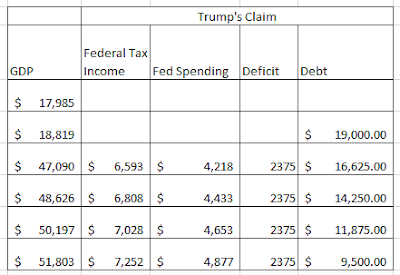
Donald plans to cut the top tax rate on individuals from nearly 40% to 25% and to cut corporate income tax from 35% to 15%. Credible analysis of his plans suggest that it would cut federal revenues by about $1 trillion per year, reducing federal taxes as a percentage of GDP from 19% to 14%.
Donald has revealed no plans to cut government spending, so the best estimate is that his plan will increase the annual deficit about $1 trillion per year. Without offsetting cuts, every dollar of lost tax revenue is one more dollar of new debt.
In yesterday's interview, Donald claimed that he would eliminate the $19 trillion government debt within 8 years.
Let's take him at his word for a moment and assume that because he's president the economy will magically grow enough to offset not just the $1 trillion in lost taxes but pay down another $2.375 trillion of debt each year. (That's what it takes to reduce a $19 trillion debt to zero in 8 years.)
Here are the numbers:
Donald drops federal taxes from average of 19% of GDP to 14%.
Donald keeps government spending stable.
Donald reduces the national debt by $19 trillion in 8 years.
The current projections look like this:

What is Trump promising? What sort of GDP would allow him to cut taxes as a percentage of GDP AND reduce the debt? This:

To make his promises add up would mean GDP leaping from close to $20 trillion to roughly $50 trillion, which is about what total global GDP is right now.
Where does Donald get his information? It's hard to tell if it is from Marvel or DC but it's certainly a comic book and not a text book.
Subscribe to:
Posts (Atom)