Showing posts with label abraham lincoln. Show all posts

30 September 2020

Another Stark Contrast Between The Republican Party's First and Last Presidents: Lincoln, Trump and Time

I've previously argued that Lincoln was the Republican Party's first president (okay, that's not an argument) and Trump will be its last.

The simplest framing of that argument is simply that in 1860, the brand new Republican Party's plan for a national (rather than rural) industrial economy dependent on capital (rather than slavery) was truly visionary, an advance on every front. The decades that followed were unprecedented in terms of productivity growth, improvement in quality of life and the rapid growth in products and wealth. Now, in 2020, Trump's plan for a national (rather than global, as the economy dependent on a worldwide web and container ships has become) industrial economy dependent on financial and industrial capital (rather than an information economy dependent on intellectual capital) is reactionary, representing regress rather than progress. The telegraph was awesome once upon a time but today people prefer to text or video conference. Factory work once represented the future of job creation. Not today.

Lincoln had to create a national, industrial economy. Trump is trying to destroy a global, information economy.

Here is another way that Trump and Lincoln differ.

The conversations to create a new world have to be thoughtful, sustained, and zoom out to big pictures and zoom in to the small details; explore consequences and nuance and paint a picture of the new world proposed. Construction takes sustained planning, execution, and coordination with others.

The Lincoln - Douglas debates that brought the Republican Party's first president into the national limelight had a curious format. They were adversarial but each speaker had sufficient time to make his point. "The first speaker spoke for 60 minutes, the second had a 90 minute rebuttal, and then the first speaker had a 30 minute rebuttal/time for closing arguments."

I was unable to find what was the longest time Trump made it without interrupting or speaking in last night's debate but I don't think he remained silent for even one of Biden's two minute windows. For Lincoln, 30 minutes was the shortest time slot and 90 was the longest. In last night's debate, 2 minutes was the longest window and Trump could not even remain silent that long.

Singer and Brooking in LikeWar share a study that in 2000, the average attention span of an internet user was measured at twelve seconds. By 2015, it had shrunk to eight seconds - slightly less than the average attention span of a goldfish. We barely have time for tweets and memes. (What does a goldfish think? "Oh look! A castle." Pause. "Oh look! A castle!")

Lincoln had time enough to speak a new world into existence. Trump only wants time enough to destroy one. And the less time you have to think about what he's doing, the less likely you are to see how destructive he is, much less have time enough to imagine the next one.

01 August 2020

The Republican Party's Mission is Done

About a year ago, I was at the Nixon Library. I had been to the Reagan Library months before and compared to that, the Nixon Library had very few visitors. Something to do with Watergate and resignation.

The docent said that about a quarter of the visitors to the Nixon Library are from China. The Chinese remember Nixon as the president whose visit helped to open up China to the rest of the world; Nixon visited China in the early 1970s and by the end of the 1970s, Deng Xiaoping had become China’s leader. Deng would begin the economic changes that began China’s amazing economic growth and opened it up to the rest of the world.

From the time of Lincoln – their first president – to about WWII, Republicans were focused on a domestic policy of making ours an industrial rather than agricultural economy. After WWII, Republicans were focused on a foreign policy of spreading capitalism to the rest of the world.

Eisenhower’s Marshall Plan helped to rebuild Europe and Japan after WII. Nixon visited China. Reagan stood in Berlin and told Gorbachev “Bring down this wall.” Bush and Cheney invaded Iraq, promising to make it a beacon of democracy and capitalism.

But a curious thing happened.

As Republicans were busily exporting policies for an industrial economy to the rest of the world, that industrial economy was – like the agricultural economy before it – being eclipsed by a new economy.

Trump’s policy seems weird but has an odd kind of logic seen from this perspective. It is quite possible that in his mind, seeing that the industrial economy has been successfully exported around the world (particularly in China), it is now his job to revive the domestic policy of creating an industrial economy here. This shift in focus to foreign countries has caused us to lose the industrial economy that made us great, made us a world power. It is his mission to recreate it.


But of course, the Republicans are where the Democratic Party was at the time of Lincoln: promoting policies for an economy already eclipsed. At the time of Lincoln, the agricultural economy had been eclipsed by the industrial economy At the time of Trump, the industrial economy has been eclipsed by the information economy.

Republican identity is so bound with capitalism (which I would say is a crude synonym for industrial economy), that it is not clear that they can shift to a new identity now that their mission is done. In any case, reviving the past has never seemed a particularly effective way to create the future.

12 March 2020

Globalization and Today's Reality

Markets across the West are down 9 to 15% today. It's important to talk globalization.

The most defining issues of our day are not national. Pandemics, economies, financial markets, global warming, immigration, culture, ideas, research .... all of these issues are about as neatly contained within borders as are clouds.

The US went to war in 1860 to settle a really important question: would we be a confederacy of independent states or a union of states? Before Lincoln, the most common phrase was "The United States are." After Lincoln, the most common phrase was, "The United States is." Lincoln made us a nation. By 1860, railroads, a nascent stock market, and factories able to make enough goods for a nation and not just a neighborhood had transformed the US from a collection of neighborhoods and states into a nation. The world had become bigger and our government needed to adapt. At that point, state economies had become less meaningful than the national economy and we needed a national government to match that.

Today a similar thing has happened in regards to national borders. We cannot resolve the big issues of the day with national policy. It requires international alliances and strong international organizations, just as the growth of the economy in the late 1800s required a national government.
Globalization is not just about international trade. It is about creating strong alliances and organizations that enable coordination and cooperation. National today is what states were 150 years ago. And just as states still have distinct cultures and policies, so will nations. That said, our reality is global. We need institutions that match that reality.

28 May 2018

Trump as Trickster

Lewis Hyde's Trickster Makes This World  is a brilliant look at how trickster gods from cultures on every continent seem to be a constant, the gods whose mischief and disdain for the systems that order daily life disrupt those systems. Sometimes the chaos they unleash is destructive, sometimes creative, and sometimes merely affirms the need to restore the status quo.

Loki
The tricksters Hyde cites include Krishna and Coyote, from two different Indian cultures; Monkey,  and Eshu from two different African cultures; Hermes from the Greeks and Loki from the Scandinavians. Hyde calls them boundary crossers whose disdain for norms both help to change norms and to define them.

Hyde writes that prophecy is not about prediction in the sense that it predicts that the stock market will fall in October. Rather, prophecy reveals truths that will still be true in the future.  This section of his book from 1998 is prophetic about Trump.
These threats on both sides, to the shameless person and to the world around him are, I think, what sometimes lead people to ask if the trickster isn't really a psychopath. Certainly there are parallels. Psychopaths lie, cheat, and steal. They are given to obscenity and, as one psychologist puts it, exhibit "a confusion of amorous and excretory functions." [Think pee tape.] They're not just antisocial, they're foolishly so (they "will commit thefts, forgery, adultery, fraud, and other deeds for astonishingly small stakes and under much greater risks of being discovered than will the ordinary scoundrel"). While they are often smart, they have a sort of "rudderless intelligence," responding to situations as they arise but unable to formulate any coherent, sustainable, long-term plan. They are masters of the empty gesture, and have a glib facility with language, stripping words of the glue that normally connects them to feeling and morality. Finally, they lack both remorse and shame for the harm and hurt that trail behind them. One way or another, almost everything that can be said about psychopaths can also be said about tricksters. [p. 158 of Hyde's Trickster Makes This World, 1998, Farrar, Straus and Giroux, New York, NY.]

Why, if this definition of trickster so aptly describe him then, is Trump so popular?  That's like asking why are the trickster gods so compelling that they have shown up in so many cultures? Perhaps it is because tricksters like Trump mock what people reverence. You can't really hope that a trickster will abide by norms. He defies them. Hyde quotes another author, Rickets, who shows how trickster stories can be read as parodies of shamanism.
In shamanic initiation, for example, the spirits kill and resurrect the initiate, often placing something inside the resurrected body - a quartz crystal, for example - which the shaman can later call forth from his body during healing rituals. If someone in your group claims such powers, you might find wry humor in stories which have Coyote, when he needs advice, calling forth (with much grunting) his own excrement. ... Trickster's failure implies that shamanic pretensions are daydreams at best, fakery at worst. [p. 294 of Hyde's Trickster Makes This World.]

If experts are our modern shamans, then Trump is continuing with this tradition of mocking shamans in a hundred ways that are variants on his appointing Rick Perry as Energy Secretary; Rick Perry who - in a debate - could not even remember the name of the Energy Department he wanted to eliminate. Only a trickster would make a person who thought so little of an agency that they both wanted to eradicate it and couldn't remember its name as the leader of that agency. Trump thumbs his nose at the experts who pretend to understand and predict the systems - from weather systems that define our climate to the financial systems that create booms and busts or even the government agencies he is supposed to manage - that define our world. He thumbs his - well, whatever - by bragging about the size of his penis in a presidential debate. He's shameless and his supporters love him for this for at least a couple of reasons. If the experts deserve mocking rather than reverence then even the non-experts can feel superior - or at least equal - to those experts. And once the standards have been mocked by the trickster Trump - whether when he has sex with porn stars while his wife is home with a new baby or when he shares conspiracy theories with Alex Jones - there is no longer a credible basis for calling them deplorable.

That said, past generations paid a great price for the transition to something new. Trump may be the price we pay and if so, he may be a bargain by contrast.

In 1860, Abraham Lincoln became the 6 year-old Republican Party's first president. The new Republicans laid in place a set of policies that helped the country catch the wave of the industrial economy.  After the Great Depression, the modern Democratic Party - from FDR to Kennedy and Clinton - created a set of policies that helped the country to catch the wave of the information economy. Waves don't come out of calm seas and the chaos of the Civil War and the Great Depression and the second world war seemed - in retrospect - to mark a transition from an old to a new economy. During Lincoln's time we had a literal battle between Union soldiers and Confederates, two groups with very different ideas about whether we lived in a world contained by states or nations.  The transition ushered in with FDR's engagement in the second world war and Clinton's signing of NAFTA and WTO trade agreements was from national to international economic and political realities. Republicans made us bigger than states; modern Democrats made us bigger than a nation. Chaos in the form of bloody wars and assassinations marked these messy transitions into something new.

I think that we're now moving from an information to entrepreneurial economy and such a transition seems inevitably messy. It is unsurprising that a trickster has shown up at this time of transition. Tricksters are boundary crossers, creating and thriving on the chaos that marks transitions. Trump might just be the trickster who is disrupting the status quo enough to make it easier to create the next, new thing. We always pay a price for moving into the new; we still don't know the final tab for the Trump presidency but it could be one of the lowest we have ever paid, which seems to me just one more sign that we're making progress even if Trump - who as trickster belongs to earlier, more archaic worlds - is not.

02 December 2017

Why the Republican Tax Cuts Won't Help the Economy: Understanding the Difference Between the Economies and Parties of Lincoln and Trump

Trillions in excess reserves, cash and negative interest rate bonds calls into question Republican's claim that the economy needs tax cuts to create additional capital.

Abraham Lincoln was the first Republican president. He was part of a visionary party who realized that the industrial economy had changed the rules in a few ways. One, it made capital even more important than land. Two, it made slavery, which was always immoral, now bad economics. Three, it made the national economy most relevant to good policy (goods now produced in growing factories were now transported across state lines by growing railroads to be sold in department stores all across the country) rather than the old state economy. When the south seceded, the largely Republican northern legislators passed a flurry of laws to accommodate this new industrial economy that was supplanting the agricultural economy.

Since the time of Lincoln, a key to understanding Republican policy and strategy is understanding that they believe that nothing is more important to economic prosperity than capital.

There is good reason for such a belief. If you are working with your bare hands you do well to create more than a few pennies - maybe a few dollars - of value a day. If you have capital equipment like a vehicle, a lathe, a computer or factory, you can potentially create thousands - even millions - of dollars in value each day.

The thinking behind the Republican tax breaks traces back to this belief that they need to encourage more investment by corporations by taxing them less. Their belief is that as more money is invested in things like lathes, computers and factories, American workers will be more productive. As it has since the time of Lincoln, more capital from more investments will make us more prosperous.

It is true that capital is essential to our economy. So is agriculture. There is a difference, though, between knowing that we'd perish without farmers and expecting agriculture to employ a growing number of people. In 1800 about 90% of Americans worked in agriculture; by 2017, about 1 or 2% do. Agriculture is essential but that is very different from saying that more farmers will make our country more prosperous. Agriculture is not the place we look in 2017 for the creation of new jobs and wealth.

Capital, too, is essential but that is different from saying that more capital will make us more prosperous. Manufacturing (admittedly just one manifestation of capital) is not the place we look in 2017 for the creation of new jobs and wealth. As farming before it, jobs in manufacturing have been in steady decline as a percentage of the workforce since about 1940.

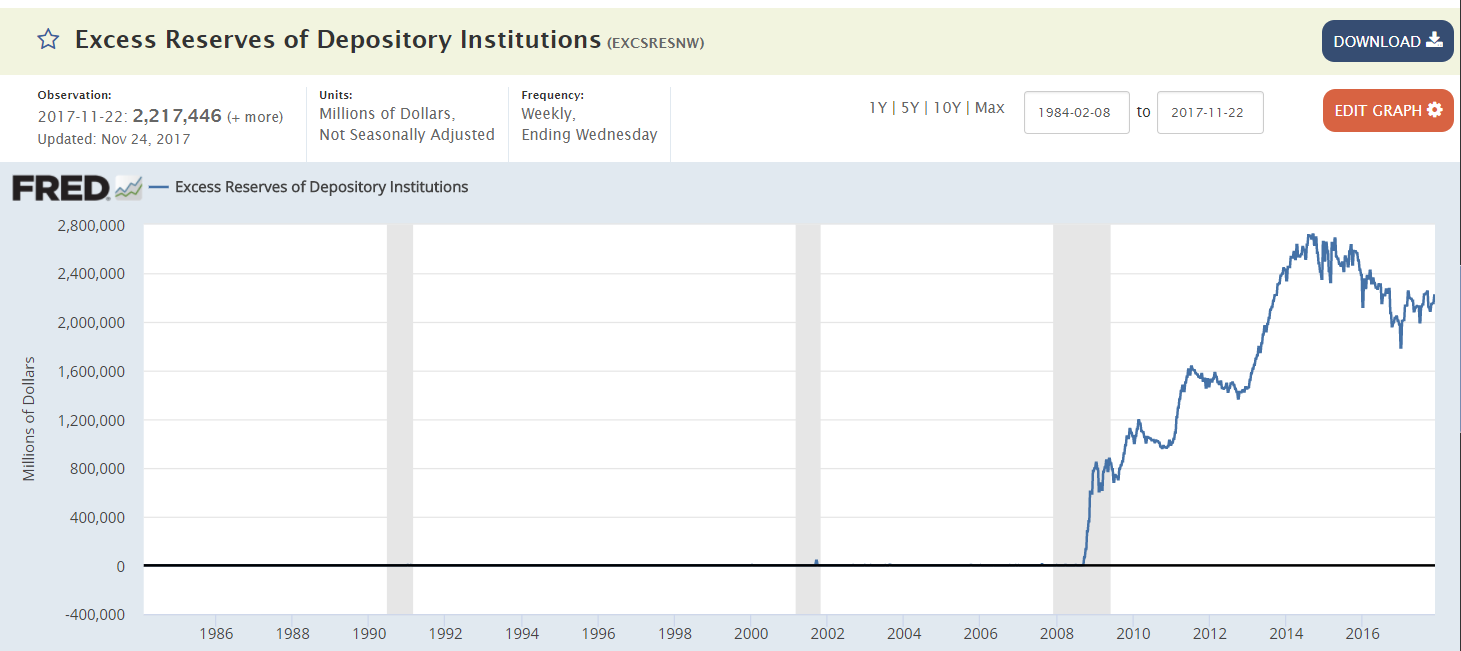
Again, the simple justification for Republican tax cuts is the belief that they will result in more capital investment. The story of excess reserves calls that into question.

From the early 1980s through 2008, excess reserves in the US banking system mostly bounced around between $1 and $2 billion dollars. Banks are required to keep a certain level of reserves on hand, essentially money they hold in case you come in to make a withdrawal on your account. And simply because it is nearly impossible to have every dime "working" as loans, etc., banks also keep a little reserves in excess of what is required. They have an incentive to keep these reserves to a minimum because they just sit there idle, generating no interest, so it makes sense that they wouldn't hold much in excess reserves.


Then we got hit with the Great Recession. One huge risk was that the credit system would collapse. Among other things, the Fed pumped capital into the banking system to encourage economic activity. The Fed could put capital into the banking system but banks had to put it out into the economy via loans to households and businesses.

Banks are literally professionals at understanding credit risk and knowing when to loan money for a kitchen remodel or a business expansion. Bankers - like business executives, teachers, police,  and engineers - make mistakes but this matter of deciding where capital should be employed to maximize the returns on capital is quite literally their job. If they have a billion dollars, they will look for a way to invest or loan that out in order to create a return. Only as a last resort will they leave it idle and not making money.

So what happened when the Fed pumped a record amount of money into the banking system? You can see that below; the one to two BILLION became two to three TRILLION, a jump of 1,000X.


Janet Yellen has helped to engineer a draw down of these excess reserves without disrupting the economy but after peaking at $2.7 TRILLION in 2014, excess reserves are still $2.2 trillion.

Bankers - the experts on capital allocation - are letting trillions sit idle because they don't see profitable ways to employ this capital. Another way to put it is that they don't see capital as scarce.

Excess reserves are not the only bits of evidence that the economy has an abundance of capital. Last year companies in the S&P 500 spent $536.4 billion on buybacks. What does that mean? They spent half a trillion simply buying their own stock rather than investing that money into hiring, factory expansion, or advertising. Like bankers, big corporations don't see capital as scarce but instead see it as abundant, literally having more than they can use. Corporate cash is close to $2 trillion.

The Dutch have financial records that go back 500 years. Think about all that has transpired since 1517: the Protestant Revolution and religious wars that killed tens of percent of the population in certain regions of Europe, coming to an understanding that Columbus had actually discovered new continents and then settling those Americas, democratic revolutions, the industrial revolution, world wars, a Great Depression .... these 500 years have hardly been uneventful. And yet, last year was the first time that the Dutch recorded the sale of negative interest rate bonds. You give a country $100 and get back $99. The Netherlands, the EU, France, Japan .... nine countries had issued about $12 trillion in negative interest rate bonds as of last year

To sum up, US banks have $2.2 trillion in reserves, the S&P 500 has $2 trillion in cash (even while spending half a trillion a year on buybacks), and there are more than $12 trillion in negative interest rate bonds around the world.

None of this suggests that the West faces a scarcity of capital.

So let's get back to the Republican tax cut. The thinking behind it is simple: if we tax less there will be more capital and that capital can be employed to expand businesses that will generate more profit and jobs. And that, of course, assumes that capital is scarce.

Capital was scarce 150 years ago during Lincoln's presidency. At that time, nearly any policies that encouraged the growth of capital were likely to have a positive effect on the economy, helping to make us all more prosperous.

Capital is now abundant. Policies that starve public education and research to send back more capital to corporations and individuals will hurt economic growth, not help it. There is no way that someone can look at the evidence and conclude that what our economy lacks now is capital. There is no way, of course, unless you have failed to update what was once a great perspective to adjust to a new landscape. The party of Lincoln has given way to the party of Trump and mindful intelligence that carefully considers new facts has given way to mindless ideology that ignores them.

03 May 2007

Failure

• Age 22: Lost job
• Age 23: Defeated for state legislature
• Age 24: Failed in business
• Age 27: Nervous breakdown
• Age 34: Ran for congress and defeated
• Age 39: Defeated again
• Age 46: Ran for senate and defeated
• Age 47: Defeated for nomination for vice president
• Age 50: Defeated again for senate
• Age 51: Abraham Lincoln became the 16th President of the U.S.

The difference between beiong a success or failure may be determined by something as simple as when you stop.