In December of 1947, Bell Labs researchers laid the foundation for the world that so defines us today.
Doug Ring and Rae Young wrote a memo "Mobile Telephony: Wide Area Coverage," in which they laid out the idea of a honeycomb of hexagons and repeating frequencies within cells, a system that would eventually be called cellular phones.
John Bardeen and Walter Brattain - working under the management of William Shockley - were perfecting the transistor that became the foundation for computer chips.
Claude Shannon coined the term "bit" as he defined a new field that would be known as information theory. (No one had previously thought of a unit of measurement for something as abstract as information.)
All within one month.
Why mention this?
World War 2 ended in 1945. A tremendous amount of money, problem-solving and research went into this problem of how to save democracy. WWII was a tragedy but it triggered a tsunami of problem-solving and breakthroughs. More importantly, it was a catalyst for new ideas and exposed everyone to new situations. It wasn't just that a lot of knowledge came out of this. It set in place processes, practices and new technologies that continued to generate new knowledge. As all that potential shifted from war to peacetime, it created new possibilities. About two years after the world war was over, its momentum helped to lay the foundation for the smart phone you're holding in your hand right now, a supercomputer in your palm linked to endless libraries of information.
Our response to COVID-19 could be very similar, a catalyst for ideas that will create new worlds. Some good will come out of these odd times.

R World (Ron Davison muses aloud)
Showing posts with label corporation. Show all posts
Showing posts with label corporation. Show all posts


22 March 2020
Where Progress Comes From - and what we had best not blow up
In a time of crisis, everything is questioned. That makes sense but the West has made progress in certain ways that should never be undone. These things should not be questioned.
1. Freedom of religion and freedom from religion
Martin Luther's declaration that "We are all priests," is the claim that freed us from theocracy. There was a time when people looked to the church to explain causation and looked to supernatural causes rather than natural causes as reasons for why people got sick, crops failed or ships wrecked.
The Enlightenment thinkers who founded the US were among the first to free the community from the tyranny of one religious voice, allowing us all to freely choose how - and whether - worship. One of the biggest benefits of this is that it shifted the basis for social cohesion from dogma to science. Science builds on testable hypotheses and regularly generates new understanding. Scientific thinking is the stuff of progress.
The first amendment to the US Constitution captures beautifully the dimensions of this:
Congress shall make no law respecting an establishment of religion, or prohibiting the free exercise thereof; or abridging the freedom of speech, or of the press; or the right of the people peaceably to assemble, and to petition the Government for a redress of grievances.
2. Democracy
The notion that a community should be for all its members and not just the aristocracy is another essential layer to the prosperity of our modern world. Theocracies and democracies are just made up but the consequences are real. Of the 10 most prosperous countries in the world, 10 are democracies.
3. The American Dream
Retirement income. The possibility of early retirement. Owning one's own home. Time and money for vacations. Most importantly, enough affluence to choose what career and what company - perhaps even one's own company - to work at.
The notion that people can freely and easily participate in job markets, credit and stock markets, and be consumers in a world with millions of products and services is another foundation stone to progress.
These three are foundations to the world in which we now live. They do need continual improvement and refinement. They need to be offered more broadly. (We need to continue efforts to make it easier for everyone to vote and lift more people out of poverty.) We will not make progress by having less of these three; we will have progress by having more them, more independence of thought and reliance on scientific rather than superstitious thought, more ability for communities to define the laws and policies that define their world, and more widely shared affluence.
These three also represent a transformation of the dominant institution from a tool for the elites into a tool for the masses. "We are all priests," and "We the people," made church and state tools for the individual, overturning theocracies and monarchies. The 20th century story of how the average person was given access to credit and investment markets and department stores and online shopping is a story of widespread poverty giving way to widespread affluence. The 20th century included the story of how financial markets - like church and state before them - became a tool for the masses and not just elites. Progress will never come from blowing these up, or reversing any of these three major institutional changes. It will come from furthering them.
More dramatic than incremental improvements on these three previous victories, though, is a transformation of the corporation. Like church, state, and bank before it, the corporation is now the dominant institution.
In the early 20th century, we made dramatic gains as corporations learned how to mass manufacture goods, giving the common person goods that had previously reserved for elites. Ford's Model T might be the most dramatic example of this.
Year - Number Sold - Price
1910 19,050 $900
1910 19,050 $900
1925 1,911,705 $260
This is a wonderful example of the American Dream in action, a good once out of reach becoming accessible. A broad swath of people were able to enjoy what only a few had earlier been able to enjoy.
Today's corporation is less about making products than creating value. In the company of 1920 succeeded by making products that benefited more people, the company of 2020 succeeds by making value that more benefits more people. Because of the transformation that has come from the American Dream, every year more Americans are benefiting from this latter promise of modern companies.
What does this mean for the corporation? For it to become a tool for the common person, it needs to build mechanisms that allow its employees to more easily create - and share in - wealth through forms of entrepreneurship. Like church, state and bank before it, the corporation needs to be made the tool of the common person and not just elites.
Progress won't blow up the three freedoms that have come from making church, state, and bank our tools to be used for us rather than we for them. Progress will come from extending that pattern of progress once more into yet another dominant institution.
02 May 2018
"We will loan you our trillion dollar tax cut," investors tell government
Here is an interesting pair of numbers.
In the first quarter of 2018, US companies announced $242 billion in stock buybacks. At that pace it will hit nearly one trillion dollars for the year.
In the first half of the year, the federal government will run a deficit of $600 billion. At that pace it will borrow roughly 1.2 trillion dollars for the year.
Put differently, corporations have a trillion more than they can spend this year and the federal government needs a trillion more than it has.
It sounds like an onion headline: "We will loan you our tax cut," investors tell government.
16 February 2018
The Switch That Triggered the Rise of the West (Can Also Be Switched Off)
"I am not an advocate for frequent changes in laws and constitutions, but laws and institutions must go hand in hand with the progress of the human mind. As that becomes more developed, more enlightened, as new discoveries are made, new truths discovered and manners and opinions change, with the change of circumstances, institutions must advance also to keep pace with the times. We might as well require a man to wear still the coat which fitted him when a boy as civilized society to remain ever under the regimen of their barbarous ancestors."- Thomas Jefferson
From the time of Homer (roughly 1,000 BC) until Marco Polo (about 1300 AD), incomes were stagnant.
 Starting about 1300, productivity began to rise and with it came a remarkable transformation in life. In the 18th century, life expectancy in England was about 35 to 40 years and now it's about 80. Incomes are up about 30X from when Shakespeare was buying ink. What happened in England was fairly representative of what happened in the US, Canada, Germany, France and the rest of what we now call the West.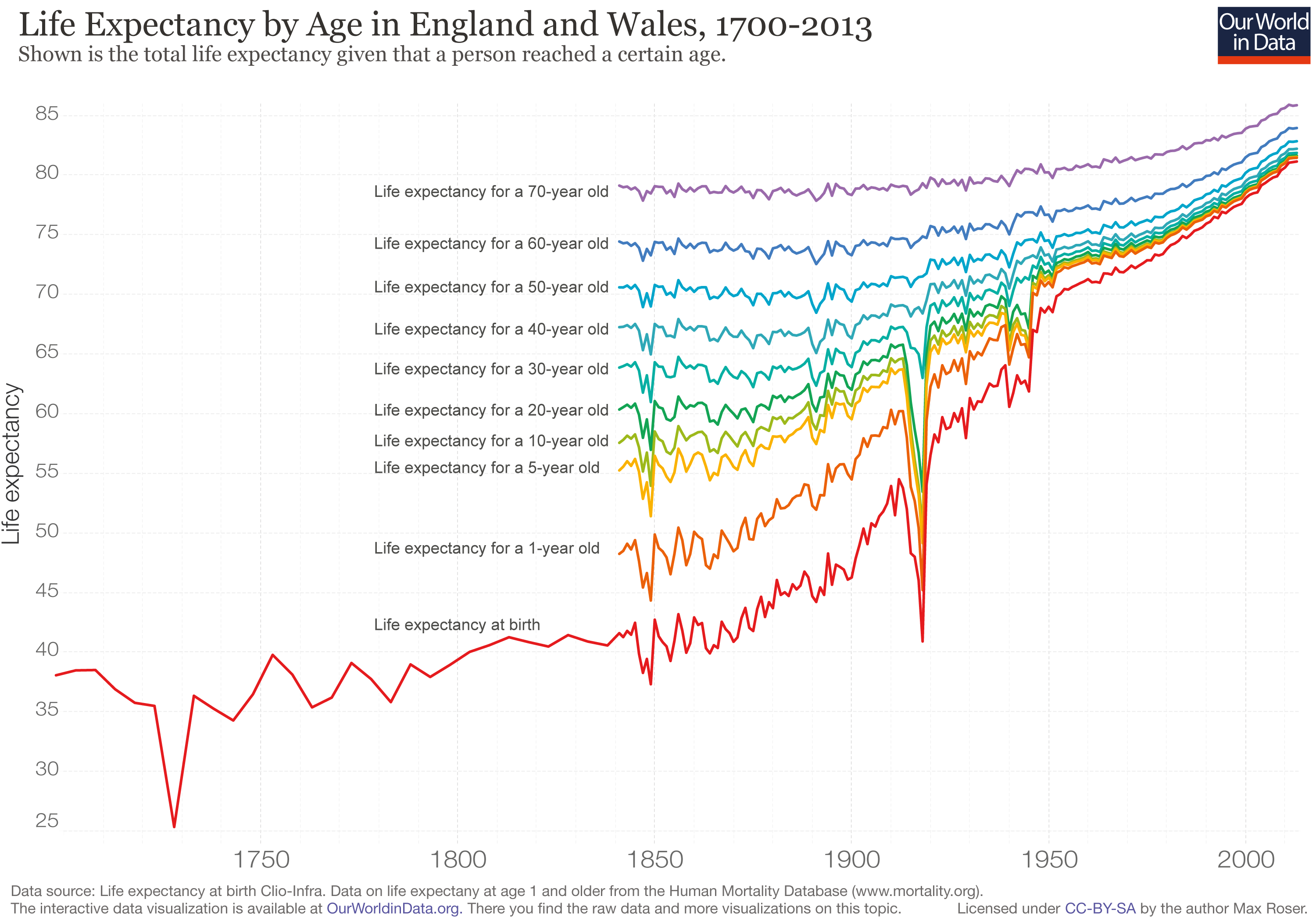
 |
| Change in income from century earlier |
The West started this parade but it no longer leads it. Singapore has higher per capita GDP than the US, England, or Germany. There is nothing uniquely British about industrial economies or uniquely American about entrepreneurial economies. Anyone can lead this parade but why did the West start it? I think it's because of a unique approach the West took to its defining institutions.
Social invention is an overlooked component of progress. Banks, corporations, and nation-states matter as much in this story of progress since 1300 as trans-Atlantic ships, steam engines, and computers. The very notion, though, that these institutions are merely tools - no different than engines or electronics - is what has made the West different.
People within the the West have taken three distinct approaches to institutions.
Social Conservatives and Social Inventions as Sacred
The first approach is the most obvious. You come to awareness as a small child, growing up with the wonder of a church, the splendor of a king, the wealth of a bank and when you become an adult you accept that this is the way things are. Realizing how instrumental are these institutions to your world, you fight to defend them as they are.
Social conservatives treat social inventions as sacred. These are the loyal Catholics who see in the Protestant Revolution a route to hell and social chaos. These are the royalists who see in challenges to the crown a tumult of conflicting claims for authority, a challenge to all that is sacred. These are the capitalists who see conspiracies in the Central Bank that "runs" things, feeling instead that the banker should be left inviolate and unregulated.
They are quite right that these institutions keep us from chaos. I personally feel like institutions - social inventions - are the simplest reason that we have more control over our lives than do the great apes.
Radicals and Social Inventions as Disposable
Radicals go to the other extreme. They are well aware of how awful the church or state or bank has been. The French Revolutionaries outlawed religion at one point. The Enlightenment was about science and rationality and religion was all about superstition and dogma; it had to go. Radicals knew the church was merely an obstacle to progress and had to go.
Whether it is atheists who want to eradicate the churches, communists who want to shut down financial markets, or anarchists who want to outlaw laws, the radicals quite accurately see all that is awful about these social inventions and want them gone.
They also don't have a clue about how important are these flawed institutions to civilization, to modern life.
The radicals and social conservatives are an important part of the conversation and should always be heard; left in charge, though, they'll only ruin things. They're important voices who should never actually be given power to change anything but instead should only have power to point out problems and make suggestions.
Power over these social inventions should instead be given to people who are not naive enough to believe we can live without them or naive enough to believe that they should be defended in some current or (more often) idealized past form.
Social Inventions as Tools
Progress has been made by the folks who see social inventions as tools. Not sacred things that need protection. Certainly not as disposable. Progress has followed from people who realize how important the church is to how people construct meaning and gain empathy and compassion, become more loving and happy even when life hits one with the inevitable tragedies of illness, death, financial setbacks or even wars and pandemics.
The ones who see church, state and bank as mere tools realize that - just as with cars or can openers - these tools are more valuable as more people are able to use and define them. "We are all priests," as Martin Luther claimed, or "All men are created equal," as Jefferson wrote express the sentiment of those who don't think that popes or kings should have a unique right to define the institutions that so define us.
And the social inventions as tools people are the ones who are unafraid to change these institutions to make them work better for who we really are and aspire to be than who we imagine our ancestors once were. A church is not sacred but it is precious. What does this mean? Everything about it should be challenged except for what it does for people; a church is more important than a juicer only because of what it makes. Fresh orange juice is lovely but meaning and compassion can make the difference between whether or not you even feel like it's worth it to get out of bed to make that orange juice.

The West has led the great parade of progress in no small part because it has treated its vital institutions as mere tools and subject them to challenge and redesign as if they were products no different than cars or radios. They're not sacred. They're not disposable. We've made progress by changing our relationship to church, state, and bank, making them tools for anyone rather than just popes, kings, and bankers. We will make progress again in this generation by making a similar shift in how we treat corporations, turning them into tools for employees to create wealth and jobs and not just tools reserved for CEOs (who, by the way, are also employees). Freedom of religion, the spread of democracy, the American Dream and the popularization of entrepreneurship have treated - and will treat - our big institutions as mere tools. That orientation is essential to progress.
So why mention all this? Because in the wake of the Great Depression, extremists seized governments everywhere; fascists and communists took control and progress halted or reversed everywhere they did. Now, in the wake of the Great Recession, extremists are again gaining power.
On the left we have activists who see banks as evil. And on the right we have activists who see banks as sacred. The first group doesn't understand the importance of banks, the second group doesn't understand the importance of regulating them and subjecting them to a central bank. Those on the left aren't numerous enough in the states to spoil capital markets but those on the right actually are in Trump's government. Trump is moving to deregulate banks so that banks are tools for bankers and not the community, not for everyone. The social conservatives don't believe in Keynesian economics (most recent evidence of that is the fact that they protested deficits when unemployment was high and now want larger deficits now that unemployment is low) or monetary policy.
Social conservatives are also working to reverse democracy. In 1789, only white, property-owning Protestant men could vote. About every 50 years, another group gained voting rights until, by the end of the 20th century even minority women who rented could vote. Courts have repeatedly ruled that Republican efforts to reverse voting rights are actually targeted at reversing that, taking power from minorities and the poor to vote.
Finally the continued effort to impose a religious definition of when life starts (at the instant of conception) and dismissing any other reasonable definition is an attempt to encroach on freedom of religion, the freedom of women to follow their own conscience and belief about when sperm and egg become a baby.
Social conservatives are wonderful to have in a community. They remind us that family as an institution really does matter, that churches make lives better for so many, that banks and the state create order we would not have without them. We should listen to them. But social conservatives are better reminders than managers; put in power, they treat as sacred what any forward moving community treat merely as as tools that are best used by many rather than a few.
Prosperous and happy communities will continue to construct institutions that are tools that help people to create meaning and be compassionate. They may not even call these institutions churches - and that is part of the genius of lumping freedom of religion under the first amendment along with freedom of assembly, speech, and press, the realization that it is the freedom to form thoughts and express them that is at the heart of religious freedom.
Prosperous and happy communities will continue to construct institutions that are tools to allocate and create capital that helps to fuel progress in productivity and profits. Again, they may not even call these banks but they will be tools that make people richer and able to afford now what they cannot pay for until later.
Prosperous and happy communities will continue to construct institutions that are tools for governing, for creating policies that make their world safer, easier to navigate, and more likely to offer them lucrative options and freedom to live a life as they please - whether in the form of neighborhood planning boards or the UN or any level of government between.
Prosperous and happy communities will continue to construct and revise institutions that are tools for creating wealth and jobs, new technologies and new products and services and in the process of creating value for customers, suppliers, stockholders and the community.
And the communities that prosper the most will never pretend that these tools should be reserved for the elite. They will never pretend that they are not necessary. They will never pretend that they are anything but tools.
What has fueled progress for the West is treating these great institutions as tools. Every time we've instead treated them as disposable or sacred, progress stalls or even reverses.
06 February 2017
Trump's Wildly Impractical Immigration Ban and Why 120 Companies Are Suing Him Over It
Trump's ban on immigrants shows a disrespect for our constitution and an ignorance of modern economic realities.
Let's start with Syria, a country on the banned list. Put aside for a moment the motivation of simple human compassion to help people who've been bombed out of their homes. Among the other reasons to challenge this ban is one ancient and one modern.
First the ancient. Jesus healed people in Syria and Paul preached there, which suggests a connection to a predominantly Christian nation.

Then the modern. Steve Jobs' father came to the US from Homs, Syria. This is what it looks like now.

This is what the Apple campus looks like, headquarters to the world's most valuable publicly traded company, a company currently worth nearly $700 billion (about 9X Syria's GDP), a company co-founded and reinvented by Steve Jobs, son of Syrian immigrant.

And that brings us to the heart of this argument: modern business is international business. This is bigger than Syria. Immigrants are an integral part of the American economy. Friday I was with a client in Orange County and met with 3 project managers and their core technical teams of four. As so often is the case in those situations, the teams were dominated by immigrants. One team of four had two people from the Middle East (Orange County has a very large Iranian community and they may have been part of that) but each of the three four-person teams had at least two foreign born team members. One team member, Peter, I just thought was American until he spoke in an impeccable British accent. The project managers were all from California but their team members were from China, Philippines, Iran, the UK, and India. Oh, and a couple were from California.
I once sat in a conference room with a technical team making a next generation computer chip for a Fortune 100 company. There were about 12 of us in the room. The conversation at lunch time went to green cards and visas and every single person had a story. (Mine was about my Canadian wife.Theirs was about their own experience of migrating to the US for school or work.)
About a week ago, one of the team leads I had worked with last year at a startup on Google's campus posted something about giving a demonstration of the surgical robot he'd helped to create to Sergei Brin, the co-founder of Google who is now worth nearly $40 billion. He was delighted by that but almost more delighted that Brin had gone to the protest against Trump's ban at the San Francisco airport. Why was he so delighted? He's from Iran. Brin's show of solidarity not only was affirming but raises the probability that as he pursues his career in the US his own parents will be able to come to visit him.
The teams within our leading companies are so intertwined with other countries. Monday of last week, the second person I spoke to at my new client's campus was a man from Iran whose mother is on her deathbed. He had to cancel his trip to see her, losing thousands of dollars in nonrefundable fares and - more poignantly - the chance to see his mother one last time.
What Trump supporters don't realize is that banning travel between countries is - to the modern corporation - as impractical as banning travel between states for American families. Imagine not being able to visit your mother in Oregon because you'd taken a job in and married a fellow from California. It's inane and it's no wonder that leading tech companies like Alphabet (nee Google), Apple, Airbnb, Facebook, Microsoft, Tesla, Intel, Lyft, Netflix, Snap and Uber are among the technology companies that participated" in the legal brief to oppose Trump's ban.
The modern corporation is a multinational institution. It's customers and suppliers come from around the world and even its development teams are scattered across continents. For American based companies, 10 PM meetings with teams in India are normal, as are 6 AM meetings with teams in Europe. So many of the essential specialists who know how to design a computer circuit or heart valve or nanotechnology scope or the machinery on which such intricate and advanced equipment can be made are rare. It is normal - not unusual - for the technical teams I work with who are creating the next generation product to come from half a dozen different countries. I don't remember a single instance of working with a product development team made up only of Americans but I can remember multiple instances of working with teams who were completely from foreign countries.
What Americans don't realize is that if those team members aren't here, they will still get hired to create next generation products. They will just work in Mumbai or Shanghai or Eindhoven, Netherlands. And when that happens, the restaurants, dry cleaners, carpenters, car repair crew, hundreds of other service people who work with and for them will be in Mumbai, Shanghai and Eindhoven. They won't be here in San Jose or Austin or Boston. The result will be fewer, not more jobs. We're not protecting jobs by barring immigrants; we're shifting them to other places where multi-national teams are free to assemble. The teams of experts will assemble, the only question is where. Given how open we've been here in the US, the natural answer to the question of where best to assemble those teams has been the US. That could change.
It would be enough if Trump's ban was simply unconstitutional. It would be enough if it simply banned immigrants from countries who have never once killed an American on our soil, a policy based on irrational fear. But even if all that doesn't matter - and it should, it should matter greatly - this ban is based on such a wildly naive and ignorant model of how modern corporations actually work, how dependent we are on a vast web of specialists, technologies, and knowledge that respects borders about as much as the flow of air currents. The ban is ignorant. The global economy is a vast, evolving, and interdependent thing that has lifted billions out of poverty and given us a quality of life the description of which generations 100 to 150 ago would find fantastical, nonsensical and about as believable as teams made up of men and women from every continent working together on next generation products. I'm sure that there were elements of Stalin's Five Year plans that were more firmly planted in economic reality than Trump's immigrant ban.
The companies who oppose his ban aren't trying to be cute or politically correct or compassionate. They're simply trying to run a business and when borders become walls that becomes incredibly difficult. Difficult enough that some of our best jobs might just go outside of the US.
09 September 2014
Cubicle-Roots Funding for R&D (One Approach to the Popularization of Entrepreneurship)
I'm once again inside a company working with a team of technical experts who are planning the development of a fairly complex system. Already it looks like senior managers' expectations are out of line with the teams' perception. That's dangerous because senior managers invest the money.
This problem has its roots in organizational design, the allocation of power. Product development is inherently complex and there is no good way for just a few people in positions of power to fully understand what they're investing in. Employees who might blow the whistle on a key problem that could sink the project may think twice about such honesty if the result is a cancellation of the project and them losing jobs.
Today, senior managers approve a project, agreeing to invest millions to get a new product to the point that they can sell it for profit. But product development is ripe with risk. Technology can fail to work as predicted, forcing management to scrap it. And given that a product is dependent on so many different technologies, it's worth remembering that it takes an unexpected failure in just one technology to drive serious delays, compromises or overruns. Debugging critical software can take longer than planned, resulting in a product offering that is largely obsolete by the time it is released. A key supplier can change terms, driving up costs to the point that the cost of goods sold wipes out projected profits. And, of course, the internal dynamics of the team itself can mask dysfunction until the project blows up.
You can rely on a model in which elites looking down on this complexity judge it. Or you might consider a model that actually depends on the perspective of people who live within this complexity. It's a bit like the difference between reliance on central planning and a reliance on markets.
Readers of my blog and book know that I'm arguing for the popularization of entrepreneurship. Among other things, this means nudging - in some cases radically shifting - the role of employee to something more akin to entrepreneur. A different model for product development could illustrate what that might look like.
This problem has its roots in organizational design, the allocation of power. Product development is inherently complex and there is no good way for just a few people in positions of power to fully understand what they're investing in. Employees who might blow the whistle on a key problem that could sink the project may think twice about such honesty if the result is a cancellation of the project and them losing jobs.
Today, senior managers approve a project, agreeing to invest millions to get a new product to the point that they can sell it for profit. But product development is ripe with risk. Technology can fail to work as predicted, forcing management to scrap it. And given that a product is dependent on so many different technologies, it's worth remembering that it takes an unexpected failure in just one technology to drive serious delays, compromises or overruns. Debugging critical software can take longer than planned, resulting in a product offering that is largely obsolete by the time it is released. A key supplier can change terms, driving up costs to the point that the cost of goods sold wipes out projected profits. And, of course, the internal dynamics of the team itself can mask dysfunction until the project blows up.
You can rely on a model in which elites looking down on this complexity judge it. Or you might consider a model that actually depends on the perspective of people who live within this complexity. It's a bit like the difference between reliance on central planning and a reliance on markets.
Readers of my blog and book know that I'm arguing for the popularization of entrepreneurship. Among other things, this means nudging - in some cases radically shifting - the role of employee to something more akin to entrepreneur. A different model for product development could illustrate what that might look like.
Imagine that rather than having senior managers make funding decisions about which products to pursue, you relied on the wisdom of the crowd. More specifically, had organizations take their lead from employees whose willingness to invest - or not - would signal the new product's potential.
Imagine that anyone in the organization - from a charismatic CEO like Steve Jobs to an introverted programmer or designer - could make presentations to the organization proposing a development project. (And yes, this very process would drive education in NPV education, market analysis, technology risk, etc. To properly support it would lead to more widespread business education for employees.)
Imagine that a portion (10%? 33%?) of every employee's 401(k) fund had to be invested in either a fixed interest annuity with low-risk and return (say, 1 or 2% above inflation) or the company's R&D projects.
Imagine further that employees would be able to investigate any potential project that individuals are proposing, able to do due diligence on this investment possibility. Given some portion of their wealth would be a function of the success of these internal projects, they could use personal relationship and company data to determine who had the right personality to lead a team and which technologies had brilliant potential and which had obvious flaws.
Imagine that whenever employees encountered a proposal they were excited about they could invest some portion of their 401(k) internal allotment, taking a stake in its future success.
Imagine that only when employee-led investments hit some critical mass that the company would match (1 to 1? 100 to 1?) employee investments and fund a new project. A business plan might come from a confident project manager who could make a part of the plan a tripling of his salary - or a significant portion of the future value of this new product. Key technical people might be able to propose similar raises or equity-sharing plans. And remember, if the employees strongly disliked any part of the plan, they could simply refuse to invest. A form of negotiation might emerge in the form of iterative proposals that would finally result in a plan that attracted investors.
Imagine that the result would be that R&D funds were more strategically allocated, based on richer and more nuanced understandings than any senior managers might have. And imagine, too, that such proposals would occasionally make certain teams or team members rich. Perhaps even give some intrapreneurs more money than the CEO.
Imagine that such mechanisms would help to popularize entrepreneurship, help to distribute income and wealth more broadly throughout the organization and - at the same time - create more total wealth and income.
Whether it would make employees the equivalent of venture capitalists or make R&D funding more like a kickstarter campaign would likely depend on the culture and specifics of the process. In either case, it would promise a less centralized, more market-driven model than what we have now. That seems to have worked for nation-states where some percentage of the citizens in a developed country are likely to make more than the chief executive. (About 6 million Americans make more than we pay Obama.) It might be worth trying within the corporation.
Imagine that anyone in the organization - from a charismatic CEO like Steve Jobs to an introverted programmer or designer - could make presentations to the organization proposing a development project. (And yes, this very process would drive education in NPV education, market analysis, technology risk, etc. To properly support it would lead to more widespread business education for employees.)
 |
| Raise your hand above the cubicle if you like this proposal |
Imagine that a portion (10%? 33%?) of every employee's 401(k) fund had to be invested in either a fixed interest annuity with low-risk and return (say, 1 or 2% above inflation) or the company's R&D projects.
Imagine further that employees would be able to investigate any potential project that individuals are proposing, able to do due diligence on this investment possibility. Given some portion of their wealth would be a function of the success of these internal projects, they could use personal relationship and company data to determine who had the right personality to lead a team and which technologies had brilliant potential and which had obvious flaws.
Imagine that whenever employees encountered a proposal they were excited about they could invest some portion of their 401(k) internal allotment, taking a stake in its future success.
Imagine that only when employee-led investments hit some critical mass that the company would match (1 to 1? 100 to 1?) employee investments and fund a new project. A business plan might come from a confident project manager who could make a part of the plan a tripling of his salary - or a significant portion of the future value of this new product. Key technical people might be able to propose similar raises or equity-sharing plans. And remember, if the employees strongly disliked any part of the plan, they could simply refuse to invest. A form of negotiation might emerge in the form of iterative proposals that would finally result in a plan that attracted investors.
Imagine that the result would be that R&D funds were more strategically allocated, based on richer and more nuanced understandings than any senior managers might have. And imagine, too, that such proposals would occasionally make certain teams or team members rich. Perhaps even give some intrapreneurs more money than the CEO.
Imagine that such mechanisms would help to popularize entrepreneurship, help to distribute income and wealth more broadly throughout the organization and - at the same time - create more total wealth and income.
Whether it would make employees the equivalent of venture capitalists or make R&D funding more like a kickstarter campaign would likely depend on the culture and specifics of the process. In either case, it would promise a less centralized, more market-driven model than what we have now. That seems to have worked for nation-states where some percentage of the citizens in a developed country are likely to make more than the chief executive. (About 6 million Americans make more than we pay Obama.) It might be worth trying within the corporation.
10 August 2014
"Corporate entrepreneurship and innovation will be the next big thing for the next 10 years" - Steve Blank
Steve Blank recently said,

I think that the popularization of entrepreneurship is going to transform the corporation because so many of us are employees now. We couldn't leave knowledge work to autodidacts last century and we can't leave entrepreneurship to the innovative few outside of corporations in this.
Some people are beginning to understand that entrepreneurship will lead development now the way that capital did in the 19th century or the way that knowledge work did in the last. I'm still not hearing much about how that will transform business, but if people aren't talking about that, they still don't fully understand what we're facing. Popularizing entrepreneurship within the corporation will transform it as much as mutual funds and credit cards transformed finance and as much as democracy transformed the nation-state.
Corporate entrepreneurship and innovation will be the next big thing for the next 10 years, and the business school that sets up a program for that will be printing money from executive education and gradating a cadre of MBAs who will be snapped up by large companies that are desperate to reintroduce innovation inside their corporations.
Are any business schools making strides in corporate innovation? Corporate innovation is something that’s coming down the pipe. But I haven’t seen a business school that has understood that this is a big idea. The first couple that do will own the space. It’s wide open. We’re going to have a great time in the next five to 10 years.I find this affirming because Blank has been ahead of the curve for probably a decade and the fact that he's seeing the need to make corporations more entrepreneurial aligns with the ideas I've been advocating for decades.
This is a huge opportunity and unmet need – business schools haven’t pivoted yet. Now they’re getting the startup innovation courses right, but corporate innovation is a lot more complicated, and the startup techniques and classes don’t apply. There has been very little literature and research on the subject.
I think that the popularization of entrepreneurship is going to transform the corporation because so many of us are employees now. We couldn't leave knowledge work to autodidacts last century and we can't leave entrepreneurship to the innovative few outside of corporations in this.
Some people are beginning to understand that entrepreneurship will lead development now the way that capital did in the 19th century or the way that knowledge work did in the last. I'm still not hearing much about how that will transform business, but if people aren't talking about that, they still don't fully understand what we're facing. Popularizing entrepreneurship within the corporation will transform it as much as mutual funds and credit cards transformed finance and as much as democracy transformed the nation-state.
Market Economy
|
Period
|
Big Social
Transformation
|
Where Power is
Dispersed
|
First,
Agricultural
|
1300 to 1700
|
Religion
|
Church
|
Second,
Industrial
|
1700 to 1900
|
Politics
|
Nation-state
|
Third,
Information
|
1900 to 2000
|
Finance
|
Bank &
Financial Markets
|
Fourth,
Entrepreneurial
|
2000 ~
|
Business
|
Corporation
|
07 November 2011
The Simple, but Sweeping, Answer to the Question of How to Create More Jobs
We can continue to try repairing the old economy or we can
create a new one.
Financial crises, stagnant wages, persistently high
unemployment, protests, and growing government deficits coinciding with a loss
of government jobs are all legitimate problems in their own right, but they are
more likely symptoms of something deeper. We’re living into one of the four
biggest economic transitions since the Dark Ages.
Since about 1300 CE. a pattern of social invention and
revolution has created three economies:
an agricultural, an industrial, and an information economy. And that
pattern is now repeating to create a fourth, entrepreneurial economy.
These changes we’re experiencing are different from normal
business cycles. This is bigger.
The last shift in the West – beginning around 1900 - took
us from an economy led by advances in capital to one led by advances in
knowledge work, a transition from an industrial to an information economy.
Progress from about 1700 to 1900 came from dramatic
increases in capital: steam engines, factories, stock and bond markets, and
banks were invented or recreated and the communities that increased capital the
most advanced the most.
Progress from about 1900 to the present followed from the
rise of knowledge workers: inventions like the modern university and
corporation, and radical advances in information technology helped to create an
information economy in which companies making virtual products often became
more valuable than those making “real stuff.” Communities that ignored the
question of how to create more knowledge workers and make them more productive,
and just focused instead on capital, were left behind. When the limit shifts so
must the focus.
The emergence of each new economy has forced a revolution
in the dominant institution. This is no small thing. The power of elites over
the institution is dispersed outwards. People once used as tools by the
institution begin to use the institution, instead, as a tool. “We are all
priests!” Martin Luther declared, overturning the notion that religion was
something to be defined by the pope. The first economy, from about 1300 to
1700, was catalyst to the Protestant Revolution. The second economy, from about
1700 to 1900, brought us democratic revolutions. The third economy, from about
1900 to 2000, democratized finance as knowledge workers’ pension funds and
401(k) funds came to define investment markets.
This new fourth economy will likely transform the
corporation – today’s dominant institution - in similar ways. Most obviously,
the role of the employee will become more like that of an entrepreneur.
The
simple, but sweeping, answer to the question of how to create more jobs is that
we need to become more entrepreneurial. The question of how we become more
entrepreneurial will first be answered within the corporation.
Depending on how one measures it, corporations make up
between one third to two thirds of the 100 largest economies in the world, yet very
few of them encourage entrepreneurship.
Developed countries are considered lands of opportunities
where people can expect to make more than heads of state. (About 6 million
Americans make more than Obama.) By contrast, corporate employees are about as
likely to make more than the CEO as past citizens of Iraq, Libya, or 17th
century France were to earn more than Saddam, Kaddafi, or Louis XIV. Such restraints
to opportunity and autonomy suggest huge gains could follow from democratizing corporations
and creating more entrepreneurial opportunities for the employees within them.
Our media and attention is fixated on political – and
sometimes financial – changes we could make to create jobs, but it may turn out
that such changes are merely incidental to the scope of the changes needed within
corporations.
Despite initial appearances, we’re living in a time of
incredible opportunity. Shifting our focus to overcoming the limit of
entrepreneurship will mean advances as dramatic – and at times as disorienting
– as those of the last three economies. (And if you’re a student of history,
you realize how very dramatic that is.) An entrepreneurial economy is ready to
emerge. Millions of new jobs depend on today’s communities redefining the corporation
as dramatically as past communities redefined church, state, and bank. The fourth
economy is ready to emerge but it’s not something we’ll see as long as we stay
focused on trying to repair the third economy.
Ron Davison has consulted to some of the world’s largest
corporations and is author of The Fourth
Economy: Inventing Western Civilization, available on amazon.com.
24 May 2011
Why Cities Keep Growing, Corporations And People Always Die, And Life Gets Faster | Conversation | Edge
Why Cities Keep Growing, Corporations And People Always Die, And Life Gets Faster | Conversation | Edge
Geoffrey West shares some fascinating things that he and his team have learned about systems dynamics. (Click through on the subtitle to see his talk or scroll down to read the transcript.)
One, growth in cities provides some economies of scale. Give him the number of people in a city and he can give you the number of gas stations, miles of roads, etc. The good news is that these kinds of things grow more slowly than the population.
Economic activity, however, grows faster than the number of people. Incomes and innovation within a city grow faster than the population. This, too, is a good thing.
His team has recently analyzed data on companies and he's found a few odd things. One, the profits to sales ratio shrinks as a company gets larger. Two, the rate of innovation also slows. Three, the volatility of sales each year actually becomes greater than the profit percentage. (For instance, at a particular stage, volatility in annual sales of 10% might accompany a profit rate of only 5%.) Companies die as they become less tolerant of crazy ideas and crazy people (their rate of innovation, consequently, slows).
Oddly, as cities become larger they foster more innovation yet as companies become larger they become less innovative. This - it seems to me - has to do with how citizens are "managed" less than employees.
Oddly, as cities become larger they foster more innovation yet as companies become larger they become less innovative. This - it seems to me - has to do with how citizens are "managed" less than employees.
One of the things that makes this so fascinating to me is that it suggests that these dynamics explain more about rates of growth and life expectancies (yes, even of companies) than more traditional explanations like culture, history, and conscious policies. For me, it is further confirmation that an understanding of systems is not just going to be nice in this new economy: it will be necessary.
17 May 2011
Corporate Immaturity
The 1990s were a good time for economics and business in America.
During Clinton's administration, median incomes rose $6,000, more jobs - 22.5 million - were created than under any other administration, unemployment and inflation were at the lowest in 30 years, and the number of people living in poverty dropped by 15 million.
About the same time, Jack Welch was CEO of General Electric. He, too, presided over record performance. During his 20 years, GE's revenues rose from $27 billion to $130 billion, and its market value rose from $14 billion to $410 billion.
Two popular leaders who presided over great business / economic performances.
In Jack Welch's best year, he made $125 million.
In Clinton's best year, he made the same amount as he did in his worst year: $200,000.
Jack's salary could have paid Bill's for 625 years.
Such disparity was not an anomaly of the 90s. Last week, oil company CEOs appeared before the Senate. All three of the American CEOs made more than the entire US Senate. (Well, nearly all. Chevron's CEO made only $16.3 million, about a million less than the 100 senators 's combined salary of $17.4 million. Conoco and Exxon's CEOs made $17.9 and $29 million.)
This seems like a serious clue that the corporation is still immature, about where the nation-state was at the dawn of the Enlightenment.
After he’d removed the Finance Minister from his position, Louis took the man’s wealth and added it to his own. Suffice to say, Louis lived well. And in this we see the final problem with absolute monarchies: they make the state a tool for the few.
Unemployment is persistently high. Median wages have been largely stagnant for decades. Yet CEO pay continues to steadily - and spectacularly - rise. Is anyone out there talking about reform?
[1] Will & Ariel Durant, The Age of Louis XIV: a History of European Civilization in the Period of Pacal, Moliere, Cromwell, Milton, Peter the Great, Newton and Spinoza: 1648 – 1715 [New York, NY, Simon & Schuster, 1963] 19
09 February 2011
Changing What it Means to be Employed
Bad: increasingly employees face the same risk to future income as entrepreneurs. Worse: they don't share the same potential for returns.
Entrepreneurs face huge risk. More than half of businesses (about 90% by some estimates) fail. But entrepreneurs face this risk for at least two reasons: if they are successful they have the chance to be very successful AND various kinds of success can mean more autonomy and choice about how to live their lives.
Employees today in any arena face huge risk. Government employees and academia have joined the ranks of employees in the private sector, in small or large companies. Employees are probably as insecure as they've ever been, unsure what combination of demotion, reduction in benefits, or job loss they're likely to face. Or, more accurately, they simply aren't sure when they'll face these changes. But unlike entrepreneurs, employees don't face much of an upside. If the business or organization they're in is successful, they are more likely to be employed. (Even that is dicey, given the penchant for outsourcing.) But organizational success for the employee is as likely to mean more stress from additional work as it is to mean promotions and profit sharing.
I don't think that entrepreneurs and organizations can protect employees from market forces. Employment is simply going to be less secure. That, it seems to me, is a fact of life.
Entrepreneurs and organizations can do more to share success with employees. On the downside, the economy has already made employment more like entrepreneurship in terms of risk. This negative can be more than offset by doing more to include employees in the upside of organizational success, giving them more autonomy and more potential for shared equity and profits as organizations succeed.
Hope for reward can offset some of the stress of dread of risk. Also, employees who can make more than just their salaries can also save a little more in anticipation of the inevitable job dislocations that it seems simply come with a dynamic, global economy.
Finally, as employees are treated more like entrepreneurs they're likely to act more like entrepreneurs, helping organizations to become more responsive to changing markets, adding to organization's ability to provide profits and salaries.
Today's situation could be very different. Good: employees are increasingly treated like entrepreneurs, sharing risks, rewards, and responsibilities. Better: organizations and employees are healthier and feel more in control of their own destinies and economic health.
Entrepreneurs face huge risk. More than half of businesses (about 90% by some estimates) fail. But entrepreneurs face this risk for at least two reasons: if they are successful they have the chance to be very successful AND various kinds of success can mean more autonomy and choice about how to live their lives.
Employees today in any arena face huge risk. Government employees and academia have joined the ranks of employees in the private sector, in small or large companies. Employees are probably as insecure as they've ever been, unsure what combination of demotion, reduction in benefits, or job loss they're likely to face. Or, more accurately, they simply aren't sure when they'll face these changes. But unlike entrepreneurs, employees don't face much of an upside. If the business or organization they're in is successful, they are more likely to be employed. (Even that is dicey, given the penchant for outsourcing.) But organizational success for the employee is as likely to mean more stress from additional work as it is to mean promotions and profit sharing.
I don't think that entrepreneurs and organizations can protect employees from market forces. Employment is simply going to be less secure. That, it seems to me, is a fact of life.
Entrepreneurs and organizations can do more to share success with employees. On the downside, the economy has already made employment more like entrepreneurship in terms of risk. This negative can be more than offset by doing more to include employees in the upside of organizational success, giving them more autonomy and more potential for shared equity and profits as organizations succeed.
Hope for reward can offset some of the stress of dread of risk. Also, employees who can make more than just their salaries can also save a little more in anticipation of the inevitable job dislocations that it seems simply come with a dynamic, global economy.
Finally, as employees are treated more like entrepreneurs they're likely to act more like entrepreneurs, helping organizations to become more responsive to changing markets, adding to organization's ability to provide profits and salaries.
Today's situation could be very different. Good: employees are increasingly treated like entrepreneurs, sharing risks, rewards, and responsibilities. Better: organizations and employees are healthier and feel more in control of their own destinies and economic health.
03 February 2011
Living Somebody Else's Life - Beyond Inherited Goals to Corporate Transformation
We inherit goals. Personally, we find ourselves living within systems that have been designed by previous generations for their goals. Not just people but even institutions inherit goals.
The new nation-state first saw itself in a role like that of the Medieval Church. The church made itself responsible for the souls of its congregants and the early kings' gave themselves a similar role. The resultant chaos and bloodshed that came from centuries of religious wars was atrocious. It literally took centuries for the nation-state to ignore the goal of the church and instead focus on goals like the safety and prosperity of its citizens.
The corporation, too, seems to have first accepted the goal of the previously dominant institution. In this case, the corporation tries to imitate the goal of the bank, to make money, or, more specifically, to provide a return on capital. This misses the point. I've heard Russell Ackoff and Peter Drucker each make the point that profit is to a corporation what oxygen is to a person: vital but by no means its goal.
Corporations today, like the nation-state after the Reformation, is the most dominant institution. One of the keys to it realizing its potential to make life better for communities is that it treat profit not as the goal but as just one of its necessary conditions. Even if this were all that were involved in transforming the corporation, it would mean a large shift in how we think about our world. The good news is that once people begin thinking about the goal of the corporation beyond making money they will begin the process of reinvention. Then we will more often see the many and way cool things it can be.
The new nation-state first saw itself in a role like that of the Medieval Church. The church made itself responsible for the souls of its congregants and the early kings' gave themselves a similar role. The resultant chaos and bloodshed that came from centuries of religious wars was atrocious. It literally took centuries for the nation-state to ignore the goal of the church and instead focus on goals like the safety and prosperity of its citizens.
The corporation, too, seems to have first accepted the goal of the previously dominant institution. In this case, the corporation tries to imitate the goal of the bank, to make money, or, more specifically, to provide a return on capital. This misses the point. I've heard Russell Ackoff and Peter Drucker each make the point that profit is to a corporation what oxygen is to a person: vital but by no means its goal.
Corporations today, like the nation-state after the Reformation, is the most dominant institution. One of the keys to it realizing its potential to make life better for communities is that it treat profit not as the goal but as just one of its necessary conditions. Even if this were all that were involved in transforming the corporation, it would mean a large shift in how we think about our world. The good news is that once people begin thinking about the goal of the corporation beyond making money they will begin the process of reinvention. Then we will more often see the many and way cool things it can be.
25 January 2011
Tipping Point: The Corporation Eclipses the Nation-State
In this era of globalization, quality of life is increasingly a function of corporate, not government, policy.
52 of the 100 largest organizations in the world are corporations. Over half. [fn1]
This is even more remarkable given that corporations did not exist 150 years ago. [fn 2]
Just one of the many things suggested by this is that if the media wants to remain relevant, they may want to consider playing reporters within and for these corporations in the same way that they've learned to do within and for governments. It is within the corporation that our futures are being defined. It is time for communities to act like it.
------------
[fn 1] Jointly ranking companies by sales and countries by government spending.
[fn 2] More precisely, the modern, joint-stock, limited liability corporation did not exist. Lest you think that a legal technicality, in 1800 there was not a single organization that employed 500 or more employees, whereas today about half of all workers are employed by such organizations.
52 of the 100 largest organizations in the world are corporations. Over half. [fn1]
This is even more remarkable given that corporations did not exist 150 years ago. [fn 2]
Just one of the many things suggested by this is that if the media wants to remain relevant, they may want to consider playing reporters within and for these corporations in the same way that they've learned to do within and for governments. It is within the corporation that our futures are being defined. It is time for communities to act like it.
------------
[fn 1] Jointly ranking companies by sales and countries by government spending.
[fn 2] More precisely, the modern, joint-stock, limited liability corporation did not exist. Lest you think that a legal technicality, in 1800 there was not a single organization that employed 500 or more employees, whereas today about half of all workers are employed by such organizations.
19 December 2010
What if Twitter & Facebook Were Revolutionary?
When we listened to just a few, we listened a long time. Politicians and pundits were expected to go on at length - speeches and programs of 30 to 60 minutes, essays and books that were hundreds of - or even a hundred thousand - words.
But today's model is less about spending time with a few respected voices than spending time with lots and lots of friends and friendly - or not so friendly - voices. Even if we double the time we spend collecting news and opinion, we have to fragment it over more and more people. This necessarily forces concision, forces us to condense our thoughts into fewer words.
Brain cells continually communicate with each other, but they are very efficient at it. These cells tend to communicate by exception, minimizing the "I'm here" signal. The brain already burns an enormous amount of energy even with this minimalist model. This efficiency is the only way to allow billions of cells to be connected.
Facebook status comments, tweets, and texts seem to be moving us towards this model of communication over a broader net of people - a truly distributed model that doesn't dispense long messages outwards from some central point (like radio or TV) but instead sends lots and lots of short messages between nodes, or people. This model is not about hierarchy; it is about connection.
For centuries, the progression in the West has been towards dispersing power outwards rather than concentrating it in a few. It seems as though we are now rapidly evolving a communication and reporting model that supports this more than ever.
Stay tuned: power follows the flow of information and communication. Our old institutions that place power at the top - from church and schools to governments and corporations - are going to rapidly evolve as the communication structures that hold them in place shift. In fact, they used to call this kind of thing revolutionary. This could get really interesting.
10 December 2010
Time for Real Business News
In today's world, we rightfully praise brave reporters who work inside of repressive countries, struggling to report and analyze facts. But right here in the US, we have closed societies that get even less objective reporting than what comes from these countries: the corporations that define so much of our societal norms, incomes, and menu of products and services are largely exempt from real reporting.
Imagine even something as simple as the approval ratings of CEOs and senior management by a companies' employees, something akin to the approval ratings of presidents or Congress. "Do you approve of the strategic direction of your senior management team?" Or, "Do you think that the CEO is adding value to the company?" would be incredibly revealing questions that could be asked of employees at, say, Fortune 500 firms. Investors, prospective employees, strategic partners, customers and - of course - current employees would greatly benefit from such an insight. As it is now, though, the thing that passes for business news is simply movements in stock price and new product announcements. And when reporters talk to anyone about the company, it is inevitably a CEO or other Chief of some kind. This is akin to taking the word of only the president in a country when trying to understand it.
Modern corporations define far too much of the modern world to be exempt from reporting standards similar to what we subject democratic countries and their leaders. (And as the Wikileaks brouhaha has revealed, even supposedly open Western nations react badly to the equivalent of diplomatic gossip being leaked.) It's time for this to change. The question is, what network is brave enough to pioneer a new standard for business reporting? And speaking of business, it seems to me that such reporting would make for good business.
Imagine even something as simple as the approval ratings of CEOs and senior management by a companies' employees, something akin to the approval ratings of presidents or Congress. "Do you approve of the strategic direction of your senior management team?" Or, "Do you think that the CEO is adding value to the company?" would be incredibly revealing questions that could be asked of employees at, say, Fortune 500 firms. Investors, prospective employees, strategic partners, customers and - of course - current employees would greatly benefit from such an insight. As it is now, though, the thing that passes for business news is simply movements in stock price and new product announcements. And when reporters talk to anyone about the company, it is inevitably a CEO or other Chief of some kind. This is akin to taking the word of only the president in a country when trying to understand it.
Modern corporations define far too much of the modern world to be exempt from reporting standards similar to what we subject democratic countries and their leaders. (And as the Wikileaks brouhaha has revealed, even supposedly open Western nations react badly to the equivalent of diplomatic gossip being leaked.) It's time for this to change. The question is, what network is brave enough to pioneer a new standard for business reporting? And speaking of business, it seems to me that such reporting would make for good business.
07 December 2010
Who Do You Trust?
Harris Poll:
The industries that are trusted by the most people are supermarkets (29%), hospitals (29%), banks (20%) and electric and gas utilities (19%).
The industries that are trusted by the fewest people are tobacco (2%), oil (4%), telecommunications (7%), and managed care companies (7%)
Funny thing about trusting banks more than tobacco companies. Tobacco companies are quite explicit about the product that they're selling; by contrast, banks are a little more opaque (have you tried making sense of your credit card contract?). You can trust tobacco companies to sell you a product that is bad for you; you can never be sure with banks and their loans.
Poor Americans. We don't trust our big institutions - from government to corporations - and yet we can't live without them.
The industries that are trusted by the most people are supermarkets (29%), hospitals (29%), banks (20%) and electric and gas utilities (19%).
The industries that are trusted by the fewest people are tobacco (2%), oil (4%), telecommunications (7%), and managed care companies (7%)
Funny thing about trusting banks more than tobacco companies. Tobacco companies are quite explicit about the product that they're selling; by contrast, banks are a little more opaque (have you tried making sense of your credit card contract?). You can trust tobacco companies to sell you a product that is bad for you; you can never be sure with banks and their loans.
Poor Americans. We don't trust our big institutions - from government to corporations - and yet we can't live without them.
16 October 2009
We Are Financing the Chamber of Commerce to Work Against Us
Read this article to see why I once thought that Elliot Spitzer would be - and should be - our president in the next decade:
The U.S. Chamber of Commerce must be stopped. Here's how to do it.
The intro ...
The U.S. Chamber of Commerce must be stopped. Here's how to do it.
The intro ...
The U.S. Chamber
of Commerce—the self-proclaimed voice of business in Washington—has been
wrong on virtually every major public-policy issue of the past decade: financial
deregulation, tax and fiscal policy, global warming and environmental
enforcement, consumer protection, health care reform …
The chamber remains an unabashed voice for the libertarian worldview
that caused the most catastrophic economic meltdown since the Great Depression.
And the chamber's view of social justice would warm Scrooge's heart. It is the
chamber's right to be wrong, and its right to argue its preposterous ideas
aggressively, as it does through vast expenditures on lobbyists and litigation.
Last year alone, the chamber spent more than $91 million on lobbying, and,
according to lobby tracker Opensecrets.org, it has spent more than twice as much on lobbying during the past 12 years as any
other corporation or group.
The problem is, the chamber is doing all this with our money. The chamber
survives financially on the dues and support of its members, which are most of
America's major corporations listed on the stock exchange. ..
How, you might ask, do we own these companies? Public pension funds and
mutual funds are the largest owners of equities in the market. They are the
institutional shareholders that have the capacity to push management—and the
boards of the corporations. Yet the mutual funds and pension funds have failed
to do so.
30 September 2009
Modern Corporation: modeled on the medieval church
In two earlier posts, I concluded that the medieval church became evil. This matters because the medieval church is still a model for institutions who could follow it down the same path. It is difficult to overcome a blueprint at the foundation of Western Civilization, a blueprint referenced in the design of the modern corporation. The medieval church had popes and priests who discerned the will of God and directed the congregants; the modern corporation has CEOs and mangers who discern the will of the market and direct the employees.
The US represents for many the apex of progress yet 84% of people here are unhappy in their jobs.
Job dissatisfaction hardly compares with burning at the stake. In the grand scheme of history, it is a fairly petty and pathetic complaint to be unhappy at work. Yet if one can’t enjoy what one does all day – what defines one’s life – it makes one question the progress up to this point. Is this really the culmination of thousands of generations of genetic and social evolution? Or could it be that the transformation of work and what it means to create value and to be valued is the next personal frontier, the domain for the next revolution?
About a decade ago, I went into GM to do some training and consulting work. I left appalled. The managers were conscientious and the employees seemingly sincere and yet they seemed more like parents and children than consenting adults. The distribution of power constrains employees from acting like adults.
The corporation – GM and nearly every business – could learn something about needed change by looking at the huge transformation of the church over the last half millennia.
Two big changes to come out of the Protestant Revolution were the entrepreneurial approach to religion and the shift in authority to the individual. These two are inextricably linked.
Post- Protestant Revolution religion is wildly entrepreneurial. Luther claimed that we are all priests and the germ of this idea – the notion that individual revelation and conviction ought to be the root of religious belief – continues to spark new denominations. The World Christian Database tracks 9,000 denominations.
In terms of freedoms granted, the church may be the most evolved and modern of our institutions. Churches either meet the need of their congregants or the congregants go elsewhere – or nowhere. It is not just freedom across religions but within. Even people who call themselves Catholic can profess and practice very different things from each other.
If the medieval church is the model for the current corporation, we can hope that the post-Protestant Revolution church is the model for the future corporation.
There is a great deal that will be different in the next version of the corporation, but most of these changes will begin with a shift in the notion about where authority ought to lie: in central authorities or in the individual. It means trusting the individual with true freedom. All the needed design changes for the corporation can follow from this profound shift.
The US represents for many the apex of progress yet 84% of people here are unhappy in their jobs.
Job dissatisfaction hardly compares with burning at the stake. In the grand scheme of history, it is a fairly petty and pathetic complaint to be unhappy at work. Yet if one can’t enjoy what one does all day – what defines one’s life – it makes one question the progress up to this point. Is this really the culmination of thousands of generations of genetic and social evolution? Or could it be that the transformation of work and what it means to create value and to be valued is the next personal frontier, the domain for the next revolution?
About a decade ago, I went into GM to do some training and consulting work. I left appalled. The managers were conscientious and the employees seemingly sincere and yet they seemed more like parents and children than consenting adults. The distribution of power constrains employees from acting like adults.
The corporation – GM and nearly every business – could learn something about needed change by looking at the huge transformation of the church over the last half millennia.
Two big changes to come out of the Protestant Revolution were the entrepreneurial approach to religion and the shift in authority to the individual. These two are inextricably linked.
Post- Protestant Revolution religion is wildly entrepreneurial. Luther claimed that we are all priests and the germ of this idea – the notion that individual revelation and conviction ought to be the root of religious belief – continues to spark new denominations. The World Christian Database tracks 9,000 denominations.
In terms of freedoms granted, the church may be the most evolved and modern of our institutions. Churches either meet the need of their congregants or the congregants go elsewhere – or nowhere. It is not just freedom across religions but within. Even people who call themselves Catholic can profess and practice very different things from each other.
If the medieval church is the model for the current corporation, we can hope that the post-Protestant Revolution church is the model for the future corporation.
There is a great deal that will be different in the next version of the corporation, but most of these changes will begin with a shift in the notion about where authority ought to lie: in central authorities or in the individual. It means trusting the individual with true freedom. All the needed design changes for the corporation can follow from this profound shift.
30 June 2009
From Agricultural to Industrial to .... Bubble Economy?
The problem is not that financial markets are too mature and able to create too much capital and credit. The problem is that the corporation is too immature and unable to create profitable opportunities using that capital and credit. The result? Capital bids up the price of existing assets and we have a series of bubbles. Policy makers looking at financial markets will only see the symptom of this problem. We need to start talking about corporate reform.
James Fallows of the Atlantic talked to Nouriel Roubini, who spoke about the danger and increasing severity of economic bubbles.
“These asset bubbles are increasingly frequent, increasingly dangerous, increasingly virulent, and increasingly costly,” he said. After the housing bubble of the 1980s came the S&L crisis and the recession of 1991. After the tech bubble of the 1990s came the recession of 2001. “Most likely $10 trillion in household wealth [not just housing value but investments and other assets] has been destroyed in this latest crash. Millions of people have lost their jobs. We will probably add $7 trillion to our public debt. Eventually that debt must be serviced, and that may hamper growth.”
After talking about the dynamic of bubbles and how we've been dependent on them for growth, Roubini says,“'The question is, can the U.S. grow in a non-bubble way?'” He asked the question rhetorically, so I [James Fallows] turned it back on him. Can it?"
For me, the core problem is that we’ve created massive potential for financial stimulus but have not created a corresponding potential for translating that into new ventures. So, the financial clout is used to bid up the prices of existing assets rather than create new ones. This can’t help but create a series of bubbles, it seems to me. The problem is not that financial markets are too capable of creating capital. The problem is that business markets are too feeble at using that capital to fund innovation.
Businesses are not that interested in innovation and creativity. They prefer predictability. This is typical of fiefdoms run by the last of the monarchs. The dispersion of power within corporations to employees who would be eager to create equity would not only result in more innovation but would require more capital. Financial markets are capable of creating the credit and capital to finance new ventures at a faster rate: corporations don’t avail themselves of this, more often than not generating cash rather than consuming capital as if they did not operate in a possibility-rich environment.
As long as capital markets are biased towards the purchase of used securities – buying stocks and financial instruments for investments already created – we’re likely to see a series of bubbles. Once we get better at making entrepreneurship a normal part of the daily routine of business, we’ll still have bubbles but I suspect that they won’t be nearly as frequent or pernicious. And the foundational economy upon which financial markets rests will be more diversified and vibrant, offsetting the bubbles that do occur.
James Fallows of the Atlantic talked to Nouriel Roubini, who spoke about the danger and increasing severity of economic bubbles.
“These asset bubbles are increasingly frequent, increasingly dangerous, increasingly virulent, and increasingly costly,” he said. After the housing bubble of the 1980s came the S&L crisis and the recession of 1991. After the tech bubble of the 1990s came the recession of 2001. “Most likely $10 trillion in household wealth [not just housing value but investments and other assets] has been destroyed in this latest crash. Millions of people have lost their jobs. We will probably add $7 trillion to our public debt. Eventually that debt must be serviced, and that may hamper growth.”
After talking about the dynamic of bubbles and how we've been dependent on them for growth, Roubini says,“'The question is, can the U.S. grow in a non-bubble way?'” He asked the question rhetorically, so I [James Fallows] turned it back on him. Can it?"
For me, the core problem is that we’ve created massive potential for financial stimulus but have not created a corresponding potential for translating that into new ventures. So, the financial clout is used to bid up the prices of existing assets rather than create new ones. This can’t help but create a series of bubbles, it seems to me. The problem is not that financial markets are too capable of creating capital. The problem is that business markets are too feeble at using that capital to fund innovation.
Businesses are not that interested in innovation and creativity. They prefer predictability. This is typical of fiefdoms run by the last of the monarchs. The dispersion of power within corporations to employees who would be eager to create equity would not only result in more innovation but would require more capital. Financial markets are capable of creating the credit and capital to finance new ventures at a faster rate: corporations don’t avail themselves of this, more often than not generating cash rather than consuming capital as if they did not operate in a possibility-rich environment.
As long as capital markets are biased towards the purchase of used securities – buying stocks and financial instruments for investments already created – we’re likely to see a series of bubbles. Once we get better at making entrepreneurship a normal part of the daily routine of business, we’ll still have bubbles but I suspect that they won’t be nearly as frequent or pernicious. And the foundational economy upon which financial markets rests will be more diversified and vibrant, offsetting the bubbles that do occur.
16 October 2008
Financial Crisis as Prelude to Transformation of Corporation
“It will have to change in order to stay the same.”
- Daniel Greenstein
In the century between 1690 and 1790, political innovations triggered the financial innovations that gave birth to capitalism. More democratic governments gave birth to modern financial markets.
In this century, financial innovations can trigger business innovations that will give birth to a new entrepreneurial economy. Financial innovations can help to fund a period of entrepreneurship that will transform corporations.
I am going to state this as simply as I can:
The reason for the financial crisis has far less to do with financial markets than with the capacity of corporations and communities for entrepreneurship. Financial markets did their job – they created money, credit and a host of financial products. The problem is that this money went to bidding up the price of what already exists (e.g., stocks and real estate) rather than financing the creation of something new (e.g., new business ventures and the infrastructure for new transportation and energy technologies).
A series of bubbles have burst. First in stocks in 2000. Then in real estate in 2005. Again in stocks this year. Too much money was chasing too few possibilities. There are actually more mutual funds than stocks. Huge sums of money was seeking higher returns, bidding up the price of financial products and trying to enhance returns through leverage.
Too little of it – as a percentage – went into the creation of something new, went into infrastructure like public works or the creation of alternative fuels, or new businesses or new products.
The corporate world did not adapt to these innovations in financial markets – remaining a relatively staid place where little innovation is expected to occur (at least within corporations), particularly innovations that would demand the sums of money generated by the recent spate of innovations in financial markets.
This has a parallel from about 1690. First the Dutch and then the English made innovations in politics that triggered innovations in finance. The Dutch and British were the first to adopt constitutional monarchies and first to invent modern stock and bond markets. It is no coincidence that these two went together.
Constitutional monarchies – the political innovation of the Dutch and English - made kings and queens subordinate to laws and a constitution. Monarchs could no longer just tell their subjects to give them money – to simply tax them. Under this new form of government, Parliament had power to resist. When the king said, “Pay me a million in taxes,” Parliament could say, “Why don’t we loan you the money instead and you can pay us back. We’ll buy bonds that pay interest.”
Figuring out how to finance this prompted the emergence of modern bankers and bond markets. Innovations in politics – the constitutional monarchy and Parliament – triggered innovations in finance – the birth of bond markets and the gradual popularization of investing. This was huge because it laid the foundation for the birth of capitalism.
What is the parallel for today?
Innovations in financial markets have created our predicament today. We’ve leveraged our way onto a precipice and governments are now trying to talk credit markets down off the ledge before they jump.
As easy as it is to dismiss this “excess” in financial markets as proof of greed and madness, these financial innovations have created a huge capacity for credit and expansion. The problem is not that we’ve created more money, more capacity for financing. The problem is that we’ve used that money to bid up the price of existing things – stocks and homes – rather than to create something new. More specifically, we failed to apply this new credit and expansion to the creation of new ventures.
The innovations in finance can turn out to be as wonderful as the innovations in politics were hundreds of years ago. To properly work, though, we’ll need to see innovations in business, a transformation of the corporation.
Right now, corporations are set up to – for the most part – be founded by entrepreneurs and then run by employees. In order to properly use the money financial markets are capable of producing, the corporation will have to become much more entrepreneurial – a place where a growing percentage of employees behave more like entrepreneurs.
Transforming the corporation into an entrepreneurial place is going to turn corporations into net users of cash rather than net producers. Properly done, turning corporate employees within the corporation into entrepreneurs will require lots and lots of cash: perhaps as much as the recent spate of financial innovations has generated.
We are facing a great moment in history. Going back to the Great Depression, however, will suggest only some needed regulations. It will not suggest the innovations that are most likely to take us into an economy as different from this information age as capitalism was from the agricultural economy.
The ability to create money and credit ought not to be considered a bad thing. And if we can again use innovations in one major institution (finance this time instead of politics) to trigger innovations in another (business instead of finance), we can move towards a new economy.
The idea is not to perfect the old world with these innovations. Rather, the idea is to create a new one. This has always been the theme of progress. There is no reason to believe that the way of change has changed for our own time.
- Daniel Greenstein
In the century between 1690 and 1790, political innovations triggered the financial innovations that gave birth to capitalism. More democratic governments gave birth to modern financial markets.
In this century, financial innovations can trigger business innovations that will give birth to a new entrepreneurial economy. Financial innovations can help to fund a period of entrepreneurship that will transform corporations.
I am going to state this as simply as I can:
The reason for the financial crisis has far less to do with financial markets than with the capacity of corporations and communities for entrepreneurship. Financial markets did their job – they created money, credit and a host of financial products. The problem is that this money went to bidding up the price of what already exists (e.g., stocks and real estate) rather than financing the creation of something new (e.g., new business ventures and the infrastructure for new transportation and energy technologies).
A series of bubbles have burst. First in stocks in 2000. Then in real estate in 2005. Again in stocks this year. Too much money was chasing too few possibilities. There are actually more mutual funds than stocks. Huge sums of money was seeking higher returns, bidding up the price of financial products and trying to enhance returns through leverage.
Too little of it – as a percentage – went into the creation of something new, went into infrastructure like public works or the creation of alternative fuels, or new businesses or new products.
The corporate world did not adapt to these innovations in financial markets – remaining a relatively staid place where little innovation is expected to occur (at least within corporations), particularly innovations that would demand the sums of money generated by the recent spate of innovations in financial markets.
This has a parallel from about 1690. First the Dutch and then the English made innovations in politics that triggered innovations in finance. The Dutch and British were the first to adopt constitutional monarchies and first to invent modern stock and bond markets. It is no coincidence that these two went together.
Constitutional monarchies – the political innovation of the Dutch and English - made kings and queens subordinate to laws and a constitution. Monarchs could no longer just tell their subjects to give them money – to simply tax them. Under this new form of government, Parliament had power to resist. When the king said, “Pay me a million in taxes,” Parliament could say, “Why don’t we loan you the money instead and you can pay us back. We’ll buy bonds that pay interest.”
Figuring out how to finance this prompted the emergence of modern bankers and bond markets. Innovations in politics – the constitutional monarchy and Parliament – triggered innovations in finance – the birth of bond markets and the gradual popularization of investing. This was huge because it laid the foundation for the birth of capitalism.
What is the parallel for today?
Innovations in financial markets have created our predicament today. We’ve leveraged our way onto a precipice and governments are now trying to talk credit markets down off the ledge before they jump.
As easy as it is to dismiss this “excess” in financial markets as proof of greed and madness, these financial innovations have created a huge capacity for credit and expansion. The problem is not that we’ve created more money, more capacity for financing. The problem is that we’ve used that money to bid up the price of existing things – stocks and homes – rather than to create something new. More specifically, we failed to apply this new credit and expansion to the creation of new ventures.
The innovations in finance can turn out to be as wonderful as the innovations in politics were hundreds of years ago. To properly work, though, we’ll need to see innovations in business, a transformation of the corporation.
Right now, corporations are set up to – for the most part – be founded by entrepreneurs and then run by employees. In order to properly use the money financial markets are capable of producing, the corporation will have to become much more entrepreneurial – a place where a growing percentage of employees behave more like entrepreneurs.
Transforming the corporation into an entrepreneurial place is going to turn corporations into net users of cash rather than net producers. Properly done, turning corporate employees within the corporation into entrepreneurs will require lots and lots of cash: perhaps as much as the recent spate of financial innovations has generated.
We are facing a great moment in history. Going back to the Great Depression, however, will suggest only some needed regulations. It will not suggest the innovations that are most likely to take us into an economy as different from this information age as capitalism was from the agricultural economy.
The ability to create money and credit ought not to be considered a bad thing. And if we can again use innovations in one major institution (finance this time instead of politics) to trigger innovations in another (business instead of finance), we can move towards a new economy.
The idea is not to perfect the old world with these innovations. Rather, the idea is to create a new one. This has always been the theme of progress. There is no reason to believe that the way of change has changed for our own time.
Subscribe to:
Posts (Atom)