Showing posts with label capital. Show all posts

10 August 2020

How Compound Interest Made the Industrial Economy Obsolete

We don't have good intuition for compound interest over time.

Imagine that two families each started with $100 in 1900.
One family enjoys a 4% return every year.
The other family enjoys a 12% return every year.

After a decade, the 12% family has $311 compared to the 4% family's $148. They have twice as much.

After a century, the family getting 4% has $5,050.
The family getting 12% has $8,281,797,452.

12% is only three times 4% but over a century it is the difference between having thousands or billions of dollars.

This return doesn't come from magic. The returns on financial capital come from the same dynamic of compound returns on industrial capital. And it explains why there have been fewer factory jobs every decade since about WWII.

I was working with a management team for a mine in Michigan. When those guys - most in their 50s and 60s - had started their career, the trucks pulling ore out of the mines could carry about 25 tons of ore. Now those trucks carry more than 350 tons.

Assume that when they began their careers, that mine employed 100 truck drivers. Today, to carry the same amount of ore, they would need only 7 drivers.

The productivity of industrial capital - like financial capital - compounds over time. The original $100 you invested in 1900 will be making more money in 2000. The original factory or mine you setup in 1900 will be producing more product in 2000 with fewer workers.

Given our intuition for compound interest is so poor, it is little wonder that we fail to understand how a growing economy might actually need fewer and fewer factory workers even as it makes more and more stuff.

Meanwhile, a country like China that began industrializing decades - probably close to a century - after we did is still at the stage of compound interest that it needs 100 workers in the mine or factory rather than the 7 we in the US need.

People who don't understand how compound interest works could look at this and think that "our factory jobs are going to China." China's per capita GDP is one-sixth ours and one horribly crude way to think about that is to assume that their level of industrialization means that they need about 6 factory workers (or truck drivers) for every one we need. Our jobs are not going there; they simply need more workers given how much less capital they have.

Returns to capital eventually give a country such an abundance of capital that capital no longer limits. At that point, a community has transitioned from an industrial economy into an information economy. New jobs and wealth will not be created in factories or industrial companies but instead in cubicles and information economies. US Steel and General Motors fall in value and the number of employees and Microsoft and Google rise.

To fight to get back all those factory jobs from 1950 is to fight to get back to a time of less capital, less wealth, less productivity. It is like fighting to return to a time when 90% of the population still farmed just to feed us all. Progress leaves behind earlier stages of development as it takes us into new stages. The miracle of compound interest is one big reason why.

05 August 2020

The 20th Century as the Century of Labor: the invention of retirement, knowledge work and the worker as capitalist

In the early 1900s, labor followed capital. Specifically, workers came off of the farm to work in factories. By the late 1900s, capital followed labor.

Workers used to need the industrial capital that increased their productivity; investors now need intellectual capital that increases their returns. Four companies are now worth more than a trillion dollars, making thousands - possibly hundreds of thousands - of investors rich. Those four - Apple, Microsoft, Amazon and Alphabet (Google) - have leveraged the efforts of knowledge workers via the design of software, processes, and processes.

In the same way that workers once brought their labor to factories that made things in places like Manchester or Detroit to enhance the return to their efforts, investors now bring their capital to these companies that manipulate the symbols of things to enhance the returns to their capital.

The Labour Party was founded in 1900 in the UK. At about that same time, the Democratic Party was struggling to reinvent itself from the farmers' party to a labor party. These changes in political realities followed from changes in economic realities.

The 20th century was the century of labor, which got its workweek reduced from 60 to 40 hours, gained safer working conditions, got children out of factories and into schools, and invented retirement, something made possible by extending life expectancy from 47 to 77 and making labor the new bourgeois, investors in their own and other companies' stocks as they built up retirement portfolios.
And this reality of making more and needing to prepare for a retirement also made financial capital more eager to invest in the companies that hired knowledge workers.

Employees at companies like IBM and Eastman Kodak in the 1960s began to buy stocks in their own companies as their salaries grew. They saw surprising returns from this and informed family and friends. Investing became more popular. In 4Q of 1969, mutual funds were worth $48 billion. By 4Q 2019, mutual funds were worth $17.7 trillion.

One of the reasons that financial capital is no longer scarce is because there are so many capitalists now. An increasing percentage of employees are also investors. This new abundance of capital has driven down its price; the returns to capital measured by the interest rates on bonds has moved close to zero. It's no wonder that everyone - even labor itself - is now placing bets on the returns to labor and entrepreneurship in the form of stock in the companies that employ the most iconic of today's knowledge workers.

The Self-Exploitation of Intellectual Capital: How Returns to Labor Have Eclipsed Returns to Capital

Social security only began keeping track of salaries over $50 million in 1997. (In 1990, the highest group it broke out were folks making more than $5 million.) In 1997, 13 people made more than $50 million in salary. By 2018, that had increased to 211.

In the last 50 years, arguably only the returns to entrepreneurship have grown more than the returns to elite labor. This huge gain in wages is easiest to see with CEOs and professional athletes. 

In 1969, Willie Mays was the highest paid major league baseball player at $135,000. In 2019, Mike Trout was the highest paid player at $37.7 million. (Willie made about two-thirds what we paid Nixon to be president; Trout makes 94X as much as we pay Trump.)

In 1969, the ratio of CEO to average worker pay in the S&P 500 was 32. In 2019, it was 264. (Which means that S&P 500 CEOs make per day what their employees do per year.) 

Median wages between 1990 and 2018 grew about $4,700. Meanwhile, wages for those in the top 1% grew about $114,000. (Both numbers are adjusted for inflation.) Folks making median wage had about $90 more per week; folks in the top 1% had an extra $2,200 per week.

The old models still suggest that capital is the source of income inequity. The new data suggests that it is increasingly returns to labor - unique skills and intellectual capital - that drive big differences in income. 

As Daniel Markovits points out in The Meritocracy Trap, one of the fascinating things about this is that to be rich once meant you owned land and capital and could afford to be idle. Those assets worked for you. Increasingly, being rich means working more than the poor, not less. Bankers used to work 10 to 3; now investment bankers report working 17 hours a day. In 1962, elite lawyers were expected to bill about 1,300 hours a year; now they are asked to bill 2,400 hours a year, which means working long hours six days a week. To be rich now means having to put in the hours to get a return on the skills or intellectual capital you have created. The old, financial capitalist exploited the worker; the new, intellectual capitalist has to exploit him or herself.

Information on social security here.
Information on CEO to worker pay ratios here.

22 July 2020

The Price of Capital Has Never Been Lower - and what that means for policy

Prices are a simple but effective signal that simply say, "This is cheap! Use it abundantly!" or "This is expensive! Use it sparingly!" 

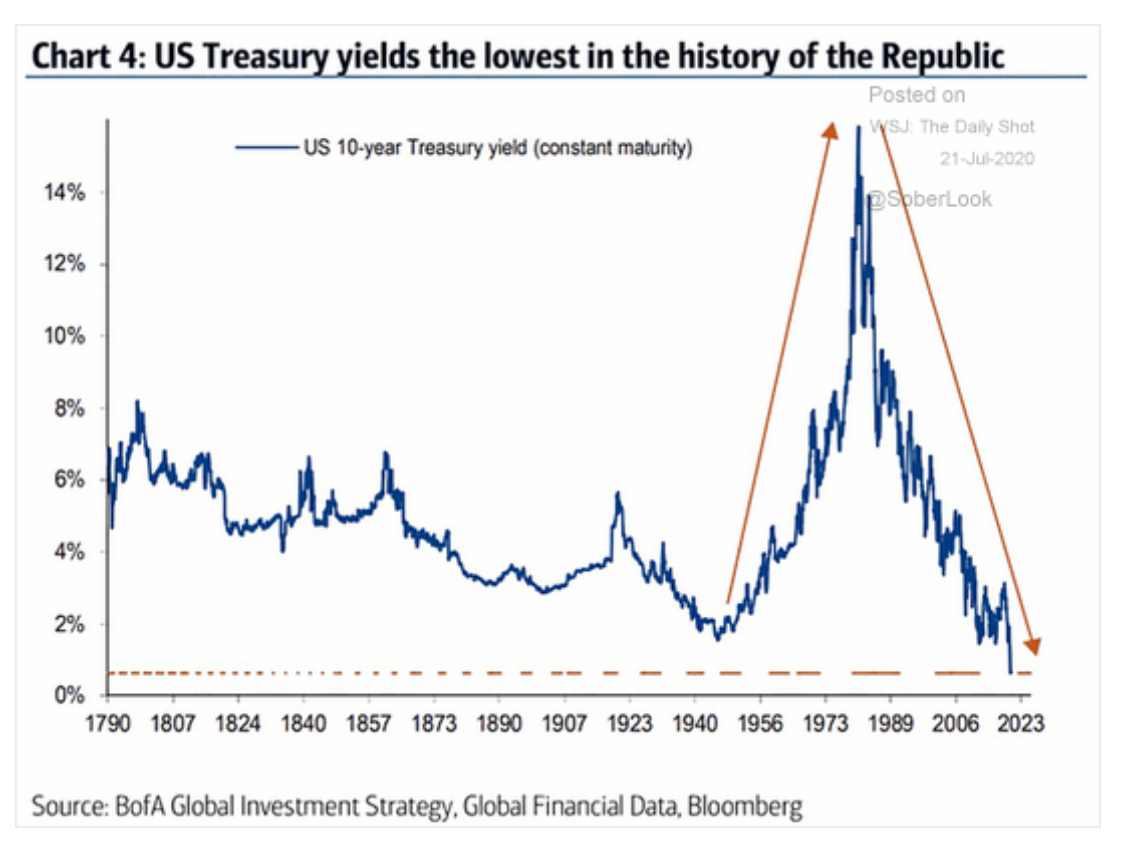
The price of capital is the interest rate and interest rates are at their lowest in the history of the country. The market message is "Use capital abundantly!"

How? Well, with unemployment at its highest levels since the Great Depression, use it for infrastructure projects and developing new technologies like green energy and subsidizing valuable services like childcare and elder care. In the private and public sector, use an abundance of capital to fund entrepreneurship and innovation.

Capital is abundant and cheap, Great jobs, financial independence and better technology are scarce and expensive. If we use capital right - treating it as abundant - we can eventually create an abundance of the things that are currently still scarce and expensive, transforming them just as we have capital over the last century or so. 

That's the stuff of progress.

Image

14 June 2019

Your Money for Nothing - When Capital is Free

File under: things that mostly just fascinate me but really do affect everyone:
"$20 trillion of the $55 trillion in global sovereign bonds currently yield zero percent or less." From here.

Why does it fascinate me? In our new reality, money is free for countries.
Why does this affect you? It means that we're under-investing in infrastructure, education and most importantly of all, research. All of that can essentially be conducted by nation-states with zero percent loans. A return of even 1% on that investment covers the cost of capital. A lot of what passes for returns to capital now are actually winning bets on entrepreneurship. 

We're going to look back on the first decades of the 21st century as a lost opportunity for massive investments in projects - public sector and private sector (in the form of startups and corporate initiatives) - given that capital was free and we had more university graduates than we were fully employing.

Future generations' assessment of us will be that what we lacked in imagination we more than made up for in risk-aversion. And instead of funding grand projects, we used this free capital to bid up the price of art, stocks and other pre-existing assets.

02 December 2017

Why the Republican Tax Cuts Won't Help the Economy: Understanding the Difference Between the Economies and Parties of Lincoln and Trump

Trillions in excess reserves, cash and negative interest rate bonds calls into question Republican's claim that the economy needs tax cuts to create additional capital.

Abraham Lincoln was the first Republican president. He was part of a visionary party who realized that the industrial economy had changed the rules in a few ways. One, it made capital even more important than land. Two, it made slavery, which was always immoral, now bad economics. Three, it made the national economy most relevant to good policy (goods now produced in growing factories were now transported across state lines by growing railroads to be sold in department stores all across the country) rather than the old state economy. When the south seceded, the largely Republican northern legislators passed a flurry of laws to accommodate this new industrial economy that was supplanting the agricultural economy.

Since the time of Lincoln, a key to understanding Republican policy and strategy is understanding that they believe that nothing is more important to economic prosperity than capital.

There is good reason for such a belief. If you are working with your bare hands you do well to create more than a few pennies - maybe a few dollars - of value a day. If you have capital equipment like a vehicle, a lathe, a computer or factory, you can potentially create thousands - even millions - of dollars in value each day.

The thinking behind the Republican tax breaks traces back to this belief that they need to encourage more investment by corporations by taxing them less. Their belief is that as more money is invested in things like lathes, computers and factories, American workers will be more productive. As it has since the time of Lincoln, more capital from more investments will make us more prosperous.

It is true that capital is essential to our economy. So is agriculture. There is a difference, though, between knowing that we'd perish without farmers and expecting agriculture to employ a growing number of people. In 1800 about 90% of Americans worked in agriculture; by 2017, about 1 or 2% do. Agriculture is essential but that is very different from saying that more farmers will make our country more prosperous. Agriculture is not the place we look in 2017 for the creation of new jobs and wealth.

Capital, too, is essential but that is different from saying that more capital will make us more prosperous. Manufacturing (admittedly just one manifestation of capital) is not the place we look in 2017 for the creation of new jobs and wealth. As farming before it, jobs in manufacturing have been in steady decline as a percentage of the workforce since about 1940.

Again, the simple justification for Republican tax cuts is the belief that they will result in more capital investment. The story of excess reserves calls that into question.

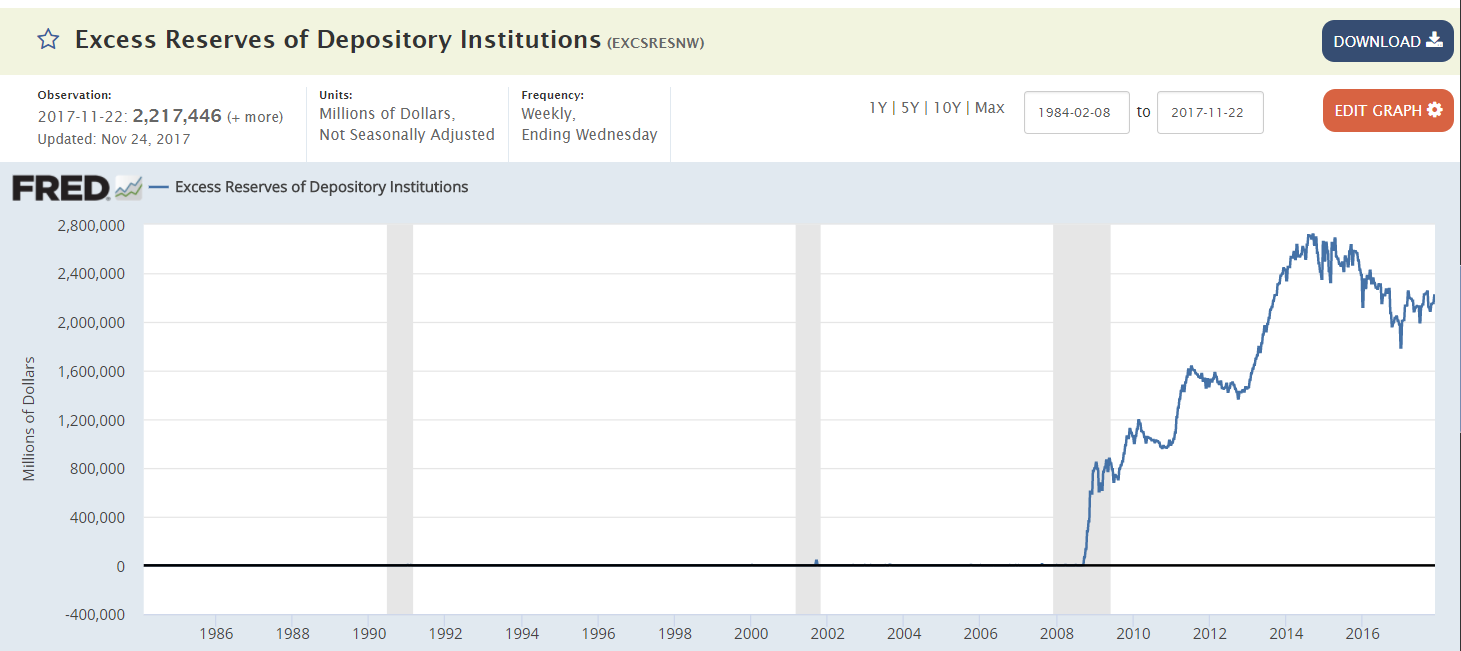
From the early 1980s through 2008, excess reserves in the US banking system mostly bounced around between $1 and $2 billion dollars. Banks are required to keep a certain level of reserves on hand, essentially money they hold in case you come in to make a withdrawal on your account. And simply because it is nearly impossible to have every dime "working" as loans, etc., banks also keep a little reserves in excess of what is required. They have an incentive to keep these reserves to a minimum because they just sit there idle, generating no interest, so it makes sense that they wouldn't hold much in excess reserves.


Then we got hit with the Great Recession. One huge risk was that the credit system would collapse. Among other things, the Fed pumped capital into the banking system to encourage economic activity. The Fed could put capital into the banking system but banks had to put it out into the economy via loans to households and businesses.

Banks are literally professionals at understanding credit risk and knowing when to loan money for a kitchen remodel or a business expansion. Bankers - like business executives, teachers, police,  and engineers - make mistakes but this matter of deciding where capital should be employed to maximize the returns on capital is quite literally their job. If they have a billion dollars, they will look for a way to invest or loan that out in order to create a return. Only as a last resort will they leave it idle and not making money.

So what happened when the Fed pumped a record amount of money into the banking system? You can see that below; the one to two BILLION became two to three TRILLION, a jump of 1,000X.


Janet Yellen has helped to engineer a draw down of these excess reserves without disrupting the economy but after peaking at $2.7 TRILLION in 2014, excess reserves are still $2.2 trillion.

Bankers - the experts on capital allocation - are letting trillions sit idle because they don't see profitable ways to employ this capital. Another way to put it is that they don't see capital as scarce.

Excess reserves are not the only bits of evidence that the economy has an abundance of capital. Last year companies in the S&P 500 spent $536.4 billion on buybacks. What does that mean? They spent half a trillion simply buying their own stock rather than investing that money into hiring, factory expansion, or advertising. Like bankers, big corporations don't see capital as scarce but instead see it as abundant, literally having more than they can use. Corporate cash is close to $2 trillion.

The Dutch have financial records that go back 500 years. Think about all that has transpired since 1517: the Protestant Revolution and religious wars that killed tens of percent of the population in certain regions of Europe, coming to an understanding that Columbus had actually discovered new continents and then settling those Americas, democratic revolutions, the industrial revolution, world wars, a Great Depression .... these 500 years have hardly been uneventful. And yet, last year was the first time that the Dutch recorded the sale of negative interest rate bonds. You give a country $100 and get back $99. The Netherlands, the EU, France, Japan .... nine countries had issued about $12 trillion in negative interest rate bonds as of last year

To sum up, US banks have $2.2 trillion in reserves, the S&P 500 has $2 trillion in cash (even while spending half a trillion a year on buybacks), and there are more than $12 trillion in negative interest rate bonds around the world.

None of this suggests that the West faces a scarcity of capital.

So let's get back to the Republican tax cut. The thinking behind it is simple: if we tax less there will be more capital and that capital can be employed to expand businesses that will generate more profit and jobs. And that, of course, assumes that capital is scarce.

Capital was scarce 150 years ago during Lincoln's presidency. At that time, nearly any policies that encouraged the growth of capital were likely to have a positive effect on the economy, helping to make us all more prosperous.

Capital is now abundant. Policies that starve public education and research to send back more capital to corporations and individuals will hurt economic growth, not help it. There is no way that someone can look at the evidence and conclude that what our economy lacks now is capital. There is no way, of course, unless you have failed to update what was once a great perspective to adjust to a new landscape. The party of Lincoln has given way to the party of Trump and mindful intelligence that carefully considers new facts has given way to mindless ideology that ignores them.

10 June 2017

The Biggest Danger of the GOP - Or What The Comey Hearing Drowned Out

Thursday, the House GOP passed a bill to repeal Dodd-Frank. Friday, the NASDAQ fell nearly 2%. Meanwhile, the world fixated on a UK election essentially won by the party already in power and a Comey testimony in which we learned that Trump lies. The news of the day was good cover for bad legislation. Really, really bad legislation.

A little story

A little town is divided among three groups. One group is pro-football, the other is anti-football and the third group is mostly neutral.

The anti-football group got that way because a couple of kids were seriously injured. One will be in a wheelchair for life. The anti- group simply argues that no sport is worth this risk.

The pro-football group are simply fans. They love the sport, point to the tradition, the way it gives the kids something to come together on and cheer for, the way it builds a sense of community, and how it calls young men to excellence. 

The problem is, the pro-football group has been hijacked by a sub-group so repulsed by the idea of rules to make the game safer that they've gone in the opposite direction. Call this group the football fanatics. They think that kids shouldn't even have to wear helmets if they don't want to - or can at least wear the old leather helmets that were good enough for players in the 1920s.

Here's the problem. The pro- group is only one or two spectacular injuries away from losing football altogether. And given the way the fanatics are approaching this - eliminating "silly rules that just slow down the game" like flags on late hits or tackles that involve helmet to helmet contact, etc., they have greatly raised the risk of serious injury.

The people who should be most grieved by the fanatics are the fans who care less about any specific rules of football than they do about just having the game in town. Because what the fanatics are doing is making it probable that the anti-football group will get their spectacular injuries that lead to cancelling the program.

The real story

Which brings us to capital markets.

Thursday, buried beneath the tsunami of coverage of the Comey hearing and UK election - the House passed a bill to repeal Dodd-Frank. Two major provisions of this bill set us up for another Great Recession: one provision exempts financial institutions from capital and liquidity requirements to allow them to take on more risk and another provision puts in place bankruptcy provisions in lieu of "orderly liquidation." So, financial institutions are free to take on more risk and when that risk leads to bank failure it won't be treated systematically. That is, it sets up the conditions for a run on the banks like the one that lead to the Great Depression. People will need to withdraw capital to protect themselves at the exact moment that the banking system would need more liquidity. 

Capital markets are one of the great inventions of mankind. Credit can finance the construction of high-speed trains or a cup of coffee, finance your education that launches your career or your house that becomes your home. Credit can finance research that cures an old cancer or a new product. The capital markets that have emerged since about 1700 have transformed our world, giving us longer lives, and making us more productive and happy. The joy football has brought into Americans lives is microscopic in comparison to what capital markets have brought. 

The Republicans are philosophically opposed to regulations. They are the pro-football fanatics who believe that the game of capitalism would be made better if only we removed all those troublesome rules that just get in the way of a good game. And while it's true that the game goes slower with rules and regulations, it also saves people from serious injury that comes from the failure of one or two big institutions becoming catalyst for a Great Recession. 

Real fans of football would shut out the fanatics who try to eliminate rules. Real fans of capital markets would do the same to the anti-regulation fanatics who - just years after the worst recession in nearly a century - are working to eliminate the regulations that save us from serious injury. Anyone who wants to see capital markets survive, evolve and prosper to continue to enable prosperity, will come out against this deregulation inspired by ideology. 

The biggest danger of the GOP's approach to repealing Dodd-Frank is that it will enable anti-capital market forces to make more coherent arguments against them. We now have a president who supports dictators; we can easily have a president in a decade who supports communists. If you love football, you would shut down the fanatics arguing against making it safer; if you love capital markets, you would shut down the fanatics working against making them safer. 


09 June 2017

The Real Failing of Modern Politics

Yesterday's UK election brought home what is for me the major failing of modern politics. There was little question that the biggest winner would be either Jeremy Corbyn's Labour Party or Theresa May's Conservative Party. Simply put, Corbyn wants more government spending and May wants more government austerity. These positions are distasteful to most voters because on the one hand it means more taxes and on the other it means fewer government services.

What is the biggest failing of modern politics within the West? Politicians have largely given up on promising prosperity. They've run out of tricks. W. Bush pushed capital gains tax reduction to stimulate more investment and investors pumped money into weird things like mortgage backed securities, thus setting us up for the Great Recession. Democrats push for investing more money into education but already we have more graduates than new jobs. (In 2013, the American educational system created 3.7 million college graduates (from AA and BA degrees to PhD and professional degrees) but only 2.4 million net new jobs.) What worked brilliantly in the 18th and 19th centuries (encouraging the creation and deployment of capital) and what worked fabulously in the 20th century (creating an extensive public school system to make K-12, even K-BA education the new normal) simply is not enough in this new century.

We will need capital in today's economy. More than ever. We will need well educated workers in this new economy. Again, more than ever. The difference? Capital and knowledge workers no longer lead the parade of progress. Entrepreneurship does. Any policy makers intent on creating prosperity need to focus on creating an entrepreneurial system.

One of the most spectacular inventions of the two centuries from 1700 to 1900 was the development of a financial system. Through a combination of private and public sector efforts, the West created an incredible ability to finance projects as vast as interstate highways or as small as the purchase of a coffee with a credit card. And policy makers can influence that system with changes in interest rates and other policies to stimulate or cool an economy, helping to promote the creation of jobs or to lower the rate of inflation. Our financial system is vast, complex, and rightfully the focus of policy makers throughout the economy.

One of the most incredible inventions of last century was the development of an education system that changed the experience of children from that of entering the work force at the age of 8 or 10 to that of entering university at 18 or 20. Again, this is a vast system with many moving parts but it is possible - through policy initiatives and cultural norms - to change and influence education and thus the economy through this system.

By contrast, we still have not developed a comparable entrepreneurial system. That is the work of our generation. We can lower interest rates and increase borrowing, change educational standards and increase the number of students who get a high school diploma or a graduate degree in business or education. Meanwhile, our relationship to entrepreneurs is about what it was to education in the 1800s. In 1800 most communities supported freedom of speech and thought but they largely left education to autodidacts and elites, self-taught gentlemen who could afford libraries, trips abroad or time at a university. The masses were not expected to get much of an education. In 2000, most communities support the ideas of entrepreneurship and grant a measure of freedom to private citizens to try their hand at starting a business. Entrepreneurship is left to those who are strong enough to push against the system or financially supported enough to fund a venture that might take years to become profitable. (The children of the affluent are far more likely to become entrepreneurs.) We don't expect the masses to consider - or even know how to approach - entrepreneurship. Unlike education, we have yet to popularize entrepreneurship.

Rather than force communities to choose between cutting services or cutting taxes, really effective politicians will engage in a conversation about how to create prosperity. During the 20th century, not only did families end up with vastly more income but they were able to fund a vastly larger government. There wasn't a trade off. The private AND public sector got enormously better. Prosperity gives you that option.

My own sense is that until communities throughout the West get as serious about the work of popularizing entrepreneurship, they'll continue to pursue a politics of divisiveness that forces communities to choose between the lesser of two lessers rather than the greater of two mores.

12 April 2015

The British as Social Inventors (or, the policies that could make the UK wildly prosperous again)

The UK will elect its next prime minister in just a few weeks, on 7 May.

As an American, I envy the fact that British politics is so much more humane. But judging from the political debate earlier this month between the UK's seven major party leaders, the British seem to have lost their sense of history. Why were they the world’s leading force for centuries? Why are former British colonies so much more affluent than former colonies of Spain or France? Why is English still the world’s dominant language when it comes to business, science, and innovation? Knowing the answer to that question provides the answer to how the UK could again make its economy vibrant, perhaps even a global leader.


The simple answer is that, from before 1534 when Henry VIII severed ties with Rome to help to create the nation-state to the time that the British invented the single-payer healthcare system in 1948, the British led in social invention. And not just any sort of invention. They led in the social inventions that helped overcome that period's limit to economic progress.

Instead of discussing social inventions that redefine a century, though, political leaders are now arguing about changing tax rates or spending small percentages, each trying to find the right balance between fiscal responsibility and addressing needs. There is no sense of history now. Just a sense of responsibility. Rather than ask how to create jobs they’re asking how much unemployment and welfare they can afford. Rather than asking how to create wealth, they’re asking how much debt is reasonable. And rather than ask how to make the British once again world leaders in economic growth, they’re asking questions about how fairly government services are being shared among the poor and new immigrants. As an American I can only envy this delightful sense of fairness. In the end, though, it’s less about whether you share the mastodon kill fairly than whether you learn how to domesticate crops. If you want a great community, you don't choose between fairness and progress.
For centuries, the British were the world’s leaders at changing people’s minds about what was possible. Their social inventions were not just about what was fair or right. Their social inventions actually created wealth in ways that were unprecedented in world history.
The British National Health Service (NHS) is the oldest single-payer healthcare system in the world and is a wonderful example of social invention. The British set up a system that made healthcare a right rather than something only people above a certain income could access. Like so many of their social inventions, most of the West has since adopted some form of what the British created. (Even we Americans have taken steps towards following this example.)
But long before that, they also invented new institutions that made people more prosperous. 
In 1623, Edward Coke championed legislation - patent law - that rewarded inventors. By 1699, Thomas Savory had invented a steam engine. At that point, for the first time in thousands of years, per capita income began to rise. Because of social inventions like patent law that let people profit from the investment of time and money into new products, the British led in the industrial revolution.

The British were not just social inventors. They rapidly adopted what worked in other countries. The Dutch were the first to set up a corporation that could trade in a remote part of the globe on behalf of the state (the Dutch East India Trading Company), the first to set up a stock market (to trade shares in that one corporation) and the first to set up a central bank that could help to regulate currency and make loans on behalf of the state. The British were smart enough to adopt those inventions when they brought William and Mary over from the Netherlands in 1689 to become their monarchs, and that soon helped them to pass even the Dutch in per capita income. This was not just the kingdom that gave us the invention of the steam engine: it gave us Charles Darwin and the concept of evolution.  The British continued to innovate and tinker with these big inventions. It was the Bank of England that became the model for the world's central banks. And the eventual change they made to the corporation was even more momentous.
In 1862, the British Parliament passed the Company Act and invented the limited-liability, joint-stock company. That is, they invented the modern corporation, the best institution yet made for the creation of jobs, products, and wealth. John Micklethwait and Adrian Wooldridge called it “yet another quirky Victorian invention that changed the world.” Putting aside the fact that the Americans more fully subordinated themselves to this new institution, this transformative social invention was British.
Whether it is through patent law or the modern corporation, central banking or NHS, no people have done more than the British to make history by changing history. No people have been more ready to re-invent themselves or their institutions. 
So what could the British do now? What social inventions would shift their conversations from unemployment to job creation, from debating about how much debt they could afford to best strategies for creating wealth? It would be any social invention that would help them to overcome today’s limit to progress, which is different from the limit of a century ago – or two centuries earlier.
From about 1300 to 1700, the limit to progress was land and because the British people led in social invention and adoption that helped them to overcome the limit of land – from a nation-state and private property to standardized measurements and colonization – they became the world’s leading economy. 
From about 1700 to 1900, the limit to progress was capital and because the British people led in social invention and adoption that helped them to overcome the limit of capital – from patent laws that inspired invention to central banking policies that stabilized financial markets – they were the world’s leading economy.
From about 1900 to 2000, the limit to progress was knowledge workers. Even though the British people invented the modern corporation – the place where knowledge workers created products, wealth, and jobs through product manufacturing and invention – they lost their lead to the US, Germany, and Scandinavian countries because they were slower to realize the importance of public education. (In 1875, England’s illiteracy rates were about 10X higher than those in Germany and the Scandinavian countries.) In a world where English is the dominant language, it’s worth noting that kindergarten is a German word. The social and technological inventions that did the most to create knowledge workers and make them more productive were the ones that made communities richer and more powerful. One might argue that as the world's original capitalists, the British saw their invention of the modern corporation more as an investment tool than as a tool for making knowledge workers more productive, and lagged because - for a time - they made capital more important than labor.
The conversation the British people need to have now isn’t about how to get more land and make it more productive. Land is no longer the limit. The days of colonization and the British Empire are past. It’s not about how to get more capital and make it more productive. Trillions of pounds of capital wander the globe in search of returns. A massive infusion of capital now is as likely to sit idle in banks (or, in the form of industrial capital like robots, make labor sit idle at home) as to create jobs and wealth. It’s not even a question of how to create more knowledge workers or make them more productive. The good news is that - largely because of British social inventions - the West has overcome the limits of land, capital, and knowledge workers. The bad news is that more of those factors that no longer limit won't just fuel economic progress.

Period (roughly)
Market Economy
Develop & Acquire
1300  1700
First, Agricultural
Land
1700  1900
Second, Industrial
Capital
1900  2000
Third, Information
Knowledge Workers
2000 ~
Fourth, Entrepreneurial
Entrepreneurship

So what is the limit to today's economy that social inventions must help communities to overcome? Entrepreneurship. Last century, the West popularized knowledge work. Between 1900 and 2000, the economies of the West transformed from industrial economies dependent on child labor to information economies dependent on adult education. Now, it is time to popularize entrepreneurship. The first wave of this popularization will likely be like the British adoption of Dutch institutions. That is, communities able to adopt the policies of Silicon Valley, creating an entrepreneurial region, will make great progress. The next wave will likely come in the form of changing the corporation again. This will involve making more employees more entrepreneurial, allowing them to create equity and not just products. No one has yet taken the lead in this but the British (or for that matter, the Scandinavians, Germans, Canadians, Americans or the people of Singapore) could become leading innovators in this. And just as the British became prosperous in ways that past generations could not have imagined when they boldly overcame the limits of capital, so could this next generation.

The question for today’s economy is how to create more entrepreneurs and how to make more employees more entrepreneurial. As people find creative answers to these questions, they'll create jobs for knowledge workers and will fully employ the trillions in capital that people like Marin Wolf and Ben Bernanke warn is symptom of a savings glut (or investment dearth). Knowledge workers and capital are no longer limits. Entrepreneurship is.
The British people have proven themselves incredibly creative. For centuries. There is no question about that. The only question is whether British policy makers will decide to find creative answers to the question of how to create more entrepreneurs or how to make more employees more entrepreneurial. Last time they got serious about finding ways to overcome the limit to progress through thousands of small and large social and technological inventions, they gave us the industrial revolution. Who knows what extraordinary world lies on the other side of the myriad inventions that will help the West to overcome the limit of entrepreneurship?


04 June 2014

There is no Bubble in Venture Capital for Tech Firms.

In 2010

Mortgage financing is 647X as much as what we plow into tech startups. Outstanding consumer credit is 147X as much as the VC community puts into technology startups.

Since the start of the year, Facebook has spent more than $21 billion acquiring startups and Google has spent $4 billion. That's $25 billion in acquisitions for just two of the more prominent names in tech in just the first 5 months of this year. Meanwhile, VCs put only $24 billion into startups all of last year.

My own sense is that the venture capital market is still far from mature, perhaps where consumer credit was in the 1970s when the modern credit card was just emerging. 

There is a question about whether Venture Capital is fueling another bubble, akin to 2000. Based on this data, I don't think so. Not even close. It seems to me - given the importance and potential of new ventures - the ratio of financing for new ventures is - if anything - too low compared to mortgages and consumer credit. In a decade we might find talk of bubble in 2014 comical.


24 May 2014

Financial Markets and a New Definition of Taking a Bath

Global financial assets are well over $200 trillion, doubling every decade since 1990. In 1990, total debt and equity outstanding was $50-some trillion. By 2000 it was over $100 trillion. By 2010, it was over $200 trillion.

Between 1995 and 2007, only one quarter of this additional financing went to corporations and households. This money is not being used to start or expand businesses or even to finance purchases by households of everything from refrigerators to university educations.

Every decade we double our financial assets but of late those assets are merely going into speculative sorts of enterprises as opposed to financing actual economic activity.

The result is something akin to water in a bathtub, waves sloshing about in a closed system. Financing is used to finance financial activity and it rushes in and then out, creating odd turbulence without actually flowing into anything new.

The problem is not the volume of financing. That's actually a wonderful thing. The problem is that our limit no longer lies in the quantity of financing; that financing is limited by where it can go. We still haven't created enough viable opportunities for that financing, from public to private sector ventures. Until we do, we'll keep trying to predict the movement of waves in a tub.


20 June 2011

One Party Each For the Four Factors of Production

For decades, it has been enough to favor capital or labor in economic policy. It might be time for a new political party that favors entrepreneurship instead.

Every developed country has at least two parties that either give priority to capital or labor. In the UK, they have the decency to explicitly label one of the parties "Labor" (or, more precisely, "Labour"). Nobody names their capital party that, preferring to call it the conservative party. Or, in the US, it is Democrat and Republican. By any name, the "no, no, capital is more important party" and the "you have got to be kidding, labor is more important" parties have defined so much of the economic policies in all developed countries in the last century.

More recently, a party has emerged to protect the environment, to protect the nature that provides us with our natural resources. The Green Party is, unlike the various conservative and labor parties, actually a worldwide party.


It is not too much of a simplification to say that conservatives feel that all good things follow from treating capital right (for instance, by giving lower tax breaks to capital gains than to other forms of income) and labor party folks feel that economic progress comes from treating labor well (things like old age pension and minimum wage law). But what if neither of these any longer leads economic development? What if it is not enough to merely attract capital and educate workers? 


We have capital, labor, and resources parties. We have, that is, parties representing each of the four factors of production save one: entrepreneurship.

Why not an entrepreneurial party? One that doesn't subordinate labor to capital or vice versa but instead subordinates them all to the creation of the new? Labor has no place to work when we don't create new businesses. Capital moves from bubble to bubble when it is merely bidding up the price of existing assets and not creating something new. Labor and capital alike can be a part of entrepreneurship, and only this raises wages and returns to capital.

Entrepreneurship is not just about business. Charter schools and non-governmental agencies and foundations are examples of entrepreneurship in the public sector. More importantly, entrepreneurship done right is about creating new, sustainable systems. A business entrepreneur creates a system that can produce profit even when the entrepreneur has moved on.

Our modern world faces a crisis of systems. Systems as varied as financial and ecosystems, and fresh water and educational systems, health care and energy systems all flirt with collapse and degradation. One thing that it seems we can say with great confidence is that we need to learn more about systems and how to sustain, design, transform, and thrive within them. The difference between an employee and an entrepreneur is whether they take the system as a given or create a new one. Entrepreneurship as an act of system creation is something we need lots of.

What about a party that promoted the interests of entrepreneurs? Certainly the entrepreneurs who start businesses but more broadly, every kind of social entrepreneur? What if we had a party that sided with what was possible instead of spending all its energy on protecting what was? What about a new party that promotes the most recently acknowledged, most sophisticated, and most transformative of the four factors of production?