Showing posts with label popularizing entrepreneurship. Show all posts

14 January 2019

Growing Income Inequality and the Real Policy Solution of Popularizing Entrepreneurship

The effects of automation are accelerating as algorithms grow more sophisticated and a global market means more people who might come up with that one killer app or manufacturing process or delivery trick that quickly obsoletes 2 or 3 people or even 2 or 3 industries steadily grows by millions every month.

How does one counter that? Income vulnerability seems inevitable in a world of growing disruption. The good news is that the team who creates the new solution to obsolete the old one(s) will get rich; the bad news is that there is a whole swath of people will lose income and wealth as they become obsolete. If we want to ride this wild horse of automation to higher productivity, we need to acknowledge that our safety nets need to be good. How this happens will ultimately involve a mix of unemployment insurance, universal healthcare, affordable or free education and retraining for any age, and perhaps a variant of guaranteed income. But those are mere bandages on the body politic, merely a way to mitigate the pain of disruption. The solution that is essential to couple with more rapid automation is more rapid entrepreneurship and innovation.

When we no longer need 90% of our people to grow our food on the farm, we can use them for other things. Some can get into food preparation and serving, letting us enjoy a wider variety of foods that people in 1790 America (when 90% of the population was in agriculture) would have never imagined: foods like sushi, adoboda tacos, spaghetti, and liquid nitrogen ice cream. Others can design and make cars, legos, barbie dolls, and new drugs. If there is nothing else to do but grow food, reducing the percentage of our workforce needed to grow food from 90% to 1% (which is roughly where it is today) is a catastrophe. 1% of the population would be incredibly rich and the other 99% would literally need credit just to buy food. But we innovate and those 99% come back with cool stuff that entices the farmer to give up his food. (Or, more precisely, he sells his crop for money he can use for the cool stuff.)

The problem with wealth and income inequality today is not that people are getting rich automating jobs. The problem is that we have not learned how to balance that rate of automation with an equal or even better rate of innovation and entrepreneurship.  What this means will involve everything from even more money poured into R and D to more funding even within Fortune 500 companies for entrepreneurial efforts that simultaneously allow employees and the company to create new wealth.

As mentioned, programs to mitigate income and wealth inequality seem both necessary and inevitable. But to stop there is not enough. The real question of economic progress should be: how do we create the new so rapidly that it feels like the old industries are not automating jobs fast enough to free up workers to enter the new industries and companies? 

Economics makes a big deal of supply and demand and equilibrium between them. It's a beautiful and powerful concept. But just as important to prosperity is understanding the balance between automation and innovation, destroying the old while creating the new. What is the solution for automation obsoleting jobs? Popularizing entrepreneurship: making it easier for more people to be more entrepreneurial and even changing the definition of work as much as the information economy has or the industrial economy before that.

22 September 2018

From Gates to Bezos - What the Change in World's Richest Man Tells us About a Shift From an Information to Entrepreneurial Economy


On America’s west coast there are examples of what the popularization of entrepreneurship could look like at the regional and company-level.

Silicon Valley continues to attract more venture capital and to create more wealth than any country in the world. The folks in the Bay Area have created an entrepreneurial economy.

Further north in Seattle, Jeff Bezos has created an entrepreneurial company.

Jeff Bezos recently emerged as the world’s richest man and is the world’s only triple-digit billionaire. Bezos is an entrepreneur. He has also created a platform that has popularized entrepreneurship. Not only does Amazon have more than 500,000 employees, it has "2 million sellers, hundreds of thousands of authors, [and] millions of Amazon Web Services developers.”  And, Bezos reports, "In 2017, for the first time in history, more than half of units sold on Amazon worldwide were from third-party sellers."[1] 

Bezos isn’t doing all the entrepreneurial lifting at Amazon; he’s got millions of co-entrepreneurs and the result is that as they struggle to become rich they inevitably increase his net worth. People who create, make or ship products hope to get rich by selling through Amazon. Jeff Bezos is just one of the millions of entrepreneurs who use the platform that his team has built.

Knowledge workers turn raw data into knowledge in the same way that factories turn raw materials into products. A computer makes knowledge work far easier and during the 1980s and 1990s, the personal computer became ubiquitous as knowledge work evolved and became more common. Microsoft provided the PC’s operating system and software like Word, Outlook, and Excel and for Microsoft it was like having a patent on forks and spoons when people stopped eating with their hands.

In 1995, Bill Gates became the world’s richest man by creating tools that enabled knowledge workers to do their work. In 2018, Jeff Bezos became the world’s richest man by creating tools that enabled entrepreneurs to do their work. From the last couple of decades in the 20th century to the first couple of the 21st century, the source of new wealth was shifting from making knowledge work easier to making entrepreneurship easier.

Sometimes what is most obvious deserves the closest scrutiny. A region that has created record amounts of wealth. The world’s richest men? Those might just hold clues as to how the economy is changing. Successful economic policies in this century will popularize entrepreneurship.

Three categories of successful 21st century economic policies will be “follow the lead of Silicon Valley,” create an entrepreneurial track in education, and make it easier for employees to act - and be rewarded - like entrepreneurs


[1] https://www.sec.gov/Archives/edgar/data/1018724/000119312518121161/d456916dex991.htm

06 September 2018

The American Way - What Amway and Shaklee Had to do with the Popularization of Entrepreneurship

Richard DeVos died today. In 1959 he co-founded Amway with his friend Jay Van Andel. Like Shaklee - founded just three years earlier - Amway had an interesting business model. Rather than manufacture products to be sold in stores by someone else, these new businesses recruited sales people to be part of the business. The bad thing about the model is that it is wildly inefficient compared to, say, a Walmart where sales costs are so much lower and less labor intensive. The good thing about the model is that the product is being sold by people who can explain why it deserves a price premium and - most interesting of all - make money for recruiting people better than them.

My mother was in Shaklee [note that I'm not as familiar with Amway but think it generally has the same model] and one of the really fascinating things about it is that if she recruited someone who was downstream from her, she got some credit for their success. I don't know the exact formula but I do know that she partly had incentive to sell product and partly had incentive to recruit people even better than her. With the right people "downstream" from her, her income was enhanced. She was an entrepreneur (or at the very least a salesperson) who could make more money by recruiting other entrepreneurs (or salespeople) - some of whom might even be better than her.

I think this should be emulated by more traditional Fortune 500 firms. 

Imagine that when hiring someone to join the Fortune 500 firm, each manager wasn't just trying to recruit someone able to do the job and report to that manager. Imagine instead managers trying to bring on board "employees" who had the entrepreneurial drive or perspective that could result in their transcending their designated role to build the business. And imagine that these managers who hired employees who turned out to be even better at the entrepreneurial effort of building the business saw an increase in their income because of the success of the people they'd hired.

For one thing, managers would be happy to hire someone who quickly advanced beyond that hiring manager. You would be happy to have people who quickly outgrew a role and forced you to - sigh - go through the hassle of hiring again. For another, managers would do a lot to develop these new hires because of this incentive. (We invest in things that offer a return.) And the focus on the business would be less about finding people to fill roles in an existing business than in finding people who could build the business. This is not a bad mechanism (albeit just one mechanism) for the popularization of entrepreneurship. 

I kind of like the idea of this being the American Way (or as those two cool Dutch guys abbreviated it, Am'way). 

That's a fairly cool business legacy.

16 February 2018

The Switch That Triggered the Rise of the West (Can Also Be Switched Off)


"I am not an advocate for frequent changes in laws and constitutions, but laws and institutions must go hand in hand with the progress of the human mind. As that becomes more developed, more enlightened, as new discoveries are made, new truths discovered and manners and opinions change, with the change of circumstances, institutions must advance also to keep pace with the times. We might as well require a man to wear still the coat which fitted him when a boy as civilized society to remain ever under the regimen of their barbarous ancestors."- Thomas Jefferson

From the time of Homer (roughly 1,000 BC)  until Marco Polo (about 1300 AD), incomes were stagnant.

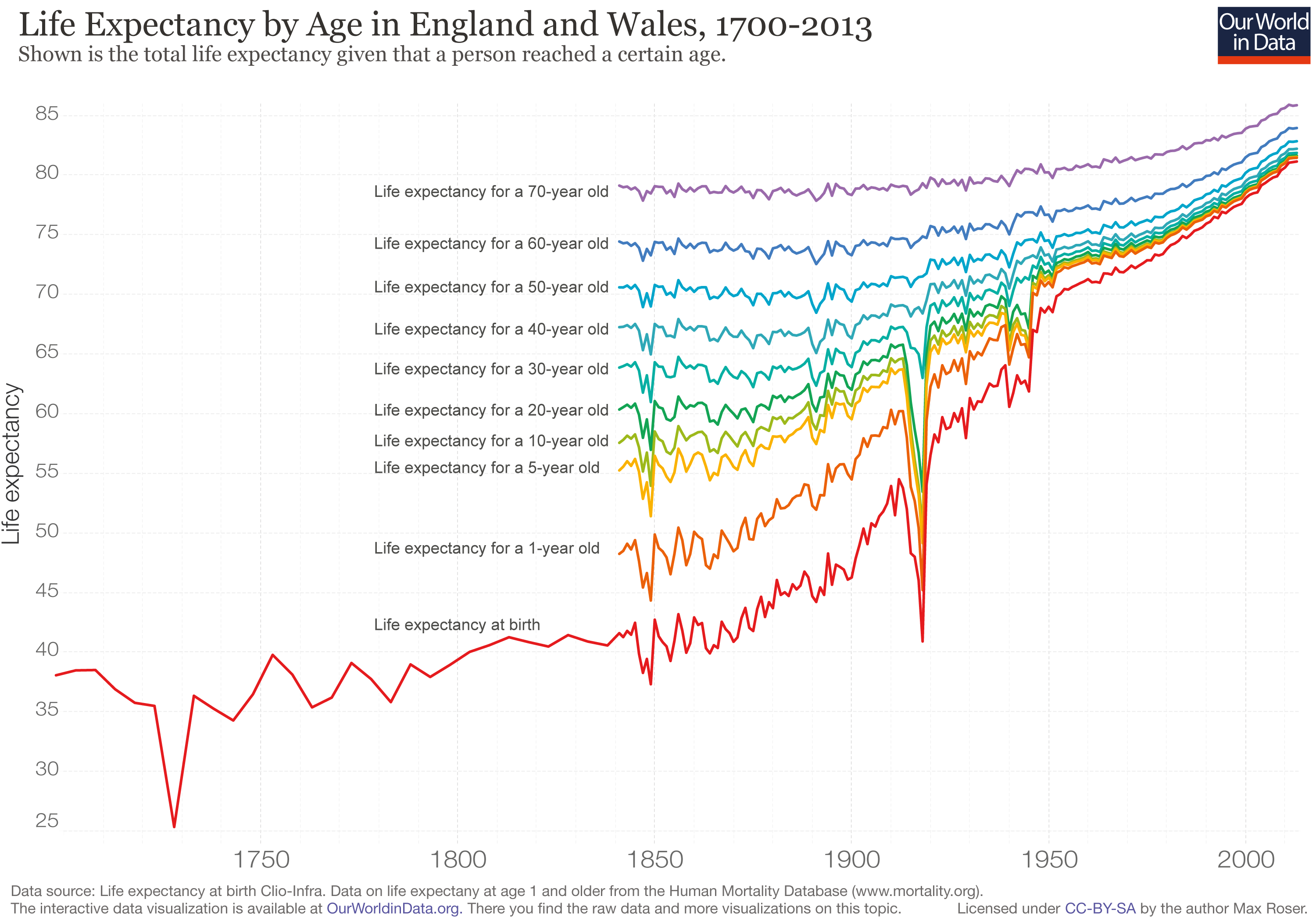
Starting about 1300, productivity began to rise and with it came a remarkable transformation in life. In the 18th century, life expectancy in England was about 35 to 40 years and now it's about 80.  Incomes are up about 30X from when Shakespeare was buying ink. What happened in England was fairly representative of what happened in the US, Canada, Germany, France and the rest of what we now call the West.


Change in income from century earlier
Since the 1700s the median income for each century has steadily gone up. From 1700 to 1900, per capita GDP tended to be about 62% higher than it was a century earlier. That was the reward for creating more capital and making it more productive. From 1900 to 2000, per capita GDP tended to be about 158% higher than it was a century earlier. That was the reward for creating more knowledge workers and making them more productive. So far this century, per capita GDP tends to be about 250% higher than it was a century earlier. This is the result of continued gains in capital, knowledge workers and their IT, and - most importantly for this century - the increasing power of entrepreneurship.

The West started this parade but it no longer leads it. Singapore has higher per capita GDP than the US, England, or Germany. There is nothing uniquely British about industrial economies or uniquely American about entrepreneurial economies. Anyone can lead this parade but why did the West start it? I think it's because of a unique approach the West took to its defining institutions.

Social invention is an overlooked component of progress. Banks, corporations, and nation-states matter as much in this story of progress since 1300 as trans-Atlantic ships, steam engines, and computers. The very notion, though, that these institutions are merely tools - no different than engines or electronics - is what has made the West different.

People within the the West have taken three distinct approaches to institutions.

Social Conservatives and Social Inventions as Sacred
The first approach is the most obvious. You come to awareness as a small child, growing up with the wonder of a church, the splendor of a king, the wealth of a bank and when you become an adult you accept that this is the way things are. Realizing how instrumental are these institutions to your world, you fight to defend them as they are.

Social conservatives treat social inventions as sacred. These are the loyal Catholics who see in the Protestant Revolution a route to hell and social chaos. These are the royalists who see in challenges to the crown a tumult of conflicting claims for authority, a challenge to all that is sacred. These are the capitalists who see conspiracies in the Central Bank that "runs" things, feeling instead that the banker should be left inviolate and unregulated.

They are quite right that these institutions keep us from chaos. I personally feel like institutions - social inventions - are the simplest reason that we have more control over our lives than do the great apes.

Radicals and Social Inventions as Disposable
Radicals go to the other extreme. They are well aware of how awful the church or state or bank has been. The French Revolutionaries outlawed religion at one point. The Enlightenment was about science and rationality and religion was all about superstition and dogma; it had to go. Radicals knew the church was merely an obstacle to progress and had to go.

Whether it is atheists who want to eradicate the churches, communists who want to shut down financial markets, or anarchists who want to outlaw laws, the radicals quite accurately see all that is awful about these social inventions and want them gone.

They also don't have a clue about how important are these flawed institutions to civilization, to modern life.

The radicals and social conservatives are an important part of the conversation and should always be heard; left in charge, though, they'll only ruin things. They're important voices who should never actually be given power to change anything but instead should only have power to point out problems and make suggestions.

Power over these social inventions should instead be given to people who are not naive enough to believe we can live without them or naive enough to believe that they should be defended in some current or (more often) idealized past form.

Social Inventions as Tools
Progress has been made by the folks who see social inventions as tools. Not sacred things that need protection. Certainly not as disposable. Progress has followed from people who realize how important the church is to how people construct meaning and gain empathy and compassion, become more loving and happy even when life hits one with the inevitable tragedies of illness, death, financial setbacks or even wars and pandemics.

The ones who see church, state and bank as mere tools realize that - just as with cars or can openers - these tools are more valuable as more people are able to use and define them. "We are all priests," as Martin Luther claimed, or "All men are created equal," as Jefferson wrote express the sentiment of those who don't think that popes or kings should have a unique right to define the institutions that so define us.

And the social inventions as tools people are the ones who are unafraid to change these institutions to make them work better for who we really are and aspire to be than who we imagine our ancestors once were. A church is not sacred but it is precious. What does this mean? Everything about it should be challenged except for what it does for people; a church is more important than a juicer only because of what it makes. Fresh orange juice is lovely but meaning and compassion can make the difference between whether or not you even feel like it's worth it to get out of bed to make that orange juice.


The West has led the great parade of progress in no small part because it has treated its vital institutions as mere tools and subject them to challenge and redesign as if they were products no different than cars or radios. They're not sacred. They're not disposable. We've made progress by changing our relationship to church, state, and bank, making them tools for anyone rather than just popes, kings, and bankers. We will make progress again in this generation by making a similar shift in how we treat corporations, turning them into tools for employees to create wealth and jobs and not just tools reserved for CEOs (who, by the way, are also employees).  Freedom of religion, the spread of democracy, the American Dream and the popularization of entrepreneurship have treated - and will treat - our big institutions as mere tools. That orientation is essential to progress.

So why mention all this? Because in the wake of the Great Depression, extremists seized governments everywhere; fascists and communists took control and progress halted or reversed everywhere they did. Now, in the wake of the Great Recession, extremists are again gaining power.

On the left we have activists who see banks as evil. And on the right we have activists who see banks as sacred. The first group doesn't understand the importance of banks, the second group doesn't understand the importance of regulating them and subjecting them to a central bank. Those on the left aren't numerous enough in the states to spoil capital markets but those on the right actually are in Trump's government. Trump is moving to deregulate banks so that banks are tools for bankers and not the community, not for everyone. The social conservatives don't believe in Keynesian economics (most recent evidence of that is the fact that they protested deficits when unemployment was high and now want larger deficits now that unemployment is low) or monetary policy.

Social conservatives are also working to reverse democracy. In 1789, only white, property-owning Protestant men could vote. About every 50 years, another group gained voting rights until, by the end of the 20th century even minority women who rented could vote. Courts have repeatedly ruled that Republican efforts to reverse voting rights are actually targeted at reversing that, taking power from minorities and the poor to vote.

Finally the continued effort to impose a religious definition of when life starts (at the instant of conception) and dismissing any other reasonable definition is an attempt to encroach on freedom of religion, the freedom of women to follow their own conscience and belief about when sperm and egg become a baby.

Social conservatives are wonderful to have in a community. They remind us that family as an institution really does matter, that churches make lives better for so many, that banks and the state create order we would not have without them. We should listen to them. But social conservatives are better reminders than managers; put in power, they treat as sacred what any forward moving community treat merely as as tools that are best used by many rather than a few.

Prosperous and happy communities will continue to construct institutions that are tools that help people to create meaning and be compassionate. They may not even call these institutions churches - and that is part of the genius of lumping freedom of religion under the first amendment along with freedom of assembly, speech, and press, the realization that it is the freedom to form thoughts and express them that is at the heart of religious freedom.

Prosperous and happy communities will continue to construct institutions that are tools to allocate and create capital that helps to fuel progress in productivity and profits. Again, they may not even call these banks but they will be tools that make people richer and able to afford now what they cannot pay for until later.

Prosperous and happy communities will continue to construct institutions that are tools for governing, for creating policies that make their world safer, easier to navigate, and more likely to offer them lucrative options and freedom to live a life as they please - whether in the form of neighborhood planning boards or the UN or any level of government between.

Prosperous and happy communities will continue to construct and revise institutions that are tools for creating wealth and jobs, new technologies and new products and services and in the process of creating value for customers, suppliers, stockholders and the community.

And the communities that prosper the most will never pretend that these tools should be reserved for the elite. They will never pretend that they are not necessary. They will never pretend that they are anything but tools.

What has fueled progress for the West is treating these great institutions as tools. Every time we've instead treated them as disposable or sacred, progress stalls or even reverses.

26 October 2017

Two Simple Policy Goals

Maybe I'm simple minded but I don't think that policy has to be terribly complex.  

A great test of your economic policy is how easily someone can start a new business that has a legitimate chance of creating wealth and jobs.

A great test of your social policy is how easily a single mom can raise a child who has a legitimate chance to be happy and productive.


Doing well on those tests is not trivial. If you are successful at popularizing entrepreneurship you have a great education system, easy access to capital markets that are well regulated and reward people who invest well and punish people who abuse investors or borrowers, and stable, predictable laws around property and wealth. Your culture embraces disruption and protects losers enough that your community has little resistance to new companies, technologies and industries and welcomes change. You have things like universal healthcare so that would-be entrepreneurs face less risk when they take on the risk of a new business. Your culture sees social invention and product invention the same way: you keep improving what you have and looking for new ways to reach old goals more effectively, whether that goal is to store fresh food for longer like a fridge now does (and like some other technology may do in the future) or create meaning and community like a church now does (and like some new social invention may do in the future). 

If you are successful at making it easy for every parent to raise a child, this again has many policy implications. People have easy access to birth control and abortion so that they can easily control when they become a parent. Maternity and paternity leave is generous without penalizing companies that employ young people who are more likely to be starting careers and families. Childcare is affordable. Jobs can be customized. (The Netherlands has brought birthrates back up by offering more flexible job options: many parents (mostly mothers) work part-time.) You have a vigorous defense of the environment, minimizing the probability that children will be exposed to threats that might not show up for decades.

Rather than penalize entrepreneurs who would create jobs and wealth by making them jump through hoops,or ignoring the fact that their educational needs are just as real as those who would pursue a vocation or white-collar job, the community should make it easier for them in a host of ways, from mentoring programs to bureaucratic aides to help them through necessary legal, financial and regulatory hoops. Rather than penalize young mothers who would raise up the next generation of workers and citizens, the community should make it easier for them in a host of ways, from mentoring programs to childcare along with logistical and emotional support to help them through the various challenges of parenting.

If your mothers are raising the children they aspire to raise, you'll have an emotionally whole and productive citizenry. If your entrepreneurs are creating the businesses they aspire to, you'll have steadily rising wealth and income and strong job markets that enable the community to finance personal things like fine meals and communal things like beautiful parks and good roads. If you focus on making life easier for single mothers and entrepreneurs you will automatically make it easier for two-parent families and no children families. If you focus on making it easier for entrepreneurs, you will automatically make it easier for employees and investors.


The policy implications of these two goals - the various programs and initiatives that would help further us towards these goals - could be continually enhanced by - among other things - running focus groups with real and aspiring entrepreneurs and real or aspiring single moms. Asking them what would make them more successful, what obstacles and frustrations the have, what their needs are and sorts of resources they need would help to inform policies that could make a difference. Tracking the efficacy of these policy initiatives to determine what makes the most difference for the least time and money could be used as further feedback about which policies to continue and which to let die. With these two goals, a community could continuously experiment to see how best to achieve them. It's hard to imagine how such policy experiments wouldn't make the community better for everyone.

05 March 2017

The Fourth Economy & the Popularization of Entrepreneurship (or how work evolves from farming to entrepreneurship)


Graphic created by Jacob Morch jacobmorch.com

The definition of work changes as economies evolve. The grandchildren of farmers became factory workers and the grandchildren of factory workers became knowledge workers.  There’s good reason to believe that the definition of employee will change again, this time into something like entrepreneurship.

Thomas Jefferson imagined the United States as a country of educated, gentleman farmers. Even when he became president in 1801, though, the percentage of Americans farming had begun its steady decline. Now, each month economists await the announcement of nonfarm payroll employment. Today farm jobs are not even included in the country’s defining measure of jobs lost and gained.


Alexander Hamilton’s vision of an industrialized nation turned out to be more prescient but in recent decades, manufacturing’s share of the work force has also been in steady decline. Next century, economists may await the nonmanufacturing payroll employment report.


Millions voted for Trump and his promise to bring back manufacturing jobs. As promises go, it seems more akin to a 1916 campaign promise to bring back farming jobs than an adaptation to new realities. Yet acknowledging that farming and manufacturing are unlikely to reverse their decline leaves us with the question about the source of next generation jobs.
------------
The economy has shifted but policy has not. Until economic policy begins to address the new limit, it will continue to be ineffective.

Over the last 40 or 50 years the per capita GDP growth rate has fallen. The fallout is not just economic. It has made voters less trusting of major institutions and expressed itself in surprising victories for BREXIT and Trump. Most people now feel that “the system is broken, unfair, and failing them.”[1]


Meanwhile, one place that has done remarkably well in the last half century is Silicon Valley, a place that more than any other has become synonymous with entrepreneurship.

About a century ago, Henry Ford made business history by doubling the wages of his factory workers. Doubling. Not only was he making cars more affordable, he was paying working class people enough to buy them.

In 2016, median wages in the US were about $51,000 a year. Like Ford, Silicon Valley has doubled that. In Santa Clara County – one reasonable approximation of Silicon Valley – average wages were $117k, or 118% higher than the national average.


It’s possible that Silicon Valley is an anomaly, a place that other communities can only envy but never emulate. A more interesting possibility is that Silicon Valley is to a new entrepreneurial economy what Manchester, England of the 1700s was to a new industrial economy: just the first place to enter a new economy whose practices will eventually spread around the world.

Four Economies and Four Limits
Agricultural economies give way to industrial economies, which give way to information economies. Most people share that intuition but their understanding of what these labels mean and how to distinguish between them is fuzzy. Even industrial economies have farms and information economies have factories. It takes a little explanation, but limits can clarify the distinction between different economies and predict a fourth, entrepreneurial economy.

Economy
Period in West
1st, Agricultural
1300 to 1700
2nd, Industrial
1700 to 1900
3rd, Information
1900 to 2000
4th, Entrepreneurial
2000 to ~

Before talking about economies, imagine a factory with four stages. It gets raw materials in on one end and sends product out the other. The materials that become a finished product must pass through all four stages before they’re sold.


The numbers and height of the bar indicate how many products a stage can process in an hour. The first stage can process only 1, the second can process 2 and the fourth and final stage has the capacity to process 4 products an hour.
The customers don’t buy the unfinished product from any intermediate phase, though. They only buy product that comes out of the whole factory, product that has passed through all four phases. The question is, what is the capacity of this whole factory? How many products can it produce per hour?


The answer is 1 per hour. Your factory’s capacity is equal to the capacity of your first stage. You could call that a bottleneck, a constraint or limit. Whatever you call it, this limit defines the capacity for your whole factory. If it can only feed the next stage 1 item per hour, it doesn’t matter that the second stage has the capacity to process 2 items per hour because it won’t get product fast enough to process that many.

Until you increase the capacity of the first stage, you will not increase the capacity of your factory. So, you experiment. Maybe you speed up the process, simplify the process or just buy a second machine for that first stage. However you do it, you eventually double the capacity of this first stage to get a picture like this:


The good news is that by doubling the capacity of the first stage you have just doubled output for the whole factory. Armed with the knowledge that focusing on the first stage makes all the difference, you continue to experiment and invest in improving that first stage until you find a way to double its capacity again.


This time, though, doubling the capacity of your first stage does not change your factory output. Why? You were so successful at improving the first stage that it is no longer the limit to your factory. Your limit has shifted elsewhere.

Two lessons from your factory could apply to any system.[2]
  •        To improve the system, you have to focus on the limit, and
  •        Success eventually shifts the limit.


So, what limits an economy? In every introductory economics course, students learn that there are just four factors of production: land, capital, labor, and entrepreneurship. Anything of value created by an economy depends on some mix of these four factors and one of those would have to be the limit at any given stage of economic development. Land includes all natural resources, from herring to oil, acreage and cotton. Capital includes the financial and industrial tools that transform those natural resources into finished products, the factories that can turn cotton into clothing and the stocks or bonds that finance the machines and factories. After the industrial revolution, the labor of knowledge workers – people like accountants, engineers and advertisers – who manipulate the symbols of things rather than actual things was the most defining labor. Finally, entrepreneurship brings together land, capital and labor into a profitable enterprise.

The four phases of a factory can become four factors of production in an economy and we can examine limits to an economy in the same way that we examined limits to the factory. The output of an economy can be measured by things like jobs or wealth, income or GDP.


Different limits create different economies
Agricultural economies are limited by land. Wealth between 1300 and 1700 didn’t result from advances in information technology (not that the Gutenberg Press wasn’t disruptive) but instead came from trade, conquest, and colonization with faraway lands and creating nation-states and private property in your own land.

An industrial economy is limited by capital. Between 1700 and 1900, the creation of wealth was less about exploration, conquest and colonization than it was about building the factories that could turn raw materials into finished goods and then build out canals and railroads to distribute those goods. Wool and cotton became fashion. Iron ore became railroads. Skyscrapers rose in cities and cars emerged to drive between them.

An information economy is limited by knowledge workers. Between 1900 and 2000, it wasn’t enough to have factories that could make more products than anyone had ever seen before. They had to be the right products (which required marketing and design expertise) made for and sent to the right places (which took manufacturing and distribution knowledge) by the right methods (which took advertising and retail display experts.)

An information economy emerges after an industrial economy. Before the automation of the industrial economy, you need workers to manipulate actual things, afterwards, machines can do that and  labor can shift its focus to manipulating symbols. The sequence from agricultural to industrial to information economies is not just an historical sequence, it’s a logical one.

Economy
Limit
Period in West
1st, Agricultural
Land
1300 to 1700
2nd, Industrial
Capital
1700 to 1900
3rd, Information
Knowledge Workers
1900 to 2000
4th, Entrepreneurial
Entrepreneurship
2000 to ~

Economies are complicated and progress is slow so it makes sense that as communities gradually overcome limits they’ll cling to the processes that once made them great. Like the factory manager who keeps doubling the capacity of his first process step to no avail, communities can continue to create foreign colonies, spending huge sums on a global empire even after they’ve entered an industrial economy. Or more recently, they might pump money into their economy or create graduates past the point that capital or knowledge workers actually limit the rise in per capita GDP. It is almost inevitable that communities will continue to do what they’re now good at even after reaching a point of diminishing benefit. Cultures last longer than cost-benefit analysis and new practices become old habits.

An additional complication is that there are always pockets within a larger community that face earlier limits, and those limits define local culture and politics. When natural resources are the basis for wealth in a region, for instance, it will be more religious and more inclined towards policies like a strong military that support the notion of a zero-sum economy. It’s not the ingenuity of people that creates an oil field but is instead just a gift of God or nature. And that oil field doesn’t get larger because we decided to share it. Either I own it or you do, and rather than win-win we’re going to have a winner and a loser in this exchange. There will always be regions that lead or lag in development and thus will lead or lag in the reality they experience and that informs their convictions. It’s not just that a person living in rural Kentucky has a different political philosophy than her peer in Cambridge, MA; the daily reality that informs her perspective is different.
One other way to understand a limit is to look at its price. Scarce factors are expensive and abundant factors are cheap.

The success of the second economy made capital abundant. Traditional bankers who emerged from the second economy (many of our current banking practices were defined in England by 1900) carefully loaned out money, trying to minimize the risk of losing capital. Venture capitalists, by contrast, treat capital as abundant and fully expect to lose quite a few investments. Given they’re taking equity in a new firm rather than hoping to get back capital with interest, they know that only a fraction of their investments need to succeed in order for them to get great returns. Traditional banking evolved when capital was scarce: venture capitalists evolved when capital was abundant.
What is scarce now? Entrepreneurship and we can see that in its price. At 31, Bill Gates became the richest self-made billionaire in history. A generation later, Mark Zuckerberg became a billionaire at 24. The price of capital is the interest rate and towards the end of last year, investors owned about $12 trillion in negative interest rate bonds. Trillion. We have a glut of capital and a shortage of entrepreneurs, which suggests that effective policy would focus on increasing the supply of entrepreneurs rather than the supply of capital. Between 1700 and 1900, we learned how to increase the supply of capital through a variety of means, from popularizing savings and investment (from founding father proverbs like “A penny saved …” to expanding the number of people who bought wartime bonds and then later became savers) to changing the money supply or interest rates. If policy makers think that we’re short of capital, they can quickly pump billions into the economy. There are no comparable policy levers for increasing levels of entrepreneurship. Not yet.

When The Old Limits No Longer Limit
If capital were still a limit, we’d be in great shape. The S&P 500 have $1.5 trillion in cash and in the third quarter of last year they paid out $200 billion in dividends and stock buybacks. Banks excess reserves have dropped from their August 2014 high of $2.7 trillion but are still at a staggering $1.9 trillion.[3] (Before the Great Recession, excess reserves in the US were closer to $1.5 billion.)

Our education system helped us to overcome the limit of knowledge workers. In 1900, less than 10% of 14 to 17 year olds were formally enrolled in education. By 2000, less than 10% were not. In a century, the US went from an industrial economy dependent on child labor to an information economy dependent on adult education. That helped to transform life in the 20th century, real incomes increasing 6X to 8X and life expectancy rising from 47 to 77.

If knowledge workers and their information technology were still a limit, creating more graduates would help to create more jobs. In 2013, the American education system created 3.7 million graduates, everything from folks with AA degrees to PhDs and all the degrees in between. That same year, the economy ended the year with 2.4 million more jobs than it had at the start. We’re creating graduates faster than we’re creating jobs, 15 new graduates for every 10 net new jobs. It’s no wonder that student debt is becoming a growing issue.

It’s not just ineffectual to pursue old policies in a new economy. It can be dangerous.

A glut of money creates problems. Investors in search of returns, unwilling to accept negative interest rate bonds, too readily bought expensive things like tech stocks in 1999 or subprime mortgage instruments in 2007. Trillions in investments can create a series of bubbles and busts as it wanders the earth like a murmuration of starlings in search of returns.

A glut of graduates creates problems. Young people not only start careers with mounting debt but find it more difficult to find jobs they could not have worked with just a high school diploma. Millennials who are the best-educated generation in history nevertheless fear that they’ll be the first generation in American history to do worse than their parents. (This student debt will also make it tougher for them to finance startups. As medical school has become more expensive, for example, the percentage of doctors working for large groups or hospital has gone up relative to those who start a private practice.)

One consequence of continuing to pursue dated policies is that it makes it tougher to pursue any policy. When incomes are steadily rising, politics is civil. Families can pay a little more in taxes to support schools and help the poor while still taking home more pay after taxes. When incomes are stagnant, politics becomes more divisive. Few people like the idea of not supporting education or the sick but if the choice is between that or less take home pay? Well, the conversation becomes more heated and compromise is harder to reach on top of the fact that everyone starts this policy conversation disenchanted and bewildered.

We don’t need to jettison incredible financial and educational systems that are essentially over-producing, creating more capital or graduates than we can fully employ. We just have to stop looking to those systems as the means to create jobs and wealth. As we become successful at overcoming this new limit of entrepreneurship, we’ll be able to fully employ capital and college grads. Eventually, we will even create enough demand for them to bid their prices up further.


The Central Question of Every Economy
The central question for any generation concerned about economic progress is how to overcome its limit, not the limit of its grandparents or founding fathers. Creative answers to that question result in a new economy and a very different community.

In retrospect, the central question of economic development from about 1700 to 1900 was simple: how do we get more capital and make it more productive? The creative answers to this included everything from the Dutch stock market, Rothschild’s international bond market and the British banking system to the spinning jenny, steam engine, and continuous production technology. (The question is simple. The answers can be complicated.)

The central question of last century was, how do we create more knowledge workers and make them more productive? The creative answers to this included the popularization of K-12 education, the modern university, R&D labs, the modern corporation and information technology.

The question that policy makers everywhere – city hall and senate floor, corporate boardrooms and universities – should now ask has two parts:
  •       How do we create more entrepreneurs and make them more effective?
  •        How do we make employees more entrepreneurial?

Creative answers to these simple questions will transform the economy. We now have a financial system and an education system. We don’t have an entrepreneurial system but instead expect our entrepreneurs just to show up, like autodidacts in 1800. Changing will be an odd, fascinating and profitable project. Think about educating students to be prepared to become entrepreneurs in the same way that we now educate students to become university students and knowledge workers, for instance, or changing the definition of employee.

Changing the Definition of Work. Again.

Perhaps more interesting than the question of how to create more entrepreneurs is the question of how to make employees more entrepreneurial. We – rightfully – make a big deal about national economic policy. It’s worth keeping in mind that measured by GDP or revenue, of the 100 biggest economic entities only 31 are countries; the other 69 are corporations. (Walmart’s $480 billion in revenue would put it just between Sweden and Belgium’s GDP.) Corporate policy deserves as much discussion as national policy if we’re interested in progress. The most important topic in this discussion might be to ask what it means to be an employee in a time when AI like IBM’s Watson is liable to automate knowledge work in the same way that capital automated manual work.

Think about changing employment so that employees within a corporation had as much freedom to pursue new ventures as citizens within a country. Roughly 800,000 Americans make more than the $400,000 a year that we pay the president.[4] That sort of thing was unthinkable in Egypt under Hosni Mubarak or France under King Louis XIV, but as nation-states evolve, people within them have the potential to prosper more than even the head of state. Contrast that with how evolved the corporation is. While it’s common for professional athletes or portfolio managers to make more than their managers, it is rare that anyone inside a traditional Fortune 500 firm makes more than the CEO. What if employees could become more entrepreneurial, were able to create equity by taking existing products into new markets or by leading product and business development efforts that are akin to startup activities? And what if the success of those ventures could actually result in their making more than the head of the company in the same way that an American entrepreneur has the potential to make more than the American president? This dispersion of power and pay is just one way that the popularization of entrepreneurship will change the corporation.

Overcoming the limit of entrepreneurship will require and result in new legislation, new education, and new definitions of what it means to be an employee. As importantly, it will continue in a grand tradition of the west, doing for business what earlier economies did for religion, politics, and finance. That is, it will expand freedom for the individual. There is no way to make employees more entrepreneurial without giving them more freedom.

There are interesting examples of popularizing entrepreneurship within companies. Ricardo Semler did something interesting with his Brazilian company Semco. He gave his employees freedom to negotiate work arrangements. People working side by side on the factory floor doing similar work might have very different arrangements. One was paid hourly, another a monthly salary, another paid by piecework and another might actually be paying Semco to use equipment to make product that she – the employee – could later sell herself. Uber lets “employees” accept or reject specific fares and take just one fare a week or work all day. Amazon’s marketplace and Apple’s iTunes are platforms that let companies and entrepreneurs sell their own products. P&G is among the companies who richly reward successful product development leads whose responsibilities overlap quite a bit with entrepreneurs. All of these are examples of enabling entrepreneurship, blurring the boundary between traditional definitions of employee and entrepreneur, and giving the employee more freedom to define their own work and its results.

This matter of employees gaining more autonomy is not incidental to progress. Autonomy is a way to define progress and each new economy has given the individual in the West more freedom. If you have shoes you have more options about where to go than if you are barefoot; if you have a car you have even more options. If you live in a democracy, you have more options about what to believe and how to live than if you live in a theocracy. If you have a credit card you have more options than if you need to approach a banker to request a loan for a specific item, or can’t get a loan at all. If you have the freedom to create equity as an employee you have more freedom than if you’re expected to adhere to a process someone else defined.

The popularization of entrepreneurship will increase our product options and levels of wealth. Progress, though, is only partly about more and better products. That is only one way that our lives expand to include more options. The first economy didn’t just bring potatoes and tomatoes to Europe; it brought religious freedom. The second economy didn’t just bring fashion and automobiles to households; it brought democratic freedoms. And the third economy didn’t just give us radio and the polio vaccine; it made capitalists out of knowledge workers, giving them financial options that people in 1900 would have found as baffling as the internet. The fourth economy will transform business and work in the same way that the first three economies transformed religion, politics, and finance. That is, it will give us more autonomy, as economic progress always does.

As you might imagine, there is a great deal more to this new economy than would can be captured here. My book, The Fourth Economy: Inventing Western Civilization, can be found here. It's a longer read but it does explain progress from the Dark Ages to about 2050.


[1] https://twitter.com/Bill_Gross/status/821245915579240448
[2] Eli Goldratt, author of The Goal and Critical Chain popularized the ideas of Theory of Constraints (TOC) in the 1980s and 1990s within many Fortune 500 companies and government agencies.
[3] https://fred.stlouisfed.org/series/EXCSRESNS
[4] https://www.ssa.gov/cgi-bin/netcomp.cgi?year=2015