Showing posts with label democracy. Show all posts

22 March 2020

Where Progress Comes From - and what we had best not blow up

In a time of crisis, everything is questioned. That makes sense but the West has made progress in certain ways that should never be undone. These things should not be questioned.

1. Freedom of religion and freedom from religion
Martin Luther's declaration that "We are all priests," is the claim that freed us from theocracy. There was a time when people looked to the church to explain causation and looked to supernatural causes rather than natural causes as reasons for why people got sick, crops failed or ships wrecked.

The Enlightenment thinkers who founded the US were among the first to free the community from the tyranny of one religious voice, allowing us all to freely choose how - and whether - worship. One of the biggest benefits of this is that it shifted the basis for social cohesion from dogma to science. Science builds on testable hypotheses and regularly generates new understanding. Scientific thinking is the stuff of progress.

The first amendment to the US Constitution captures beautifully the dimensions of this:

Congress shall make no law respecting an establishment of religion, or prohibiting the free exercise thereof; or abridging the freedom of speech, or of the press; or the right of the people peaceably to assemble, and to petition the Government for a redress of grievances.

2. Democracy
The notion that a community should be for all its members and not just the aristocracy is another essential layer to the prosperity of our modern world. Theocracies and democracies are just made up but the consequences are real. Of the 10 most prosperous countries in the world, 10 are democracies. 

3. The American Dream 
Retirement income. The possibility of early retirement. Owning one's own home. Time and money for vacations. Most importantly, enough affluence to choose what career and what company - perhaps even one's own company - to work at.

The notion that people can freely and easily participate in job markets, credit and stock markets, and be consumers in a world with millions of products and services is another foundation stone to progress. 

These three are foundations to the world in which we now live. They do need continual improvement and refinement.  They need to be offered more broadly. (We need to continue efforts to make it easier for everyone to vote and lift more people out of poverty.) We will not make progress by having less of these three; we will have progress by having more them, more independence of thought and reliance on scientific rather than superstitious thought, more ability for communities to define the laws and policies that define their world, and more widely shared affluence.

These three also represent a transformation of the dominant institution from a tool for the elites into a tool for the masses. "We are all priests," and "We the people," made church and state tools for the individual, overturning theocracies and monarchies. The 20th century story of how the average person was given access to credit and investment markets and department stores and online shopping is a story of widespread poverty giving way to widespread affluence. The 20th century included the story of how financial markets - like church and state before them - became a tool for the masses and not just elites. Progress will never come from blowing these up, or reversing any of these three major institutional changes. It will come from furthering them.

More dramatic than incremental improvements on these three previous victories, though, is a transformation of the corporation. Like church, state, and bank before it, the corporation is now the dominant institution.

In the early 20th century, we made dramatic gains as corporations learned how to mass manufacture goods, giving the common person goods that had previously reserved for elites. Ford's Model T might be the most dramatic example of this. 
Year  -   Number Sold  - Price
1910        19,050             $900
1925    1,911,705            $260
This is a wonderful example of the American Dream in action, a good once out of reach becoming accessible. A broad swath of people were able to enjoy what only a few had earlier been able to enjoy.

Today's corporation is less about making products than creating value. In the company of 1920 succeeded by making products that benefited more people, the company of 2020 succeeds by making value that more benefits more people. Because of the transformation that has come from the American Dream, every year more Americans are benefiting from this latter promise of modern companies.

What does this mean for the corporation? For it to become a tool for the common person, it needs to build mechanisms that allow its employees to more easily create - and share in - wealth through forms of entrepreneurship. Like church, state and bank before it, the corporation needs to be made the tool of the common person and not just elites.

Progress won't blow up the three freedoms that have come from making church, state, and bank our tools to be used for us rather than we for them. Progress will come from extending that pattern of progress once more into yet another dominant institution. 

26 April 2018

Macron May Have Just Emerged as the New Leader of the West

Given that Trump has retreated into fear and nationalism, Macron may emerge as the new leader of the West.

In April of 2016, Macron founded his En Marche party.

In April of 2017, Macron won the election that put him against Marine Le Pen in the May runoff election to become president of France.
In April of 2018, Macron addressed US Congress in the most articulate defense of post-WWII West since Trump was sworn in.

The guy just hit 40 in December.

To appreciate what a surprising character he is, consider this:
The American Macron is 37 and still 18 months away from starting her new political party before winning the 2020 presidential election.

Macron spent a fair bit of the speech articulating his beliefs which should have made most audiences say, "Yeah, well obviously" just 5 years ago but today smack of controversy because of what Trump has forced on us. Here are a couple of passages that deserve consideration.

I believe in democracy....To protect our democracies, we have to fight against the ever-growing virus of fake news, which exposes our people to irrational fear and imaginary risks. ...Without reason, without truth, there is no real democracy -- because democracy is about true choices and rational decisions. The corruption of information is an attempt to corrode the very spirit of our democracies.


I believe in concrete action. I believe the solutions are in our hands.I believe in the liberation of the individual, and in the freedom and responsibility of everyone to build their own lives and pursue happiness.
I believe in the power of intelligently-regulated market economies. We are experiencing the positive impact of our current economic globalization, with innovation, with job creation. We see, however, the abuses of globalized capitalism, and digital disruptions, which jeopardize the stability of our economies and democracies.I believe facing these challenges requires the opposite of massive deregulation and extreme nationalism.Commercial [Trade] war is not the proper answer to these evolutions. We need free and fair trade, for sure. A commercial war opposing allies is not consistent with our mission, with our history, with our current commitments to global security. At the end of the day, it would destroy jobs, increase prices, and the middle class will have to pay for it.I believe we can build the right answers to legitimate concerns regarding trade imbalances, excesses and overcapacities, by negotiating through the World Trade Organization and building cooperative solutions.We wrote these rules; we should follow them....
I believe in building a better future for our children, which requires offering them a planet that is still habitable in 25 years.

The full transcript is here:

http://www.elysee.fr/declarations/article/transcription-du-discours-du-president-de-la-republique-emmanuel-macron-devant-le-congres-des-etats-unis-d-amerique/ 

Clinton, Dubya, and Trump were all born within months of each other. It seems that we're past the expiration date on that "boomers as leader" model and I'm getting excited about the prospect of turning things over to the younger generation.


Vive la France!


16 February 2018

The Switch That Triggered the Rise of the West (Can Also Be Switched Off)


"I am not an advocate for frequent changes in laws and constitutions, but laws and institutions must go hand in hand with the progress of the human mind. As that becomes more developed, more enlightened, as new discoveries are made, new truths discovered and manners and opinions change, with the change of circumstances, institutions must advance also to keep pace with the times. We might as well require a man to wear still the coat which fitted him when a boy as civilized society to remain ever under the regimen of their barbarous ancestors."- Thomas Jefferson

From the time of Homer (roughly 1,000 BC)  until Marco Polo (about 1300 AD), incomes were stagnant.

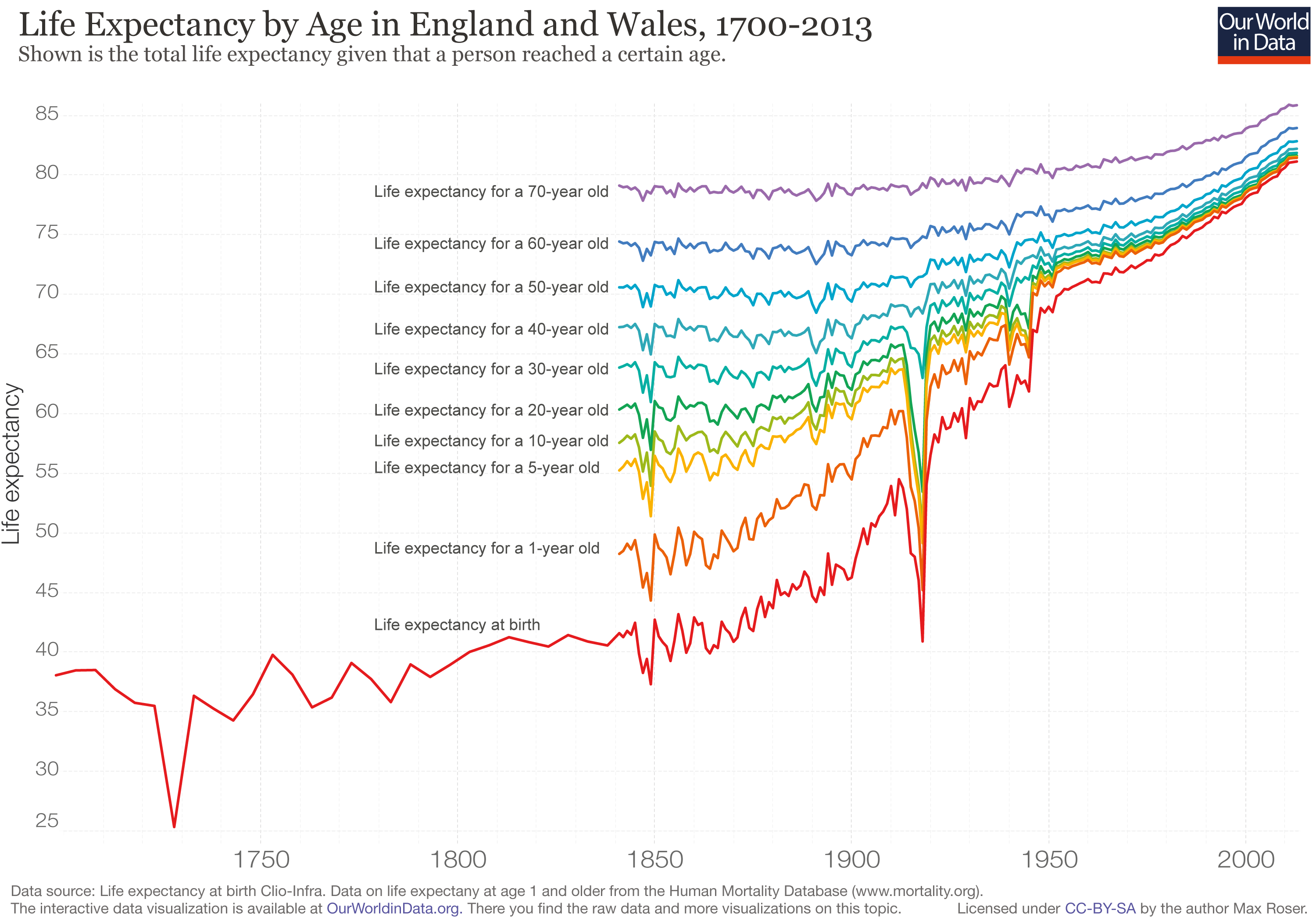
Starting about 1300, productivity began to rise and with it came a remarkable transformation in life. In the 18th century, life expectancy in England was about 35 to 40 years and now it's about 80.  Incomes are up about 30X from when Shakespeare was buying ink. What happened in England was fairly representative of what happened in the US, Canada, Germany, France and the rest of what we now call the West.


Change in income from century earlier
Since the 1700s the median income for each century has steadily gone up. From 1700 to 1900, per capita GDP tended to be about 62% higher than it was a century earlier. That was the reward for creating more capital and making it more productive. From 1900 to 2000, per capita GDP tended to be about 158% higher than it was a century earlier. That was the reward for creating more knowledge workers and making them more productive. So far this century, per capita GDP tends to be about 250% higher than it was a century earlier. This is the result of continued gains in capital, knowledge workers and their IT, and - most importantly for this century - the increasing power of entrepreneurship.

The West started this parade but it no longer leads it. Singapore has higher per capita GDP than the US, England, or Germany. There is nothing uniquely British about industrial economies or uniquely American about entrepreneurial economies. Anyone can lead this parade but why did the West start it? I think it's because of a unique approach the West took to its defining institutions.

Social invention is an overlooked component of progress. Banks, corporations, and nation-states matter as much in this story of progress since 1300 as trans-Atlantic ships, steam engines, and computers. The very notion, though, that these institutions are merely tools - no different than engines or electronics - is what has made the West different.

People within the the West have taken three distinct approaches to institutions.

Social Conservatives and Social Inventions as Sacred
The first approach is the most obvious. You come to awareness as a small child, growing up with the wonder of a church, the splendor of a king, the wealth of a bank and when you become an adult you accept that this is the way things are. Realizing how instrumental are these institutions to your world, you fight to defend them as they are.

Social conservatives treat social inventions as sacred. These are the loyal Catholics who see in the Protestant Revolution a route to hell and social chaos. These are the royalists who see in challenges to the crown a tumult of conflicting claims for authority, a challenge to all that is sacred. These are the capitalists who see conspiracies in the Central Bank that "runs" things, feeling instead that the banker should be left inviolate and unregulated.

They are quite right that these institutions keep us from chaos. I personally feel like institutions - social inventions - are the simplest reason that we have more control over our lives than do the great apes.

Radicals and Social Inventions as Disposable
Radicals go to the other extreme. They are well aware of how awful the church or state or bank has been. The French Revolutionaries outlawed religion at one point. The Enlightenment was about science and rationality and religion was all about superstition and dogma; it had to go. Radicals knew the church was merely an obstacle to progress and had to go.

Whether it is atheists who want to eradicate the churches, communists who want to shut down financial markets, or anarchists who want to outlaw laws, the radicals quite accurately see all that is awful about these social inventions and want them gone.

They also don't have a clue about how important are these flawed institutions to civilization, to modern life.

The radicals and social conservatives are an important part of the conversation and should always be heard; left in charge, though, they'll only ruin things. They're important voices who should never actually be given power to change anything but instead should only have power to point out problems and make suggestions.

Power over these social inventions should instead be given to people who are not naive enough to believe we can live without them or naive enough to believe that they should be defended in some current or (more often) idealized past form.

Social Inventions as Tools
Progress has been made by the folks who see social inventions as tools. Not sacred things that need protection. Certainly not as disposable. Progress has followed from people who realize how important the church is to how people construct meaning and gain empathy and compassion, become more loving and happy even when life hits one with the inevitable tragedies of illness, death, financial setbacks or even wars and pandemics.

The ones who see church, state and bank as mere tools realize that - just as with cars or can openers - these tools are more valuable as more people are able to use and define them. "We are all priests," as Martin Luther claimed, or "All men are created equal," as Jefferson wrote express the sentiment of those who don't think that popes or kings should have a unique right to define the institutions that so define us.

And the social inventions as tools people are the ones who are unafraid to change these institutions to make them work better for who we really are and aspire to be than who we imagine our ancestors once were. A church is not sacred but it is precious. What does this mean? Everything about it should be challenged except for what it does for people; a church is more important than a juicer only because of what it makes. Fresh orange juice is lovely but meaning and compassion can make the difference between whether or not you even feel like it's worth it to get out of bed to make that orange juice.


The West has led the great parade of progress in no small part because it has treated its vital institutions as mere tools and subject them to challenge and redesign as if they were products no different than cars or radios. They're not sacred. They're not disposable. We've made progress by changing our relationship to church, state, and bank, making them tools for anyone rather than just popes, kings, and bankers. We will make progress again in this generation by making a similar shift in how we treat corporations, turning them into tools for employees to create wealth and jobs and not just tools reserved for CEOs (who, by the way, are also employees).  Freedom of religion, the spread of democracy, the American Dream and the popularization of entrepreneurship have treated - and will treat - our big institutions as mere tools. That orientation is essential to progress.

So why mention all this? Because in the wake of the Great Depression, extremists seized governments everywhere; fascists and communists took control and progress halted or reversed everywhere they did. Now, in the wake of the Great Recession, extremists are again gaining power.

On the left we have activists who see banks as evil. And on the right we have activists who see banks as sacred. The first group doesn't understand the importance of banks, the second group doesn't understand the importance of regulating them and subjecting them to a central bank. Those on the left aren't numerous enough in the states to spoil capital markets but those on the right actually are in Trump's government. Trump is moving to deregulate banks so that banks are tools for bankers and not the community, not for everyone. The social conservatives don't believe in Keynesian economics (most recent evidence of that is the fact that they protested deficits when unemployment was high and now want larger deficits now that unemployment is low) or monetary policy.

Social conservatives are also working to reverse democracy. In 1789, only white, property-owning Protestant men could vote. About every 50 years, another group gained voting rights until, by the end of the 20th century even minority women who rented could vote. Courts have repeatedly ruled that Republican efforts to reverse voting rights are actually targeted at reversing that, taking power from minorities and the poor to vote.

Finally the continued effort to impose a religious definition of when life starts (at the instant of conception) and dismissing any other reasonable definition is an attempt to encroach on freedom of religion, the freedom of women to follow their own conscience and belief about when sperm and egg become a baby.

Social conservatives are wonderful to have in a community. They remind us that family as an institution really does matter, that churches make lives better for so many, that banks and the state create order we would not have without them. We should listen to them. But social conservatives are better reminders than managers; put in power, they treat as sacred what any forward moving community treat merely as as tools that are best used by many rather than a few.

Prosperous and happy communities will continue to construct institutions that are tools that help people to create meaning and be compassionate. They may not even call these institutions churches - and that is part of the genius of lumping freedom of religion under the first amendment along with freedom of assembly, speech, and press, the realization that it is the freedom to form thoughts and express them that is at the heart of religious freedom.

Prosperous and happy communities will continue to construct institutions that are tools to allocate and create capital that helps to fuel progress in productivity and profits. Again, they may not even call these banks but they will be tools that make people richer and able to afford now what they cannot pay for until later.

Prosperous and happy communities will continue to construct institutions that are tools for governing, for creating policies that make their world safer, easier to navigate, and more likely to offer them lucrative options and freedom to live a life as they please - whether in the form of neighborhood planning boards or the UN or any level of government between.

Prosperous and happy communities will continue to construct and revise institutions that are tools for creating wealth and jobs, new technologies and new products and services and in the process of creating value for customers, suppliers, stockholders and the community.

And the communities that prosper the most will never pretend that these tools should be reserved for the elite. They will never pretend that they are not necessary. They will never pretend that they are anything but tools.

What has fueled progress for the West is treating these great institutions as tools. Every time we've instead treated them as disposable or sacred, progress stalls or even reverses.

10 July 2017

What Made - and Still Makes - Western Civilization Great


INSTITUTIONS AS TOOLS OR SACRED OBJECTS
The battle between social conservatives and progressives

In last week’s speech in Poland, Trump warned about a threat to Western Civilization. He mentioned “history” six times and spoke of          “the bonds of history, culture, and memory,” and “the bonds of culture, faith, and tradition.” Speaking for the right, Trump is proudly pointing to the West as having a superior tradition worth fighting for.
Douglas Murray, author of The Strange Death of Europe: Immigration, Identity, Islam, argues that the Left in Europe is essentially embarrassed to argue that their culture is really better than any other and authorities have actually looked away number of atrocities, including honor killings (families killing their own sisters and daughters because of their shame at who they’ve married) because it might seem racist to prosecute these as crimes.
So we have the Right arguing for tradition and the Left arguing for cultural relativism. The one would head backwards and the other would stand around awkwardly, apologizing for seeming to suggest that their ways are any better than that of any other people.
What seems to be missing is the appreciation for history without treating historical institutions as sacred or a culture as synonymous with race or nationalism (which it is not).
The West was seemingly the first to do something that set it apart and set it on the road to progress. This is worth defending.

INSTITUTIONS AS SACRED OBJECTS OR SIMPLY TOOLS
How we think about institutions defines our communities. Three ways to characterize the great institutions of the West like church, state, and bank are:

      Sacred objects that must be preserved: this the attitude of the social conservative
2.      Obsolete objects that must be eradicated: this the attitude of the radical
3.      Simply tools that everyone should have access to: this is the attitude of the progressive


The debate in the West today is between social conservatives and progressives. The radicals who in past generations argued to outlaw religion (as the French Revolutionaries and Soviets did), financial markets (as communists throughout the world did last century) and even the nation-state (as anarchists have) are largely ignored in today’s political debates. Institutions separate us from the other primates and the real argument is not over whether we should have them but how we should treat them.
The most defining revolutions of the West were led by progressives and transformed these institutions:

1.      Church - the battle between Protestants and Catholics that gave us freedom of religion between about 1300 and 1700
2.      Nation-state – the battle between royalists and revolutionaries that gave us democracy between about 1700 and 1900
3.      Bank - the democratization of financial markets that gave us the American dream between about 1900 and 2000


Each revolution turned a dominant institution ruled by elites into a tool used by the average person. These were not one-time events. For instance, democracy was a revolution but it took centuries more to extend it from white, property owning Protestant men to even 18-year-old minority women. Early forms of religious freedom just gave you a choice between Catholic, Calvinist and Lutheran, not the thousands of denominations and religions (including atheism) available today. Like economic progress, this social progress isn’t something that happens one year and then stops; it is on-going and progress is as dependent on social change as it is on technological change.
Social conservatives are more likely to wonder about the intentions of founding fathers. If you see institutions as tools, though, the idea of protecting them from change is about as odd as insisting that Rudolf Diesel or Henry Ford never intended for us to drive cars with cup holders or GPS. Even if true it’s irrelevant to those of us alive now.
It’s difficult to understand how visceral is the reaction to Trump without understanding how differently social conservatives and progressives think about our major institutions.

FREEDOM OF RELIGION
First amendment:
Congress shall make no law respecting an establishment of religion, or prohibiting the free exercise thereof; or abridging the freedom of speech, or of the press; or the right of the people peaceably to assemble, and to petition the Government for a redress of grievances.

As it turns out, freedom of religion, free speech, a free press and political activism are all intertwined. Our founding fathers had genius enough to see that and packaged them into the same amendment. All have to do with freedom of thought but started with freedom of religion.
In 1302, Pope Boniface issued a bull that asserted his lordship over all of Christendom. By 1648 the Treaty of Westphalia essentially took away the pope’s power to dictate religion to a ruler and the ruler’s power to dictate religion to the people. The battle for freedom of religion played out between roughly 1300 and 1700 and gave us terrible atrocities like the Spanish Inquisition and the Thirty Years War that killed about ten percent of Europe’s population before reaching a resolution.
Had freedom of religion merely brought peace, that would have been enough. There is more, though. Once you’re free to choose your beliefs, you might just choose to base those beliefs on scientific evidence rather than religious revelation. As it turns out, freedom of religion allows scientific thinking to flourish.
In the early 1600s, the Church put Galileo under house arrest; by the late 1600s, England made Newton the Master of the Mint. Freedom of religion enabled the rise of science.
Progressives see in Trump’s travel ban targeted at Muslims not just a challenge to freedom of religion, which is reason enough to be upset. They see it as an attack on freedom of thought. Trump “knows” that Islam is the wrong religion and that climate change is not real and that he’s being attacked by “fake news.” Social conservatives see Trump as protecting their true and sacred religion; progressives see him as attacking freedom of thought.


DEMOCRACY
The next big revolution played out between about 1700 and 1900. At its beginning monarchs had absolute power and by its end those monarchs were either constrained by law or had been removed. The nation-state had become a tool for the average person and not just the elites. Rule of law and a representative government are foundational to democracy and both continue to evolve.
Newton defined laws that could apply universally to any object, from planet to moon to apple. His friend John Locke argued for laws that would apply universally to any person, from aristocrat to merchant to laborer. Laws that governed the natural world and should govern the social world were a focus of the Enlightenment thinkers who inspired democratic revolutions.
When Trump asks the head of the FBI not to investigate his National Security Adviser, this is a challenge to the rule of law, taking us back to the old system of personal privilege. When he leads a task force to investigate voter fraud (that all studies suggest is nonexistent), he is actually moving to make voting more restrictive. (Although he does seem rather sanguine about foreign interference, even if he’s trying to block Americans without photo ID.)
The invention of the car was dramatic but no one with a choice between a Tesla and a Model T would choose to drive the T. Like the car, democracy continues to evolve. If 1776 was the moment Americans “invented” modern democracy it is worth remembering that voting rights continue to expand to include more people over time. It took 200 years before the 18 year olds we sent to war could vote.
The real question is, who should be able to define the policies that define the community they live in? Put differently, is the government a tool for anyone to use or is it reserved for just a few? Progressives and social conservatives have very different answers to this.

THE AMERICAN DREAM
The most recent of our great institutions to be made a tool of the masses and not just the elites is the bank (or, more broadly, financial markets that include credit and investment markets). This access has helped people to become more affluent and more able to define their own lifestyle.
The levels of consumption that enable individuals to pursue the American dream would not be possible without modern capital markets. Warren Buffet argues that his upper-middle class neighbors in Nebraska live better than John D. Rockefeller did roughly a century ago. The cars, smart phones, TVs, and polio vaccines the average American now has rely on vast amounts of capital. The billions it takes to produce and purchase this vast array of goods would boggle the mind of any adult living in 1900, even John D. Rockefeller.
Access to financial markets gives the individual access to the American dream and the credit card and 401(k) account might be the simplest symbols of this broadening of access. Keynesian economics is another element of this revolution.
One of Keynes most overlooked insights into capital markets was this: capital markets could reach equilibrium before labor markets did. In other words, it was possible for capitalists to stop investing before a community reached full employment. If capital markets were just tools for elites, communities would have to accept this; if they were to be tools for the masses, communities would have to adopt policies that changed this. Keynes gave us options for this.
Unemployment during the Great Depression hit 25%; during the Great Recession, it peaked at 10%. One big reason for the differences in severity was the application of Keynesian stimulus; Bernanke did all he could to prop up credit markets to encourage investment and consumption. Like church and state before it, the bank has been made a tool for the average person. Interest rates were used to maximize employment, not returns to capital.
Social conservatives don’t like the Federal Reserve or its charter to subject financial markets to larger goals like employment. Again, as with church and state, they feel that what we’ve inherited is sacred and should not be changed. For them, Keynesian is a bad word. The battle between social conservatives and progressives over banking regulations and Federal Reserve policy often seems obscure but there is a reason that bank is the first part of bankrupt. The consequences of getting this policy wrong are severe.

INSTITUTIONS AS TOOLS
For centuries, progress has followed from letting more people have access to these great institutions, using them as tools for their own benefit. Life got better when our founding fathers extended the use of government from just aristocrats to landed gentry; it got better again when it was extended to women in the early 20th century and to minorities in the late 20th century. There is no evidence that progress now lies in the opposite direction, in restricting rather than broadening access to freedom of religion, democracy, and the American dream. The more that people have been able to use church, state and bank as tools for their own lives, the better the world has become.


17 April 2017

Why Democracies Never Move as Fast as Business, Science, Technology or Culture

Politics is likely to progress at a glacial pace compared to every other important way that the modern world is defined and created.

Architecture, music, business, science, athletics, engineering are all examples of fields that are defined and furthered by elites, by people who are in the top 1%. You don't have to get 55% of your population to master genetics in order to enjoy the benefits of genetic engineering. If even 1% of your population becomes skilled in genetic engineering, you can see transformative benefits.

By contrast, political policy and philosophy in a democracy depend on the majority. It's not enough for an elite few to gain special compassion or policy wisdom. Whatever story encapsulates this compassion or wisdom has to translate into the language of the crowd.

We are motivated by impulses that we don't really understand, impulses like the ones that make TV reporters, crowds and columnists cheer bombing raids, impulses that make us more distrustful of people with different coloring than us, impulses that make us more likely to empathize with someone beautiful with a petty need than someone ugly with a great need. Worse, we live in and depend on systems as complex as global climate, local ecosystems, a global economy and local housing market and our understanding of these systems is at best partial and at worst distorted. Even the best among us take on policy questions with some mix of distorted personal judgments and poor systems appreciation. And it is not our best who determine votes: it is the 51%.

It's a scary combination. Our technology advances at the speed of the top percentile and our policies advance at the speed of the 51st percentile.

08 November 2016

You Can't Praise Democracy Without Praising Those Other Idiots

We all are subject to the conceit that our own intelligence and morality is superior. And it's one of the reasons that so many people are afraid of what democracy will bring. It's stylish to decry the stupidity of "them," a group that ultimately means people who don't vote like us.

One of the many miracles of economics is that it coordinates the efforts of strangers. People I don't even know helped to make my shirt and my computer. They got money from me, a person they don't even know.

Democracies are similar to markets in that they enable strangers to agree to policies.

Democracies flourish for the same reason that markets do: it let's the common person choose. Ultimately our government - like our malls and farmer's markets - is shaped by individual choice. No system has done more to sustain innovation and progress. As it turns out, those [liberals / conservatives] who horrify you are smarter than you think and they care as much about the country as you do. You're not unique in your intelligence or altruism. Nobody is. Inevitably there are unintended consequences of policies and laws and inevitably there is someone who irritates you who points that out. That's why you are not the only one we let vote and why we let so many other people vote. They may be idiots but they make you smarter.

There are problems with democracy. For one, I believe that systems do so much to define our world that we need to make systems thinking as common and as required as reading. Thomas Jefferson thought education was essential to a functioning democracy. Today, a good education should emphasize system dynamics as much as it does grammar or multiplication. Democracy is impossible with an illiterate population; it's problematic with a population that doesn't appreciate or understand systems. (What do  I mean by systems? Ecosystems. Economies. Financial systems. Education systems.) This and other problems with democracy can be addressed though.

Also, elections are also terribly contentious. And for good reason. We are one nation but on election days we settle the current argument about how we'll define that nation. That's not a trivial conversation or one we're happy to lose.

That said, there is no substitute for the voice and values of the people. And that is why we have democracies.

Today is a happy day.

02 February 2010

The Difference Between Experts and Expectorate

"McCain was in communication with Bernanke and Paulson, too, but to less useful effect. In one exchange with the Fed chairman, McCain compared the causes of the crisis to some recent management troubles at Home Depot. It's kind of like that, isn't it? he asked Bernanke. No, it's not, a flabbergasted Bernanke replied.
[p. 381 of Game Change by Heilemann and Haperin]


When even the man who came close to becoming president doesn't understand the difference between macro and microeconomics*, I suppose I ought not to be so dismayed by what we see among the talking heads and the general public. Of course there is nothing unique about the dismissal of economic experts. The public has rejected the claims of experts from domains as varied as astronomy (well, now that we have pictures we accept the notion that we're hurtling through space at high speeds in spite of the fact that our hair is not blowing back every time we stand outside), climate change, evolution and medicine.

Perhaps in the future, we'll have a series of questions one has to answer about what best we know. It seems probable that we'll know more and better in the future and some of that will refute what best we know now. But I have little respect for people who reject the claims of experts until they can first explain those claims. If you understand current science and theories on these topics and THEN choose to reject them, good enough. Your rejection I can accept. If the only thing you know about what the experts assert is that they are wrong, whatever you're expressing doesn't really even qualify as an opinion: it might just be gas or, well, expectorate.

So, what about a new phase of democracy? We make people take a driver's test before they can get a license and yet bad policy is more dangerous than bad driving. Perhaps we ought to give out different levels of voting license to our representatives in Congress. On some things, anyone can vote. On other issues, one needs a special license. And again, you don't even have to agree with the conventional wisdom - you just have to understand it.

The making of policy is wonderfully public. This is good. Or can be, if the public and their politicians knew when they didn't know. Sadly, too many take Palin's approach.
"Palin was waging a persistent internal crusade to reverse one of the [McCain] campaign's major strategic decisions. ... When her traveling chief of staff, Andrew Smith, pointed out to her that McCain, Schmidt, and Davis had reached their conclusion on the basis of complex calculations involving the polls and the budget, Palin simply shrugged and uttered one of her signature phrases: 'I know what I know what I know.'"
[p. 409 of Game Change by Heilemann and Haperin]

One of my favorite thinkers, W. Edwards Deming, said you could trust a man who knows his limitations. It seems that we could say the same thing about a polity and its media and representatives.

* The difference between macroeconomics and microeconomics is this simple: when Keynes helped to define macroeconomics he essentially said that the whole (the macro) economy has characteristics different from its parts (the microeconomy). Implied in this is the use of fiscal and monetary policy to stimulate or dampen demand but chronic deficits are no more essential to Keynesian economics than atomic bombs are to Einstein's theory of relativity. Keynesian economics does, however, suggest that regional, national, and even global economic policy will need to depend on something other than a laissez faire approach to economics or simply relying on agents within the economy to do what seems best from their perspective.

23 September 2008

Why Not Program-Specific Government Bonds?

Scott Adams of Dilbert fame makes an interesting suggestion at his blog. What if the rich were given an option to, say, buy homes with bad mortgages and required to rent them out? It would sort of be a tax but it would offer the rich the hope of a return, taking some of the sting out of "paying" extra taxes.

But what if investors had more options than a simple government bond? We have 37 kinds of ketchup but only one kind of federal bond? Why not a bond that finances alternative energy and another that finances war and another that finances transportation infrastructure? It would be even better if the bonds not only paid the traditional interest rate but offered a premium based on the performance of what they financed.

For example, let's say that there was a bond for community college programs to train trades people for plumbing, electrical, and carpentry work. If graduates from the program were employed in the trades at a rate of 85% or higher (to pick a number out of the air), you would get a premium of 1% on your annual return. If the rate of successful placement were 96%, you would get a 4% premium. The more promising you thought the program, the more likely you'd be to invest.

This would put markets to work as a means to finance government programs, letting investors "vote" on programs they felt would yield better returns, would create more value for the community.

And once that is in place, I see no reason why we couldn't go further with this, allowing taxpayers to indicate, when filing taxes, where they would like their money to go. I suspect that the Pentagon would get less and the National Science Foundation or National Institute of Health would get more. And I suspect that future generations, who would benefit from this research and investment, would thank us.

30 May 2008

A New Kind of Conversation - A New Kind of Democracy

In the old media, people chose between various options, magazines like the Nation or the New Republic, for example. In the new media, people write their own material on blogs rather than simply commenting on the essays of elites.

In the old democracy, people chose between various options, candidates like George H. Bush and Michael Dukakis, for example. In the new democracy, people will collaborate to create their own policies, rather than simply griping about the proposals of elites.

There are a variety of technologies that will enable this. Publishing and communication no longer needs to be routed through central points like the local newspaper or TV and radio stations. The Internet is going to be essential to this at some level. But the real advances in technology have little to do with hardware and a great deal to do with our ability to create a conversation.

Creative dialogue ought to be the fuel for policy formulation. Simply learning what is going on in people’s lives and, rather than imposing some notion of how or why they deserve their fate or are victims, creating a conversation about what is and what is possible. Currently, with the emphasis on elections, this kind of conversation is nearly impossible for candidates. It’s hard to formulate policy that works when you’re busy imposing your view of the world onto people’s consciousness.

The real catch 22 for policy formulation is the seeming intractability of reality from perception. A rock doesn’t much care about your perception of it: thrown at the proper trajectory, it’ll smack you in the side of the head. By contrast, social realities are rooted in perceptions. You’ll see it when you believe it, is the quip. David Bohm said that most apparent problems were actually paradoxes that traced back to a root paradox about self awareness.
“However, when one beings to think about himself , and especially about his own thoughts and feelings, then if one observes carefully, he will find that this approach leads to a paradoxical pattern of activity. The paradox is that whereas one is treating his own thinking and feeling as something separate from and independent of the thought that is thinking about them, it is evident that in fact there is, and can be, no such separation and independence.”


The technological innovation that is needed for the next major advance in democracy is the ability to suspend advocacy. The next democracy will have more to do with conversations than speeches. The point is not to win the argument; the point is to adapt and adapt to reality.

Lest you too quickly scoff at this possibility, we might be moving in this direction. McCain has proposed regular sessions with Congress akin to those argumentative bouts between the British Prime Minister and Parliament. Obama has said that he will post all non-emergency legislation online for five days, soliciting comments from anyone and everyone before he would sign it. These are small steps, but they seem to me indicative of the kind of promises candidates must make to get our vote.

When groups begin to convene to formulate and implement policy, we have a chance for policy to become more important than campaigning. Maybe the best part about this is what it suggests about a shift in power.

Russell Ackoff makes the distinction between "power over" and "power to." If you have power over someone, you can restrain them from doing certain things. You keep them from polluting or driving on the wrong side of the road. If you give people power to, you enable them to do certain things. They can make money in jobs you prepared them for with education or live longer in spite of cancer that you cured.

As democracy is now practiced, it seems to much focused on power over - who is going to win, which party is going to rule? In this alternative democracy, the focus can land where it ought: on power to.

25 March 2008

It Is Time to Sue George Bush for Policy Malpractice

But I don't understand why these sharks just thrash about on the floor and then die. They were so powerful in the ocean.

Tim Hackler asks, Is democracy a natural state of mankind?, in a provocative editorial. He offers this:

Here is a thought experiment to put things in perspective. Imagine a map of the world in 1800. color in all the countries that took part in or were directly influenced by the Enlightenment (let us say, England, Scotland, France, Italy, Germany, Austria, Czechoslovakia, Slovenia, Belgium, Luxembourg, Switzerland, Greece, Spain, Portugal, the Netherlands, the US, Canadian, and the Scandinavian countries).

Now jump forward two centuries and color in all the countries with working democracies (as defined by the Economist Intelligence Unit). It is virtually the same map. Every one of those 22 nations (or their derivatives) today has a working democracy. And how many countries have a fully functional democracy but were not among, or did not spring from, those 22 countries? Just one – Japan.


I completely agree that Enlightenment thinking is predecessor to democracy - or at the very least, it needs to be coincident with it. A particular way of thinking about the world based on reason and data is necessary as a foundation for one particular version of that - the use of reason and votes in the formulation of policy.

But as with the shark, context is often the least visible thing in the equation - yet it is crucial.

The whole notion of evolution, though, depends on context. The environment determines what works and what does not – natural selection is a slow but appropriate response to the environment. Without an environment, natural selection has no traction, no relevance. The finches immortalized by Darwin’s study were different from one another because the food they ate – their environment – was different.

It is likely no coincidence that the man who though he could kerplunk democracy down into Iraq without a context like Enlightenment thinking is a man who is disdainful of evolution. “Let there be democracy,” George declared, but to no avail. He was speaking into a void.

It is not bigotry to point out that different societies are at different stages of development. It says nothing about a 6 year old’s intelligence to suggest that she is not ready for college. It says nothing about Iraqi’s potential to say that the country is not ready for Western-style democracy.

At least 150,000 Iraqis have been killed since our invasion. About 4.2 million Iraqis have been displaced by the violence (a comparable percentage of the US population would equate to nearly 2 million dead Americans and 50 million American refugees.) Now, we've reached the milestone of 4,000 dead American soldiers.

Some brave souls continue to work on reviving the shark. It’s not obvious, though, what they can do without water. If you bring a shark into the forest, you can pretty much guarantee casualties. This, more than anything else, will be George Bush’s legacy. When future generations talk about his lack of environmental awareness, they could just as easily be talking about his foreign policy as his energy policy.

30 November 2007

A Small Flaw in Democracy

Bernard spoke from behind his newspaper. “We’re a gloomy lot, aren’t we?”

“We?” I said, looking up from my game of solitaire. “Who is ‘we’? I’m having nothing but fun here. You’re the one reading the news.”

“We have cures for baldness, erectile dysfunction, we eat like kings .... Yet what do we do with this miraculous capacity for speech?”

“Complain about people complaining,” I guessed.

“You twit,” he said before continuing. “You know what we’re complaining about today?”

“Slow service,” I said, looking for our waiter.

“No,” Bernard said, staring at me. “We come here because the service is leisurely. It gives us time to read the paper and talk.”

“Oh. Right.”

“I’ll tell you what we’re complaining about. The projection that social security won’t be able to pay full benefits in the year 2042.”

“Well, I think that’s something that should be addressed.”

“A projection 35 years into the future by the same pundits who can’t tell me what my portfolio is going to be doing 35 hours from now? We’re complaining about this?”

“It’s like climate change,” I said. “These are big problems that take a long time to change. You can’t be cavalier about the problem just because it’s a long way off.”

“Look at me,” Bernard said.

I looked. He’s in good shape for man close to 80. Lean. Intelligent eyes. Wrinkles. Thin hair where hair is left at all. Lots of wrinkles.

“I look like a man who is worried about 2042?”

Come to think of it, his skin looked a bit like parchment. He had a point.

“This is the problem with democracy,” Bernard said. “To cast an intelligent vote you need time to research the issues. Everyone but us retired folks is too busy to read anything. The rest of you, you’re busy doing whatever,” he said, gesturing dismissively at my game of solitaire. “So, you leave your future in the hands of people who have no future.” He turned the page. “Whoever thought that was going to work?”

16 October 2007

As American as Baseball & Apple Pie


Dennis Kucinich and Ron Paul are certainly the most interesting and provocative candidates running for president. I love that Kucinich wants to set up a Department of Peace and that Paul wants us to stop acting like an empire. They have no chance of winning, though, and for good reason. Liberals are more sensitive to market failures and more willing to step in where businesses fail. Conservatives, by contrast, are more sensitive to government failures and are more willing to stop subsidizing failed government programs. But some liberals simply go too far and just don't trust markets, ever. Same goes for some conservatives and government programs.

It's not true that Ron Paul wants to abolish all government or that Dennis Kucinich wants to abolish all businesses. But they both stray close enough to such positions to have earned Americans skepticism and distrust. Kucinich's health plan isn't just an attempt to step in to rectify market failures. He makes explicit his distrust of markets when he says that companies ought not to profit off of illness. It would be hard to pack more misunderstanding about capitalism into a single sentence. Ron Paul basically wants to do away with all government programs save defense. (Okay, so I'm exaggerating, but not by much.) He wants to keep us from the pitiful lifestyle of the Swedes (where the tax burden is over 50%) and imitate instead the enviable lifestyle of the Mexicans (who suffer a tax burden of only 18.5%).

The reason that Paul and Kucinich have never gained much traction in the polls is that the average American - however much he's become disgusted with businesses or government - still fundamentally believes in markets and elections and the results they produce. Most of us have caveats about such beliefs, but very, very few Americans believe in doing away with government programs or company profits. For that reason, the two men who carry suspicion of these two institutions the furthest have found themselves the furthest from the center of the American polity and of any hope for victory. For Americans, disgust with government programs and profitable companies is like disgust with family; it's inevitable but not to be construed to mean they're ready to be estranged. For all their kvetching, Americans love their markets and elections and are not only willing to live with the results but are unwilling to live without them.

03 October 2007

Mob or Majority?

The only thing that keeps the majority from becoming a mob is the rights of the individual. Here are three tidbits from O'Reilly, Goleman, and Milgram to argue my case.

I’m at the gym the other day, getting news without sound. Bill O’Reilly is on. A graphic flashes up, something to the effect that “Was it proper that the police tasered that guy at Florida State who asked a rambling question of John Kerry?” The poll results? 75% said yes, and 25% said no. The vast majority of Americans agree that it makes sense to inflict pain on a guy who they find annoying.

Daniel Goleman, in his new book Social Intelligence, tells the story of 3 year olds in a study. Stage one, the 3 year olds are exposed to adults playing a game by clearly observed rules. Stage two, puppets come into the room and begin to play the same game – but make obvious mistakes. The reaction of the children? They begin to clamor for the puppets to behave properly. Not only do the children learn the rules, they seem to have a compulsion to foist those rules onto others, ensuring social conformity. (Goleman speculates that the basis for this might be genetic.)

In a famous study at Yale, Stanley Milgram learned how willingly individuals become Nazis. In the wake of World War 2, wondering at how an entire nation could become willing accomplices to evil, Milgram set up a study that appeared to have two volunteers – one of whom inflicted pain on the other in a study of memory. One volunteer would read a list of paired words, like “bird,” and “nest.” The other “volunteer” would be tested on memory, as the first volunteer would read “bird” and the second volunteer would be expected to say “nest.” If the second “volunteer” forgot the response word – or didn’t say anything – the first volunteer would administer a shock. The shock administered would steadily increase in voltage, up to 450 volts, an amount marked “dangerous.”

As it turns out, the second “volunteer” was actually an actor. The shock was simulated. And as the shock increased in intensity, this actor would scream in pain, would begin to complain about a bad heart, and would eventually not speak at all. The actual volunteer could continue to administer the shock even if the actor was not responding – a penalty for not remembering.

Milgram expected (as did almost everyone he asked) that only about four-tenth of one percent of the population would ever take the shocks all the way to the max level of 450 volts. As it turns out, more than half did. (Since duplicated dozens if not hundreds of times across countries and age groups, the results of Milgram’s study indicated that the average person would, indeed, be a willing accomplice to evil even if they might not initiate it.)

All this to say, O’Reilly’s data might indicate that we still haven’t done a particularly good job of over-riding the impulse to conform and to enforce conformity. As a guy whose ability to fit in has always been spotty (at best), this tendency of groups frightens me.

The real brilliance of the founding fathers was not just that they embraced democracy. Knowing the psychology of groups, they went further: they granted civil rights to ensure that the individual was protected from the democratic majority eager to coerce conformity.

17 June 2007

Oops! We Must Have Shipped Iraqis Democracy 1.0

Those of you who have installed old versions of software know that you can find yourself battling bugs that have been addressed in later versions.

The problems in Iraq, the insurgency and the fighting between Shiites and Sunnis, probably have to do with the social dynamics in Iraq. Or, it might have to do with the version of democracy that we've shipped into Baghdad.

Not having used the "establish democracy" function of our version of democracy in centuries, we forgot that our version includes ethnic cleansing: a little bug that the West has tried to design away, with varying levels of success, in subsequent Democracy releases. Sadly, someone in DC forgot to ship the Iraqis one of the newer versions.