In analysis, you have two kinds of errors: false positives and false negatives. [This blog post was inspired by Phil Rosenzweig's piece for Edge.org.]
You will make errors. You'd like to think that you put only guilty people in prison or only buy stocks that will steadily increase your wealth but .... the fact is that we're bad at understanding the past much less predicting the future.
So, given that you will make errors, it is important to ask in which direction you'd rather err. Would you rather put 10 people in prison who deserve to go free or put 10 people on the streets who deserve prison? Would you rather frequently pass on buying a stock that doubles in value again and again or frequently buy stocks whose value collapses? When you adopt an approach to investing, criminal trials or developing policy, in which direction would you rather err?
Rosenzweig points out that the type of error we would prefer depends on the context. When it comes to science, we want to avoid a false positive. The data has to be very clear for a majority of scientists to say, "We have a new theory." You don't rewrite textbooks to accommodate one study. The same thing in a trial. We need to be very certain that a person is guilty before we put them in prison for a decade.
By contrast, in business you may be more accepting of a false positive. "We think this new market has great promise," your marketing team says. An engineer on your team tells you that he thinks he can solve the design problem that has been creating big warranty costs for the company. Even if the likelihood of them being right is low, it could be perfectly rational to invest in that new market or technology. If you lose one million dollars in bad investments 9 times during the year but on the 10th time you crack open a billion dollar market, your company wins. If you wait for proof that the market is profitable ... well, it will be your competition who provides that proof, not you. The data that proves it is a good investment comes too late to inform your decision about whether or not to invest.
You don't want 9 good guys in prison in order to make sure that you keep one bad guy off the streets; you do want to lose $10,000 in 9 bad investments if it means that you make $1,000,000,000 in 1 good investment. Sometimes you want to avoid false positive sand sometimes you want to avoid false negatives.
So where does government policy fall? Do we prefer false positives or false negatives?
Dee Hock was the founding CEO of VISA, the man who dreamed up the modern credit card. He said that every policy has intended effects and unintended effects; you always get the unintended effects. Whatever you try in government policy has a very good chance of leading to some behavior you hoped to avoid. If you make heroin illegal, you drive up its price which can drive up the crime rate as users steal to pay for it. If you force companies to file more paperwork and conduct more studies before allowing them to go public, your community ends up with fewer startups. Even knowing this you may decide it is better to make heroin illegal or save investors from scams masquerading as legitimate startups, but you should anticipate such consequences from policies. Expecting to get policy right on the first attempt is like thinking you can write code without debugging. I think that argues for embracing policy as something more like investments than criminal trials; we want to try 9 things that fail in order to try the one thing that will make our communities better.
Progress does not mean getting rid of problems. Progress means solving better problems. In one century parents face the problem of getting their kids enough to eat to stay alive. In the next century parents face the problem of getting their kids to eat healthy. They are both problems but the second is so very, very much better than the first. Good policy isn't necessarily predictable and it certainly isn't flawless; it can, though, bring us to the point of dealing with a better set of problems. If you don't try new things your problems never get better.
One other reason to treat policy as a place where it is better to have false positives is that, ultimately, our standard of living is a product of our knowledge. In David Deutsch's fascinating book The Beginning of Infinity, he makes the argument that it simply isn't true that the earth is - alone among the places we know in this universe - the one place that is safe for us to inhabit. Or, rather, he points out that the claim is not that simple. As it turns out, most of us live in places where we'd die without knowledge of how to make and wear clothes, shelter, heating or air conditioning. We don't actually live on a particularly friendly planet, he points out, so much as we now have knowledge that allows us to live in hostile places like Fairbanks, Alaska or Phoenix, Arizona. With even more knowledge we can figure out how to live in even more hostile places like the moon or Mars. Where we can live or even how well we live is a product of knowledge. We know how to combat infection now, so our lives are longer. We know how to provide potable - that is, safe to drink - water straight out of a tap to anyone in the country; that simple knowledge may have done more to extend life expectancy than all the very cool drugs discovered in the last century.
One big reason to try things that may not work is that we will create more knowledge. Curiously, the very fact that policies have unintended effects is one more reason to try new things: every test or trial has the potential to reveal new knowledge. Again, it is the accumulation of knowledge that will make our lives better. Experiences that result in new knowledge can fuel progress.
One last thing. Our condition has changed in recent centuries in ways that suggests that we should more actively make mistakes. If all you have is $1,000, you should probably invest that $1,000 cautiously; if you have $10,000,000, you should take some risks with $1,000 increments. When a bad move is likely to result in starvation, it's a pretty good idea to avoid false positives, to insist on certainty and err towards clinging to traditions. You can't blame people from 1500 for wanting certainty. But as we gain prosperity and margin for error ... well, errors are easier to make. Our condition is better than it was centuries ago; that should make us more bold in trying new things.
A huge percentage of scientific research does not result in anything cool or useful. A majority of business startups fail. Yet a prosperous community that is making progress will have lots of both kinds of activity going on, innovation and entrepreneurship that is more likely to fail than succeed. Government policy should be treated more like these domains than the courtroom where we look for overwhelming proof before moving forward. When it comes to progress, it is less about looking at existing evidence than it is about creating new evidence, less about what we have proven than what we might prove.

R World (Ron Davison muses aloud)


26 April 2018
Macron May Have Just Emerged as the New Leader of the West
Given that Trump has retreated into fear and nationalism, Macron may emerge as the new leader of the West.
In April of 2016, Macron founded his En Marche party.
The full transcript is here:
http://www.elysee.fr/declarations/article/transcription-du-discours-du-president-de-la-republique-emmanuel-macron-devant-le-congres-des-etats-unis-d-amerique/
Clinton, Dubya, and Trump were all born within months of each other. It seems that we're past the expiration date on that "boomers as leader" model and I'm getting excited about the prospect of turning things over to the younger generation.
Vive la France!
In April of 2016, Macron founded his En Marche party.
In April of 2017, Macron won the election that put him against Marine Le Pen in the May runoff election to become president of France.
In April of 2018, Macron addressed US Congress in the most articulate defense of post-WWII West since Trump was sworn in.
The guy just hit 40 in December.
To appreciate what a surprising character he is, consider this:
The American Macron is 37 and still 18 months away from starting her new political party before winning the 2020 presidential election.
To appreciate what a surprising character he is, consider this:
The American Macron is 37 and still 18 months away from starting her new political party before winning the 2020 presidential election.
Macron spent a fair bit of the speech articulating his beliefs which should have made most audiences say, "Yeah, well obviously" just 5 years ago but today smack of controversy because of what Trump has forced on us. Here are a couple of passages that deserve consideration.
I believe in democracy....To protect our democracies, we have to fight against the ever-growing virus of fake news, which exposes our people to irrational fear and imaginary risks. ...Without reason, without truth, there is no real democracy -- because democracy is about true choices and rational decisions. The corruption of information is an attempt to corrode the very spirit of our democracies.
I believe in concrete action. I believe the solutions are in our hands.I believe in the liberation of the individual, and in the freedom and responsibility of everyone to build their own lives and pursue happiness.
I believe in the power of intelligently-regulated market economies. We are experiencing the positive impact of our current economic globalization, with innovation, with job creation. We see, however, the abuses of globalized capitalism, and digital disruptions, which jeopardize the stability of our economies and democracies.I believe facing these challenges requires the opposite of massive deregulation and extreme nationalism.Commercial [Trade] war is not the proper answer to these evolutions. We need free and fair trade, for sure. A commercial war opposing allies is not consistent with our mission, with our history, with our current commitments to global security. At the end of the day, it would destroy jobs, increase prices, and the middle class will have to pay for it.I believe we can build the right answers to legitimate concerns regarding trade imbalances, excesses and overcapacities, by negotiating through the World Trade Organization and building cooperative solutions.We wrote these rules; we should follow them....
I believe in building a better future for our children, which requires offering them a planet that is still habitable in 25 years.
http://www.elysee.fr/declarations/article/transcription-du-discours-du-president-de-la-republique-emmanuel-macron-devant-le-congres-des-etats-unis-d-amerique/
Clinton, Dubya, and Trump were all born within months of each other. It seems that we're past the expiration date on that "boomers as leader" model and I'm getting excited about the prospect of turning things over to the younger generation.
Vive la France!
22 April 2018
You'll Always Be an Idiot at Most Things
Jeff Bezos is the world's richest guy, worth $112 billion at age 54.
In his annual letter as CEO of Amazon, he shared some advice about high standards that struck me as valuable.
It is worth reading in it's entirety here:
https://www.sec.gov/Archives/edgar/data/1018724/000119312518121161/d456916dex991.htm
One of the questions he asks is
I would go further and word it a little differently. You will always be awful at most things.
Let's say that you are an eloquent, wonderful speaker. It would be widely impressive if you were a great speaker in two or three languages (most people do well to pull off eloquence in one) but regardless, you will be an absolutely hopeless speaker in the vast majority of the world's languages. You're limited even within your own domain of speaking.
And let's say that you're wonderful at toplologic phases of matter within math theory. Generally speaking, the closer you are to world's best the more specific is your knowledge. If you're an expert in one math domain you are likely only okay at other math theories or speed of computation, say. And of course you will eventually hit academic areas (medieval history, epigenetics, etc.) in which your knowledge and mastery are woefully short of the standards we'd expect of someone earning a bachelor's degree in that subject.
Even baseball players are rarely great hitters and great pitchers; such people come along about once per generation. The Angels have such a player in Shohei Ohtani, an incredible player who has an ERA of 3.6 and batting average of .333. He's amazing, but this is something I know: no NBA or NHL playoff team wants his help right now. Ohtani is terrible at most sports. (Well, terrible by world-class standards. You'd likely still be happy to have him on your team - any team - at a family reunion picnic.)
We're awful at most things, okay at a few, and - if we're lucky - wonderful at one or two.
So what does this mean? First of all, as Bezos points out, be humble. Secondly, know your limitations or trust the guidance of someone who does, someone who can tell you what you're great at and can do for a career and what you might just want to do for fun, what to improve at and what to simply abandon. Third, realize that you will always need other people; they can do well things that you can't do at all. Fourth, be careful about believing that your success in one thing predicts anything about success in another. And that brings me to Trump.
Trump might be the most gifted media magnet of my lifetime. He grabs our attention and holds it. 40% of Americans love him and 60% hate him but everyone stares aghast. He drove up the ratings of the very media outlets he attacks, simultaneously working to undermine their credibility by hollering "fake news!" while driving up their ratings by causing us all to tune in to see what crazy things he's said and done and whether today he has moved closer or farther from criminal charges. He's a natural genius at media.
Sadly for us citizens, high standards are domain specific. Trump doesn't understand how dependent are modern markets on trade, immigration, and disruption. He dismisses science and experts as less credible than his gut or the TV pundits he finds most appealing. This natural genius at media is a natural idiot at policy.
Trump should be both an example and a warning for all of us. We all should aspire to be even 1% as good at something as Trump is at media. And if we should be lucky, talented, and obsessed enough to pull that off, we should immediately remember that no matter how good we are at that one thing, we are still an idiot at most things.
And this is kind of cool. It means no matter how good you are, you can admire someone else - billions of others - as better than you. Even if you are Shoehei Ohtani or LeBron James, you could literally be tutored on millions of topics by other people who have mastered things that you won't do, much less be bad at.
So go do your thing. Become great at it if you can. And then be humble about it because, you're an idiot at most things. As Deming said, "You can trust a man who knows his limitations." And your limitations are nearly limitless.
In his annual letter as CEO of Amazon, he shared some advice about high standards that struck me as valuable.
It is worth reading in it's entirety here:
https://www.sec.gov/Archives/edgar/data/1018724/000119312518121161/d456916dex991.htm
One of the questions he asks is
whether high standards are universal or domain specific. In other words, if you have high standards in one area, do you automatically have high standards elsewhere? I believe high standards are domain specific, and that you have to learn high standards separately in every arena of interest.
Understanding this point is important because it keeps you humble. You can consider yourself a person of high standards in general and still have debilitating blind spots. There can be whole arenas of endeavor where you may not even know that your standards are low or non-existent, and certainly not world class. It’s critical to be open to that likelihood.
I would go further and word it a little differently. You will always be awful at most things.
Let's say that you are an eloquent, wonderful speaker. It would be widely impressive if you were a great speaker in two or three languages (most people do well to pull off eloquence in one) but regardless, you will be an absolutely hopeless speaker in the vast majority of the world's languages. You're limited even within your own domain of speaking.
And let's say that you're wonderful at toplologic phases of matter within math theory. Generally speaking, the closer you are to world's best the more specific is your knowledge. If you're an expert in one math domain you are likely only okay at other math theories or speed of computation, say. And of course you will eventually hit academic areas (medieval history, epigenetics, etc.) in which your knowledge and mastery are woefully short of the standards we'd expect of someone earning a bachelor's degree in that subject.
Even baseball players are rarely great hitters and great pitchers; such people come along about once per generation. The Angels have such a player in Shohei Ohtani, an incredible player who has an ERA of 3.6 and batting average of .333. He's amazing, but this is something I know: no NBA or NHL playoff team wants his help right now. Ohtani is terrible at most sports. (Well, terrible by world-class standards. You'd likely still be happy to have him on your team - any team - at a family reunion picnic.)
We're awful at most things, okay at a few, and - if we're lucky - wonderful at one or two.
So what does this mean? First of all, as Bezos points out, be humble. Secondly, know your limitations or trust the guidance of someone who does, someone who can tell you what you're great at and can do for a career and what you might just want to do for fun, what to improve at and what to simply abandon. Third, realize that you will always need other people; they can do well things that you can't do at all. Fourth, be careful about believing that your success in one thing predicts anything about success in another. And that brings me to Trump.
Trump might be the most gifted media magnet of my lifetime. He grabs our attention and holds it. 40% of Americans love him and 60% hate him but everyone stares aghast. He drove up the ratings of the very media outlets he attacks, simultaneously working to undermine their credibility by hollering "fake news!" while driving up their ratings by causing us all to tune in to see what crazy things he's said and done and whether today he has moved closer or farther from criminal charges. He's a natural genius at media.
Sadly for us citizens, high standards are domain specific. Trump doesn't understand how dependent are modern markets on trade, immigration, and disruption. He dismisses science and experts as less credible than his gut or the TV pundits he finds most appealing. This natural genius at media is a natural idiot at policy.
Trump should be both an example and a warning for all of us. We all should aspire to be even 1% as good at something as Trump is at media. And if we should be lucky, talented, and obsessed enough to pull that off, we should immediately remember that no matter how good we are at that one thing, we are still an idiot at most things.
And this is kind of cool. It means no matter how good you are, you can admire someone else - billions of others - as better than you. Even if you are Shoehei Ohtani or LeBron James, you could literally be tutored on millions of topics by other people who have mastered things that you won't do, much less be bad at.
So go do your thing. Become great at it if you can. And then be humble about it because, you're an idiot at most things. As Deming said, "You can trust a man who knows his limitations." And your limitations are nearly limitless.
17 April 2018
James Joyce, Schrodinger, Multiverses and Virtual Reality
In 1939, James Joyce of Dublin released Finnegan's Wake, a stream of consciousness novel that suggested that each mind was it's own little universe and a community was collection of these parallel universes briefly connected by shared events and then almost immediately fractured again into tiny, independent streams by the different narratives we give to these same events.
In 1952, Schrodinger was in Dublin and after warning his audience that what he was about to say sounded lunatic, he said that his equations suggested that there were a variety of histories that had all happened, which David Duetsch suggests in The Beginning of Infinity was the introduction of the idea of multiverses.
It sounds fanciful but quantum physics suggests that there are parallel universes. Each time there is a choice point - you call either Mary or Prudence for a date - what actually happens is that there are now two universes that branch off from that choice; in one we trace the ripple effect of Mary rejecting you and in the other we trace the ripple effect of Prudence saying, "Yes! I will marry you!" And of course each of those paths has its own set of infinite ripples.
Virtual reality might result in a world where Joyce's notion of personal consciousness as its own virtual world would be given a new dimension. You don't just imagine a different world; you experience it.
Perhaps in that world one person lifts his hand to swing a sword, another to caress a lover, another to pick an apple, and each move is nonetheless synchronized as the players are unwittingly all working the same factory line even while they think they're in their own world. In this particular multiverse, the person who best understands how to create the technology that simultaneously maximizes coordination and individual initiative is the person who has the most wealth and power .... but of course what she will do that wealth and power that makes her feel any more special than her many minions slaying dragons in their world while assembling parts in hers is hard to guess.
23 March 2018
How Real Estate Has Made Trump's Economic Policies so Dangerous
Probably the most insidious way that real estate has shaped
Trump's mind is that it has given him a zero-sum worldview.
An acre next to the Empire State Building would have cost $90 million in 2006, 30,000X what an acre in Kansas costs. New York's real estate market is dominated by corporations and family wealth and if your grandfather didn't have the bravado or wisdom to buy an acre of Manhattan, you probably don't own one now. Jared Kushner and Donald Trump didn't move from Kansas as young men and buy acreage; they come from real estate families.
 |
| Trump Tower Chicago, photo from Ron Davison |
Dynasties and Development
If Angela Merkel loved Trump, it wouldn't noticeably change his odds of getting a Trump Tower Berlin. If Vladimir Putin loved Trump, it enormously changes his odds of a Trump Tower Moscow.
Real estate developers need permits and dictators are better able to provide those than democracies, and this is one of the simple, often overlooked reasons why Trump pays a disproportionate amount of attention to dictators rather than presidents.
Real estate also needs financing.
In 2007, just before the mortgage crisis bust, the Kushner family paid roughly $2 billion for 666 5th Avenue. It has caused them trouble ever since. Mueller is investigating Kushner family finances. (Jared's dad has already served time in prison.) For instance, the Kushner family met with Qatar for financing for their 666 property and later, after Qatar said no, Kushner worked with the Saudi's on a blockade of Qatar. Financing is key to success in real estate and Trump and Kushner have trouble getting loans from American banks, which also explains their fondness for dictators. (For more on these stories and Jared Kushner, listen to Robert Wright's interview with Elizabeth Spiers.)
This entanglement with foreign powers - from Russia to Saudi Arabia - is key to understanding how Trump and Kushner see politics. They aren't going to offend the entities who may be a source of loans or approvals for big developments. Presidents of a democracy cannot make you rich; dictators can.
The Magical Origins of Wealth
Homes in Detroit cost $44,600 and $1.3 million in San Francisco. For the same price, you could buy one home in San Francisco or 29 in Detroit, where you could sleep in a different home every day of the month.
People who bought an apartment building or couple of rental homes in San Francisco 30 years ago have "done well" in spite of the fact that what they actually did is no different from what people who bought real estate in Detroit did. Real estate is derivative; if it is located in a community that knows how to create jobs and wealth, its price goes up.
William J. Bernstein claims that the simplest predictor of home prices is the mortgage payments folks can afford. What someone buying or selling real estate does isn't the determinant of whether it sells for $50k or $500k; that price is determined by what the local community is doing to either create jobs that pay $15,000 a year or $150,000.
Had the Trump and Kushner families settled in Detroit and owned real estate there, they'd either be small time or even bankrupt as a result of borrowing heavily to buy property that dropped - rather than soared - in price. Given they had the good sense to be born into New York real estate families, they are rich. Or at least have really big mortgages.
If you own or develop real estate in a prosperous area, it's easy to think of wealth as something that just magically happens. Trump never mentions economic development plans that involve investment in R&D or education. In his mind, it is enough to simply deregulate and let economic development happen.
Zero-Sum
Probably the worst way that real estate has shaped Trump's worldview, though, is this: real estate is probably the most zero-sum industry in the US and success in it can easily drive a win-lose or at best win attitude.
The first economy, an agricultural economy from about 1300 to 1700, was land based and the easiest thing to see about an acre or oil well is that if you get it I won't. One of us wins and another loses. War and the emergence of standing armies, guns, cannons, and artillery defined a great deal of this time and the conquest of land was key to prosperity.
You were likely born in the third economy, an information economy from about 1900 to 2000. If I give you an acre and you give me an acre - assuming they are comparable acres - neither of us comes out ahead. By contrast, if I give you an idea and you give me an idea - assuming they are comparable ideas - we both come out ahead.
In this fourth economy, an entrepreneurial economy from about 2000 to 2050, collaboration is even more important. 20 years ago, a typical product development team I worked with would sub out about 10% of its work to an outside company; now it is more likely to be a third. Specialization and the drive for the best collaborators has made teams even more reliant on outside companies, and folks working on teams who have either moved from another country or now work in another country. Customers will only buy a world-class product, whether that means incredibly cheap or incredibly good or both. To get a world-class product you need to collaborate with team members from all over the world and everyone in the process needs to benefit.
If the third economy was win-win, the fourth economy is win-win-win-win-win; investors, employees, partners, customers, and entrepreneurs all have to win for an enterprise to work. If even one of those groups thinks they'll lose, they can scuttle the whole enterprise.
Trump's zero-sum sensibilities are at odds with modern economic realities. Acreage is zero-sum. If you get that building at 666 5th Avenue, I don't. Deal-making is critical to success and Trump's deals are win-lose. The thought that Canada, Mexico AND the US could all be winning from NAFTA is laughable to Trump; in his mind, someone is either winning or losing in trade relationships. (And apparently his measure of who is winning or losing is the trade deficit, an odd scorecard that distorts so much.)
The real estate industry has to be one of the most zero-sum industries in the US. The fact that this is the industry Trump rose out of makes him far more likely to take a win-lose approach with other nations, whether in trade wars or real ones.
In his book Sapiens, Yuval Noah Harari makes an interesting point about California. If a foreign power conquered it in 1850, during California's gold rush, they would get most of the wealth. If a foreign power conquered California today, it would chase away all the wealth that now is in the form of people and their ideas, networks, companies and industries rather than in the form of gold nuggets that could be seized along with the land. Once upon a time conquest captured wealth; now it destroys it.
In this willingness to go to war to "win," Trump shows a lack of understanding of how modern economies work, a failure to understand that it is networks of trade and idea exchange that spill across borders that need to be protected and not land that neatly fits within borders. Taking a win-lose approach to fourth economy realities threatens the wealth and jobs that make a community prosperous.
14 March 2018
The Libertarian Philosophy - A Truth (often ignored) and a Misconception (largely embraced)
Libertarians advocate one thing that seems to me obviously right (but is often resisted) and another obviously wrong (but nonetheless wins the approval of most Americans).
A general trust in markets seems to me the most important thing they get right. Market solutions don't require consensus or bringing along committees and citizen action groups or the popular vote. An entrepreneur can just try something and assuming they can convince the right mix of investors and employees to go along, they have a chance to change how we live. That's pretty cool and the libertarians' trust in individuals seems to me repeatedly justified by the on-going success of entrepreneurs whose success may never have been predicted by any majority opinion.
The problem with market-driven progress is that it blows in on gales of creative destruction. Solar power can close down coal mines; digital photography can close down picture development kiosks. The status quo has a lot of wealth and power and part of what libertarians get right is that because of this power, government tends towards crony capitalism that protects existing industries in order to protect those investors and employees rather than forcing them to respond to the market. Government can become an obstacle to progress. Look at the coal miners in West Virginia, an industry that began in 1740. If we protect the 44 year old miner today, how much longer do we need to save his job? For two more generations? Two more years? What is society's obligation to protect him? Some politicians will say that for as many generations as he'll vote for you to go to DC to protect him and as long as the coal mining investors will fund your political campaign. Industries that would have a rough time getting thousands from a venture capitalist are sometimes successful at getting billions from governments.
Libertarians' belief that we should let markets disrupt and create new wealth and jobs even while eradicating old jobs and wealth is something I think is right. Still, it seems easy to find programs that protect industries (think of our enormous subsidies to farming and oil). This feel likes a truth often ignored.
So what do I think they get obviously wrong? This notion that government should then be small. I believe that successful markets depend on robust government programs in at least two ways. People always want protection and security. If you are not going to protect their jobs and industries, you need to offer them some personal protection. This, to me, means healthy unemployment insurance, jobs retraining and really hefty subsidies to kindergarten through grad school education, among other things. I also believe that we can hardly spend too much on research at places like the Center for Disease Control or National Health Institute or the National Science Foundation.
I have worked with hundreds of product development firms within companies, from startups funding only one project to Fortune 50 firms with thousands of projects. They develop new products. They need a product that can launch soon. The pharmaceutical companies have the longest development window - about a decade - but most target product launches within about 2 to 4 years. You've heard of R&D, research and development? This is D, the development. It's important. It's crucial. As cliche as it sounds, it can change the lives of investors and consumers. The iPhone is an example of development. The rightful focus of private companies is the D in R&D.
Research is hugely uncertain, though. It will probably result in nothing. If it does result in something cool it may happen a decade or three later than you expected. Not every cool thing becomes profitable. Because of this, corporations rarely finance research and it needs to be heavily funded by government, by groups like DARPA (the Defense Advanced Research Projects Agency) or the University of California. This research - the R - is crucial to corporations' later development - the D. "The parts of the smart phone that make it smart—GPS, touch screens, the Internet—were advanced by the Defense Department," as Mariana Mazzucato points out in her book The Entrepreneurial State: Debunking Public vs. Private Sector Myths. Corporations try to find a way to translate R that has taken one to two decades into D that takes two to four years. It's a pretty cool system.
The libertarian fantasy that communities work well with lean governments is wrong on two counts: a community that learns to sail the gales of creative destruction makes its people feel secure with change rather than resistant to it (which requires a strong welfare state) and getting the research to the point that companies can make it profitable takes considerable public sector leadership.
The contest between the public and private sector is not zero sum. A strong public sector can make the private sector healthier, and vice versa. (And obviously by strong I don't mean power over, the power of corporate lobbyists to choke government or for governments agencies to choke corporations. Instead, I mean power to, the way that advances in one lead to advances in the other, each enabling the other.)
When a libertarian talks about how markets are more innovative than government programs and how individuals should be given freedom to pursue what they think will make them happy, nod knowingly and agree with him. (Libertarians are twice as likely to be men, so this is probably a "him" you're talking to.) Say something like, "Yeah. The pursuit of happiness. It's literally in our founding documents."
When he tells you that this means governments should be much smaller, laugh at his naivete. (Libertarian men love when you do that because then they chuckle with you and say, "Well, you can't blame me for wanting lower taxes.")
The formula that has seemed to work for progress is to let entrepreneurs and companies rapidly change our world while funding the cost of their creativity with research and education and then funding the cost of their disruption with welfare, unemployment insurance, universal healthcare and - yep - more education and jobs training. Who pays for those government programs? Everyone, but the ones who pay the most are the ones who succeed the most: those successful entrepreneurs and companies who so benefit from being part of a system that knows how to create and then harness the gales of creative destruction.
A general trust in markets seems to me the most important thing they get right. Market solutions don't require consensus or bringing along committees and citizen action groups or the popular vote. An entrepreneur can just try something and assuming they can convince the right mix of investors and employees to go along, they have a chance to change how we live. That's pretty cool and the libertarians' trust in individuals seems to me repeatedly justified by the on-going success of entrepreneurs whose success may never have been predicted by any majority opinion.
The problem with market-driven progress is that it blows in on gales of creative destruction. Solar power can close down coal mines; digital photography can close down picture development kiosks. The status quo has a lot of wealth and power and part of what libertarians get right is that because of this power, government tends towards crony capitalism that protects existing industries in order to protect those investors and employees rather than forcing them to respond to the market. Government can become an obstacle to progress. Look at the coal miners in West Virginia, an industry that began in 1740. If we protect the 44 year old miner today, how much longer do we need to save his job? For two more generations? Two more years? What is society's obligation to protect him? Some politicians will say that for as many generations as he'll vote for you to go to DC to protect him and as long as the coal mining investors will fund your political campaign. Industries that would have a rough time getting thousands from a venture capitalist are sometimes successful at getting billions from governments.
Libertarians' belief that we should let markets disrupt and create new wealth and jobs even while eradicating old jobs and wealth is something I think is right. Still, it seems easy to find programs that protect industries (think of our enormous subsidies to farming and oil). This feel likes a truth often ignored.
So what do I think they get obviously wrong? This notion that government should then be small. I believe that successful markets depend on robust government programs in at least two ways. People always want protection and security. If you are not going to protect their jobs and industries, you need to offer them some personal protection. This, to me, means healthy unemployment insurance, jobs retraining and really hefty subsidies to kindergarten through grad school education, among other things. I also believe that we can hardly spend too much on research at places like the Center for Disease Control or National Health Institute or the National Science Foundation.
I have worked with hundreds of product development firms within companies, from startups funding only one project to Fortune 50 firms with thousands of projects. They develop new products. They need a product that can launch soon. The pharmaceutical companies have the longest development window - about a decade - but most target product launches within about 2 to 4 years. You've heard of R&D, research and development? This is D, the development. It's important. It's crucial. As cliche as it sounds, it can change the lives of investors and consumers. The iPhone is an example of development. The rightful focus of private companies is the D in R&D.
Research is hugely uncertain, though. It will probably result in nothing. If it does result in something cool it may happen a decade or three later than you expected. Not every cool thing becomes profitable. Because of this, corporations rarely finance research and it needs to be heavily funded by government, by groups like DARPA (the Defense Advanced Research Projects Agency) or the University of California. This research - the R - is crucial to corporations' later development - the D. "The parts of the smart phone that make it smart—GPS, touch screens, the Internet—were advanced by the Defense Department," as Mariana Mazzucato points out in her book The Entrepreneurial State: Debunking Public vs. Private Sector Myths. Corporations try to find a way to translate R that has taken one to two decades into D that takes two to four years. It's a pretty cool system.
The libertarian fantasy that communities work well with lean governments is wrong on two counts: a community that learns to sail the gales of creative destruction makes its people feel secure with change rather than resistant to it (which requires a strong welfare state) and getting the research to the point that companies can make it profitable takes considerable public sector leadership.
 |
| James Watt, employee at University of Glasgow, the same university that employed professor Adam Smith |
When a libertarian talks about how markets are more innovative than government programs and how individuals should be given freedom to pursue what they think will make them happy, nod knowingly and agree with him. (Libertarians are twice as likely to be men, so this is probably a "him" you're talking to.) Say something like, "Yeah. The pursuit of happiness. It's literally in our founding documents."
When he tells you that this means governments should be much smaller, laugh at his naivete. (Libertarian men love when you do that because then they chuckle with you and say, "Well, you can't blame me for wanting lower taxes.")
The formula that has seemed to work for progress is to let entrepreneurs and companies rapidly change our world while funding the cost of their creativity with research and education and then funding the cost of their disruption with welfare, unemployment insurance, universal healthcare and - yep - more education and jobs training. Who pays for those government programs? Everyone, but the ones who pay the most are the ones who succeed the most: those successful entrepreneurs and companies who so benefit from being part of a system that knows how to create and then harness the gales of creative destruction.
08 March 2018
Open vs. Closed Economy
The San Diego Union Tribune was gracious enough to let me make an argument for an open economy here:
http://www.sandiegouniontribune.com/opinion/commentary/sd-utbg-economy-trade-war-20180308-story.html

http://www.sandiegouniontribune.com/opinion/commentary/sd-utbg-economy-trade-war-20180308-story.html

07 March 2018
In Defense of Thomas Jefferson
Thomas Jefferson was brilliant and visionary, a man who did as much as anyone to institutionalize the potential of the Enlightenment. Without him it's not clear that our Declaration of Independence, constitution or even Bill of Rights would be the remarkably durable and influential documents they are. He has also lost standing as one of our great presidents because he owned slaves and had a relationship with one.
John Davison Rockefeller became the world's first billionaire in 1916. In today's dollars that would be worth $30 billion and his assets when he died would have been worth 1.5% of GDP, equivalent to about $300 billion today. Why mention this? Because today there are more than 1,500 billionaires on the planet and if we were to simply compare Rockefeller to billionaires, it would fail to really capture who he was. We understand that we need to adjust and that while any adjustments to his wealth a century ago are bound to include some measure of controversy, it is not controversial to suggest that an adjustment be made. Even more important than his money, if we brought him into today's world we'd laugh at the quality of his car, the fact that he didn't own a private jet or TV or any antibiotics. His time was very different and the way to measure his economic or business impact is by measuring how he changed business, how he compared to his peers, and how much wealth he created - not by comparing him to today's wealthy.
We don't measure Jefferson by whether he owned slaves. We measure his greatness by how much he changed the world and how that change has rippled into future generations. Before Jefferson, aristocracy and power was something inherited; after Jefferson "all men were created equal." It's true that he apparently didn't stop to think that not only could a land surveyor like Washington be equal to a king like George but that a black person could his equal just much as a white person. It is also true that as future generations tried to honor the spirit of "all men are created equal" it helped to fuel racial equality. His vision of democracy helped to change hundreds of countries and democracies almost invariably result in the creation of wealth and longer lives, enabling people more freedom to think, live according to their conscience, and choose a life of their own making. We measure Jefferson's life by how many lives are better because of what he wrote and created, not by the fact that he fails to measure up to all our modern day standards.
You don't need many people as impactful as Jefferson. The measure of how great a person is is not whether they had as nice a car in 1800 as everyone seems to have today or whether they were as "woke" about racial or feminists issues as many are today. The measure of how great a person is how much they were able to move the people of their time forward.
We are not better people than Jefferson because we don't own slaves. That's like thinking we're richer than Rockefeller because we have access to antibiotics or smart phones. The equivalent of Jefferson today would be the person able to end childhood poverty, making sure that every child had a safe place to sleep each night and there would be no difference in the quality of educational opportunities because of the difference in parents' income. The equivalent of Jefferson today would be someone who restructured democratic procedures and institutions so that people felt as delighted by their government as they are by their favorite restaurant. You aren't better than Jefferson unless you move the world forward as much as he did and I rather doubt that anyone reading this silly blog post is that person. But if you are, congratulations and let me tell you something I have never been able to tell Jefferson: thank you for making this a better world and while I'm not thrilled about whatever obvious flaws you have (perhaps you eat meat from factory animals or spend $200 on shoes, $200 you could send to refugee children or ... well who knows what all), I'm game to overlook them in you even if my great grandchildren (rightfully, I think) don't overlook those flaws in your great grandchildren. Progress means that we're appalled at how past generations lived and thought. Someday progress may even mean that how we live and think isn't largely defined by our own times (although my imagination fails me in understanding how that might be possible).
The measure of progress is not where we are but how far we have come. The measure of greatness is not how we compare to the standards of people living two centuries after us but instead how much we changed the standards from when we were born. By that measure, it's not clear to me that we have anyone today who can compare to Jefferson.
 |
| In the Jefferson Memorial |
We don't measure Jefferson by whether he owned slaves. We measure his greatness by how much he changed the world and how that change has rippled into future generations. Before Jefferson, aristocracy and power was something inherited; after Jefferson "all men were created equal." It's true that he apparently didn't stop to think that not only could a land surveyor like Washington be equal to a king like George but that a black person could his equal just much as a white person. It is also true that as future generations tried to honor the spirit of "all men are created equal" it helped to fuel racial equality. His vision of democracy helped to change hundreds of countries and democracies almost invariably result in the creation of wealth and longer lives, enabling people more freedom to think, live according to their conscience, and choose a life of their own making. We measure Jefferson's life by how many lives are better because of what he wrote and created, not by the fact that he fails to measure up to all our modern day standards.
You don't need many people as impactful as Jefferson. The measure of how great a person is is not whether they had as nice a car in 1800 as everyone seems to have today or whether they were as "woke" about racial or feminists issues as many are today. The measure of how great a person is how much they were able to move the people of their time forward.
We are not better people than Jefferson because we don't own slaves. That's like thinking we're richer than Rockefeller because we have access to antibiotics or smart phones. The equivalent of Jefferson today would be the person able to end childhood poverty, making sure that every child had a safe place to sleep each night and there would be no difference in the quality of educational opportunities because of the difference in parents' income. The equivalent of Jefferson today would be someone who restructured democratic procedures and institutions so that people felt as delighted by their government as they are by their favorite restaurant. You aren't better than Jefferson unless you move the world forward as much as he did and I rather doubt that anyone reading this silly blog post is that person. But if you are, congratulations and let me tell you something I have never been able to tell Jefferson: thank you for making this a better world and while I'm not thrilled about whatever obvious flaws you have (perhaps you eat meat from factory animals or spend $200 on shoes, $200 you could send to refugee children or ... well who knows what all), I'm game to overlook them in you even if my great grandchildren (rightfully, I think) don't overlook those flaws in your great grandchildren. Progress means that we're appalled at how past generations lived and thought. Someday progress may even mean that how we live and think isn't largely defined by our own times (although my imagination fails me in understanding how that might be possible).
The measure of progress is not where we are but how far we have come. The measure of greatness is not how we compare to the standards of people living two centuries after us but instead how much we changed the standards from when we were born. By that measure, it's not clear to me that we have anyone today who can compare to Jefferson.
How Apps, Entrepreneurship and a Steady Boom Have Brought Unemployment Claims to an All-Time Low
The Facts
The 4-week moving average of initial unemployment claims is at an all-time low.
In raw numbers, it was actually lower in 1969 but at that point the labor force was exactly half (well, okay, 50.7%) what it is now. So as a percentage, it has never been lower in recorded history.
This statistic is a measure of how many people walk into an unemployment office to say, "I've lost my job and don't have another one to go to."
In April of 2009, 658,000 people filed for unemployment each week. That was the worst of the Great Recession. October of 1982 was even worse, with 671,750 walking into unemployment offices around the country during a single week.
But the American economy is always shedding and creating jobs, at a rate of about 2 million per month. It's remarkable that such a small number of folks laid off or quitting one job don't end up in an unemployment office before they get their next job.
The week of 24 February, only 220,500 people filed initial unemployment claims. The last time it was lower was 27 December 1969 - nearly 50 years ago - when it hit 219,750. As a percentage of the labor force, though, that 1969 number equated to about 1.1% of the labor force showing up in an unemployment office during the month whereas this latest number suggests only 0.5% of the labor force filed for unemployment in the month. It's a stunning number.
The Theories
The most obvious explanation is an uninterrupted rise in jobs created that has now gone on for 88 months (and counting). Every month that results in more jobs created than destroyed means that many fewer people unemployed or unable to find a job. I think there is more to even than that, though.
Simply put, the economy has never been more efficient at creating new jobs and then matching unemployed people to those new jobs. I don't know why but I have a theory that it is because of apps and entrepreneurship.
Uber, Lyft, Mechanical Turk, PostMates, and other apps quickly match people to tasks they can do. Even the websites like Monster, and Indeed have accelerated the time it takes for employers to find qualified employees to hire. Some apps quickly find someone to perform a task; other sites accelerate the time it takes to find a new employee.
Once upon a time, in small communities, you knew that Todd could help carry heavy loads and Melissa could repair fragile things. You could easily find help and they could find work. As the world got bigger and more advanced, it became harder to know who could program in Java vs. C, or who could design period-furniture and who could repair modern furniture. It took a long time for the unemployed to find jobs and for employers to find help. It would take months to find the right person for a job and for tasks that might take only minutes or days, you might never find a match. There was a lot of friction in job markets even a decade ago.
Now software lets a person who wants to drive you to the airport find the person who wants a ride to the airport within about 15 minutes. It's easier than ever to find a match and this makes for nearly friction-less labor markets. This means that more people are downloading an app to make money (I know, to qualify as an Uber driver is not as easy as downloading an app) rather than waiting for a person to hire them. One result is a lower number of folks who file for unemployment.
Another element is increased levels of entrepreneurship. It is easier than ever to start or expand a business. Once upon a time you had to get loans to buy a store or build a factory to start a business; now you can fund a software startup with six laptops. More than half of American employees now work at least part of the week at home. This suggests that the overhead for office space per person is dropping, one less barrier to starting or expanding a business. (I know. It's not THAT cheap or simple. Still, even renting a cubicle is cheaper than setting up a factory.) A great number of employees are hired as contractors; some because that is now how corporations are engaging employees and some because that is an increasingly common way to put someone through the equivalent of a probationary period. There is less commitment and expense in "hiring" an employee and thus less hesitancy to do so. Employees still face a great deal of uncertainty about particular contracts or income levels but less likely to go long stretches without some kind of income.
In this way it's a bit like the move from a bank account that offers 3% annual rate vs. a stock that could rise or fall 30% in a year. Income will fluctuate more but employment will not. People are less likely to turn to unemployment insurance than to another job or task that could mean a temporary rise or fall in pay. If not already, I suspect that fewer people will look back at the last ten years of employment as a steady rise of 4% in annual pay and will instead see rise and falls more akin to the performance of a 401(k).
What It Means
One thing that no one would suggest, though, is that the Uber drivers are fine with just their cars and Uber app. Among other things, they need roads to drive on. Why mention this obvious thing? As the economy and information systems become more adept at matching supply and demand, it's important to support the infrastructure that makes it work. In this case, it's not just roads. People who are more likely to be getting their income from contract jobs and apps need things like universal healthcare to replace the standard benefits once provided by corporate employers and job training programs to make them steadily more productive. The good news is that these more efficient markets will mean less reliance on government unemployment insurance; the bad news is that more tenuous income streams suggests a greater need for things like government health insurance and education.
Another implication of more efficient labor markets is the very real possibility that the natural rate of unemployment has dropped. The ideal rate of unemployment would not be zero for the simple fact that finding a great fit between employee and job is not an instantaneous process. Given it takes a little while to find a great match, it makes sense that somewhere between 2 to 5% of the labor force would be unemployed at any given time. If it is true that it's easier for people to find work, it makes sense that this rate has gone down. What that means is that if string of uninterrupted job creation continues another 6 to 24 months, the unemployment rate could approach 3%. [I've already forecast about a 33% chance of a recession but if that doesn't hit this year, unemployment could steadily trend downwards.]
In all, more efficient labor markets is yet another great sign of progress. It doesn't mean that business cycles are over but it does mean that in any given month fewer people face the prospect of unemployment. That's pretty cool.
The 4-week moving average of initial unemployment claims is at an all-time low.
In raw numbers, it was actually lower in 1969 but at that point the labor force was exactly half (well, okay, 50.7%) what it is now. So as a percentage, it has never been lower in recorded history.
This statistic is a measure of how many people walk into an unemployment office to say, "I've lost my job and don't have another one to go to."
In April of 2009, 658,000 people filed for unemployment each week. That was the worst of the Great Recession. October of 1982 was even worse, with 671,750 walking into unemployment offices around the country during a single week.
But the American economy is always shedding and creating jobs, at a rate of about 2 million per month. It's remarkable that such a small number of folks laid off or quitting one job don't end up in an unemployment office before they get their next job.
The week of 24 February, only 220,500 people filed initial unemployment claims. The last time it was lower was 27 December 1969 - nearly 50 years ago - when it hit 219,750. As a percentage of the labor force, though, that 1969 number equated to about 1.1% of the labor force showing up in an unemployment office during the month whereas this latest number suggests only 0.5% of the labor force filed for unemployment in the month. It's a stunning number.
The Theories
The most obvious explanation is an uninterrupted rise in jobs created that has now gone on for 88 months (and counting). Every month that results in more jobs created than destroyed means that many fewer people unemployed or unable to find a job. I think there is more to even than that, though.
Simply put, the economy has never been more efficient at creating new jobs and then matching unemployed people to those new jobs. I don't know why but I have a theory that it is because of apps and entrepreneurship.
Uber, Lyft, Mechanical Turk, PostMates, and other apps quickly match people to tasks they can do. Even the websites like Monster, and Indeed have accelerated the time it takes for employers to find qualified employees to hire. Some apps quickly find someone to perform a task; other sites accelerate the time it takes to find a new employee.
Once upon a time, in small communities, you knew that Todd could help carry heavy loads and Melissa could repair fragile things. You could easily find help and they could find work. As the world got bigger and more advanced, it became harder to know who could program in Java vs. C, or who could design period-furniture and who could repair modern furniture. It took a long time for the unemployed to find jobs and for employers to find help. It would take months to find the right person for a job and for tasks that might take only minutes or days, you might never find a match. There was a lot of friction in job markets even a decade ago.
Now software lets a person who wants to drive you to the airport find the person who wants a ride to the airport within about 15 minutes. It's easier than ever to find a match and this makes for nearly friction-less labor markets. This means that more people are downloading an app to make money (I know, to qualify as an Uber driver is not as easy as downloading an app) rather than waiting for a person to hire them. One result is a lower number of folks who file for unemployment.
Another element is increased levels of entrepreneurship. It is easier than ever to start or expand a business. Once upon a time you had to get loans to buy a store or build a factory to start a business; now you can fund a software startup with six laptops. More than half of American employees now work at least part of the week at home. This suggests that the overhead for office space per person is dropping, one less barrier to starting or expanding a business. (I know. It's not THAT cheap or simple. Still, even renting a cubicle is cheaper than setting up a factory.) A great number of employees are hired as contractors; some because that is now how corporations are engaging employees and some because that is an increasingly common way to put someone through the equivalent of a probationary period. There is less commitment and expense in "hiring" an employee and thus less hesitancy to do so. Employees still face a great deal of uncertainty about particular contracts or income levels but less likely to go long stretches without some kind of income.
In this way it's a bit like the move from a bank account that offers 3% annual rate vs. a stock that could rise or fall 30% in a year. Income will fluctuate more but employment will not. People are less likely to turn to unemployment insurance than to another job or task that could mean a temporary rise or fall in pay. If not already, I suspect that fewer people will look back at the last ten years of employment as a steady rise of 4% in annual pay and will instead see rise and falls more akin to the performance of a 401(k).
What It Means
One thing that no one would suggest, though, is that the Uber drivers are fine with just their cars and Uber app. Among other things, they need roads to drive on. Why mention this obvious thing? As the economy and information systems become more adept at matching supply and demand, it's important to support the infrastructure that makes it work. In this case, it's not just roads. People who are more likely to be getting their income from contract jobs and apps need things like universal healthcare to replace the standard benefits once provided by corporate employers and job training programs to make them steadily more productive. The good news is that these more efficient markets will mean less reliance on government unemployment insurance; the bad news is that more tenuous income streams suggests a greater need for things like government health insurance and education.
Another implication of more efficient labor markets is the very real possibility that the natural rate of unemployment has dropped. The ideal rate of unemployment would not be zero for the simple fact that finding a great fit between employee and job is not an instantaneous process. Given it takes a little while to find a great match, it makes sense that somewhere between 2 to 5% of the labor force would be unemployed at any given time. If it is true that it's easier for people to find work, it makes sense that this rate has gone down. What that means is that if string of uninterrupted job creation continues another 6 to 24 months, the unemployment rate could approach 3%. [I've already forecast about a 33% chance of a recession but if that doesn't hit this year, unemployment could steadily trend downwards.]
In all, more efficient labor markets is yet another great sign of progress. It doesn't mean that business cycles are over but it does mean that in any given month fewer people face the prospect of unemployment. That's pretty cool.
28 February 2018
The Terribly Boring Headline That Won't Generate Any Outrage or Clicks: Income Mobility in the US is Not So Bad
The economist Raj Chetty of Stanford was in San Diego 27 February talking about income mobility. He's exploring a really important topic with fascinating data.

 Even assuming that inflation adjustments let you accurately compare incomes from 1970 and 2010, families are smaller. If you make $28,000 with a family of four in 1970 or $27,000 with a family of three in 2010, is your family income really lower? In this example, family income has dropped by $1,000 but income per family member has actually gone up from $7,000 to $9,000.
He used two measures of income mobility. The first measured what percentage of children made more than their parents had at the same age. The other was a measure of what percentage of children born in the bottom 20% made it to the top 20%. Those seem to me like very different measures.
Doing Better Than Your Parents

90% of the people born in 1940 were making more at age 30 than their parents had at age 30. That is a really clear measure of progress: the next generation is more affluent than the last. But as you can see in this graph, that percentage drops sharply until about 1960 and then continued to drop, albeit more slowly, up to the point of people born in the 1980s. Roughly 90% of 30 year olds in 1970 were doing better than their parents had at 30, but by 2010 only about 50% were. That seems alarming but I don't think it's as bad as this first graph looks.
First, there are adjustments that Chetty himself makes.
Adjusting for inflation across generations is not trivial. How do you properly adjust for the price of a mid-sized sedan in 1970 and 2018? The first might reach 100,000 miles and the second might reach 200,000; the first has seat belts and the second has air bags. A TV in 1970 might have been 15" and offered 3 channels; a TV in 2018 might be 50" and offer 300 channels. We could contrast a list of products like this, nearly all of them showing a similar uptick in quality that makes price adjustments tough.
 Even assuming that inflation adjustments let you accurately compare incomes from 1970 and 2010, families are smaller. If you make $28,000 with a family of four in 1970 or $27,000 with a family of three in 2010, is your family income really lower? In this example, family income has dropped by $1,000 but income per family member has actually gone up from $7,000 to $9,000.
If you adjust for inflation and family size, the downward trend is less severe. About 95% of 30 year olds in 1970 were making more than their parents at the same age and that dropped to roughly 70% by the 1980s (not a mere 50% as suggested before making these adjustments).
A drop from 95% to 70% of the next generation doing better is not great but even that is arguable. The average person in 2010 had a library of on-demand articles, books, songs, movies and TV shows that dwarfed the choices of even the richest people of 1970. House prices have gone up but so has the average square footage of homes and the quality of appliances within them. We have a wealth of choices at the grocery store and in 1970 not only did you have just a couple of tomato sauces to choose from in the store but it was tough to find good sushi, ramen or falafales in most of the country. People in 2010 had more choices about how to live their lives than people in 1970 and not all of that can be properly captured in income statistics.
One last thing? The Great Recession was awful. Between 2000 and 2009, the economy destroyed a million jobs. In the 1980s (and 1990s and probably 2010s), the economy created roughly 20 million jobs. Any comparison of how people in 2010 are doing with people in 1990 has to account for the terrible shock that was the Great Recession. All else being equal, we would expect to see a downturn in the percentage of people in 2010 who are doing better than their parents did at 30. Millennials - like the rest of us - had to learn how to swim. Unlike us older folks, they had to learn how to swim in a tsunami and because of that careers were slower to take off and that could not help but be reflected in these numbers. I suspect that as we get further from the recession, this measure of what percentage of 30 or 40 year olds are doing better than their parents will rise.
Doing Better Than Your Peers
What about Chetty's other - very different - measure of income mobility? What percentage of people born in the bottom 20% make it to the top 20%?
Let's explore this number a little. If parents made zero difference, we would expect that any kid born in any part of the distribution could land in any other part of the distribution by the time she's an adult. Maximum mobility means that there is no correlation between where you start and where you land. 20% of the kids born in the bottom 20% would make it to the top 20%. 20% of the kids born in the bottom would land in the middle. And 20% of the kids born in the bottom 20% would end in the bottom 20%.
This measure is zero sum, though. Every one percent of the kids who move out of the bottom 20% displace someone else. No matter how much your economy grows or stagnates, there will never be more (or less) than 20% in the top (or bottom) 20%.
It is true that perfect income mobility by this measure means that a kid born in the bottom 20% is just as likely to end up in the top 20% (or middle 20%) as she is the bottom 20%. It is also true that any kid born in the top 20% of income distribution is just as likely to end up in the top (or middle) 20% as he is to end up in the bottom 20%. Perfect mobility means that parents make no difference. That's certainly not the case now. Chetty shared a remarkable statistic: kids born into the top 1% of households (those with incomes of $650,000 or more), were 80X more likely to be admitted to Stanford than kids born into median income households.
What I find curious about this measure of income mobility is that if Chetty could convince CEOs, mayors, senators and tenured professors to pursue policies that would lead to perfect mobility, it means that the children of those policy makers would be just as likely to end up in the bottom 20% as in the top 20% where they started. I find it hard to imagine many of these leaders willing to adopt policies that allow for perfect income mobility by this measure. By both absolute and relative measures, affluent parents like the idea of their children doing well.
That said, it does seem like a healthy community would allow for children born in poverty to rise to the top and for children born rich to fall into the middle or bottom based on their own - and not their parents' - merit.
There are very real differences in a communities' ability to raise a child born in the bottom 20% up to the top 20%, from poor to affluent. Segregation is one big reason for this. Atlanta and Sacramento have the same percentage of blacks, whites, and Hispanics but Atlanta is much more segregated. (Whites live in one part of town, blacks another, etc.) A kid born in the bottom 20% has a 10% chance of reaching the top 20% in Sacramento; in Atlanta that kid's chances are just 4% and this seems illustrative of what Chetty sees across cities in the US. Segregating people by any grouping - education, race, income - seems to result in less income mobility. (And, as seen in other research, this ability of a community to expose its kids to a variety of other people seems to raise income and wealth for everyone.)
Entrepreneurship and innovation also seems to matter. If your community is creating new jobs and wealth, your kids have a better chance to rise. San Jose, San Francisco and Seattle are among the best communities for giving kids a chance to rise to the top; Cleveland, Detroit and Atlanta among the worst. (See one comparison of communities here.)
Finally, one of the most fascinating points Chetty made was merely implied. Some communities do a much better job of creating opportunities than others. A poor kid growing up in such an area has double or triple the odds of becoming affluent. I don't know enough about the data to conclude this but the impression I was left with is that spending money to get your kid into an innovative, integrated, affluent neighborhood will do more for her prospects than using those same dollars to get her into a better university. Geography is culture, and culture matters.
I'd be fascinated to know more about the differences in communities that are more effective at letting you do better than your parents but curiously, most of Chetty's research focused instead on the differences in communities that raised the probability of poor kids becoming rich. Given there will only ever be 20% of the population in the top 20% but 100% of us could be doing better than our parents, the latter seems like a goal that is easier to align around and more effective.
18 February 2018
A Failure of Empathy and the Preposterous Notion of 197 Shootings in Legislatures in the First 18 Years of This Century
"We all are born with a certain package. We are who we are: where we were born, who we were born as, how we were raised. We're kind of stuck inside that person, and the purpose of civilization and growth is to be able to reach out and empathize a little bit with other people. And for me, the movies are like a machine that generates empathy. It lets you understand a little bit more about different hopes, aspirations, dreams and fears. It helps us to identify with the people who are sharing this journey with us."
- Robert Ebert, film critic
There have been 197 school shootings in the first 206 months of this century. Congress has not passed a single piece of legislation in response to the fact that more than 3 people are being shot in schools - more than one of them killed - each month.
It is true that this problem of shootings in America is complicated. It is also true that high school students feel that trigonometry is complicated and yet we - rightfully - force them to work on trig problems. Shootings are complicated but not more than any of thousands of problems that are given out each day to millions of students. We ask them to solve these problems because it will make them better.
A failure of empathy is the root of Congress's lack of response to this carnage. Let's do a simple thought experiment, changing out schools for legislatures.
There have been 197 shootings in legislative bodies in the first 206 months of this century. Congress has not passed a single piece of legislation in response to the fact that more than 3 people are being shot in congress - more than one of them killed - each month.
Does anyone believe that the above paragraph could ever exist in the real world? After just 19 shootings in legislatures - 19 stories about congresspeople rather than students or legislative aides rather than teachers - does anyone believe that new laws would not quickly be passed?
Maybe the most essential feature of any leaders is empathy. What help would you need if your mom were single and poor and you had no access to mentors? What help would you need if you were an aspiring entrepreneur without access to mentors? What would it be like to be faced with the prospect of 30 years of commuting an hour each way to work? What would it be like to be on your third military deployment in two years? Leaders who make communities happier places are leaders who can empathize with people they are not and understand what would help.
In no small part because our legislators cannot understand what it would be like to go to work each week wondering if theirs will be the legislative body where the one congressperson will go berserk and begin shooting, or where some madman with an AR-15 will walk into the deliberative chambers to begin systematically shooting helpless, frightened congresspeople, they will not do a thing for our students and teachers. "Women and children first," is not a phrase heard on this ship of state.
A terribly conservative friend who loves Trump told me that what he likes best about him is that "Trump's a fighter." I guess one emphasis for leadership would be to find someone who fights, even though most of the people he fights with are fellow Americans. For me, I like the idea of empathetic leaders.
16 February 2018
The Switch That Triggered the Rise of the West (Can Also Be Switched Off)
"I am not an advocate for frequent changes in laws and constitutions, but laws and institutions must go hand in hand with the progress of the human mind. As that becomes more developed, more enlightened, as new discoveries are made, new truths discovered and manners and opinions change, with the change of circumstances, institutions must advance also to keep pace with the times. We might as well require a man to wear still the coat which fitted him when a boy as civilized society to remain ever under the regimen of their barbarous ancestors."- Thomas Jefferson
From the time of Homer (roughly 1,000 BC) until Marco Polo (about 1300 AD), incomes were stagnant.
 Starting about 1300, productivity began to rise and with it came a remarkable transformation in life. In the 18th century, life expectancy in England was about 35 to 40 years and now it's about 80. Incomes are up about 30X from when Shakespeare was buying ink. What happened in England was fairly representative of what happened in the US, Canada, Germany, France and the rest of what we now call the West.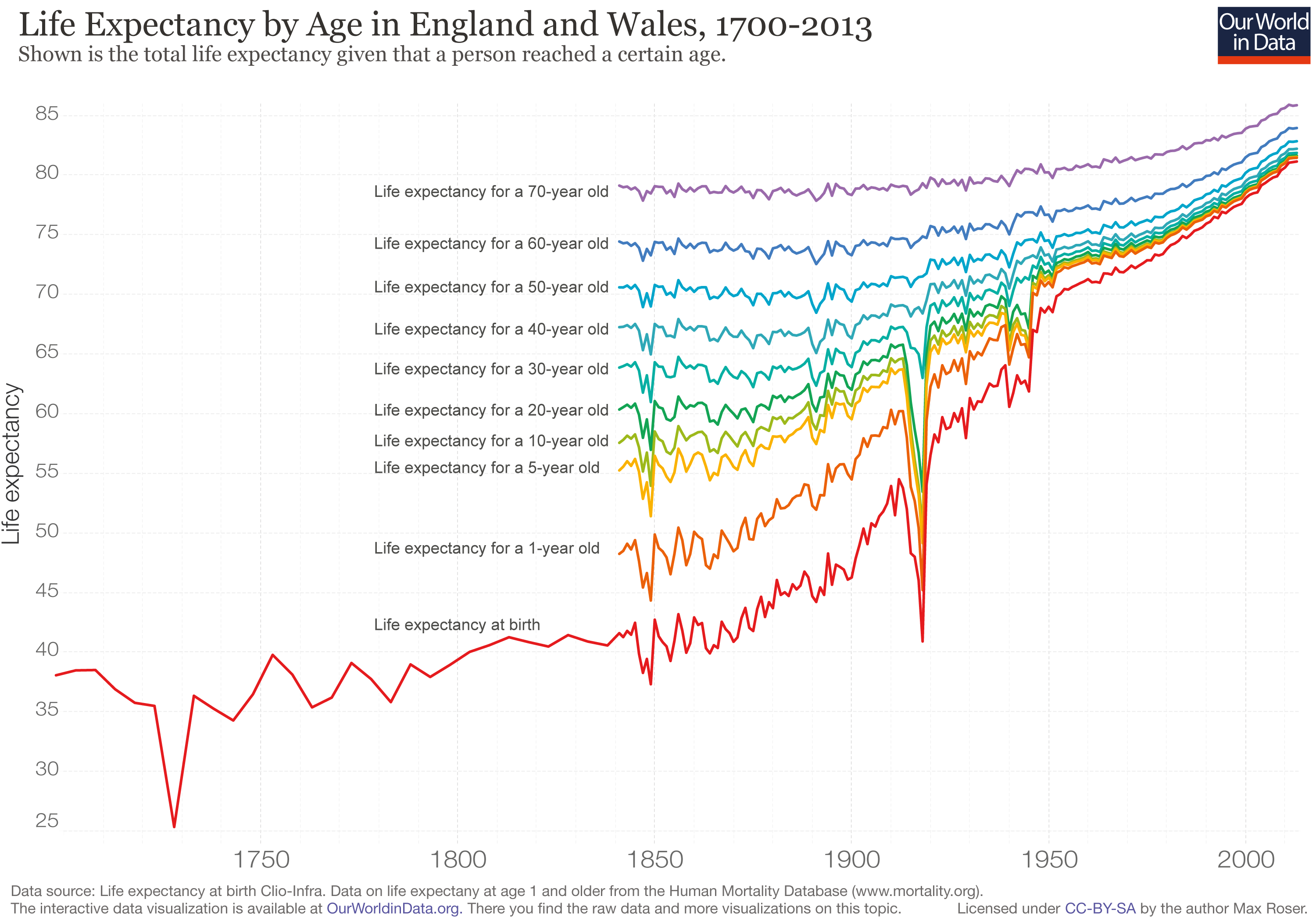
 |
| Change in income from century earlier |
The West started this parade but it no longer leads it. Singapore has higher per capita GDP than the US, England, or Germany. There is nothing uniquely British about industrial economies or uniquely American about entrepreneurial economies. Anyone can lead this parade but why did the West start it? I think it's because of a unique approach the West took to its defining institutions.
Social invention is an overlooked component of progress. Banks, corporations, and nation-states matter as much in this story of progress since 1300 as trans-Atlantic ships, steam engines, and computers. The very notion, though, that these institutions are merely tools - no different than engines or electronics - is what has made the West different.
People within the the West have taken three distinct approaches to institutions.
Social Conservatives and Social Inventions as Sacred
The first approach is the most obvious. You come to awareness as a small child, growing up with the wonder of a church, the splendor of a king, the wealth of a bank and when you become an adult you accept that this is the way things are. Realizing how instrumental are these institutions to your world, you fight to defend them as they are.
Social conservatives treat social inventions as sacred. These are the loyal Catholics who see in the Protestant Revolution a route to hell and social chaos. These are the royalists who see in challenges to the crown a tumult of conflicting claims for authority, a challenge to all that is sacred. These are the capitalists who see conspiracies in the Central Bank that "runs" things, feeling instead that the banker should be left inviolate and unregulated.
They are quite right that these institutions keep us from chaos. I personally feel like institutions - social inventions - are the simplest reason that we have more control over our lives than do the great apes.
Radicals and Social Inventions as Disposable
Radicals go to the other extreme. They are well aware of how awful the church or state or bank has been. The French Revolutionaries outlawed religion at one point. The Enlightenment was about science and rationality and religion was all about superstition and dogma; it had to go. Radicals knew the church was merely an obstacle to progress and had to go.
Whether it is atheists who want to eradicate the churches, communists who want to shut down financial markets, or anarchists who want to outlaw laws, the radicals quite accurately see all that is awful about these social inventions and want them gone.
They also don't have a clue about how important are these flawed institutions to civilization, to modern life.
The radicals and social conservatives are an important part of the conversation and should always be heard; left in charge, though, they'll only ruin things. They're important voices who should never actually be given power to change anything but instead should only have power to point out problems and make suggestions.
Power over these social inventions should instead be given to people who are not naive enough to believe we can live without them or naive enough to believe that they should be defended in some current or (more often) idealized past form.
Social Inventions as Tools
Progress has been made by the folks who see social inventions as tools. Not sacred things that need protection. Certainly not as disposable. Progress has followed from people who realize how important the church is to how people construct meaning and gain empathy and compassion, become more loving and happy even when life hits one with the inevitable tragedies of illness, death, financial setbacks or even wars and pandemics.
The ones who see church, state and bank as mere tools realize that - just as with cars or can openers - these tools are more valuable as more people are able to use and define them. "We are all priests," as Martin Luther claimed, or "All men are created equal," as Jefferson wrote express the sentiment of those who don't think that popes or kings should have a unique right to define the institutions that so define us.
And the social inventions as tools people are the ones who are unafraid to change these institutions to make them work better for who we really are and aspire to be than who we imagine our ancestors once were. A church is not sacred but it is precious. What does this mean? Everything about it should be challenged except for what it does for people; a church is more important than a juicer only because of what it makes. Fresh orange juice is lovely but meaning and compassion can make the difference between whether or not you even feel like it's worth it to get out of bed to make that orange juice.

The West has led the great parade of progress in no small part because it has treated its vital institutions as mere tools and subject them to challenge and redesign as if they were products no different than cars or radios. They're not sacred. They're not disposable. We've made progress by changing our relationship to church, state, and bank, making them tools for anyone rather than just popes, kings, and bankers. We will make progress again in this generation by making a similar shift in how we treat corporations, turning them into tools for employees to create wealth and jobs and not just tools reserved for CEOs (who, by the way, are also employees). Freedom of religion, the spread of democracy, the American Dream and the popularization of entrepreneurship have treated - and will treat - our big institutions as mere tools. That orientation is essential to progress.
So why mention all this? Because in the wake of the Great Depression, extremists seized governments everywhere; fascists and communists took control and progress halted or reversed everywhere they did. Now, in the wake of the Great Recession, extremists are again gaining power.
On the left we have activists who see banks as evil. And on the right we have activists who see banks as sacred. The first group doesn't understand the importance of banks, the second group doesn't understand the importance of regulating them and subjecting them to a central bank. Those on the left aren't numerous enough in the states to spoil capital markets but those on the right actually are in Trump's government. Trump is moving to deregulate banks so that banks are tools for bankers and not the community, not for everyone. The social conservatives don't believe in Keynesian economics (most recent evidence of that is the fact that they protested deficits when unemployment was high and now want larger deficits now that unemployment is low) or monetary policy.
Social conservatives are also working to reverse democracy. In 1789, only white, property-owning Protestant men could vote. About every 50 years, another group gained voting rights until, by the end of the 20th century even minority women who rented could vote. Courts have repeatedly ruled that Republican efforts to reverse voting rights are actually targeted at reversing that, taking power from minorities and the poor to vote.
Finally the continued effort to impose a religious definition of when life starts (at the instant of conception) and dismissing any other reasonable definition is an attempt to encroach on freedom of religion, the freedom of women to follow their own conscience and belief about when sperm and egg become a baby.
Social conservatives are wonderful to have in a community. They remind us that family as an institution really does matter, that churches make lives better for so many, that banks and the state create order we would not have without them. We should listen to them. But social conservatives are better reminders than managers; put in power, they treat as sacred what any forward moving community treat merely as as tools that are best used by many rather than a few.
Prosperous and happy communities will continue to construct institutions that are tools that help people to create meaning and be compassionate. They may not even call these institutions churches - and that is part of the genius of lumping freedom of religion under the first amendment along with freedom of assembly, speech, and press, the realization that it is the freedom to form thoughts and express them that is at the heart of religious freedom.
Prosperous and happy communities will continue to construct institutions that are tools to allocate and create capital that helps to fuel progress in productivity and profits. Again, they may not even call these banks but they will be tools that make people richer and able to afford now what they cannot pay for until later.
Prosperous and happy communities will continue to construct institutions that are tools for governing, for creating policies that make their world safer, easier to navigate, and more likely to offer them lucrative options and freedom to live a life as they please - whether in the form of neighborhood planning boards or the UN or any level of government between.
Prosperous and happy communities will continue to construct and revise institutions that are tools for creating wealth and jobs, new technologies and new products and services and in the process of creating value for customers, suppliers, stockholders and the community.
And the communities that prosper the most will never pretend that these tools should be reserved for the elite. They will never pretend that they are not necessary. They will never pretend that they are anything but tools.
What has fueled progress for the West is treating these great institutions as tools. Every time we've instead treated them as disposable or sacred, progress stalls or even reverses.
06 February 2018
Shout it - Yellen was Flawless at the Fed (Hopefully It Won't Be Another Century Before Another Woman is Fed Chair)
This Monday was our first day with Janet Yellen as Fed Chair in four years. The market marked her departure with the biggest ever one day drop in the Dow. Now that's a send off.
The job of Federal Reserve Chair has become more important since Congress has become more dysfunctional. In an ideal world, the government has a mix of fiscal and monetary tools to use to help to smooth out the inevitable bubble and busts of an economy. Now we really have just monetary policy, the tool of the Fed. In the recovery from the Great Recession, when unemployment was still above 8%, the media and Republicans made a great deal of noise about deficits. Now that unemployment is only 4.1%, the Republicans have decided to add another trillion to the debt this year with no noise from Republicans (they're the ones creating this) and very little noise from the media. This is backwards and the Fed has had to work against Congress in their efforts to keep the economy from extremes during the recovery. Yellen has done that flawlessly.
For 100 years we had Fed Chairmen. Then, four years ago, Obama appointed Janet Yellen to succeed Ben Bernanke as Fed Chair. Here is how the economy has performed during her four-year term.
The uninterrupted streak - a new record
 When Yellen took over as Fed Chair, the American economy had been creating jobs every month for 40 months. That's great but on two different occasions, the streak had lasted longer: 46 months in the mid-2000s and 48 months in the late 1980s.
 Not once did the jobs report come in negative during her time as Fed Chair. The streak is now 88 months and counting; she set a new record each month for the last 40 months of her tenure, shattering the old record and bringing the unemployment rate down from 6.7% to 4.1%. No other Fed Chair presided over a time in which every single monthly jobs reports was positive.
Second best annual job growth
Uninterrupted job creation makes it easier to create a lot of jobs. During her four years the economy did. Only one Fed Chair - Miller who served for only 17 months during the 1970s - presided over a higher annual average job growth. (And wasn't it curious how the media continued to whine about so-so job creation rates, as if they had any instances of it being better during a four year or longer Fed term?)
Second best annual rate of stock market return
 The market returns during her tenure were also second to only one other Fed Chair - Volcker. It seems fitting that the market began falling spectacularly after her last meeting Wednesday and before Powell's first day of work Monday. (Speaking of which, Powell did have a miserable start in his first two days. After Monday's huge sell off, the market return for his first day worked out to a 99.9% annual return which would have made him the first Fed Chair to have lost the entire stock market in his first year on the job. "Where are the returns Jerome?" "I don't know. Yellen seems to have taken them when she cleared out her desk.")

Lowest Inflation
The Federal Reserve has two goals: keep unemployment and inflation low. No one presided over lower inflation rates than Yellen. The goal is 2%. Her highest year was 2.1%. Only Bernanke - who was dealing with horrendous unemployment rates - was close to her and most Chairs were more than double that.
Trump, unsurprisingly, decided that Yellen's performance wasn't good enough to warrant a second term and thus hers will be the shortest term of any Fed Chair since 1979 when Carter decided that inflation was too high and he needed to truncate G. William Miller's term and replace him with Volcker.*
Of course it was unsurprising that Trump would replace Yellen. In Trump's final campaign ad, he lumped Yellen with Clinton, Soros and other world leaders as "globalist" financiers "who don't have your good in mind."
As it turns out, for a woman who didn't have our good in mind, she did pretty good. I'd go so far as to say that her performance was flawless. Let's hope it's not another century before a president has the good sense to appoint the second woman to head the Fed.
----------------------
*(It's worth noting that when Carter interviewed Volcker for the job as Fed Chair, Volcker warned him that his approach to squeezing out inflation would hurt the economy short-term and about the time Carter was running for reelection the economy would be in bad shape. Carter said, But this is what we need to do. And sure enough, in November of 1980 when Americans elected Ronald Reagan to take Carter's place, unemployment was at 7.5% and continuing to rise.)
The job of Federal Reserve Chair has become more important since Congress has become more dysfunctional. In an ideal world, the government has a mix of fiscal and monetary tools to use to help to smooth out the inevitable bubble and busts of an economy. Now we really have just monetary policy, the tool of the Fed. In the recovery from the Great Recession, when unemployment was still above 8%, the media and Republicans made a great deal of noise about deficits. Now that unemployment is only 4.1%, the Republicans have decided to add another trillion to the debt this year with no noise from Republicans (they're the ones creating this) and very little noise from the media. This is backwards and the Fed has had to work against Congress in their efforts to keep the economy from extremes during the recovery. Yellen has done that flawlessly.
For 100 years we had Fed Chairmen. Then, four years ago, Obama appointed Janet Yellen to succeed Ben Bernanke as Fed Chair. Here is how the economy has performed during her four-year term.
The uninterrupted streak - a new record
 When Yellen took over as Fed Chair, the American economy had been creating jobs every month for 40 months. That's great but on two different occasions, the streak had lasted longer: 46 months in the mid-2000s and 48 months in the late 1980s.
  Not once did the jobs report come in negative during her time as Fed Chair. The streak is now 88 months and counting; she set a new record each month for the last 40 months of her tenure, shattering the old record and bringing the unemployment rate down from 6.7% to 4.1%. No other Fed Chair presided over a time in which every single monthly jobs reports was positive.
Second best annual job growth
Uninterrupted job creation makes it easier to create a lot of jobs. During her four years the economy did. Only one Fed Chair - Miller who served for only 17 months during the 1970s - presided over a higher annual average job growth. (And wasn't it curious how the media continued to whine about so-so job creation rates, as if they had any instances of it being better during a four year or longer Fed term?)
Second best annual rate of stock market return
 The market returns during her tenure were also second to only one other Fed Chair - Volcker. It seems fitting that the market began falling spectacularly after her last meeting Wednesday and before Powell's first day of work Monday. (Speaking of which, Powell did have a miserable start in his first two days. After Monday's huge sell off, the market return for his first day worked out to a 99.9% annual return which would have made him the first Fed Chair to have lost the entire stock market in his first year on the job. "Where are the returns Jerome?" "I don't know. Yellen seems to have taken them when she cleared out her desk.")
Lowest Inflation
The Federal Reserve has two goals: keep unemployment and inflation low. No one presided over lower inflation rates than Yellen. The goal is 2%. Her highest year was 2.1%. Only Bernanke - who was dealing with horrendous unemployment rates - was close to her and most Chairs were more than double that.
Trump, unsurprisingly, decided that Yellen's performance wasn't good enough to warrant a second term and thus hers will be the shortest term of any Fed Chair since 1979 when Carter decided that inflation was too high and he needed to truncate G. William Miller's term and replace him with Volcker.*
Of course it was unsurprising that Trump would replace Yellen. In Trump's final campaign ad, he lumped Yellen with Clinton, Soros and other world leaders as "globalist" financiers "who don't have your good in mind."
As it turns out, for a woman who didn't have our good in mind, she did pretty good. I'd go so far as to say that her performance was flawless. Let's hope it's not another century before a president has the good sense to appoint the second woman to head the Fed.
----------------------
*(It's worth noting that when Carter interviewed Volcker for the job as Fed Chair, Volcker warned him that his approach to squeezing out inflation would hurt the economy short-term and about the time Carter was running for reelection the economy would be in bad shape. Carter said, But this is what we need to do. And sure enough, in November of 1980 when Americans elected Ronald Reagan to take Carter's place, unemployment was at 7.5% and continuing to rise.)
Subscribe to:
Posts (Atom)