17 May 2022

Zero-sum Thinking, Replacement Theory and How Progress Transformed the World of Our Founding Fathers

When this country began, land was the limit to progress and the simplest definition of our economic policy was to get more land. Land claimed or conquered and then sold (as well as tariffs collected) was how the government generated revenue to operate. The work of getting more land was the work of conquest. Early Americans practiced slavery and genocide; this was brutal but it was how one got ahead in zero-sum world. This was the world of which Jesus would say, "It's as hard for a rich man to enter the kingdom of heaven as it is for a camel to pass through the eye of a needle." Rich meant you were somehow exploiting others.

Land is zero sum. My gain comes at your loss (sorry about taking your old hunting grounds but, you know, I had to clear the forest to carve out a farm). There is only so much acreage or gold or timber and what you get I lose. Zero sum means competition - fierce competition.
Fortunately, something almost magical happened shortly after the US was founded. With the industrial revolution, for the first time since the ancient Greeks, we began to experience gains in per capita GDP. This meant that it was possible for your life to get better without mine getting worse. Simplest illustration of this? Rather than need two slaves to weave the fibers for my new clothes (a task that would make their life worse and mine better), I could use machines. And so could those former slaves.

Lincoln and the Republicans were acutely aware of this and it was one reason why they fought so against slavery. It wasn't just evil. With capital, slavery was unnecessary.

Still, there are a lot of people who still imagine they live in a zero-sum economy. (We don't. In truth, we live in a time of such abundance that we artificially create zero-sum conditions with sports, having strict rules about how only one of thirty NBA teams can be this year's champ no matter how much better most teams are. That ancient impulse for competition has to be sated somehow. Sports does it.)

The folks who believe this is a zero-sum world are the people who still think that immigrants are coming to steal their job.

When the US gained its independence, we had only 3.9 million people. Today we have nearly 100X more people. Or course its nonsense to think that the 330 million newborns and new immigrants since the time of the founding families had to steal jobs from the original Americans. More people mean more economic opportunities, not less. And not only do we now create 3.9 million new jobs EACH MONTH, but the pay for those jobs is multiples of what early Americans would have ever imagined.

In general, conservatives are people who have this curious notion that the past was better. Or, perhaps more accurately, they seem to think that the truths of the past still hold today. Conservatives susceptible to replacement theory still think they're living in a zero-sum economy, one where every gain you make comes at my expense. This - like the anti-vaxx movement - is evidence of a mind still shaped by pre-Enlightenment thinking. (Vaccinations were, like this great country, an invention of Enlightenment thinkers).

You don't live in a zero-sum economy. Value doesn't come at the expense of someone else. It is something we have to create. Maybe we'd have more luck with that if we looked at others as collaborators rather than competitors.

12 May 2022

What Drove Up Stock Prices - And Why Stock Prices Will Rise Again

TL/DR
Between 1980 and 2008, the number of Americans dependent on investments like 401(k)s for retirement tripled. (And I suspect it has continued to rise.)
Compared to its peak about 1998, the number of publicly traded companies has fallen to about a third.
Triple the demand. A third of the supply. I don't know how that does anything other than make prices seem high.

------

The number of publicly listed companies in the US has steadily declined since its peak in 1996. That has a lot to do with market volatility and crazy stock prices.

In the last few decades, the portion of Americans with pensions has halved and the portion dependent on the stock market for retirement has tripled.[1]

During that same time, the number of publicly listed companies - companies whose stock you can buy and make a part of your retirement account - has fallen to about one-third of its peak. [2]

And here we have one important problem with pricing stocks.

If we just look at supply and demand, the supply of companies whose stock you can buy has fallen to a third of its peak and if we just look at demand for stocks, the portion of Americans dependent on stocks for retirement has tripled. If the supply is a third and the demand has tripled, the price has no where to go but up. From this angle, crazy high stock prices are very reasonable.

Meanwhile, we have traditional measures of stock value. Traditional as in it generates profits. If you pay $100 for a share of stock, ideally that would represent - say - $5 a year in profits. The price of $100 relative to the profits of $5 works out to a Price to Earnings ratio (PE) of 100/5 = 20. What seems reasonable from a perspective of PE is something in the range of 15 to 35. (If you are expecting big growths in profits and interest rates are low - which means you discount those future profits less - PE ratios considerably higher than 15 to 35 are justified. That is to say, a growth stock could reasonably have a very high PE.) Even though Tesla has fallen by about 40% year to date, its PE is still 100. That's really high and a lot of stocks in the last year have had either really high PE ratios - or given they are not yet profitable - no PE ratio.

If we only look at PE, the stock market has been wildly overpriced.

But if you look at the demand for stocks v the supply of stocks (again, the number of publicly traded companies), the stock market has arguably been reasonably priced. People need a way to build wealth for retirement. There are not many companies being traded. The result is that the price of companies - the value of their stock - will go up. (I suspect that this fundamental demand is going to drive stock prices back up.)

There is more going on with asset prices than this but I don't think enough is said about this tension. Stock prices have been quite reasonable given growing demand for a shrinking number of stocks even though from the perspective of PE, stock prices have been silly.

What is the solution? Well, you know me and my mantra about entrepreneurship now being the limit to progress. We need more initiatives - public and private - to make more people more entrepreneurial. One simple reason? We have more capital than good investments right now. The two limits to creating more investments are public policies (for initiatives like reducing child poverty and infrastructure investments) and private initiatives to start more companies that can go public.

One way to meet the demand for publicly listed companies without making stock prices higher than PE would seem justified is to create more companies. That's going to require more entrepreneurs. More effective entrepreneurs can meet the demand for good investments without driving up the price of assets to seemingly unsustainable levels.

[1] https://www.ssa.gov/policy/docs/ssb/v69n3/v69n3p1.html
[2] https://fred.stlouisfed.org/series/DDOM01USA644NWDB

07 May 2022

Freedom of Religion as Bold, Liberating, Irrational and Key to Understanding the Debate About Abortion

TL/DR: Freedom of religion means that in spite of my conviction that you will spend an eternity in hell for not believing what I believe, I will respect your choice about what to believe. This respect for the beliefs of others has made the modern world vastly better than the medieval world. In the same way, respecting a woman's belief about "when it's a pregnancy" vs "when it's a baby" requires a similar restraint among true believers who know its a baby at the moment of conception, a similar awareness of the necessary gap between personal conviction and universal law.
In this modern world we rarely have occasion to think about what a bold, liberating and irrational thing is freedom of religion. Until you appreciate that, it’s hard to understand the modern debate on abortion.

Why is freedom of religion irrational? What is at stake is where souls will spend eternity: heaven or hell. If you know – I mean, really know – that your belief in the right god and way to worship will make the difference as to whether you suffer eternal damnation or eternal paradise, everything else pales in comparison. This life is so brief that no present sufferings are worth comparing. And if you truly loved your fellow man, you would never wish for them eternal damnation.

Odd things happen when you realize the stakes of a mistaken belief.

There is an account of good English Protestants kidnapping Irish Catholic children from their parents. Why? These poor children were to be indoctrinated into a Catholic faith that – because it was wrong – would result in their spending an eternity in hell. As an act of great kindness and compassion, they kidnapped these children to raise them as good Protestants, thus ensuring that they would spend an eternity in paradise. The trauma of mothers and children separated from one another was trivial given the stakes. “No present suffering …”

The 30 years war is another tragic example of the atrocities of war. And the consequences of not even having a concept of freedom of religion. For decades in the early 1600s Protestants and Catholics battled across central Europe, killing about 4 to 8 million people. In some regions, half the residents died. (As in any war, only a portion of the casualties were soldiers killed on a battlefield. And lest you think a few million insignificant, the equivalent portion killed in the US today would be about 70 million.) The aftermath of this madness was one of the catalysts behind our founding fathers determining that a core foundation to this country would be freedom of religion.

Religious belief was made a private matter in the US, not something you could impose on another or legislate, no matter how passionately convicted you were of how right you were or the stakes involved.

Again, freedom of religion is both the most wonderful and rational thing and the most awful and irrational thing. If you truly believe that your faith is the only one that will save a soul from eternal damnation, it is the most evil sort of thing to simply leave your neighbor to cling to mistaken beliefs that define Catholics or Jews or Scientologists or – gulp – atheists, or any number of mistaken beliefs. Seriously think about this. Eternity is at stake and you are going to let someone choose a path that means eternal damnation? And yet …

Freedom of religion required a kind of humility that had been lacking for centuries in the West. A humility of realizing that your neighbors’ beliefs were as legitimate as your own. You don’t even have to believe that they are right. You simply have to believe that they are deserving of the choice about what to believe as you are, recognizing that their convictions are as legitimate as your own. Again, you don’t even have to believe that they might be right. You might even believe that their passing on their belief to their children will also mean that those children are lost for eternity. You only have to believe that their belief they are right is as worthy of respect as your own.

Which brings me to abortion. The anti-abortion folks fiercely believe that at the moment of conception sperm and egg – the flotsam and jetsam of life, the regular waste of human existence – are transformed into precious life, into a little being as worthy of protection as a newborn. If you really believe that, it puts a burden on you as serious as the sincere belief that your faith means eternal paradise and their faith means eternal damnation. If you have real love, real care for this new life and its mother, you would never let anything happen to it. You would protect it as fiercely as if it were a child walking around in the world. These present sufferings of pregnancy and raising a child are not to be compared to murder in the same way that any present sufferings of this life pale in comparison to eternal damnation.
Similar to freedom of religion, though, to respect the choice a woman might make to act on her belief that the moment after conception sperm and egg are not instantaneously transformed into a child doesn’t even mean that you have to accept her belief. It simply means that you have to show her belief as much respect as your own. It requires a kind of humility about your own belief. And in this sense – this question of When life begins, we really are encroaching on the territory of freedom of religion. There is no observable fact that tells us the instant when life begins. That is a belief and as tends to happen with beliefs, there are differences in opinion – and conviction – about this.

You might say that given you know abortion kills hundreds of thousands of babies every year you can’t allow it to continue. You know this in the same way that good Catholics and Protestants in the 30 Year War knew that they would go to heaven and the others would suffer eternal damnation; you are utterly convicted of this belief even while knowing that there are people who believe otherwise. I’d remind you of the madness that followed from people in the West’s inability to respect the beliefs of others as just as valid as their own. No one is asking you to change your belief. We are only asking you to respect the beliefs of others just as much as you want your own beliefs respected.

From this freedom of religion, this freedom of thought, this freedom to compose a life of one’s own choosing has come a world that might well strike Europeans alive during the 30 years war as a kind of paradise. This present suffering has been dramatically reduced. The key foundation to building this present, free and comfortable world has been demanding as much respect for the beliefs of others as you would want for your own beliefs. You believe life begins at the moment of conception. Fine. We respect and honor that. No one is asking you to change that belief. We only ask that you show as much respect for another’s belief as you want shown for yours. You – rightfully – believe that it would be a horrific trauma to have an abortion forced upon you. Understand that a woman with different beliefs than your own would believe it a horrific trauma to have a pregnancy forced upon her. Whatever our differences in belief about the instant when life begins, we have the choice to believe that abortions and pregnancies are not something that should be forced upon a woman. Let people act on their beliefs. That respect is a cornerstone of the modern world and abandoning that respect adds to this present suffering in ways that are unnecessary and traumatic.

Dante and Virgil in Hell by Eugene Delacroix, 1822.

01 April 2022

The Dramatic Difference in How the Economy Performs Under Republican and Democratic Administrations

There is a dramatic difference in how the economy performs under Republican and Democratic administrations. The simplest explanation is that Republicans are committed to free markets and Democrats are activists, intervening to avoid or recover from recessions and more committed to making public investments in infrastructure, R&D and education.

The 1990s saw the rise of the internet and an economic boom. Al Gore – Senator from Tennessee before becoming Clinton’s VP - sponsored a National Information Infrastructure bill that passed into law in December of 1991, funding the development of the “information superhighway” with $600 million. The bill funded, among other things, the development of Mosaic, the first web browser. In 1990, only 15% of Americans even owned a computer. Between 1994 and 2000, the percentage of Americans online rose from 2% to 46%. Going online helped to make the 1990s better than the two decades before and after measured by wage growth and the creation of wealth and jobs.


George W. Bush took office after Clinton and quickly got to work deregulating the financial sector. Specifically, he made it easier to approve mortgages so that more Americans could buy homes. By 2008 the financial derivatives built atop mortgage loans equaled total global GDP and the bubble this created popped, leading to the worst recession since the Great Depression. The economy under Bush 2 was dramatically different than it was under Clinton and this wasn’t due to chance. Clinton and Gore pushed investments in the internet and other technologies and industries (the human genome was first sequenced towards the end of Clinton’s time in office). Bush bet instead on deregulation which blew up on him and the global economy.


Trump didn’t just undermine immigration and trade – big drivers for economic progress across the globe during Clinton’s administration. (It was not just NAFTA that became reality during Clinton’s administration; so did the World Trade Organization.) Trump refused to take any responsibility for fighting the pandemic beyond signing legislation for rapid development of vaccines, leaving each state and county largely unsupported in its efforts to test, treat and contain COVID. The pandemic hit the US harder than other OECD nations, killing more Americans and destroying more jobs. (And even after Biden took office, the vaccination rates were much lower and death rates much higher in the counties where Trump won a higher portion of votes.)

One of Biden’s first acts as president was to sign a $1.9 trillion bill to stimulate the American economy and more aggressively defend against COVID. This was a significant factor in the economy creating a record number of jobs in 2021. Not a single Republican voted for this stimulus bill; again, the simple uniting belief for Republicans is that markets don’t need interventions.


The key difference between Republicans and Democrats in office is that Republicans simply lower taxes and deregulate. By contrast, Democrats intervene with stimulus and investment bills.

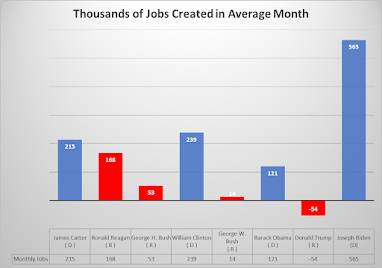
The difference was not just dramatic last year but for the last half century. In the 24 years Republicans have been in the White House since 1977, the economy has created 17.4 million jobs. In the 21+ years since 1977 that Democrats have sat in the White House, the economy has created 52.7 million jobs. An average of about 60,000 new jobs each month a Republican is in the White House compared to about 209,000 jobs a month when a Democrat is. There are people who will tell you that this is not a meaningful difference; these are the same people committed to the proposition that policy makes no difference and would have you believe that George W. Bush simply had bad luck rather than bad policy and that Clinton and Gore simply had good luck rather than good policy.

Keynes believed that financial markets were marvelous and necessary inventions and that without the right kind of policy intervention could blow up an economy and create ruin. He’s still right on both of those points even though it is fashionable on the left to revile financial markets for their tendency to create wealth inequality and those on the right to revile regulations or the need for government intervention.

Biden is old. One of the big advantages to this is that he’s seen – and learned – a lot. He knows what policy slows recoveries and what policy accelerates it. Obama had tasked him with cleaning up the mess George W. Bush had left behind in 2009. We voters tasked him with the task of cleaning up the mess Trump left behind in 2021. Partly because of how different the downturn of 2021 was from 2009 and partly because Biden learned not to drag out a recovery in a way that would leave millions more unemployed, this recovery is much more rapid than the one after the Great Recession. Sadly, Biden now has experience twice helping to facilitate a dramatic recovery.

The many Americans who love the simple idea of unregulated markets means that we could easily end up with another Bush or Trump in 2025 signing legislation for deregulation and tax relief and veto legislation that regulates markets and makes public investments in the future. Weirdly, the choice between these two paths will have almost nothing to do with past numbers and everything to do with ideology formed earlier in life. There’s not much evidence that evidence changes minds, even half a century of evidence.

12 March 2022

The Importance of Remembering the Horrors of War

Trigger warning: This is an account of horror about the close of WWII.

I've come to more often think of history as lifetimes. How far back in history was an event? Well, how old are people today who experienced that? I don't think it is an coincidence, for instance, that Americans became so enamored of the allure of markets as people who had lived through the Great Depression died off. In the 1950s, you could speak favorably of markets to an extent but if you were to say that the invisible hand of the market would correct all society's ills you would be laughed at as if you were talking about your invisible friend. By the 1980s, when the vast majority of people who had experienced the trauma of the Great Depression had died off, someone could rage at taxes and regulation as evils that kept us all from realizing our potential and people would nod along. A society is as defined by its past traumas as much as it is by its past triumphs.

Which brings me to Russia and central Europe's past traumas. In early 1945, Soviet troops began their offensive into Nazi-occupied territory. Here are a couple of excerpts from Anne Applebaum's Iron Curtain. The Poles and Hungarians, for instance, were first delighted to be liberated from the Nazis by Soviet forces but that delight soon changed.

"In part, the Soviet soldiers seemed foreign to Eastern Europeans because they seemed so suspicious of Eastern Europeans, and because they appeared so shocked by the material wealth of Eastern Europe. Since the time of the revolution, Russians had been told of the poverty, unemployment, and misery of capitalism, and about the superiority of their own system. But even upon entering eastern Poland, at that time one of the poorest parts of Europe, they found ordinary peasants who owned several chickens, a couple of cows, and more than one change of clothes. They found small country towns with stone churches, cobbled streets, and people riding bicycles, which were then still unknown in most of Russia. They found farms equipped with solid barns and crops planted in neat rows. These were scenes of abundance by comparison with the desperate poverty, the muddy roads, and the tiny cottages of rural Russia.

"When they conquered Konigsberg churches, Budapest apartments, and Berlin homes filled with antique furniture, "fascist" women living in what they perceived to be unimaginable luxury, the mysteries of flush toilets, and electric gadgets, then they were truly shocked: "Our soldiers have seen the two-storey suburban houses with electricity, gas, bathrooms and beautifully tended gardens. Our people have seen the villas of the rich bourgeois in Berlin, the unbelievable luxury of castles, estates and mansions. And thousands of soldiers repeat these angry questions when they look around them in Germany: 'But why did they come to us? What did they want?'"

This bafflement at German affluence combined with the desire for revenge against the Germans for the atrocities they'd committed in the Soviet Union. The Nazis killed about 26 million Russians during their invasion and occupation. (By comparison, Canada's entire population at this time was about 11 million.) Nearly every soldier had lost someone - a parent, wife, or child or all three - because of the Nazi invasion. One of the many ways their rage was manifest was in rape. Russian soldiers raping women in the areas they were liberating from Nazis was widespread. Applebaum again,

"The Red Army was brutal, it was powerful, and it could not be stopped. Men could not protect women; women could not protect themselves; neither could protect their children or their property. The horror that had been inspired could not openly be discussed, and official responses were usually oblique. In Hungary, the Budapest National Committee suspended the ban on abortions in February 1945, though without explaining exactly why. In January 1946, the Hungarian Social Welfare Minister issued an evasive decree: "As an effect of the front and the chaos following it there were a lot of children born whose families did not want to take care of them ... I ask hereby the bureau of orphanages ... to qualify all babies as abandoned whose date of birth is from nine to eighteen months after the liberation."

A country-wide proclamation that children born during a particular window of time were to be considered, by default, orphans. The trauma of war lasts as long as the lives of people who have experienced it. Most of those adults who experienced WWII are gone now and we now have what may become the largest land war in Europe since WWII. History, particularly horrific history, should be read and remembered, if only to lower the chance that it is relived.

10 March 2022

2021 - How a Record Year of Real GDP Growth and Job Creation Compares to Other First Years for Presidents

I'm intrigued by data but often the more data one gets, the harder it is to make it tell a story. It is easier to draw a line between two points than it is to draw a line through 13.

Here is data on how the economy did in the first year of a presidency for our last 13 presidents. The punchline is that how the economy does in the first year doesn't make any difference in how a president does in the reelection effort 3 years later.

One weird little graph I created simply shows the sum of first year real GDP growth plus millions of jobs created. (3% real GDP growth plus 2 million jobs created = 5.) You can see that the presidents who did worst by this measure - Eisenhower, Reagan and Obama - handily won reelection. Of the four who did best by this measure, one was assassinated, one was reelected, one lost reelection and one (the one who has easily done best by this measure) is still in office and might conceivably not even run for reelection. In other words, the economy doing poorly in your first year definitely doesn't hurt you and the economy doing well is absolutely no guarantee of any particular political outcome 3 years later.
Anyway, we will likely never again see a year that combines such high rates of real GDP growth and job creation as did last year. The pandemic was a unique economic event and because of (largely) bipartisan support for stimulus the temporary shutdown did not ripple into years of crippling recovery but instead has already largely ended, the economy (for the most part) recovering in record time. It was a year ago today that Congress passed a huge stimulus package and that is a big part of why this recovery has been so strong and rapid.

I still think that the degree to which it changed in 2021's "have you tried turning it off and turning it back on again?" year+ of sharp economic contraction and rapid economic recovery is being glossed over. There is a common misconception that millions of people just lost their jobs and then - months or a year later went back to those same jobs. A lot changed in that time and there was a lot of creating along with the destruction.

Obviously a lot of spending shifted from services (travel and eating out, for instance) to goods and may now shift back again. Less obviously, the economy created a record number of new businesses (venture capital double what it was in any previous year) and the level of quits - and people finding or creating new jobs - also shattered old records. To the extent that this level of creative destruction sustains higher wages, productivity gains and more entrepreneurial creativity, the amazing numbers of 2021 could ripple into the future, leading us into a time in which last year could look like prelude to a golden period of economic progress. If not, last year could just look like the economy quickly rebounding to where it was.

Anyway, here are some numbers for my two blog readers who also find such things interesting.


23 February 2022

Trump Has Clearly Sided with the World's Dictators. How Confused and Angry Do You Have to be to Side with Him?

Russia is invading a sovereign nation in the biggest land war in Europe in decades and all Trump can do is praise Putin's genius.

Trump consistently shows love for dictators and contempt for democratically elected leaders (not just leaders like Biden and Merkel but even Bush or the former nominees of his own party like McCain and Romney) and of course contempt for our democratic process and elections.
At this point you have a clear choice. Support Trump and his party in the fight against democracies or reject Trump and his party. Be careful how you vote, though. The vote you cast for the guy who hates democratically elected governments and sovereign nations is the last vote you get to cast.

06 February 2022

Transforming the Olympics - An Overdue Update after a Century+ of Artificial Scarcity

The first modern Olympics game in 1896 had only 14 countries compete. In this winter Olympics we now have 91 countries competing but still just the three medals made of 2 metals (gold and silver) and one alloy (bronze). This suggests a scarcity mentality unbefitting for modern times.

I'd like to propose the following metals for medals allowing a larger number of great athletes to say, "I got a medal at the Olympics!" even if the follow up is, "I tin-foiled in curling."

1st Titanium
2nd Gold
3rd Uranium
4th Silver
5th Copper
6th Iron
7th Bronze
8th Lead
9th Zinc
10th Tin
11th Steel
12th Aluminum

Enough of these self-imposed supply chain issues for the allocation of glory.

29 January 2022

Maybe Tom Brady's Retirement From What He Did as Well as Anyone Is a Cue For You To Retire From What You Do As Poorly As Anyone

We live in a world of specialists. The bureau of labor statistics tracks 800+ jobs and even that is a small subset of all the jobs and occupations that generate income.

Tom Brady is retiring after 22 years. He's the most accomplished quarterback in NFL history, an amazing athlete. But let me point out the obvious because it is so easy to miss. Brady is an amazing athlete and yet he could not earn a living in any of hundreds of sports. He has no natural talent at riding race horses, wrestling, soccer, gymnastics, 100 meter sprints or high jumps, ice skating (speed or figure) or volleyball. (As a professional athlete he would likely be better at all of these than any of us but I guarantee you that he's not walking away with a gold medal or big contract for any of these.) I'll go further. Any GM would sign Brady as QB but Brady could not earn a starting place for any position other than QB. He couldn't work as defensive end, offensive guard, wide receiver, or cornerback. It's not just that Brady's specialty is football. His specialty is one position in football. He would flounder in any other position. And remember Michael Jordan's attempt to play professional baseball? He helpfully demonstrated that when we say greatest athlete we have to be very specific.


Yeah but the experts said at first that we didn't need masks, you say. What else might they be wrong about? Experts do make mistakes. Tom Brady threw more than 200 interceptions in his career. He's still better than you.

Why mention all this?

You and I are not experts in epidemiology. You just aren't. You might even be wicked smart about the things you're smart about but you also need what I'll just call a meta-intelligence. What is that? Smart enough to know what you are - and are not - smart about. And if you think that Brady would be great at figure skating or you would be great at epidemiology, you lack meta-intelligence.

Stop gargling with iodine and swallowing ivermectin. Burn candles and offer prayers AFTER you've gotten your vaccination. Listen to folks who study viruses. Don't think that you can play better than any 49er or Ram you're watching tomorrow, or that you have better understanding of how a community might lower its incidence of illness or death than the experts who rigorously study viruses for a living. You pretending that you understand viruses better than the experts is not just as silly as Tom Brady pretending to be as good at basketball as Steph Curry. It is as silly as you pretending to be Brady's equal at QB. Save yourself from embarrassment and your community from harm. Show a little humility and just defer to the folks who know what they're doing in the area in which you are not a specialist.

Brady is retiring from something he did as well as anyone in history. Maybe take that as your cue to retire from something you are doing as poorly as anyone in history. Stop giving the snake oil salesmen your attention and money. Stop pretending that you're better than the specialists.

25 January 2022

How The Dynamic of Supply Chains and Inventories Could Create a Quick Drop in Inflation This Year

Here's a theory about inflation that you may not have heard. I could be wrong but this theory is based on a lot anecdotal evidence that seems to correlate with broad sets of data.

I've heard clients in Asia, Europe and the US complain about supply chain issues. Recently one told me about an item that used to have a lead time of 4 days that was recently quoted as having a lead time of 56 weeks.

For most of these clients, the price of any one item is of little consequence. They would pay double or quadruple for certain items that might mean the difference between being able to make their product or not. On site at one client making chips for cars years ago, I saw a sign reporting that the average new car has more than 100 chips. You only need a dozen of those chips to get stuck in a supply chain somewhere to delay production of the entire car. If paying more for a chip allows you to make the car, you will pay a lot more for that chip.

The other thing going on is that these folks are hoarding. If the supplies are available, they buy them. If delivery times have gone from 4 days to 4 or 40 weeks, they buy what they can now. And they don't care that much about the cost. The inventory is insurance against future supply chain issues.

To me, it sounds like the old beer game simulation that teachers of systems dynamics would run. In that, a one-time surge in demand in a system with lags could result in wild swings in demand and supply. I suspect something similar has happened here.

In the wake of the disruptions that hit with COVID, businesses are now buying more than ever. That is putting even more strain on supply chains that are working hard to produce more. Inventories are growing faster than sales. What could happen in this dynamic? Orders drop off as dramatically as they surged. People with excess inventory will halt orders.

What happens then? Prices drop.

Smarter people than me (folks like Paul Krugman and Larry Summers and Jason Furman) are arguing that inflation will take more than a year to drop. They're arguing for interest rate hikes to lower demand and thus slow inflation. They could well be right but I would trust them more if they even addressed what I see going on with clients.

ASML is one of the most complex companies you've never heard of. They make it possible to make the increasingly tiny chips that go into thousands of devices. They have a network of 4,000 suppliers. They are an extreme example of what I see everywhere.

25 years ago when I was first working with product development teams, about 10 to 20% of their work was outsourced, done by subcontractors and suppliers. That has doubled and tripled with most of my clients in the last 5+ years. Within the last year or two, I've had two clients who outsource about 90% of their development work. Discussing a subcontractor with one of them, I learned that the subcontractor actually had a subcontractor who was creating the item we were discussing. It's a world of supply chains and given the complexity of products it doesn't take much to disrupt them. Again, to protect against these disruptions they buy more to have inventory on hand, creating a surge in demand that could be a big part of what is driving up prices. To the extent that these various suppliers are ramping up production to meet these increase in demand for companies who are buying 100 for current production AND another 100 to create a bigger inventory to protect themselves against future disruptions, there could be a big drop in demand once companies feel safe enough to stop building up inventory. They might drop off on orders from 200 to 100 or - even worse - drop to ordering 0 and merely working down their inventory. In the first case, inflation would fall a little. In the second, inflation could drop a lot.

Lots of experts predicted there would be small gains in inflation from about 2% to 3 or 4% in this last year. Instead inflation hit 7%. Now experts are predicting persistent inflation in the range of 4.5% to 8% for another year or so. They might be right. They're the experts. But given the weird dynamic I hear in the stories from clients, I wouldn't be surprised to see inflation rates drop as dramatically as they rose in the last year as supply chains catch up or even overrun demand.

24 January 2022

Investing in Children Who Have Shown Poor Judgement in Their Choice of Parents

More resources help.

Hopefully future generations will find it bizarre that we so richly rewarded and so severely punished kids for their choice of parents.

Here a study shows that simply giving mothers $300 a month in the first year of life for their child made a measurable difference in a child's cognitive development.

https://www.nytimes.com/2022/01/24/us/politics/child-tax-credit-brain-function.html

Elon Musk is the world's richest man. Elon Musk's grandpa was a leader of Technocracy Incorporated (TI) in Canada from 1936 to 1941. TI advocated for a world run by experts - engineers and scientists, not politicians - whose technology would solve the world's problems. Elon was immersed in the concepts and practice of seeking and developing technology solutions from before he could remember. He did not choose his grandfather.

Jeff Bezos was the world's richest man a short time ago. His grandfather was one of the founding members of ARPA who developed ARPANET - the obscure computer to computer network that evolved into the Internet. His grandpa also managed federal west coast labs that included Los Alamos and Lawrence Livermore, probably managing more scientists and engineers than anyone else in the world at the time. Jeff spent summers at his grandpa's and cites him as an important mentor. The man who helped to develop the internet and how to manage scientists and engineers was grandfather to a man who became the world's richest by developing a wildly successful internet company by managing a large technical team. Like Musk, Bezos did not choose his grandfather.

Bill Gates was the world's richest man for a long time. His father was a local hero in the Seattle area. For instance, Howard Schultz had an agreement with another Seattle area businessman to manage Starbucks and then buy it at a certain point. The man reneged on the deal. Schultz turned to Bill Gates Sr. for help and 6' 7" Bill Sr, a multi-millionaire and lawyer involved in numerous businesses in the area, marched across the street to browbeat the man who had reneged on his deal with Schultz, a young guy who at the time had little net worth. Thanks to this timely intervention, Schultz is now richer than all but about 200 people on the planet, worth roughly $4 billion. Imagine having Bill Sr. ready and able to intervene on your behalf from the time you were born. Bill Gates did not choose Bill Gates Sr. as his father.

Nor, of course, do babies choose to be born to poor mothers. We spend trillions on nonsense in this world. We can spend a trillion or three investing in the children who didn't show the good judgement to be born to powerful, connected, wealthy, and savvy parents. Partly we should do this because it is the right thing to do for the child, an act of grace towards an innocent new to this world. Partly we should do this because the demarcation between selfish and selfless has dissolved. If children grow up with opportunities closer to what Musk, Bezos and Gates had, we all will live in a world with more and better jobs, products, and wealth. To invest in a child is to invest in the community you are dependent on. It is both terribly selfless and selfish to help a child to realize their potential.


13 January 2022

The Even More Truly Extraordinary Numbers Behind 2021's Truly Extraordinary Jobs Numbers

The BLS reports 2 numbers each month for new jobs. One is a result of household surveys. (Something like going door to door asking, "Did you get a new job last month?") The other - the official number - is a result of surveying firms. (Something like calling up businesses and saying, "Did you hire anyone last month?")

Last month the household surveys suggested 651,000 new jobs yet the official number was 199,000, a difference of 452,000. For the year, the household surveys suggest 356,000 more jobs than the official number.

Last year, we had a record number of new businesses start up. Significantly more. In 2021, 53% more businesses were started than in 2019. Those new businesses don't get surveyed because they're not yet on the list for BLS. [Per Austan Goolsbee]

On top of that, people who start unincorporated businesses aren't counted as having new jobs. They're not employees. So if you leave a job to start a business, you will actually show up as one less employee in the job count. [Per Jason Furman.]

One more item of note. When BLS reports 500,000 new jobs, that is a net number. Every month people quit, retire, get laid off or fired. So a month in which you might report 537,000 new jobs (the average for 2021), you may actually count about 4.5 million new jobs and 4.0 million jobs ended, for a net of 500,000.

Quits were at a record level last year. Compared to the rest of this century, quits are up by about 1.3 million. Per month.

So the economy is creating a record number of net new jobs in spite of the fact that 43 million people quit their job last year. (And that is just through November.)

Last year, the economy created and brought back a total of 6,448,000 jobs. Again, that is net. That shatters the old record (set in 1946, the year after World War 2 ended) by 2.2 million. And it may well prove to be an undercount because the rate of new business formation is up by 50%.

The phrase you are looking for is "strong job market."

07 January 2022

Making Sense of the Monthly Job Numbers (and a little reminder about how blurry is our vision of reality)

Since 1970, there has been only one year that ended with a lower unemployment rate than 2021. That was 2019. In this century, the unemployment rate has been higher than December's 3.9% 90% of the time. So last month's unemployment rate is really good news.

Job creation of 199,000 was absurdly low for December and while the 6.4 million for 2021 is the most jobs created for any year on record, it still leaves us down 3 million jobs from December of 2019. So that's mixed news. We needed a big number for job creation and we got a fairly normal one (by the standards of this century.)

The variability in monthly job creation during the last 2 years has been incredible. We've had a month in which we lost 21 million jobs and another month in which we gained nearly 5 million jobs. In one month. Annual job creation jumps all over the place but 180,000 is pretty typical for a healthy, normal month. Since COVID hit, half the monthly jobs numbers represented a swing of more than 650,000 in one direction or another, so monthly volatility has been about 3 to 4 times what it normally is.

On top of that, there seems to be a lot of noise in the monthly measures.

How many new jobs were created in December?
The consensus expectation was for 450k.
ADP is a private company that tracks monthly changes in private employment. Their count for December was 807k.
BLS's household survey that - well, surveys households - arrived at an estimate of new jobs of 651k.
And the official number from BLS - which surveys employers - shows a gain of just 199k. 
This 199k is the headline number.

It's worth remembering that during the long run of uninterrupted job creation in the aftermath of the 2008 Great Recession, the jobs created in a a normal month was about 200,000. What is often forgotten is that this is a net number. Every month about 2 million people were fired, laid off, quit or retired. And about 2.2 million were hired. So, the net for the month was 200,000 "new jobs" but the fact was that there were millions of new jobs that offset the millions of jobs ended. If your measurement error on the 2.2 million new and 2 million ended jobs is just 5%, and the real net for the month was 200,000, you could double the reported new jobs or erase them. Let me repeat that. With an underlying reality of 200,000 new jobs and a measurement error of 5%, it is possible to report that as anywhere from 0 to 400,000 new jobs. The last 22 months have been so volatile that it's easy to imagine that measurement error has gone up. I don't know what actual measurement error is. I do know that it exists and that's just one reason to be cautious in interpreting numbers from one month - particularly before they've been revised. 

The BLS numbers will be revised twice more over the next two months, as they always are. Pandemic volatility makes it tough to track what is going in this labor force of 162 million Americans. The good news is that we're moving in the right direction. By one measure - the unemployment rate of 3.9% - the job market is already healthy. By another measure - the millions of jobs that we've lost over the last couple of years - the economy is still weak.

As with so much in life, you can choose your narrative. Job creation is strong? Cheer about that or complain about inflation. Unemployment rate is low in December? Cheer about that or complain about the rate of job creation in December.

Lots of early retirements and some long COVID disabilities are possibly depressing the number of folks looking for work, which would explain how the unemployment rate could be so low even while we are still millions of jobs short of where we were 2 years ago. Additionally, there seem to be lots of folks who simply haven't worked out issues like childcare or elder care to be able to work again. And while we're buying more goods than ever before, the service sector still hasn't fully recovered.  You might have better or more interesting theories about what is going on. The most robust theories still await more data, though, data that smooths out the monthly variations that sometimes seem nearly as big as the phenomenon they're measuring.

01 January 2022

How Faith in an Invisible Hand has Made Republican Policies So Dangerous (And Made Biden the 21st Century Economic Repairman)

Caption for picture of regulators with chainsaw and bolt cutters from Jonathan Levy's brilliant Ages of American Capitalism.


"Increased residential mortgage lending was one route to President George W. Bush's promised 'ownership society.' Here, a number of federal regulators and banking representatives take a chain saw and pruning shears to the 'red tape' of government-lending regulations. Lax government oversight contributed to fraudulent lending practices during the 2000s."


How did the gospel of deregulation lead to the Great Recession?

As wages stagnated in the early 2000s, people tapped their homes for loans they used to maintain consumption. This was lightly regulated, lenders assuming that even if borrowers income didn't rise enough to pay the loans, the home prices would rise enough to cover the debt. Lenders bundled home loans as MBSs, mortgage backed securities. Between 2003 and 2007, there were $4 trillion in new MBSs. Then investors leveraged those into CDO (collateralized debt obligation), selling these on largely unregulated markets. Finally, these CDOs were leveraged into CDS - an insurance contract that paid out if the CDO defaulted. CDS were built on CDOs that were built on MBSs that were built atop actual home loans taken out by Americans whose incomes weren't going up but whose home values were.
How precarious were those CDSs at the top of the pyramid resting on the bet of steadily rising home prices? "Between 2004 and 2007, the value of CDS-referenced assets in the world increased from $6.4 billion to $58.2 trillion."

That's trillion. How much is $58 trillion in debt obligation? Global GDP in 2007 was $58 trillion. One type of debt was allowed to spiral into a paper value equal to the world's total GDP.

The crash was spectacular. By the time Obama took office, median household wealth in the US had crashed back to where it had been (adjusted for inflation) in 1969. All the gains during the presidencies of Nixon, Carter, Reagan, Bush 1, Clinton, and Bush 2 erased.


Gains in wealth, income, and jobs are not random. They flow from policy, from a collaboration of private and public sector initiatives.


In his final months in office, when Trump paid little attention to the pandemic that was killing more Americans daily than 9-11 had and instead obsessed over trying to invalidate the election, he essentially left COVID relief initiatives to states. At this point in the pandemic, there was little distinction between quelling the pandemic and reviving the economy. Economic policy was health policy but still he largely downplayed the risks of COVID. For him, the love of unregulated responses neatly aligned with his disdain for management responsibility. Bush's affection for deregulation led to a freefall in capital markets. Trump's affection for management neglect (its own kind of faith in the notion that government interventions were worse than no interventions) led to a freefall in labor markets. Trump is the first president since Herbert Hoover to preside over a drop in the number of Americans employed.


As he came into office nearly a year ago, Biden once again (as when he served as VP under Obama) was tasked with cleaning up a mess left behind by a Republican presidency's disastrous policies. The differences in the performance of capital and labor markets is not random.

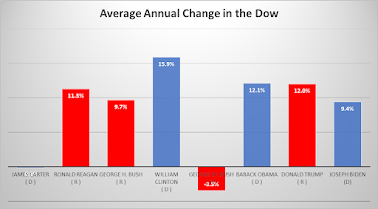
Since the start of Carter's presidency, job creation rates under Democratic presidencies has run at 6.5X what it has under Republican presidencies; stock market returns are 3X higher. It might just be that no invisible hand is going to save your economy.

22 December 2021

Four Dimensions of Progress and The Dramatic Setback to Progress in 2020

You all know that I'm fascinated by economic progress and development. Medieval serfs had very few rights, on average died in their early or mid-30s and had almost nothing in the way of income or goods (or certainly nothing in contrast to what we now have). The fact that the world gradually began to transform its technology - from equipment to institutions - to bring us to today's reality is for me the most delightful thing. Our freedoms, income and life expectancy gives us millions more options than our medieval ancestors had.

There are four simple measures of progress.

1. Did real incomes go up? Do you have a greater choice each year of goods and services to buy and enjoy? Do we have a choice of more great products for each hour of work?

2. Did the community gain more freedoms? Can you be a practicing Protestant without threat of death or expulsion or exclusion from certain key positions and rights? How about Hindu? Or atheist? Are two men free to marry just as a man and a woman are? Can women hold positions of power? Do you have more choice about how to live your life and not just more products to buy?

3. Have life expectancies gone up? Do you have more time in which to live your life choices, to pursue happiness? Between 1900 and 2000, life expectancy rose from 47 to 77. That didn't just radically alter the life span. It meant that one of the coolest inventions of the 1900s was retirement, a period of life in which someone didn't just live decades longer but was free from the obligation of work for some portion of that added time.

4. Are your gains sustainable? Are you reliant on energy sources that your great grandchildren can also enjoy, energy sources that when used don't threaten ecosystems? Are you investing as well as spending so that your grandchildren have a good shot at continuing the progress that you're the beneficiary of?

Progress means progress on these four measures: income, life expectancy, rights and sustainability.

The drop in life expectancy of 2 years in men and 1.5 years for women between 2019 and 2020 is a huge setback to progress.


I'm optimistic enough to think that the advances this pandemic is forcing / facilitating in things like advances in mRNA technology that could actually result in a longer term increase in life expectancy. Setbacks do sometimes force changes that result in a later step function in progress. But that's speculative. The reality, for now, is that COVID, deaths of despair and our responses to both have translated into a setback to progress.

19 December 2021

Comorbidities, COVID and the Excuse du jour for Dismissing a Dangerous Disease

"Well, comorbidities explain a lot about who is dying of COVID," say the same folks who have - at various times - dismissed COVID as no worse than the flu, then explained it as just a blue state or urban problem, then a hoax in that deaths from COVID are grossly over-reported because doctors are keen to collect special COVID premium fees from deaths by other causes like falling out of windows or microwave explosions and falsely attribute the cause of death to COVID. Now the argument is, "Well, comorbidities."

Comorbidity would include conditions like old, obese, or asthmatic. The argument du jour is that COVID isn't real because it is comorbidities that are the real cause, sort of a more subtle twist on the "doctors are falsifying documents" argument.
It's another wave of nonsense and misinformation. Allow me a comparison.

Imagine that you lived on the British Isles in the year 1000 or thereabouts. Vikings periodically invade to rape, pillage and kill. You're trying to discuss this problem.

"This is an atrocity. They killed Elwood and raped his wife and stripped everything valuable from his farm."
"Well of course they killed Elwood."
"What?"
"Comorbidities. You know how scrawny Elwood was. I mean, of course he couldn't stand up to a Viking attack."
"You're saying that he wasn't killed by Vikings but instead because he wasn't sufficiently buff?"
"Essentially, yeah. I mean, it's almost always the scrawny or old guys who are most likely to die."
"And the convent of nuns they attacked and raped?"
"Well, nuns. I mean. They have almost no upper body strength."
"Which explains why the Vikings raped and pillaged their convent?"
"Yes."
"And the problem isn't that Vikings are raiding our coast raping and pillaging?"
"Vikings are going to rape and pillage. Vikings are going to do what they do. You aren't going to change that."
"You don't think that maybe we could form some kind of coastal defense so that it isn't so easy for the Vikings to attack us?"
"That seems like a lot of hassle. And sounds very expensive. Just keep a broad ax handy. And do something to increase your upper body strength. You are not going to have much luck fending off Vikings."

Comorbidities is a fancy way of saying, "COVID is more likely to kill people who are vulnerable." It's self-evident nonsense presented as if it is insightful.

COVID raises the probability of death the same for everyone. It is true that different groups - young and fit high on that list - are less vulnerable and increasing their odds of dying still leave them highly unlikely to die compared to, say, an asthmatic 94 year-old who is incredibly vulnerable. (And of course death isn't the only bad thing that can happen. Long COVID can change your health for ... well no one really knows for how long.)

Saying that the vulnerable are more likely to die of any cause is not an explanation or an insight. It's just another way to dismiss COVID - a disease that has lowered life expectancy in the US for the first time since 1918 - rather than acknowledge its severity and impact.

11 December 2021

They're Making Inflation Sound Worse Than It Is

Inflation after a year of sharp contraction followed by a year of record growth is about as shocking as squealing tires on a car that goes from 75 mph to 25 mph to 65 mph within a couple of minutes.

A couple of thoughts about inflation.

One, inflation is typically overstated. Here's why.

Let's say that you have a local grocery store called Smith's in your town of River Run. They sell eggs for $4 a dozen. Then a Walmart opens in town. They sell a dozen eggs for $2.50. Lots of folks start shopping there. So, obviously this means prices have dropped, right? Nope. For consistency, the folks tracking prices now track the change in prices at Smith's separately from the prices at Walmart. If Smith's lowers their prices to $3.50 to compete, the official price drop will be 13%. If they don't drop their prices at all, the official inflation will be zero. What the officials don't do is calculate the price of eggs as dropping by more than a third in River Run. And then they track price changes for eggs at Smith's and Walmart over time. Or if you find a great supplier online who sells something for half of what they charge at your local hardware store, inflation measures don't show a drop of 50%.

The pandemic has changed buying habits. People are seeking out higher quality, greater convenience or lower prices from any of a number of retail sources - local brick and mortar or online. To the extent that this involves them finding better bargains (higher quality at the same price or lower prices for same quality) from new retailers, that shift is not showing up in measures of inflation. The period from 2020 to 2021 may have involved the most change in who people buy from of any year. That change is not reflected in inflation numbers.

Also, prices measured do not allow for changes in quality. In Robert Gordon's magisterial economics history book The Rise and Fall of American Growth, he compares the TV of his youth with one available in 2014. Electricity costs dropped as they became more efficient. They were so reliable they no longer required a service contract of $50 a year. The 1950 set was $350 for a black and white, 9 inch. By 2014, for $418 one could buy a 40" high-definition with theater surround sound and internet streaming capability. He compared two sets from 1952 and 1983 to make adjustments for quality differences. The official annual inflation rate for TVs in this period was -1.0%, prices dropping by 1% a year. His adjustment for quality improvements suggested a more dramatic annual price drop of 4.3%, a huge difference.

What's the point? Inflation is almost always overstated. It doesn't track changes in sources over time as people seek out cheaper products of the same quality from a different vendor or better quality products for the same price.

Second, stagflation is highly unlikely.

It seems to me that the great period of stagflation in the 1970s always misses a really important event. Stagflation is the worst fear of policy makers. Before the 1970s, people thought that you could have the problem of inflation with low unemployment or the problem of high unemployment with low inflation. There was a tradeoff. But in the 1970s, we had both high unemployment AND high inflation. This was called stagflation.

There were a lot of theories bandied about but I've never heard that one that makes the most sense to me. Throughout the world, former colonies were being transformed by rising nationalism. As the British and French empires were being unwound after WWI and WWII, new nation-states were emerging. Places like Iraq and Saudi Arabia that had huge oil deposits had previously gotten a token fee for their oil as companies like British Petroleum and Standard Oil operated drilling rigs there and shipped the oil to the West. In the 1970s, rising nationalism included the notion that the peoples in a country should be the ones who benefitted from their own land. They insisted on keeping a much, much larger portion of the oil revenue. This amounted to a shift in GDP from countries like the US and UK to countries like Saudi Arabia and Iraq. What happened in the US? Prices went up. (Oil was used for making and distributing a huge portion of the goods we enjoyed and now we were paying more.) GNP stagnated. (A portion of GNP that counted "their" oil as ours was shifted from the US to foreign countries.) Stagflation - it seems to me - wasn't so much a change in the tradeoff between unemployment and inflation as it was an oil shock that came from a shift in international GNP.

What does all this mean? Inflation is not as high as you think. And it is highly unlikely that we'll experience anything like stagflation over the next few years. As we start lowering unemployment less dramatically, measured inflation will probably drop.  Prices are higher now but job creation is at its highest rate on record. Monetary and fiscal policy stimuli have been huge - and rightfully so. That's going to taper off and as new job creation / reinstatement rates lower, the rate of inflation will likely taper off as well. There is still a relationship between inflation and unemployment and the 1970s don't seem to me proof that the relationship has changed.  

09 November 2021

Keynes on How We Tend to Save More and Invest Less Than We Should (And on how old ideas should be exorcised by new)

From John Maynard Keynes' General Theory of Employment, Interest and Money.

"... there has been a chronic tendency throughout human history for the propensity to save to be stronger than the inducement to invest. The weakness of the inducement to invest has been at all times the key to the economic problem. To-day the explanation of the weakness of this inducement may chiefly lie in the extent of existing accumulations; whereas, formerly, risks and hazards of all kinds may have played a larger part. But the result is the same. The desire of the individual to augment his personal wealth by abstaining from consumption has usually been stronger than the inducement to the entrepreneur to augment the national wealth by employing labor on the construction of durable assets…."

Meaning? The impulse to save is greater than the impulse to invest, to put capital to work to create something new. To me that is affirmation that we need initiatives to invest more than people naturally do.

He continues,
"One recurs to the analogy between the sway of the classical school of economic theory and that of certain religions. For it is a far greater exercise of the potency of an idea to exorcise the obvious than to introduce into men’s common notions the recondite and the remote…"

Meaning? The ideas that exorcise obviously bad practices are more powerful than ideas that are esoteric.

How can you not love Keynes?

21 October 2021

20 October 2021 We Lost Csikszentmihalyi, Who Taught Us About Creating a Life of Engagement and Meaning

“A joyful life is an individual creation that cannot be copied from a recipe.”
― Mihaly Csikszentmihalyi

One of my heroes died yesterday.

Mihaly Csikszentmihalyi wrote two books that hugely influenced my worldview. One day over lunch he agreed with my characterization of the first as an answer to the question of how to find engagement and the second an answer to the question of how to create meaning.

Freud explained great accomplishments as sublimation of cruder instincts like sex and violence into socially accepted activities. Skinner explained great accomplishments as all done in response to rewards and punishment. As a young psychologist, Csikszentmihalyi didn't think either explanation was particularly tied to real people doing real things. For instance, he interviewed a lot of folks who were painting. The thought that they were doing this as some odd diversion of energy that would otherwise go into sex and violence struck him as nonsensical. Nor did any of the painters seem to believe that they'd be rewarded as if they were a Picasso for their efforts or punished if they didn't paint. As Csikszentmihalyi talked to these people, they would often use the term "flow," as in, "I began to paint (or write or rock climb or whatever) and just got into the flow of it." His great insight was that the psychology of engagement was not only one that made us happy but was a route to productivity, creativity, and self development. Being fully engaged not only makes us feel better; it actually makes us better.

His Evolving Self never sold as well as Flow but strikes me as even more important. (Apparently I bought it as a gift for my son-in-law at least twice.) Flow was a very successful book and concept but missed something revealed to him when one day he asked a student how his summer was. The student’s eyes lit up as he told Csikszentmihalyi about his amazing job of clubbing baby seals for their fur. More innocuously, video games are a marvelous example of tasks that fully engage us – provide flow – but have dubious value outside of the experience of flow they provide. In Evolving Self he explored how lives – how our actions – have meaning. His conclusion wasn’t wildly different from Sartre’s, building on the notion that we have to create our own meaning, creating and finding flow in tasks that contribute to some greater good that lies outside of ourselves. Our lives have meaning as we connect to something bigger than us.

Csikszentmihalyi helped me – and probably millions of people – to better understand how to find and create engagement and meaning. Now that’s a life.


15 October 2021

A Tentative Theory About Why 30 Year Old Children from the Richest Families Are Less Likely to Work

Curiously, poverty and wealth alike seem to lower employment rate for the children of the poor and wealthy.

This first graph shows that as parental income rises, so does the probability that the children are in jobs. Until you reach about the 94th percentile, after which further increases in income actually lower the odds that your children have jobs at 30.


[from https://fivethirtyeight.com/features/rich-kids-stay-rich-poor-kids-stay-poor/ ]

I'd be curious to better understand this. One of my tentative explanations is based on the fact that the median wage in the US is just under $35,000. Kids raised in the top 5% of households would probably recoil at such paltry wages and thus are less likely to accept half the jobs out there - which might make it tough to get started.
Social security wages just includes income from a job. It doesn't include rental income, money from dividends or business income.

In 2020, the number of people with social security wages over $50 million rose 61% from 2019 - ten times the rate of increase of the number of people making more than $100k. The number of people making a million dollars or more rose 14%. (And yes. There was a pandemic underway and still wages rose this much.)


[social security data from https://www.ssa.gov/cgi-bin/netcomp.cgi?year=2020 ]