26 January 2023

The Data That Tells the Story About the Economy is Generally Much Better Than the Stories You Hear About the Economy

The data that tells the story about the economy is generally much better than the stories you hear about the economy. 


  • GDP grew in the last half of 2022 at an annual rate of 3.1% - a rate nearly 50% higher than what it has averaged this century.
  • Initial claims for unemployment came in at 186,000 last week, the lowest it has been since April of last year.
  • Inflation in the last half of 2022 was 1.9 percent.
  • Unemployment is at 3.5%, a level it has not dropped below since the late 1960s.
  • The NASDAQ is up nearly 10% so far this year.
  • New business formation in 2021 and 2022 was at record levels - by a considerable margin. (The average of new businesses formed in 2021 and 2022 was 49% more than what it averaged from 2016 to 2020.)
Those are facts.

Could we have a recession this year? That's distinctly possible. It is always possible. And you have heard - and will hear - all about that.

Could we have incredibly strong economic growth this year that continues for years? That, too, is distinctly possible. And you largely have not heard - and will not for some time hear - about that.

I don't think that enough is made of two real facts. One, traditional news outlets, like newspapers, continue to suffer from lowered revenues and layoffs. This means that the very source of our economic news tends to come from folks whose reality is very stressful and dire. Two, there is always strong incentive for commentators to put a negative spin on economic news because they know that happy, contented people are less likely to donate to campaigns or to vote.

If you want to know what is happening, go to data first and commentary later. Data rarely moves as dramatically as sentiment about the economy. And it often has much better news than ... well, the news.

25 January 2023

That Time in History When Incessant Tweeting Was Key to Wealth and Power

Musk points out in a response to a random tweet that it isn't possible for him to fix Twitter overnight given, you know, he has 2 other companies to run. Plus, the 9 kids. And all the tweeting he has to do.

It is fascinating.

Of all the criticism (rightfully) lobbed at Trump, weirdly, I've never heard anyone say, "Well, he sure seemed to tweet a lot for a man supposedly running a country." In Trump's last year in office, he was averaging 33 tweets a day.


Musk tweets, retweets or responds to a tweet about 24 times a day. (He was recently sued by investors for tweeting out fake news about his stock. His defense was that no one really believes what he tweets so he's not responsible for those tweets.)


Imagine someday trying to explain to young people how one gained power and wealth in the 2010s and 2020s. "Well, you should tweet incessantly. Studies show that whether you're pursuing wealth or power, tweeting a lot - and about pretty much everything - is key."

For a few years there, literally the richest guy in the world and most powerful guy in the world were focused on tweets. A lot. Is it any wonder that Sam Bankman-Fried - the guy who was briefly worth $26 billion - became one of the world's richest men while casually opining that “I'm very skeptical of books. I don't want to say no book is ever worth reading, but I actually do believe something pretty close to that."

"What is the key to success in your society?"
"Rage tweeting. Trolling. Limiting your opinions to 280 characters or less."
"Could you elaborate?"
"No. You obviously haven't been paying attention."
"Well, I did. For a bit."

23 January 2023

The Future of Gaming as Prototype for and Politics of Real Worlds

The gaming industry is now bigger than the movies and music industries combined. And I think it is just getting started in terms of impact.

One scenario that I think is distinctly plausible? Policy proposals and urban development plans will first be simulated in open games in which members of the community can participate. It will be a way to test drive new transportation solutions, urban plazas, housing solutions, businesses and malls, etc. And given that users will both try to break things and to exploit possibilities, this open simulation could be a great way to revise designs, policies and plans before they are implemented, gaining data on behavior even before the policies or developments are in place.

Russell Ackoff told the story of a building complex that had been built for a campus. They just laid down grassy lawns between the buildings, with no sidewalks. Then they watched to see where the paths naturally as people chose optimal paths from one exit to another entrance, to see what emerged. THEN they laid sidewalks that supported natural migratory paths. Imagine being able to discover such "paths" in any community, whether it be how you license, permit, tax and subsidize businesses or literally how you layout some new urban development, or how you focus educational opportunities of different kinds for different people.

Gaming creates virtual worlds. It seems like a small step to make them prototypes for real worlds.

And of course, games will always provide a place that offers more and more rapid feedback about the impact of different choices, tactics and strategies, accelerating learning more than real world experience. As we tap into that dimension of gaming, we will accelerate progress again. Or, I should say, probably already have.

06 January 2023

The Prospect of Low Unemployment Rates with No Job Growth (or how the next half century will be so very different from the last half century)

Another great jobs report: 223,000 jobs created and unemployment down to 3.5%.

The unemployment rate has hit 3.5% 7 times in the last 40 months - 3x in the last six months. How extraordinary is that? The last time the unemployment rate hit 3.5% before 2019 was in 1969. Put differently, 3.5% is an unemployment rate we used to hit every half century and now hit every other month.


We're not hitting this because we're creating an extraordinary number of jobs. This decade the economy is creating about 700,000 jobs a year, on average, and the unemployment rate has averaged 3.7%. (Yes. Even counting the huge surge in unemployment during the pandemic.) Last decade it created 2.2 million jobs per year and the unemployment rate averaged 6.2%.

We're creating fewer jobs and have a lower unemployment rate. Why? The simplest answer is that baby boomers are leaving the workforce at a rate of about 10,000 a day now. The economy does not have to create as many jobs to bring unemployment rates to historic lows.


This suggests to me that if Fed Chair Powell is looking at things like labor markets to decide if the economy is overheated, he'll get false signals. In the last 50 years, the labor force doubled. Over the next 50 years, the labor force might not grow at all. This would mean that the average number of jobs created each month will be zero and even that would be enough to keep unemployment at record lows.

31 December 2022

The Time of Two Popes Has Ended - Or Why I think that Next Year Will (Finally) Be a Normal Year

I'm suddenly far more optimistic about the new year now that we're back down to just one pope.

Benedict was the first pope to retire in 6 centuries when he resigned about a decade ago. His death marks the end of this anomalous disruption of traditions, the end of the time of two popes.

I fully expect the rate of weirdness to drop off now, the West no longer off-kilter. If I'm right about how this works, next year will be just a normal year, which will be a big relief.

Photo from NY Times.


30 December 2022

2022 in Review - Setback for Autocracies, a Reversal of Negative Real Interest Rates (and stock market gains), and Technological Advances

2022 was a year of huge stories. Huge.

In technical advances, MRNA therapy got its first positive results with a cancer vaccine, we sustained nuclear fusion for one-billionth of a second, and the Webb telescope looked back in time 13 billion years. (It is not just the future that is bright. With the Webb telescope, so is the past.) And normal people are using AI as a catalyst for creativity. 2022 could become a marker for a new era.

In finance, interest rates have gone positive again. Put simply, money is no longer free. I see this as a setback. You experienced it as the worst year for your portfolio since 2008.


In 2008, the economy destroyed 3.5 million jobs. It is little wonder that the NASDAQ fell by 40% that year. By contrast, this year the economy created 4.5 million jobs. So why did the NASDAQ fall 33% this year? The simple answer is that real interest rates rose 2% during 2022, from a NEGATIVE one-third to a positive one and two-thirds percent. Negative rates make the future incredibly valuable; rather than discount future earnings, negative interest rates actually boost them. What does that mean? Startups, companies with high-risk, high-return products who are trying to create new markets see their valuations surge. But once those rates rise from negative to positive, the value of those speculative earnings plummets.
Prior to 2022, Fed Chair Powell had continued to stimulate the economy with low interest rates even when the unemployment rate was hitting historically low rates. Twice the unemployment rate has hit 3.5% in these 2020s, its lowest rate in about half a century. And rather than raise rates, Powell kept them low, continuing to buy securities as well (what you've heard referenced as QE). Why continue to stimulate the economy with unemployment rates so low? The economy continued to create jobs without inflation.


Last year, inflation hit. Hard. It peaked at 8.1%. Powell began raising rates and all those speculative stocks and exciting unicorns saw their values plummet as interest rates rose into positive territory.


The biggest question for me is simply this: will the extended period of negative real interest rates turn out to be an anomaly or will this period of positive real rates turn out to be (as I suspect it to be) a slight setback towards a new world of negative real interest rates? If it is the first and positive real rates are the new normal, you’re not getting a snap back in your portfolio. It will languish. If it is the latter, and real rates begin dropping again next year, your portfolio will start rising again, perhaps even dramatically.

The third big story is the struggle between autocracies and democracies. It was not a good year for autocracies. Xi pursued absurd COVID policies, dramatically shutting down the country in pursuit of 0-COVID. Putin pursued absurd military policies, invading Ukraine. Both leaders demonstrated one of the biggest flaws with autocracies: the ability to pursue stupid and dangerous policies without dissent. And both leaders created inflation that hurt developed nations. Russian oil prices spiked with the Ukrainian invasion, triggering broader inflation. China’s shutdown was a big part of why supply chains were snarled, another catalyst for price hikes. Dramatically illustrated by Trump’s love for Kim Jong-un and Putin and desire to abandon NATO, autocracies had gained in recent years, leading to a democratic recession. Biden’s election and the events of the last couple of years in Russia and China have seemed to stall the advance of autocracies. This has yet to resolve and could be even messier before it does. Still, this is good news because it suggests that the advance of autocracies has stalled, if not reversed.

Science advances that read like science fiction and a setback for the advance of autocracies is great news. However, a reversal of a bold financial experiment in negative real interest rates seems to me a setback in the transition into an economy that puts more value on the world a generation from now more than it does the world of today. All of these mark 2022 as a year of dramatic change that could ripple into the next generation.

10 December 2022

Abortion, Beliefs and Freedom of Religion

"Virginia State Delegate Marie March (R) has pre-filed House Bill 1395, a law that would define life as beginning at fertilization."

Abortion seems like such a contentious issue but I only disagree with three groups of people regarding this topic. I suspect that you share my disagreement with two of these groups, perhaps all three.

1. People who think that egg or sperm - because they are alive and because they are human - are the same as human life. That's just silly. Trillions of eggs and sperms perish every day and no one cares. Sperm and egg are the garbage of life.

2. People who think that newborns aren't yet human and don't deserve to be treated as such. A newborn is human life and the fact that they can't go to the kitchen to make a sandwich and feed themselves is no excuse for treating them as anything less than precious.

3. People who think that they know the instant when the garbage of life becomes precious life, who will dictate to you when you feel like you can treat this as a pregnancy that you may not want to continue versus when you want to treat this as a little person who you will do all you can to bring into this world and nurture.

At the core of freedom of religion is this really important idea: no matter whether you are so convinced of your belief that you literally think people who don't embrace it will spend eternity in torment, you still need to respect their beliefs as being just as real and important to them as your belief is to you.

Freedom of religion rests on respect for opinions that you find ludicrous because you want the same respect paid to your personal beliefs (that some other people will certainly find ludicrous). The reason why religious fundamentalists tend to be the ones protesting the right to abortion is because they are the people least able to acknowledge that very real and very vivid beliefs that they hold might actually be wrong. Freedom of religion requires a certain humility even from true believers, whether they are atheist or Muslim, Catholics or Scientologists. "Knowing" the instant the garbage of life becomes the treasure of life, when egg and sperm are equivalent to a baby, and "knowing" that everyone else is wrong about that instant shows a lack of humility that is wildly inconsistent with a community that practices freedom of religion, a respect for differences in opinion even about really important issues like when life begins (do you believe it begins at conception? three months after conception? 6 months?) or when life ends (at death? when the last person who knew us dies or has forgotten us? never?).

The beauty of the modern world is that we've learned to respect personal beliefs without believing that everyone else must hold our own beliefs. The group I disagree with most? The group who believe that their beliefs are the only beliefs that should be legal. It's a very medieval concept and has no place in a country that was a marvelous invention of Enlightenment philosophers in part invented to grant freedom of religion and thought.

26 November 2022

How the Pandemic and Remote Work May Accelerate The Move Away From Pay as Compensation for Time and Towards Sharing Value

The pandemic may have accelerated a change in how we think about work and pay.

When the US was founded, a vast majority of work fell into one of three categories: children, slaves, and indentured servants. In every one of these arrangements, the "boss" owned your time. If you were a child you were expected to work as part of the family until you were old enough to leave home. If you were an indentured servant, you were expected to work (typically) 7 years to pay off the cost to bring you to this new country of opportunity. And, of course, slaves never saw the end of their work sentence, forced to work as long as the slave owner could wring anything out of them.

The word employee didn't enter the English language until the first half of the 19th century, a word that was largely unnecessary to describe the rare arrangements that looked anything like modern employment.

The industrial economy didn't much change the notion that work essentially meant that your employer owned your time. The factory owner needed someone to work a 12-hour (or, later, 8-hour) shift, as did the store owner. Employees were hired to work shifts and paid by the day, hour or month.
Weirdly, one of the terms often used for pay was compensation, as if everyone involved knew that employment was a compensation for lost time. (What did we call time outside of work? Free time, a term that simultaneously referred to the fact was one free to do as she wanted and also that you were spending this time without compensation.)

The information economy began to change this. Stock options at startups became more common and workweeks became longer and more erratic. Startups prided themselves on all-nighters leading up to product releases and employees who were granted stock options made considerably more than any reasonable salary would grant. (Microsoft stock ownership created 3 billionaires and an estimated 12,000 millionaires among its employees.) In this world of startups the tight link between time and pay was loosened. Someone who was part of a team that created great value would be hugely compensated. If you were part of a team that failed to create much value, your stock options might be worth nothing. And how did you get rich? By having a lot of shares. You were sharing in the wealth you helped to create.

Early in the pandemic when millions were sent home to work remotely, I heard of employers who were taking pictures every couple of minutes to confirm that the employee was “at work,” sitting at their monitor. My immediate thought was, Those supervisors don’t have a clue how those employees are adding value so they are instead measuring time spent sitting at a computer.

By some estimates, about one quarter of employees now work some portion of their workweek remotely, up from about 5% before the pandemic. It is more difficult to know whether such employees are putting in 40 hours, 4 hours, or 80 hours a week. Which is to say, it is more difficult to pay them for their time, the default compensation we’ve had since the days of slaves and indentured servants.

I rather optimistically think this will result in a win for employers and employees alike. Why? Given you can’t hold someone accountable just for showing up, you need to get clearer about how they are adding value. Instead of them casually accepting a task assignment of dubious value that nonetheless results in their getting a paycheck at the end of the month, they and their managers / employers are going to spend more time thinking about and defining how tasks add value and (probably defaulting to) some fair split between what portion of that value goes to the employee as pay and what portion goes to the company to cover fixed costs and generate profits to be distributed to shareholders.

I think this change in how we work will accelerate the move away from compensating you for your time and will increasingly move towards value sharing, making employees partners in the larger endeavor of creating value. This will increasingly mean that your time is yours to manage as you choose and the value you create will be something shared with you, your company and your customers. It may be turn out to be one of the more curiously cool things to come out of our response to this, the first post-worldwide web pandemic.

15 November 2022

Trump's Futile 2024 Run for the Presidency

Trump announced his run for president today.

We will soon see whether Republicans have become less gullible and Democrats less timid. If they have, Trump will be in jail when the next president is sworn in. If not he'll merely lose his election and depress votes for other Republican candidates, threatening to do for the Republican Party at the national level what has already happened to the Republican Party within California. And of course if he loses the primary to someone like DeSantis he will run as a third-party candidate and completely derail Republican chances in 2024, blowing up the party to salve his wounded ego.

Nothing illustrates the arc of the Republican Party better than it starting with President Lincoln who governed with such careful brilliance and ending with President Trump who is such a reckless idiot.

I had a number of early Trump supporters tell me that one reason they loved him is because he is a billionaire and doesn't need their money. And of course Donald has never made more money than he has in fund raising from these same people. Trump's candidacy will garner him a boatload of money. And in his mind, as long as he gets money and attention, he's already a winner. The GOP - even our country - was never more than just a prop in his oddly chaotic reality TV show of a political career, his quest for power destined to go down as history's most desperately tragicomic compensation for erectile dysfunction.

09 November 2022

Increased Life Expectancy Has Slowed Political Change

Increased life expectancy and lower birthrates have slowed political change.

Ronald Inglehart (who died just last year) compiled an enormous database tracking social change across dozens of countries. For instance, in one country in one year, the prevailing belief is that immigrants should have no right to jobs and homosexuals no right to life and then - a few generations later - the majority swings to the belief that immigrants have as much right to jobs as native born and that everyone has the right to marry who they love, regardless of race, religion or orientation. His database suggests that we change over time but that is misleading. As it turns out, societies change over time because people with antiquated beliefs die out to be replaced at the polls by their grandkids with more modern beliefs. Societies change but - after about 20 or 25 - people don't. As we live longer and have fewer kids, that means the pace of social change slows.

Republicans have likely gained control of the House and possibly the Senate in this Nov 2022 election. (Since 1969, control of House, Senate and White House has been divided about 70% of the time, so this is the post-Woodstock norm.)

Young voters 18 to 29 voted Democratic by 63-35% in the 8-Nov-22 election. Life expectancy was 47 in 1900. By 2000 it had hit 77. If life expectancy were still 47, this overwhelming turnout of young voters for Democrats would mean a landslide. (And would mean people 29 were "middle-aged" rather than young.) Now it is just a nudge because so many elderly voters cancel out the youths. Change is slowed because individuals don't change and we all live longer than we did a century ago.

And on that note, Chuck Grassley won re-election as the Republican Senator from Iowa and will be serving for 6 more years. And a good thing, too. I mean, if you're 89, who else is going to hire you?

04 November 2022

It's Donald's (Delusional) Party Now

As far as I know, not a single one of my Republican friends has denounced Donald. That puzzles me.

Like a toddler on his third line of coke, Trump insists that he won the last election. Even everyday Republicans insist that it is better to assuage his hurt feelings than to protect our democracy. Trump. A reality TV star who lost hundreds of millions of dollars and failed in all of his ventures until he took a TV role playing a successful businessman. (How big a failure? From the mid-1980s to mid-1990s he lost $1.2 billion. Year after year his losses were more than that of any other American. He was - literally - America's biggest loser while projecting an image as a successful business mogul. Sad.) He convinced a lot of Americans he won at business last century. And then he convinced a lot of Americans that he won an election in 2020. The word you're looking for is con man.

In 2020 he actually won in the former confederacy by 3 million votes but lost in the rest of the country by 10 million votes. The word you're looking for is loser.

The Republican Party is his now and a lot of Americans are thrilled with that. But there is a real problem with aligning with leaders who deny reality, who insist that you share their delusions. Look at North Korea, for instance, where everyone is aligned with Kim Jong Un's fantasy about the the world and his place in it. It takes the North Koreans all year to make as much as South Koreans make by mid-January. Delusions, like drugs, may make you feel warm and cozy but they actually make your reality worse, not better.


On a related note, a huge swath of Americans believe that a secret cabal is controlling the government. If you're in that group - and there is apparently a 44% chance you are - you may want to do a little soul searching about your preference for delusion over simply confronting reality.

29 October 2022

The Attack on Pelosi and the Stark Contrast Between Where Republicans and Democrats Turn for Leadership (Comparing Kentucky and San Francisco)

An intruder broke into Nancy Pelosi's home yesterday to attack her. Her husband was violently assaulted and has had surgery to repair a skull fracture.

Radicals on the right paint San Francisco as a socialist dystopia and see House Leader Pelosi as one of the reasons that California is such a hellscape. I still marvel at the levels of ignorance required to label San Francisco as socialist. Republicans' answer to Pelosi's congressional leadership is Mitch McConnell, a senator from Kentucky. It's worth comparing Kentucky and San Francisco to get an idea of the sorts of communities from which Democrats and Republicans draw their leadership, and what they hold up as models that deserve to be emulated.

No place on the planet receives more venture capital per person than San Francisco. Venture capital. Arguably the most disruptive, lucrative, and “capitalist” kind of capital in the world. San Francisco gets an average of $75,000 per resident in venture capital in 2021. Kentucky? It got just $44. San Francisco gets about 1,700X more venture capital per resident than Kentucky.


In large part because of this, San Francisco's per capita GDP is nearly 5X what Kentucky's is, $247,000 per resident compared to Kentucky's $53,000. Profits, rents, capital gains and other returns to assets coupled with their monthly salaries makes the average San Franciscan much more affluent than the average person in Kentucky.

This level of innovation and wealth creation attracts people from all over the world and leads to a level of diversity that is stark contrast to Kentucky. People in San Francisco are roughly 8X more likely to speak some language other than English in the home and to be foreign born. Firms are 4X more likely to be owned by a minority.

The right is not threatened by San Francisco being socialist. It is not socialist but is arguably the most dynamic, capitalist community in the world. San Francisco has created a culture that depends on disruption and invention, entrepreneurship and innovation. The right’s value for tradition is so strong that it sees the level of affluence and progress that follows from this disruption as threatening rather than as something to emulate, even to the point of violently rejecting it. The communities from which Democrats and Republicans draw their congressional leaders could not be in starker contrast. Republicans see this level of disruption and progress as a threat. Democrats see it as something to emulate which is why they have continued to make Nancy Pelosi their congressional leader.

06 October 2022

The Most Defining Thing About a Community: Zero or Variable Sum Worldviews

The biggest difference in worldviews seems to be the difference between zero-sum and variable-sum. If your worldview is zero-sum, you believe any gain I make comes at your expense. If your worldview is variable-sum, you are open to the possibility that we both can do better (or worse).
Variable-sum suggests that if we miss on creating opportunity for that kid from a poor neighborhood, we all do worse. He's either creating value for all of us and everyone does better because he is doing better or he is not and we're all doing worse.

Zero-sum suggests that if that kid comes across a border or leaves a bad neighborhood to get a job, it'll be stolen from us. The only way he gets ahead is from us falling behind.

In 1980, the acceptance rate at UCLA was about 75%.
Today it is close to 10%.

We even have a zero-sum worldview when it comes to education, to knowledge, to learning - domains that are so demonstrably variable-sum as to make them the perfect examples of variable sum. If you give me a dollar and I give you a dollar, we leave the exchange no better. If you give me an idea and I give you an idea, we might both be better off. (Or worse off. It could be that we exchange really dumb ideas. This is, of course, the domain of variable-sum.)

We need to do better at making people's lives better. The simplest predictor of future returns is present investments. Any community that wants to prosper has to look for reasons to invest more, not less. We could start with increasing the capacity of our great public universities, making them tools for more young people to create a better future. Because when we leave some young adult's potential untapped it reduces the potential of all of us.

One of the most curious consequences of realizing that you live in a variable sum world? The distinction between selfish and selfless begins to blur. We have to make lives better for other people to make our own lives better. It's a fairly cool reality we've gotten ourselves into.

04 October 2022

2 Major Problems With Musk Owning Twitter

Elon Musk is moving ahead on his purchase of Twitter.

I have 2 problems with that.

1. This means he'll be playing CEO for 5 companies. How I imagine his schedule:
Monday: Tesla
Tuesday: Twitter
Wednesday: SpaceX
Thursday: Neuralink
Friday: Boring Company
Saturday and Sunday: spends time with his 9 kids.

2. Musk has promised to bring Trump back to Twitter. Musk is a free speech guy who doesn't see any need for managing content. A community has a lot in common with individuals. If you maximize for work or money or fitness or socializing or religious piety or relaxing you'll have a lousy life. Life is best when you have the good sense to tamp down any and all of those, alternating what you subordinate to at different times so that your life isn't taken over by any one of the pieces of your life. Any system needs to be subordinated to the goals of the whole system, not one part of it, whether that system is a life or a community. A community needs free speech but to pretend that we should subordinate every other community goal to it is silly. The consequence of abuses from misinformation campaigns, say, or slander or deceit or misleading advertisements or blatant lies is to subordinate too many other good things to an ideal that may hold in some Platonic ideal of a community but don't hold in some Pragmatic ideal of a real community. Musk owning Twitter raises the odds that the US will give way to plutocracy because free speech is a lie in this regard: in an age of platforms, amplification and mass media, speech is NOT free. The more money you have to spread your message, the more it will be believed. Elon's net worth is greater than about 150 countries' GDP. To pretend that his "free" speech has no more influence than mine or yours suggests a high degree of self delusion.

16 September 2022

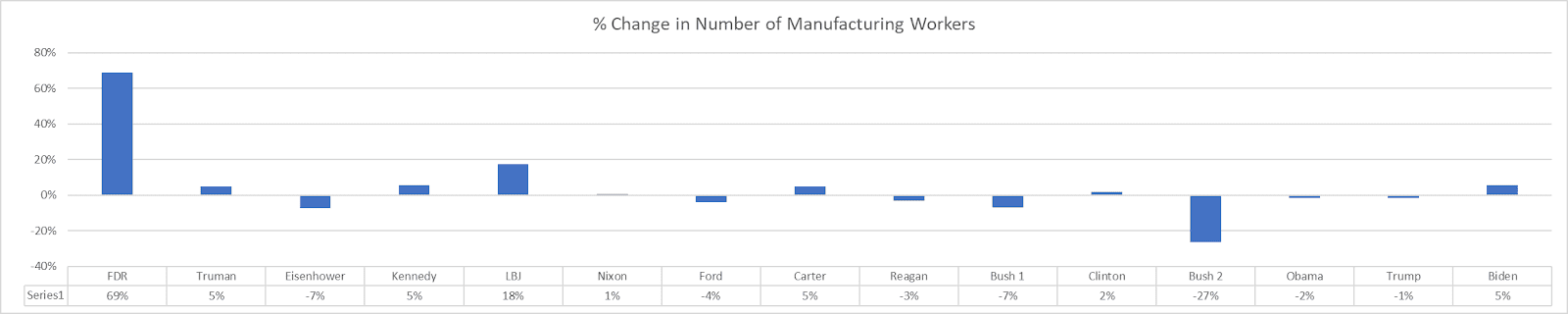
Trump is the Only Post WWII President to Hold Steady the Portion of American Workers in Manufacturing - Even Though (As With Nearly Every Other GOP President) the Number in Mfg. Dropped

Trump is unique among presidents since FDR.

Under FDR, the portion of workers in manufacturing rose dramatically: from 30.3% to 37.0%. Since then, the portion of workers in manufacturing has dropped under every president. Except Trump. When Trump began his presidency, manufacturing workers were 8.5% of the workforce. When his presidency ended, manufacturing workers were 8.5% of the workforce. 

Curiously, though, the number of Americans working in manufacturing dropped by 182,000 during Trump's presidency.

In Biden's first 19 months in office, the percentage of the workforce in manufacturing has dropped from 8.5% to 8.4%. By contrast, though, the number of Americans working in manufacturing has gone up by 668,000.

In this the two presidents are similar to others in their party.

The number of workers in manufacturing rose under every Democratic president from FDR on - except for Obama. (The number fell 195,000 during Obama's presidency.)

By contrast, the number of workers in manufacturing fell under every Republican president after FDR - except for Nixon. (The number rose 138,000 during his presidency.) 

Just as with farming before it, the portion of Americans working in manufacturing has steadily gone down since the build up of armaments during World War II. It will be interesting to see if Biden can match Trump's accomplishment of holding the percentage steady. 


16 August 2022

Four Books That Shaped My Worldview

Four books that shaped my worldview.

Robert Wright's Nonzero
We can play zero-sum games in which every win comes from someone else's loss or play variable-sum games where the sum of what we win varies. Our modern world is variable sum and we can all lose, win or lose big, most win and some lose, some win and most lose, etc. In my old age I think one of the most defining things about a group or individual is whether they believe the world is zero-sum or variable-sum.


W. Edwards Deming's New Economics
Packed with insights but for me the biggest take away is that you can either focus on measuring how people are doing within the current system (from factory floor to classroom) or focus on measuring how well the system is doing at helping people to realize their potential. Deming's advocacy for getting rid of grades and instead nurturing intrinsic motivation feels more and not less important to me as I get older.


William Deci's Why We Do What We Do
Deci offers three models for parents, managers, teachers or political leaders: control, abandon, or autonomy supportive.
Control defines process and outcomes for your child, student, employee, or citizen.
Abandonment leaves them free but unsupported.
Autonomy supportive supports them to the point of autonomy, teaching, coaching and sharing what you know to get them to the point of pursuing whatever goals they have.


Csikszentmihalyi's Flow
Csikszentmihalyi's exploration of how we get lost in work, play or conversations - become absorbed in doing - left him convinced that a big key to happiness and productivity is attaining flow. I also loved his Evolving Self and at lunch one day asked him if it is fair to characterize Flow as about how to create engagement and Evolving Self about how to create meaning. He paused for a couple of minutes and then nodded. "Yes." Long pause. "Yes. That's a really good way to put it."


All of these are of a piece, it seems. Ultimately exploring the question of how we create the systems that let us realize our potential.

09 August 2022

The Most Interesting Question About Investing

There are at least two elements to personal investing.

The first is the most obvious: how to find investments that promise the most return for the least risk. Anyone who tells you they have a secret formula or shortcut for this is either lying to you or have only been investing for a few years. Still, it is valuable to look for clues and sort out signals from noise in this space. There is a ton that gets said and written about this. Pay attention to some of it from time to time. You might learn something. And stay humble. (And of course you don't have to do the humbling on your own. Investments will inevitably do it for you.)

The other element of investing might be even more fascinating, though. When you invest you are buying futures. Obviously you are trying to pay, say, $100 for $200 in a year or a decade. You are hoping to buy a future that gives you more money than you have now, money enough that you don't have to work at 75 (or maybe you're shooting for 45). But beyond the personal future you're trying to buy, there is the question of what collective future you're trying to buy. If you buy stock in a company that is making flying cars, you are paying for that future. It may fail to materialize but that's the future you're buying, a future where people can fly around as easily as they drive around. If you buy stock in a company that is leveraging mRNA into new cures, that is the future you're trying to buy. Your investments could be an answer to the question of what kind of future you want to subsidize or accelerate.

If you could buy the future, what kind of future would you buy? That's an interesting conversation to have with your kids. Or even your neighbors' kids.

02 August 2022

A Ratio that Predicts Why We May Well Avoid a Recession

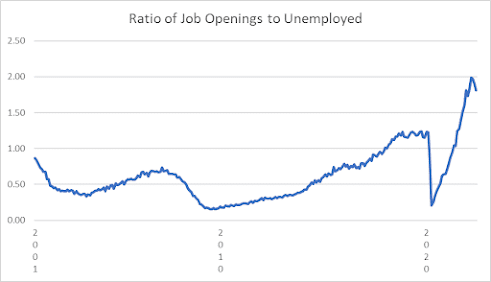
The ratio of job openings to the number of people unemployed is a simple measure of the health of the job market. This century, there have been an average of 62 job openings for every 100 unemployed people.

Jerome Powell is trying to lower inflation without causing much - or any - unemployment. The way he would do that is to bring down the number of job openings without bringing down the number of people who are unemployed. That strategy is looking distinctly possible.

For a variety of reasons, inflation seems to be dropping. Almost as importantly, to extent that Powell needs to "cool down" the labor market without triggering layoffs he seems to be doing that.

The ratio of job openings to unemployed people peaked at 200 job openings for every 100 unemployed people in March. That is triple what it has averaged this century. That is crazy.


As Powell has cooled the economy, this ratio has come down from 200 job openings for every 100 unemployed people to 180 job openings for every unemployed person. 180 is still far higher than its peak of 124 job openings for every 100 unemployed during the Trump administration. (And pre-COVID, that was a really strong job market.) The fact that Powell can bring this ratio from 180 / 100 down to 124 / 100 and still have a stronger job market than we had before COVID suggests that the Fed has a lot of room to maneuver without triggering a recession.

I know I am susceptible to optimism but this is really good news. If Powell lowers inflation without raising unemployment, it'll qualify as a very cool trick. Be prepared to applaud. And then exhale.

29 June 2022

An Argument Not Just to Bring Prayer Into School but to go further and Assign Each Teenager With the Task of Founding Their Own Religion

Lots of talk about the Supreme Court allowing prayer in school. I actually think that it is a great idea. Seriously.
William James was one of the my favorite Americans for so many reasons. He wrote the first textbook on psychology. He helped to develop an uniquely American and incredibly powerful philosophy of pragmatism. He probably was as responsible as anyone for the modernization of Harvard university and - given it has become the template for higher academics by extension he also - is responsible for so much of what defines modern education. Meanwhile, over in Britain, his brother Henry James was writing classic novels. (It would have been fascinating to talk to their parents about how to raise children.)
At one point in his life, James began to study religion. His religious friends were offended because they thought it irreverent to study something so holy and spiritual, subjecting it to the same scrutiny you might apply to annual rainfall or the property of metals at different temperatures. His agnostic and atheist friends laughed at him for thinking he could study something with so many supernatural, untestable claims. It would be difficult, for instance, to determine which denominations got more people into heaven and which lost more to hell. James pushed back on both groups. He said, I can study which religions - or more specifically which beliefs - make people happier and which make them more generous, more giving, more compassionate, more loving.
I love this notion that different beliefs lead to different outcomes. And no matter how scientific you want to be, you're left with no choice but faith on some items. Faith that it's worth getting out of bed on this morning when you still haven't any data to tell you whether it'll leave you feeling overwhelmed with grief, joy, appreciation or underwhelmed with just about anything. You don't know how - or if - your life will impact others. There are so many actions we take based on hope or dread rather than facts. That could get any number of names or labels but I would call it faith, a trust that an unknown future will evolve in a particular direction.
Children should know that there are options other than what their parents believe - whether those parents are nihilists or Catholic or Jehovah's Witnesses or secular humanists or .. well anything. I think that kids need more exposure to what people do for a living. (The Bureau of Labor Statistics tracks 800 broad categories of professions. Most 10th graders can list about 8. (Okay. I made up 8. It isn't many.)) I think that kids also need more exposure to what people believe about their life. Which beliefs make people self righteous and convinced they alone truly understand. Which beliefs leave people feeling despondent and overwhelmed? Which beliefs make people more generous, happier, more careful with other people, more shut off from new experiences ...?
We should bring prayer into schools as well as a variety of beliefs. If we do this right, not only will kids and young adults learn a great deal about how belief changes who they are and what they feel about themselves and others but they might even start their own religion. Mormons think you should follow the example of Joseph Smith. Scientologists think you should follow the example of L. Ron Hubbard. Muslims that you should follow the example of Muhammed. The Church of Christ that you should follow the example of Mary Baker Eddy. Christians that you should follow the example of Jesus. Jews that you should follow the example of Moses. Do you know what is common about all of those people? They created a new religion rather than accept what they'd inherited. What if kids from all the different faiths and religions and traditions in this fascinating experiment in diversity that we call America began to compare notes on various religions, began to take seriously what a great impact beliefs have on who we are and what we can do, and began to explore the possibility of a creative response rather than the binary responses of acceptance or rejection?
Bring prayer into schools. Bring religion and faith into schools. And then as a school project have teenagers found new religions and see how those new beliefs make them and the people they love (and suffer) better people.

26 June 2022

How American Catholics Are Turning Their Beliefs Into Our Laws

Last month San Francisco’s archbishop barred Nancy Pelosi from communion because she supports abortion rights. Put more clearly, a Catholic archbishop punished a Catholic who supports religious freedom. At 82, Pelosi is not going to have an abortion. This is not about the archbishop’s condemnation of Pelosi – a church member - for her actions. This is condemnation of her defending her constituents’ right to believe and practice something Catholics don’t. In isolation this wouldn’t be enough to suggest that Catholic leadership in the US supports ending religious freedom for Americans who aren’t Catholics but there is more.

The clear majority of Americans believe the question of abortion should be left to individual women but a majority of the Supreme Court do not. 7 of 9 of our current Supreme Court justices are Catholic and 6 seem more aligned with San Francisco’s archbishop than Nancy Pelosi. (In the spirit of full disclosure, there is some question as to whether Gorsuch identifies as Catholic or Anglican so it is possible that only 6 supreme court justices are Catholic. In any case, a significant majority.)


Overturning Roe v Wade is a clear example of an elite group overturning the will of a majority. This is the very definition of undemocratic. 

The pope teaches that life begins at conception and 6 Catholics on the Supreme Court have overturned Roe v Wade to make their Catholic convictions our national law. Or more to the point, they have decided that national law should no longer guarantee any woman the right to follow her own conscience or religious beliefs and are leaving that ruling to the states.

This isn’t the only victory for the Catholic Church now so richly represented on the Supreme Court. Last week the Supreme Court also ruled that taxpayer money should help to fund private religious schools, which will be a great aid for Catholic churches that are already tax exempt and will now also be getting government subsidies.

John Kennedy was essentially forced by the press to assure a country that had been under the rule of WASPs for centuries that if elected president he would put the American constitution and people before the pope in deciding policy. It struck me as silly that the press would ask him that. Now it seems like a simple question that should be asked of any candidate: Do you believe that God’s will as has been revealed to you should do more to shape policy than your constituents’ will?

There is indication that the Catholics are not yet done changing American laws to conform to their religious convictions. In an opinion by Catholic justice Alito, the Supreme Court has already indicated they will be reconsidering allowing same-sex marriage and access to contraceptives, two more Catholic beliefs that these justices want made into American law.

It is a curious turn of history that a country founded by Protestants for whom religious freedom – and freedom from religion – were foundational is now having the opinions of a majority of Americans overturned by a court dominated by robed justices who dress and think like Catholic clergy. It isn’t clear how far these good Catholics will go to conform American law to Catholic convictions. It is easy to believe, for instance, that they would put up obstacles to research in genetics that echo the Catholic Church’s stopping Galileo’s research into the earth’s orbit by putting him under house arrest.

It is true that no religious group in the US is larger than Catholics. It is not true that they are a majority – making up less than a quarter of us. And even if they were 51% of our population, the first amendment still suggests that they have no license to turn their religious convictions into our laws. Catholics need to understand that they are no different than Mormons, Baptists, Hindus, and atheists in this simple regard: they are welcome to live by their beliefs but not allowed to impose those beliefs on others. As Americans, our only law about religion is that we don’t have any laws about religion. And for this, even America’s most popular religion is no exception. Unless, of course, the Supreme Court rules that it is.